Quick Info
At a glance
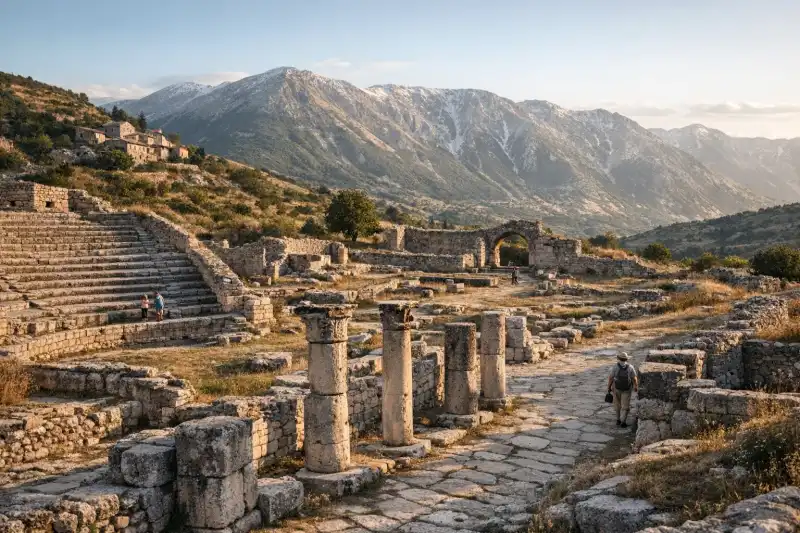
Alba Fucens, in Italy, is one of those archaeological places that feels both monumental and unexpectedly quiet. Set in the Abruzzo uplands beneath the striking mass of Monte Velino, the ancient city rises from a landscape of fields, pasture, and clear mountain light. It does not receive the same crowds as Rome, Pompeii, or Ostia, yet that relative calm is part of its power. Here, the outline of a Roman colonial city still reads clearly in the land: walls grip the hillside, streets trace old urban logic, and public monuments survive in enough detail to make the settlement feel legible rather than abstract.
For travelers interested in ancient Italy beyond the standard circuit, Alba Fucens offers a rare mix of scale, atmosphere, and historical depth. Founded as a Latin colony in the early 3rd century BCE, it occupied a strategic position in central Italy, controlling movement through a region long contested by Rome and local peoples. Over time it grew into a significant urban center, with the institutions, buildings, and infrastructure expected of a thriving Roman settlement. Today, walking through its remains means moving between different layers of Italian antiquity: pre-Roman defenses, Republican planning, imperial development, and the later transformations of a city that slowly faded from prominence. The setting adds another dimension. Unlike many urban ruins absorbed into modern sprawl, Alba Fucens still feels anchored to its original terrain, and that makes a visit especially vivid.
History
Early landscape and pre-Roman background
Before Alba Fucens became a Roman colony, this part of central Italy belonged to a frontier world of upland communities, tribal territories, and strategic routes linking the Apennines. The surrounding region was associated with the Aequi, one of the Italic peoples who frequently came into conflict with Rome during the Republic’s expansion across central Italy. The site’s naturally defensible position already made it valuable. High ground, broad views, and access corridors through the mountains gave whoever controlled it a military and political advantage.
Archaeological and topographical evidence suggests that the area was important even before formal Roman urbanization. The massive polygonal masonry visible in some stretches of the fortification system has often been connected to pre-Roman building traditions, though many sections were reused, repaired, or integrated into later Roman works. As with many ancient sites in Italy, the story is not a simple before-and-after division. Instead, Alba Fucens emerged from a landscape already shaped by local power, movement, and conflict.
Roman foundation in 303 BCE
Rome founded Alba Fucens as a Latin colony in 303 BCE, a date tied to the Republic’s steady consolidation of central Italy. Colonial foundations were not random settlements; they were instruments of policy. By planting a loyal community in a strategic position, Rome could secure conquered territory, watch potentially hostile neighbors, and project military strength into the interior. Alba Fucens was especially useful because of its relationship to regional routes and to the broad basin once occupied by Lake Fucinus.
The colony began with approximately 6,000 settlers, according to ancient sources. That number alone indicates the seriousness of the project. Colonists brought Roman and Latin institutions with them, while the city’s layout reflected the ordered planning common to Roman colonial urbanism. Streets, defensive structures, and public spaces were laid out to create a permanent center of administration, commerce, and security. Alba Fucens quickly became more than an outpost. It was a statement of Roman permanence in a formerly contested zone.
Republican importance and military role
During the middle Republic, Alba Fucens acquired a reputation as a secure and useful place of detention for important prisoners. Ancient authors mention several notable captives being held there, including foreign kings defeated by Rome. That role says much about the colony’s strategic and logistical value. It was far enough from volatile urban centers to be secure, yet sufficiently connected to major routes and political authority to remain under reliable supervision.
The city also benefited from its position within the expanding Roman road network. The Via Valeria, an important extension eastward from Rome into the central Apennines, strengthened Alba Fucens’ communications and commercial reach. Roads in the Roman world carried armies, officials, merchants, messages, and ideas, and they helped transform colonial foundations into functioning regional hubs. By the late Republic, Alba Fucens had become a well-established urban center, integrated into wider economic and administrative systems while still retaining its frontier character.
Imperial prosperity and urban development
Under the Roman Empire, Alba Fucens continued to flourish. Like many provincial and regional towns, it developed monumental public architecture that reflected both local prosperity and broader Roman civic culture. The forum, basilica, temples, baths, amphitheatre, and domestic quarters all belonged to a city whose life was public, structured, and socially layered. These were not decorative additions but the physical framework of Roman urban identity. Administration, legal activity, religion, entertainment, and trade all found their place in stone.
Its setting near Lake Fucinus also mattered economically. The basin supported agriculture and regional exchange, and imperial interventions in central Italy, including later efforts to manage the lake’s waters, shaped the surrounding landscape in ways that affected local communities. Alba Fucens stood within this broader environmental and economic network, drawing strength from both road access and rural production.
Late antiquity, decline, and afterlife
Like many ancient cities, Alba Fucens did not vanish all at once. In late antiquity, it underwent gradual change as political priorities shifted, imperial structures weakened, and settlement patterns evolved. Earthquakes likely contributed to damage and rebuilding phases, while broader instability in the western Roman world reduced the prominence of many inland urban centers. Some monuments were repurposed; others fell into disuse. Christian presence in the region reshaped sacred geography, and medieval occupation focused on different nodes nearby rather than preserving the ancient city as an intact urban organism.
Over centuries, Alba Fucens became a ruin, but not an erased one. Its walls remained visible, its street grid persisted, and many public structures survived sufficiently to attract antiquarian interest. Modern archaeology has gradually clarified the city’s plan and chronology, revealing one of the most instructive Roman colonial sites in Italy. What makes Alba Fucens so compelling today is that decline never fully obscured its original design. The city still communicates its purpose, and in that clarity lies much of its appeal.
Key Features
The first feature most visitors notice is the fortification circuit. Alba Fucens is famous for its long stretches of walls, some built in imposing polygonal masonry that fit the hillside with remarkable confidence. Even for travelers familiar with Roman ruins, these defenses stand out. They create an immediate sense of scale and strategic purpose, reminding you that this was not only a civic center but also a stronghold. Walking alongside the walls, you understand how seriously the colony’s founders took terrain, visibility, and military control.
Inside the ancient city, the Roman plan remains surprisingly readable. Streets run with enough clarity that the site can be experienced as a former town rather than a scatter of isolated ruins. This coherence is one of Alba Fucens’ greatest strengths. Visitors do not need to imagine everything from fragments; the spatial logic still exists. You can see how movement once flowed toward the civic heart, how public monuments were positioned, and how the urban fabric related to the enclosing defenses and surrounding countryside.
The forum area forms the symbolic center of that experience. Although no longer standing in complete monumental form, it retains the character of a civic core. Nearby remains of the basilica evoke the administrative and legal life of the city, while temple foundations suggest the ceremonial and religious dimensions of Roman public space. At Alba Fucens, these elements are not compressed into a modern museum setting but spread across an open archaeological landscape, which allows visitors to appreciate how public architecture worked within a functioning town.
The amphitheatre is another highlight. Less overwhelming than the giant arenas of major imperial capitals, it is compelling precisely because it belongs to a regional city. It reflects the spread of Roman spectacle culture deep into inland Italy, where communities embraced the same forms of entertainment and public gathering that characterized larger urban centers. Its surviving shape helps anchor the ancient settlement in everyday Roman life: not only administration and defense, but performance, social display, and collective experience.
Equally memorable is the site’s relationship to the landscape. Alba Fucens is not a ruin detached from nature. Mountain air, open fields, and long views are part of the visit. The presence of Monte Velino gives the ruins a dramatic backdrop, while the broad upland setting helps explain why the colony mattered strategically. Many archaeological sites are interpreted primarily through monuments; here, topography is just as important as masonry. The city makes sense because the landscape still makes sense.
Visitors should also look for the remains of domestic and infrastructural spaces, including traces of houses, streets, and service areas that reveal the ordinary mechanisms of urban life. While grand monuments often dominate attention, Alba Fucens rewards slower observation. Stone paving, changes in elevation, reused blocks, and the alignment of walls all contribute to a more complete understanding of the place. This is a site where patient walking is more rewarding than rushing from landmark to landmark.
Another important nearby feature is the church of San Pietro, just outside the main archaeological core. Though medieval in its present form, it incorporates ancient materials and stands in a landscape steeped in continuity. For many visitors, it provides a useful reminder that ancient sites are rarely frozen at the moment of Roman decline. Instead, they continue to be inhabited, reused, interpreted, and spiritually reimagined across centuries. The juxtaposition of Roman ruins and later sacred architecture enriches the visit and broadens the historical frame beyond antiquity alone.
Getting There
The easiest way to reach Alba Fucens is by car. From Rome, the drive usually takes about 1 hour 45 minutes to 2 hours via the A24 motorway toward Avezzano, then local roads toward Massa d’Albe. Expect motorway tolls of roughly €10 to €15 each way depending on your route, plus fuel. Driving gives you the most flexibility, especially because the site sits in a rural area where public transport connections can be limited and schedules may not align neatly with sightseeing.
If you prefer public transport, take a train from Rome Termini or Roma Tiburtina to Avezzano. Regional tickets are commonly in the €9 to €16 range one way, depending on service and timing. From Avezzano, you may need a local bus, taxi, or rideshare to reach Massa d’Albe and the archaeological zone. A taxi from Avezzano generally costs around €20 to €35 each way, so this option works best if shared or combined with other stops in the area.
Travelers based in Abruzzo can also approach from L’Aquila or Pescara, again most easily by car. Guided or private day trips are less common than for Italy’s major sites, but they do exist through regional operators and can be worth considering if you want historical interpretation without the logistics. However you arrive, wear sturdy shoes and bring water, especially in warmer months, as the site is open and involves walking over uneven ground.
When to Visit
Spring and early autumn are the best times to visit Alba Fucens. In April, May, September, and October, temperatures are usually comfortable for walking, the mountain light is clear, and the surrounding landscape is especially attractive. These seasons also make it easier to spend several hours exploring without the fatigue that can come with summer heat or the unpredictability of winter weather in the uplands. For photographers, spring greens and autumn tones both complement the pale stone ruins beautifully.
Summer has advantages too. Days are long, visibility is often excellent, and the archaeological area can look spectacular under strong sunlight. The drawback is exposure. Shade is limited, and midday can feel hot, particularly when walking among stone surfaces. If visiting in June, July, or August, aim for early morning or late afternoon and carry sun protection, water, and a hat.
Winter visits can be atmospheric, especially on crisp clear days when the mountain backdrop becomes even more dramatic. But temperatures are lower, weather can shift quickly, and wind or rain may make the site less comfortable. Because Alba Fucens is best appreciated on foot and in the open air, poor weather affects the experience more here than at museum-heavy destinations.
If possible, avoid rushing through on a tight schedule. The site rewards unhurried exploration and benefits from good light. Late morning through mid-afternoon usually offers the most practical balance, but sunrise and sunset can be especially memorable if you are staying nearby. In all seasons, check local opening information before traveling, as hours and access conditions may vary.
| Quick Facts | Details |
|---|---|
| Location | Near Massa d’Albe, Abruzzo, Italy |
| Ancient role | Roman Latin colony |
| Founded | 303 BCE |
| Best known for | Polygonal walls, forum area, amphitheatre, mountain setting |
| Nearest city | Avezzano |
| Best visit length | 2 to 3 hours |
| Best season | Spring and early autumn |
| Access | Best reached by car; train to Avezzano plus taxi possible |
| Terrain | Uneven archaeological ground with open exposure |
| Ideal for | Roman history enthusiasts, photographers, slow-travel visitors |
Guided tours: worth it?
A guide can be genuinely useful at Alba Fucens, especially if you want help with transport, timing, tickets, or understanding a large site without losing half the day to logistics.
Best for
- First-time visitors who want context, not just photos
- Travelers who want transport, timing, or entry logistics handled
- Short visits where a planned route saves time
When to go self-guided
Go independently if you already have transport and tickets sorted, enjoy moving at your own pace, and are comfortable checking the latest official rules before you arrive.
What I’d avoid
Skip paid tours that bundle unrelated stops you do not actually want. The best option should either save meaningful planning time or add historical context you would miss on your own.
Abruzzo archaeology and ancient sites tours
Useful when: you want to compare guided formats before deciding
Day trips from Rome to Alba Fucens and Abruzzo
Useful when: transport or pickup logistics matter
Avezzano and Alba Fucens private tours
Useful when: you want flexible timing or a private guide
Some tour links are affiliate links, which may earn Ancient Travel a small commission at no extra cost to you. I try to surface options that make practical sense for the site—not just anything bookable.
Frequently Asked Questions
Where is Alba Fucens located?
Alba Fucens is in the Abruzzo region of central Italy, near the modern town of Massa d'Albe and not far from Avezzano.
What is Alba Fucens known for?
The site is famous for its imposing polygonal walls, Roman street plan, amphitheatre, basilica, forum area, and dramatic setting below Monte Velino.
How much time should I allow for a visit?
Most visitors should allow 2 to 3 hours to walk the archaeological area comfortably, with extra time if combining it with nearby churches or a countryside stop.
Can you visit Alba Fucens from Rome in a day?
Yes. Alba Fucens can be visited on a long day trip from Rome by car, though public transport usually requires more planning and extra travel time.
Is Alba Fucens suitable for families?
Yes, but the terrain is uneven in places, so families with small children should bring suitable footwear and be prepared for paths over grass and stone.
What should I wear to Alba Fucens?
Wear sturdy walking shoes, sun protection in warmer months, and layers in spring or autumn because the upland weather can change quickly.
Nearby Ancient Sites
Appian Way Rome Guide 2026
RomanPlan a smart visit to the Appian Way with route choices, catacomb logistics, bike-vs-walk strategy, ...
Arch of Constantine Rome: Triumph Over Maxentius Guide
Roman EmpireThe Arch of Constantine commemorates Constantine's 312 CE victory. Spolia details, best photo angles...
Baths of Caracalla Rome Guide 2026
RomanPlan your visit to the Baths of Caracalla with practical route advice, history context, timing, and ...