Quick Info
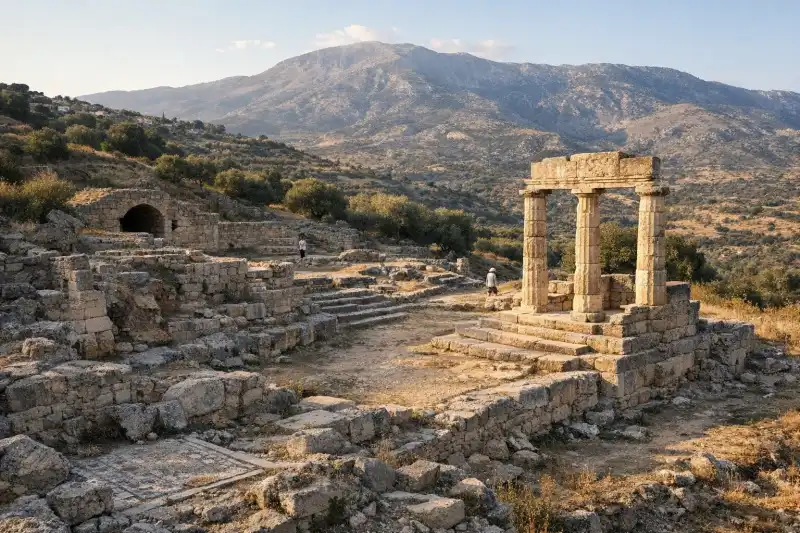
At a glance
Ancient Eleutherna in Greece occupies a broad, wind-touched ridge on the island of Crete, where olive groves, low stone walls, and mountain views frame one of the most revealing archaeological landscapes in the Aegean. Less immediately famous than Knossos yet deeply rewarding, Eleutherna feels like a place where time accumulated rather than vanished. Here, the remains of houses, roads, sanctuaries, towers, cisterns, and cemeteries do not belong to a single dramatic moment but to a long and complicated story stretching from the Early Iron Age into Roman and Byzantine times.
That layered character is exactly what makes the site so compelling. Visitors arrive not to see one monumental temple dominating the horizon, but to understand how a Cretan city lived, adapted, prospered, and remembered its dead across centuries. The setting contributes enormously to the experience. Ancient Eleutherna stands inland above the north coast of Crete, between modern Rethymno and Heraklion, near the foothills of Mount Ida. The air is often bright and dry, and from many points the landscape opens in several directions at once, making it easy to understand why this location mattered for defense, agriculture, and communication.
Today, the archaeological park and the nearby Museum of Ancient Eleutherna work together to tell the story. Excavated tombs, urban remains, and carefully displayed artifacts reveal a settlement that connects mythic memory, Homeric-era society, classical civic life, Roman prosperity, and later transformation under Christianity.
History
Early settlement and the post-Bronze Age world
Eleutherna emerged as an important community in the centuries following the collapse of the Bronze Age palace societies of Crete. By around the 10th century BCE, the site was already occupied and developing into a regional center. This makes it especially significant for understanding the Greek “Dark Age,” a period once thought obscure but now increasingly illuminated by archaeology. Eleutherna helps bridge the gap between the Minoan and Mycenaean worlds and the later rise of the Greek city-state.
Its position was strategic. Built on naturally defensible terrain with access to upland and lowland resources, the settlement could control movement across the island’s interior and maintain ties with coastal routes. Excavations suggest a community with social hierarchy, skilled craft activity, and external contacts. Burials from this era have drawn particular attention because they provide evidence for funerary practices, warrior identity, and elite display. Some discoveries at Eleutherna have even been compared to descriptions in Homer, not because they “prove” epic poetry directly, but because they evoke a world of warrior aristocracies, feasting, memory, and ritual.
The necropolis of Orthi Petra has been one of the site’s most important areas for understanding this early phase. Cremations, inhumations, grave goods, and funerary monuments reveal a society already complex in its values and status distinctions. Gold ornaments, weapons, imported objects, and ceremonial containers suggest broad cultural connections in the Mediterranean.
Archaic and Classical development
By the Archaic period, Eleutherna had developed into a recognized Cretan polis. Like other city-states in ancient Greece, it combined urban functions, regional authority, and religious life. The city minted coins, organized political structures, and participated in the shifting alliances and rivalries that shaped Cretan history. Crete was never politically simple; the island’s communities often balanced cooperation with competition, and Eleutherna appears to have been active in those regional dynamics.
Archaeological remains indicate continuous occupation and construction through the 7th, 6th, and 5th centuries BCE. Public and domestic architecture expanded, and the city’s religious and civic identity became more clearly defined. Its elevated setting allowed surveillance of routes and farmland, while nearby springs and agricultural zones supported settlement. The city likely benefited from mixed economic activity, including olive cultivation, animal husbandry, and exchange with other Cretan and Aegean communities.
Although Eleutherna does not preserve the singular monumental profile of some mainland sanctuaries, its importance lies in continuity. The city evolved rather than appearing all at once in one grand architectural burst. This gives historians a valuable record of how local Greek communities functioned over time in the island context.
Hellenistic change and Roman prosperity
In the Hellenistic period, Eleutherna remained inhabited and regionally relevant amid the wider transformations affecting the eastern Mediterranean after Alexander the Great. Cretan cities continued to negotiate alliances, warfare, and external influence, especially as larger powers became increasingly interested in the island’s strategic position. Like many urban centers, Eleutherna was shaped by these broader pressures while preserving local traditions.
The Roman conquest of Crete in the 1st century BCE marked another turning point. Under Roman administration, many Cretan cities entered new phases of prosperity, and Eleutherna was no exception. Excavated remains from Roman times include baths, villas, roads, cisterns, and substantial architectural works that point to urban vitality and investment. Roman rule often reoriented local economies and linked provincial towns more closely to imperial networks, but it did not erase earlier traditions. Instead, Roman Eleutherna appears as a place where old and new forms coexisted.
This phase is important for visitors because some of the most visible architectural remains date to Roman occupation. The site’s infrastructure, including water management and public amenities, reflects a settlement adapted to both practical needs and Roman expectations of urban life. The city’s scale and organization suggest that it was no isolated village, but a thriving node in Crete’s inland landscape.
Late antiquity and Byzantine transformation
Eleutherna continued into late antiquity and the Byzantine era, when Christianity reshaped the religious and architectural life of the city. Churches were constructed, older structures were reused, and settlement patterns evolved. As elsewhere in the Mediterranean, continuity and change happened together. Pagan civic frameworks receded, but the site remained part of an inhabited and meaningful landscape.
Eventually, destructive events and shifting political conditions contributed to decline. Earthquakes, economic change, and external threats all likely played roles. By the medieval period, the ancient city had largely passed out of active urban life, though not out of memory. Its ruins remained embedded in the Cretan countryside until modern archaeology began to uncover their significance systematically.
Excavations, especially those led by the University of Crete, transformed understanding of the site. Eleutherna is now recognized as one of the most important archaeological locations on the island for tracing long-term continuity from the Early Iron Age onward. It is not merely a ruin field; it is a key archive for the history of Crete itself.
Key Features
What most distinguishes Ancient Eleutherna is the sense of moving through a lived landscape rather than a single concentrated monument. The archaeological zone extends across different sectors, each revealing part of the city’s long biography. Paths lead visitors among stone walls, terraces, architectural foundations, and excavated remains that rise gently from the hillside. Because the site occupies elevated terrain, the visual relationship between ruins and countryside is constant. Eleutherna is best appreciated slowly, with attention to topography as much as masonry.
The necropolis at Orthi Petra is among the site’s most celebrated features. This cemetery area has yielded extraordinary evidence for early elite burials, cremation rituals, and social identity in post-Bronze Age Crete. For scholars, these findings are crucial because they open a rare window onto a period once poorly documented. For general visitors, the necropolis conveys a powerful sense of ritual seriousness and ancestral memory. Even where the physical remains appear fragmentary, the interpretation of the burials gives the place unusual emotional and historical depth.
Elsewhere, Roman remains help visitors imagine Eleutherna at a later moment of prosperity. Sections of bath complexes, water systems, and building foundations indicate a settlement with urban amenities and organized public life. These ruins may not be as theatrically preserved as some Roman sites elsewhere in the Mediterranean, but they are highly meaningful within the Cretan context. They show how an inland city adapted over centuries while participating in a larger imperial world.
The site’s churches and late antique remains point to another layer of transformation. Christianity left its mark on Eleutherna through reused materials, altered spaces, and new architectural forms. This is one of the most rewarding aspects of visiting: you are not seeing a city frozen in one era, but a place repeatedly reshaped by changing beliefs and institutions. The transitions are visible in the archaeology itself.
Equally important is the Museum of Ancient Eleutherna, located nearby and essential to a full understanding of the site. The museum houses many of the objects that give the ruins their human scale: jewelry, weapons, ceramics, inscriptions, sculptures, household items, and burial goods. Finds from the necropolis are especially striking, helping visitors connect the stone remains outdoors with the people who once inhabited the city. The museum’s displays are typically clear and focused, and they make the site’s chronology easier to grasp.
The natural setting is a feature in its own right. Eleutherna sits in a part of Crete where inland mountains, cultivated land, and distant sea routes all feel present at once. In spring, the surrounding hills can be green and bright with wildflowers; in summer, the earth hardens into gold and brown under intense sun. This landscape helps explain why settlement endured here for so long. Defense, visibility, water access, and agricultural potential all converged in one location.
Visitors often remember Eleutherna for its atmosphere of discovery. Unlike heavily crowded flagship sites, it usually feels calmer and more spacious. That relative quiet allows details to emerge: the line of an ancient road, the logic of a terrace, the placement of a tomb, the outline of a public structure against the slope. It is a place that rewards curiosity rather than checklist tourism. If you enjoy archaeology as a process of reading traces in the land, Eleutherna is one of Crete’s most satisfying destinations.
Getting There
Ancient Eleutherna is most easily reached by road from Rethymno or Heraklion, the two main urban bases on Crete’s north coast. From Rethymno, the drive usually takes about 35 to 45 minutes, depending on your route and traffic. From Heraklion, allow roughly 1 hour 15 minutes to 1 hour 30 minutes. A rental car is the most practical option for most travelers because it gives flexibility to combine the archaeological site, museum, and nearby villages in one outing. In Crete, small rental cars often start around €35 to €60 per day in the shoulder season, with higher prices in peak summer.
Taxis are possible, especially from Rethymno, but they can be expensive for a round trip if you also want waiting time at the site. Expect a one-way fare from Rethymno in the rough range of €35 to €50, and from Heraklion often €80 or more. If using a taxi, agree on the return arrangement in advance, since hailing one near the site can be difficult.
Public transport is less direct. Intercity buses on Crete are reliable for main routes, but reaching Eleutherna usually involves taking a bus toward the broader region and then continuing by local taxi. Bus fares from Heraklion or Rethymno on comparable regional routes are often under €10, but the final connection can add inconvenience and cost. For travelers without a car, an organized day tour is often the easiest solution.
Roads in the area are generally manageable, though the final approach includes narrower local stretches. Parking is usually straightforward compared with major urban sites, but arriving earlier in the day makes for a more comfortable visit, especially in summer.
When to Visit
The best times to visit Ancient Eleutherna are spring and autumn, when Crete offers mild temperatures, clearer walking conditions, and softer light on the landscape. From April to early June, the hills around the site are often at their most attractive, with greener vegetation and occasional wildflowers brightening the slopes. Temperatures are usually comfortable for walking, commonly in the high teens to mid-20s Celsius, making it easier to explore both the open-air ruins and the museum without fatigue.
Autumn, especially September through October, is another excellent window. The sea may still be warm if you are combining archaeology with coastal time elsewhere on Crete, while daytime heat begins to ease. The site can still be sunny and dry, but generally feels less punishing than in midsummer. These shoulder months are often ideal for travelers interested in photography and unhurried exploration.
Summer visits are certainly possible, but conditions can be intense. From late June through August, midday temperatures frequently rise above 30°C, and shade on the archaeological paths is limited. If visiting in summer, aim to arrive close to opening time, carry water, wear a hat, and plan the museum for the hottest part of the day if schedules allow. The bright sun can make stone surfaces and exposed paths tiring by noon.
Winter brings cooler air and a quieter atmosphere. Some days are beautiful and clear, but rain and wind are more likely, and site conditions can feel less predictable. Winter is best for travelers already based on Crete who are flexible with weather and opening times. In all seasons, check local schedules before setting out, as archaeological and museum hours may vary.
| Quick Facts | Details |
|---|---|
| Location | Inland Crete, Greece, between Rethymno and Heraklion |
| Region | Crete |
| Nearest City | Rethymno |
| Best For | Archaeology enthusiasts, history travelers, museum visitors |
| Main Periods | Early Iron Age, Archaic, Classical, Hellenistic, Roman, Byzantine |
| Famous For | Necropolis of Orthi Petra, long settlement continuity, museum finds |
| Time Needed | 2-4 hours |
| Best Season | Spring and autumn |
| Access | Best by rental car or organized tour |
| Combined Visit | Archaeological site plus Museum of Ancient Eleutherna |
Ancient Eleutherna offers one of Crete’s richest archaeological experiences precisely because it does not simplify the past. Instead, it preserves the complexity of a city that endured, adapted, and transformed across more than a millennium. For travelers interested in how communities survive historical upheaval, how burial customs reveal social values, and how landscape shapes urban life, Eleutherna is extraordinary. It asks for patience and attention, but rewards both generously. In a single visit, you can move from Homeric-era tombs to Roman infrastructure and Byzantine traces while standing in a Cretan landscape that still explains the logic of the settlement. That continuity between ruins, artifacts, and terrain is what makes Ancient Eleutherna unforgettable.
Guided tours: worth it?
Most travelers can visit Ancient Eleutherna independently. Compare a tour only if you want a tighter history-focused visit, easier logistics, or a guide who can answer questions on the spot.
Best for
- Short visits where a planned route saves time
When to go self-guided
Go independently if you prefer setting your own pace, reading as you go, and checking official hours or ticket rules directly before you arrive.
What I’d avoid
Skip paid tours that bundle unrelated stops you do not actually want. The best option should either save meaningful planning time or add historical context you would miss on your own.
Crete Archaeology Tours
Useful when: you want to compare guided formats before deciding
Rethymno Day Trips
Useful when: transport or pickup logistics matter
Ancient Eleutherna and Crete History Tours
Useful when: you want to compare guided formats before deciding
Some tour links are affiliate links, which may earn Ancient Travel a small commission at no extra cost to you. I try to surface options that make practical sense for the site—not just anything bookable.
Frequently Asked Questions
Where is Ancient Eleutherna located?
Ancient Eleutherna is located on the island of Crete in Greece, inland from the north coast between Rethymno and Heraklion, near the slopes of Mount Ida.
What is Ancient Eleutherna known for?
The site is known for its long occupation from the Early Iron Age through the Byzantine period, its necropolis, Roman remains, and discoveries that illuminate Cretan society after the Bronze Age.
How much time should I plan for a visit?
Most visitors should allow two to four hours to explore the archaeological site and museum at a comfortable pace, especially if combining both on the same day.
Is there a museum at Ancient Eleutherna?
Yes. The Museum of Ancient Eleutherna displays key finds from the excavations and provides essential context for understanding the settlement, cemeteries, and everyday life of the site.
Can I visit Ancient Eleutherna without a car?
It is possible but less convenient. Public transport options are limited, so many visitors arrive by rental car, taxi, or organized tour from Rethymno or Heraklion.
What should I wear when visiting Ancient Eleutherna?
Wear sturdy walking shoes, sun protection, and light clothing suitable for uneven terrain and strong summer heat. Carry water, especially from late spring to early autumn.
Nearby Ancient Sites
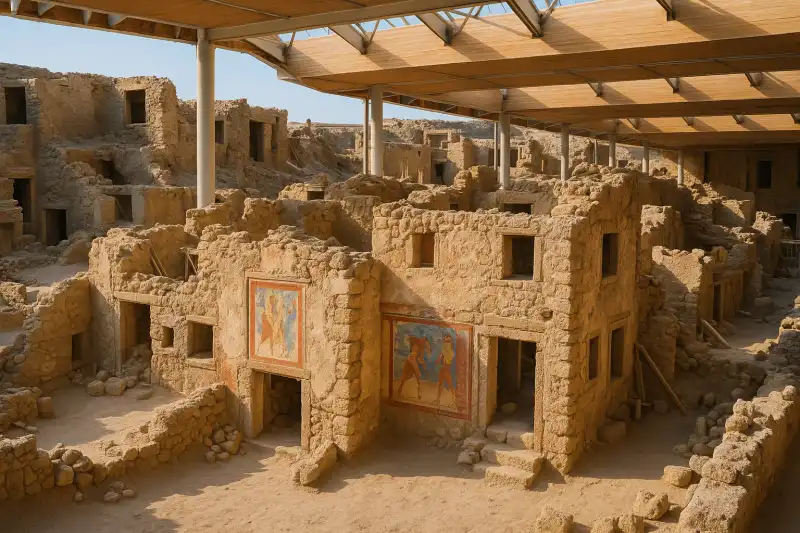
Akrotiri
Minoan / CycladicExplore Akrotiri, the Bronze Age Minoan city buried under volcanic ash on Santorini around 1613 BCE ...
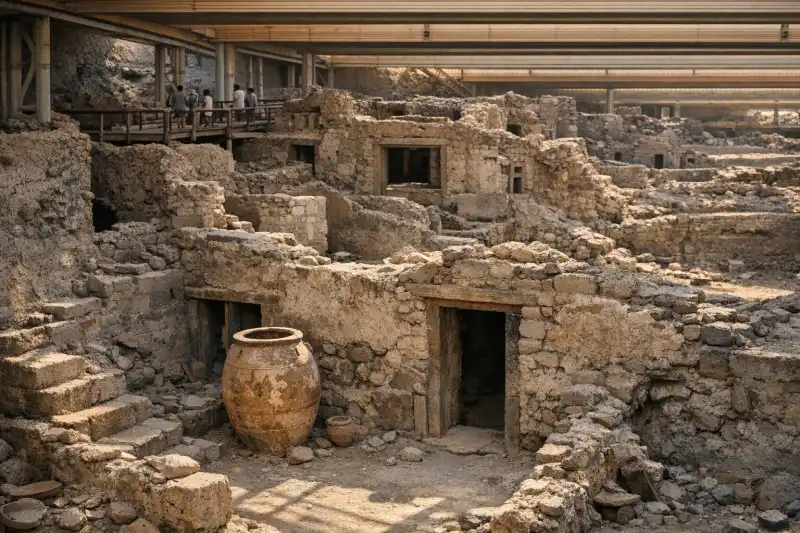
Ancient Akrotiri (Santorini)
Explore Ancient Akrotiri, the breathtaking Bronze Age settlement preserved in volcanic ash on Santor...
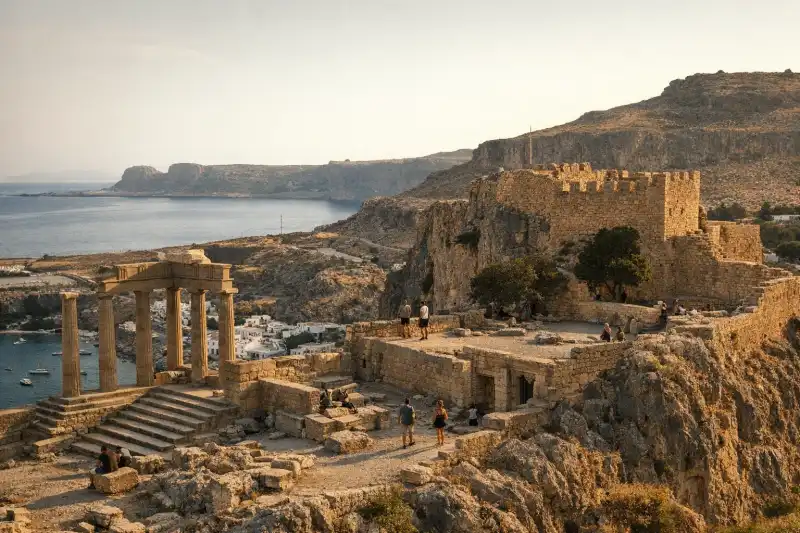
Acropolis of Lindos
Ancient Greek, Hellenistic, Roman, Byzantine, Knights HospitallerThe Acropolis of Lindos on Rhodes, Greece, is a spectacular ancient citadel blending Classical and m...