Quick Info
Curated Experiences
Guided Small-Group Tour to Baalbek, Anjar and Ksara with Lunch
Baalbek, Anjar and Ksara Private Tour from Beirut
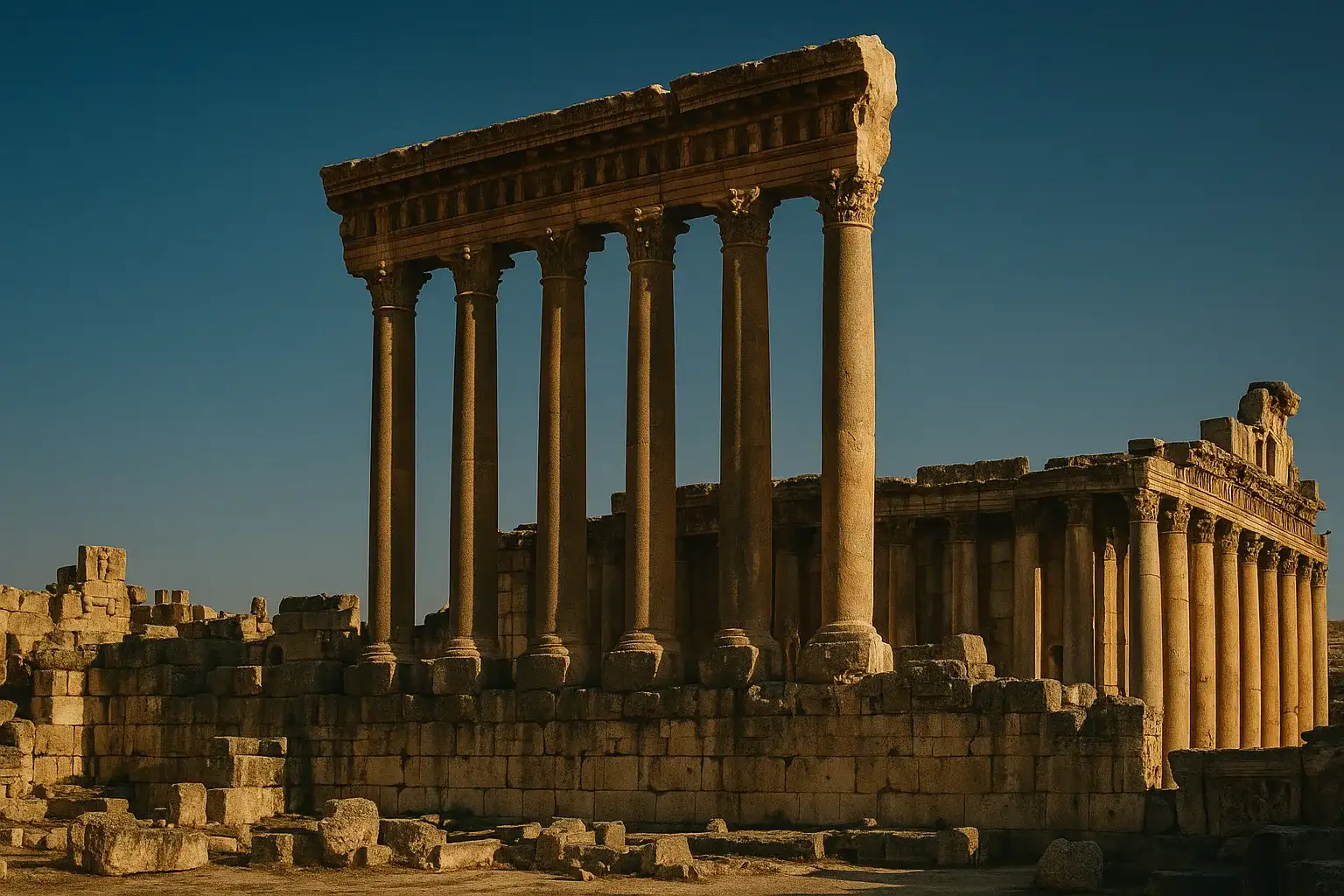
Six columns is all that remains of what was once the largest temple in the Roman Empire. They rise 22 meters above the Beqaa Valley floor—taller than a seven-story building, their Corinthian capitals still sharp against the Lebanese sky—and they are enough. Stand beneath them at midday, when the sun is directly overhead and the shadow of each column falls in a clean dark line across the ancient platform, and you understand immediately that Baalbek was built to make every other temple in the Mediterranean look modest. The Romans did not build this complex to honor the gods. They built it to prove that Rome itself was divine.
The Temple of Bacchus next door, by contrast, is almost entirely intact—all 42 of its exterior columns still standing, its cella walls preserved, its coffered ceilings carved with a precision that would be difficult to replicate today. It is, by any reasonable measure, the best-preserved major Roman temple on earth, larger than the Parthenon and in better condition than anything in Rome itself. And yet Baalbek remains one of the ancient world’s most under-visited wonders, its reputation filtered through decades of Lebanese political complexity that have kept it off the standard tourist circuit.
For those who make the journey—typically a day trip from Beirut through some of the most beautiful mountain scenery in the eastern Mediterranean—the rewards are staggering. You will walk among stones that weigh 800 tons each, through courtyards that held sacrifices on an industrial scale, past carvings so fine they look freshly chiseled. And you will very likely do it with the place nearly to yourself.
Historical Context
The site was sacred long before the first Roman engineer surveyed it. Baalbek sits at 1,170 meters of elevation in the Beqaa Valley, the fertile corridor between the Lebanon and Anti-Lebanon mountain ranges, and evidence of continuous worship here stretches back to the Phoenician period, when the god Baal—lord of storms and fertility—was honored at a regional sanctuary. The Greeks, recognizing the site’s religious importance, gave it the name Heliopolis, “City of the Sun,” associating the local deity with their own Helios. The city’s position at the crossroads of trade routes between Damascus, the Mediterranean coast, and the Syrian interior ensured both commercial prosperity and the kind of cultural layering that characterizes the Levant’s deepest sites.
When Roman armies absorbed the region in the first century BCE, they did not demolish the existing sanctuary. They amplified it. The massive temple construction programs of the first and second centuries CE transformed a respected regional shrine into the most impressive religious complex in the eastern Mediterranean—a deliberate projection of Roman power and piety aimed at the peoples of the Near East. The project consumed roughly 200 years and resources on a scale that dwarfed even the Forum of Trajan in Rome. The Temple of Jupiter was substantially complete by the mid-first century CE. The Temple of Bacchus followed during the reign of Antoninus Pius (138-161 CE). The Temple of Venus was added in the third century. Each successive construction raised the stakes.
The complex survived the Christianization of the Roman Empire, when the temples were converted into churches—a transformation that paradoxically protected them from the wholesale quarrying that destroyed so many pagan sites. An earthquake in 1170 CE caused significant damage, and later Mamluk and Ottoman rulers fortified parts of the complex. But the Beqaa Valley’s relative isolation, compared to the more accessible ruins of Greece and Italy, meant that Baalbek escaped the centuries of stone-robbing that reduced so many Roman monuments to foundations. What stands today is the consequence of that fortunate neglect: the most complete picture of monumental Roman architecture surviving anywhere in the world.
UNESCO inscribed Baalbek as a World Heritage Site in 1984, recognizing it as a masterpiece of Roman imperial engineering and one of the finest examples of ancient religious architecture.
What to See
Temple of Jupiter
Only six of the original 54 columns remain standing, but those six are sufficient to convey the scale of what stood here. Each column rises 22.9 meters from base to capital, with a diameter of 2.2 meters—dimensions that make them the largest in the entire classical world. The entablature resting atop each column weighs approximately 100 tons, raised to its position with such precision that the joints between stones remain tight after two millennia.
The temple’s podium is where the engineering becomes almost incomprehensible. The foundation incorporates the famous Trilithon: three limestone blocks, each weighing approximately 800 tons, positioned so accurately that a knife blade cannot be inserted between them. These stones were quarried from bedrock roughly one kilometer away and raised seven meters into position using ramps, levers, and techniques whose precise mechanics remain a subject of genuine debate among archaeologists and engineers. Walk to the western retaining wall of the podium and look up at the Trilithon from below. The sheer mass of the stones, seen at close range, is the single most physically impressive thing you will encounter at any Roman site anywhere.
Practical tip: The six standing columns photograph best in the morning, when the eastern light catches the stone’s warm tones. Walk around to the back (western) side of the temple platform for the best view of the Trilithon.
Temple of Bacchus
This is the reason specialists make pilgrimages to Baalbek. Built during the reign of Antoninus Pius and dedicated to Bacchus (Dionysus), the god of wine and ecstatic religion, the Temple of Bacchus preserves what has been lost at virtually every other major Roman temple: the interior. All 42 exterior columns stand. The cella walls are intact. Sections of the coffered ceiling survive, their carved rosettes and floral patterns still crisp enough to cast shadows. Staircases lead to upper galleries where priests may have conducted rituals visible to worshippers below. The floor retains patterns of imported marble arranged in geometric designs.
The dimensions—approximately 69 by 36 meters—make this temple larger than the Parthenon in Athens. Step inside and stand in the cella, looking up at the carved door frame that weighs an estimated 60 tons and features a wind-blown eagle clutching a caduceus. The detail work on the interior walls—vines, poppies, Bacchic figures—is so fine that it challenges assumptions about what Roman craftsmen could achieve at this scale. This building is not merely well-preserved. It is essentially complete.
Practical tip: Spend at least 45 minutes inside the Temple of Bacchus. The interior repays slow examination. Bring binoculars or a zoom lens to study the ceiling carvings and upper wall details.
The Great Court
The ceremonial heart of the complex, measuring 135 by 113 meters, is where public rituals and sacrifices were conducted at a scale difficult to visualize today. Exedras—semicircular recesses—line the sides, providing shaded gathering spaces and framing views of the surrounding temples. The sacrificial altars that occupy central positions are massive; one measures larger than a tennis court. During major festivals, hundreds of animals were slaughtered here, their blood channeled away through a sophisticated drainage system that Roman engineers installed beneath the paving.
The court’s design functions as processional architecture, guiding worshippers through a sequence of spatial experiences—compression through the entrance, expansion into the vast open rectangle, then the gradual ascent toward the temple doors—that built psychological intensity with every step. Even in ruin, the sequence works.
Practical tip: Stand at the eastern entrance to the Great Court and look west toward the Temple of Jupiter’s surviving columns. This view reconstructs the processional experience as closely as the ruins allow.
Temple of Venus
The circular temple at the southeast corner of the complex provides an elegant counterpoint to the masculine enormity of Jupiter and Bacchus. Approximately 20 meters in diameter, it follows a tradition of round temples associated with female deities stretching back to ancient Greece. Built during the third century CE, it is one of the later additions to the site, and its graceful proportions demonstrate that Roman architects could achieve subtle beauty alongside monumental force. Only a portion of the original colonnade survives, but the intimate enclosed space, so different from the open grandeur of the larger temples, rewards a brief visit.
Practical tip: The Temple of Venus sits slightly apart from the main complex and is easy to overlook. Five to ten minutes here is sufficient.
The Stone of the Pregnant Woman and the Ancient Quarry
About one kilometer from the main complex lies the ancient quarry where Baalbek’s stones were extracted. Here you encounter the Stone of the Pregnant Woman (Hajjar al-Hibla), a monolith weighing approximately 1,000 tons that remains attached to the bedrock where it was carved and was never moved to the construction site. Recent excavations revealed an even larger stone nearby—the Stone of the South, weighing approximately 1,650 tons—also abandoned in the quarry.
Walking among the partially extracted stones, you can see the techniques Roman engineers used: narrow channels carved around the desired block, slots for wooden wedges that were soaked with water until the expanding wood split the stone along predetermined lines. The logistics of moving 800-ton blocks from here to the temple platform, one kilometer away and seven meters higher, remain only partially understood, and the quarry is where you feel that mystery most viscerally.
Practical tip: The quarry is a ten-minute walk from the main site. It is well worth the detour but is sometimes closed to visitors. Ask at the ticket office before heading over.
Timing and Seasons
Best months: April through May, when the Beqaa Valley is green with wildflowers and temperatures hover between 18 and 28 degrees Celsius. September through November offers equally pleasant conditions with warm days, clear skies, and moderate crowds. These are the windows that most visitors should target.
Summer: June through August brings intense heat, with temperatures regularly reaching 35-40 degrees Celsius. The stone surfaces absorb and radiate heat, making prolonged exposure on the temple platforms genuinely uncomfortable. If you must visit in summer, arrive as early as possible and bring ample water.
Winter: December through February can be cold and rainy at Baalbek’s 1,170-meter elevation, occasionally dropping near freezing. Visitor numbers are at their lowest, which has its appeal, but rain on the stone surfaces makes footing treacherous.
Best time of day: Morning offers the best light on the Temple of Jupiter’s columns and the most comfortable temperatures year-round. Late afternoon, when the setting sun turns the limestone gold, is the most dramatic time to be inside the Temple of Bacchus. If your schedule allows, arrive mid-morning and stay through late afternoon.
The Baalbek International Festival: When held (typically July-August, though schedules vary with regional conditions), this cultural event established in 1956 transforms the temple complex into one of the world’s most dramatic concert venues. Orchestral concerts, opera, ballet, and traditional Arabic music performed against the backdrop of illuminated temples create an experience unlike anything else in the Middle East. Check official Lebanese cultural channels for current programming.
Tickets, Logistics and Getting There
Admission: Entry to the main site costs approximately 150,000 LBP (roughly $2-5 USD depending on the fluctuating exchange rate). Lebanon’s currency situation has been volatile since 2019, so prices in LBP should be confirmed locally. The site accepts Lebanese pounds; some vendors accept US dollars informally.
Safety first: Baalbek is in the Beqaa Valley, a region that has experienced periodic instability due to its proximity to the Syrian border. Conditions vary significantly year to year. Check your government’s current travel advisory before planning a visit. When conditions permit, Baalbek is typically visited without incident, but the security situation is the single most important factor in your planning. Travel insurance may exclude the Beqaa region—verify your policy.
Organized tours from Beirut (recommended): The safest and most convenient option. Small-group day tours run $40-80 USD and typically combine Baalbek with Anjar (Umayyad ruins, 30 minutes away) and a wine tasting at Chateau Ksara. Private tours cost $100-150 USD. Reputable operators monitor security conditions daily and will cancel or reroute if necessary. This is the approach we recommend for first-time visitors.
By private driver: Hotels in Beirut can arrange trusted drivers for $100-150 USD round trip. Negotiate the fare in advance and confirm that waiting time at the site is included.
By shared taxi: Service taxis (shared minibuses) depart from the Dawra bus station or Cola intersection in Beirut when conditions permit. This is the cheapest option but the least convenient and potentially the least secure.
Driving yourself: Possible but not recommended for visitors unfamiliar with Lebanese roads. The 85-kilometer drive from Beirut takes 1.5 to 2 hours, crossing the Mount Lebanon range with spectacular scenery before descending into the Beqaa Valley.
On-site logistics: The site is compact enough to cover in two to three hours at a comfortable pace. There is a small museum near the entrance with artifacts and architectural fragments worth a quick visit. Restrooms are available at the entrance. A handful of cafes and restaurants in the town of Baalbek, just outside the site, serve Lebanese food—meze, grilled meats, fresh flatbread—that is consistently excellent and very affordable.
Practical Tips
- Wear sturdy shoes with good grip. The site involves walking on uneven stone surfaces, climbing over rubble, and navigating steps without railings.
- Bring sun protection year-round. The site is fully exposed with no shade except inside the Temple of Bacchus. A hat, sunscreen, and at least a liter of water are essential.
- Hire a local guide at the entrance if you did not arrive with a tour. Knowledgeable guides are available for $20-30 USD and dramatically improve the experience—the architectural and engineering details are difficult to appreciate without expert commentary.
- Photography is permitted throughout the site. A wide-angle lens captures the temple scale; a telephoto reveals the extraordinary carved details on the Temple of Bacchus’s ceilings and door frames.
- Dress modestly as a matter of cultural respect. The Beqaa Valley is more conservative than Beirut. Shoulders and knees covered is a sensible default.
- Lebanese cuisine is one of the trip’s great side benefits. If your tour includes lunch in the Beqaa Valley, expect some of the best food you will eat in Lebanon. If you are traveling independently, stop at any local restaurant near the site—the quality is remarkably consistent.
- Carry US dollars in small denominations. Lebanon’s economic situation means that dollars are widely accepted and often preferred, but change can be inconsistent.
Suggested Itinerary
9:00 AM — Depart Beirut by organized tour or private driver. The 1.5 to 2-hour drive crosses the Mount Lebanon range with mountain vistas giving way to the agricultural landscape of the Beqaa Valley.
10:30 AM — Arrive at Baalbek. Enter the site and begin with the Great Court, absorbing the processional sequence from the entrance toward the Temple of Jupiter.
11:00 AM — Explore the Temple of Jupiter platform, including the six standing columns and the Trilithon viewed from below at the western retaining wall. Allow thirty minutes.
11:30 AM — Enter the Temple of Bacchus. Take at least forty-five minutes for the interior, studying the carved door frame, the ceiling details, the cella walls, and the upper galleries. This is the highlight of the entire visit.
12:15 PM — Visit the Temple of Venus and the small on-site museum. Allow twenty minutes.
12:35 PM — Walk to the ancient quarry to see the Stone of the Pregnant Woman and the Stone of the South (if open). Allow thirty minutes including the walk.
1:15 PM — Lunch in the town of Baalbek. Lebanese meze and grilled meats at a local restaurant.
2:30 PM — If combining with Anjar, depart for the Umayyad ruins (30 minutes drive). Alternatively, if time allows, return to the main site for the late-afternoon light inside the Temple of Bacchus.
4:00 PM — Depart for Beirut, arriving by 6:00 PM.
Nearby Sites
Jerash — The best-preserved Roman provincial city in the Middle East, located in northern Jordan. A natural pairing for anyone building a Levantine itinerary around Roman sites, though reaching Jerash from Baalbek requires traveling through Syria or flying via Amman—check current border crossing conditions carefully.
Petra — Jordan’s rose-red Nabataean city, carved from sandstone cliffs in the southern desert. Petra and Baalbek together represent the two most dramatic ancient sites in the Levant, and a combined Lebanon-Jordan trip is one of the great archaeological itineraries of the region.
Anjar — The Umayyad ruins in the Beqaa Valley, just 30 minutes from Baalbek, preserve the remains of an eighth-century trading city built at the crossroads of two important routes. Most Baalbek day tours include Anjar as a standard stop, and the combination of Roman and Umayyad architecture in a single day provides an excellent overview of the region’s layered history.
Byblos — One of the oldest continuously inhabited cities in the world, located on the Lebanese coast about 40 kilometers north of Beirut. Phoenician, Roman, and Crusader ruins occupy a compact archaeological site overlooking the Mediterranean. Byblos works best as a separate day trip from Beirut rather than a Baalbek combination.
Stones That Remember
There is a moment at Baalbek, usually in the Temple of Bacchus when you have been inside long enough for your eyes to adjust and the carved details above begin to resolve—the eagles, the vines, the geometric patterns that march across the ceiling—when the scale of what Roman builders achieved here hits you fully. This was not the center of the empire. This was a provincial sanctuary in the eastern territories, and yet the resources poured into it would have been excessive even in Rome. The ambition was deliberate and almost reckless: to build something so large and so perfect that no one who saw it could doubt that the gods themselves had endorsed the empire that raised it.
Two thousand years later, the stones hold. The columns stand. The carvings are still sharp enough to cut shadow. And the quarry, one kilometer away, still holds the 1,000-ton block they never managed to move—proof that even Rome sometimes reached beyond its grasp. Baalbek is not the easiest ancient site to visit, and it is not the most famous. But for those who make the journey, it may be the most astonishing.
Discover More Ancient Wonders
- Jerash — The best-preserved Roman city in Jordan, with a colonnaded main street that rivals anything in Italy
- Petra — The rose-red Nabataean city carved from Jordan’s desert cliffs
- Ephesus — The magnificent Roman city on Turkey’s Aegean coast
- Volubilis — Morocco’s best-preserved Roman ruins, set among olive groves
- Explore our Middle East ancient sites guide for more destinations across the region
Quick Facts
| Attribute | Details |
|---|---|
| Location | Beqaa Valley, eastern Lebanon |
| Country | Lebanon |
| Region | Beqaa Governorate |
| Civilization | Roman / Phoenician |
| Ancient Name | Heliopolis (Greek); Baalbek (Phoenician) |
| UNESCO Status | World Heritage Site (1984) |
| Historical Period | 1st-3rd centuries CE (Roman imperial period) |
| Elevation | 1,170 meters (3,840 feet) |
| Distance from Beirut | 85 km (53 miles); 1.5-2 hours |
| Best Time | April-May, September-November |
| Entry Fee | ~150,000 LBP (approximately $2-5 USD, varies with exchange rate) |
| Suggested Stay | Half day to full day |
| Coordinates | 34.0047, 36.2110 |
Frequently Asked Questions
Is it safe to travel to Baalbek?
Baalbek is in Lebanon's Beqaa Valley, a region that has experienced periodic instability. Check your government's current travel advisory before visiting. When conditions permit, Baalbek is typically visited on a day trip from Beirut with reputable local operators who monitor the situation closely.
What makes Baalbek's temples special?
Baalbek's Temple of Jupiter was one of the largest temples ever built in the ancient world—its columns stand 22 meters tall. The adjacent Temple of Bacchus is arguably the best-preserved Roman temple on earth, with intact cella walls, coffered ceiling sections, and extraordinary carved ornamentation. These represent Rome at its most ambitious and extravagant.
What are the mystery stones at Baalbek?
The Trilithon—three massive limestone blocks in the temple platform—each weighs over 800 tons, making them some of the largest cut stones ever moved by humans. A fourth stone, the 'Stone of the Pregnant Woman,' weighs approximately 1,000 tons and was never moved from its quarry 900 meters away. How ancient builders transported and positioned these blocks remains a subject of genuine archaeological debate.
How do I get to Baalbek from Beirut?
Baalbek is 85 km northeast of Beirut, typically 1.5-2 hours by road through the Beqaa Valley. Service taxis (shared minibuses) depart from Dawra bus station in Beirut when conditions permit. Organized day tours from Beirut offer the most convenient and secure option, often combined with Anjar (Umayyad ruins) nearby.
Can I combine Baalbek with other Lebanon sites?
Yes. A classic Lebanon itinerary combines Baalbek with Anjar (Umayyad period ruins, also in the Beqaa Valley, 30 minutes away), plus the Beiteddine Palace in the Chouf Mountains. The Jeita Grotto and Byblos (Phoenician ruins) can round out a multi-day Lebanon trip focused on historical sites.
Nearby Ancient Sites
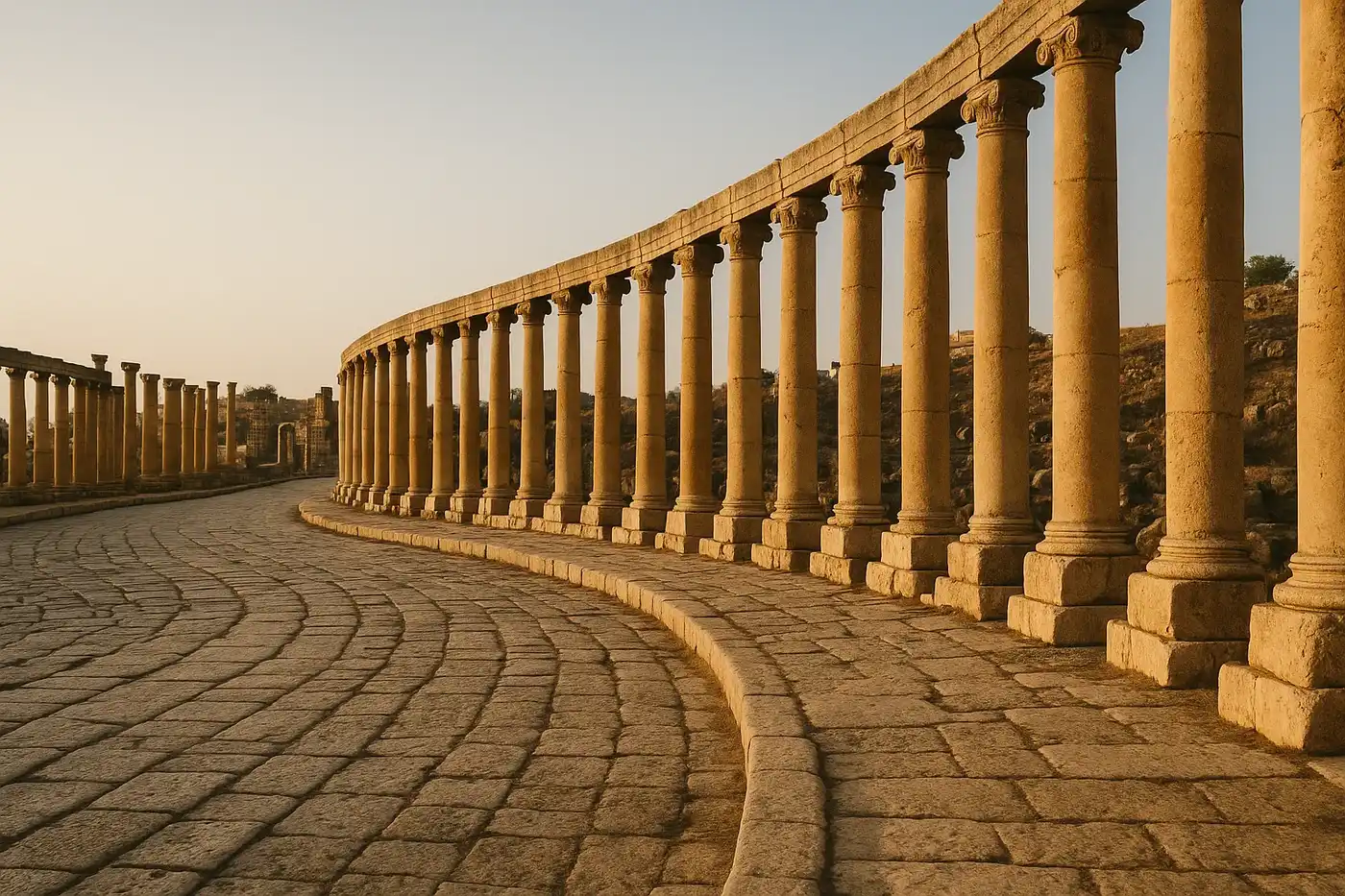
Jerash: The Pompeii of the East and Jordan's Best-Preserved
Roman / NabataeanDiscover Jerash, Jordan's remarkable Roman ruins. Walk the colonnaded streets of ancient Gerasa, exp...
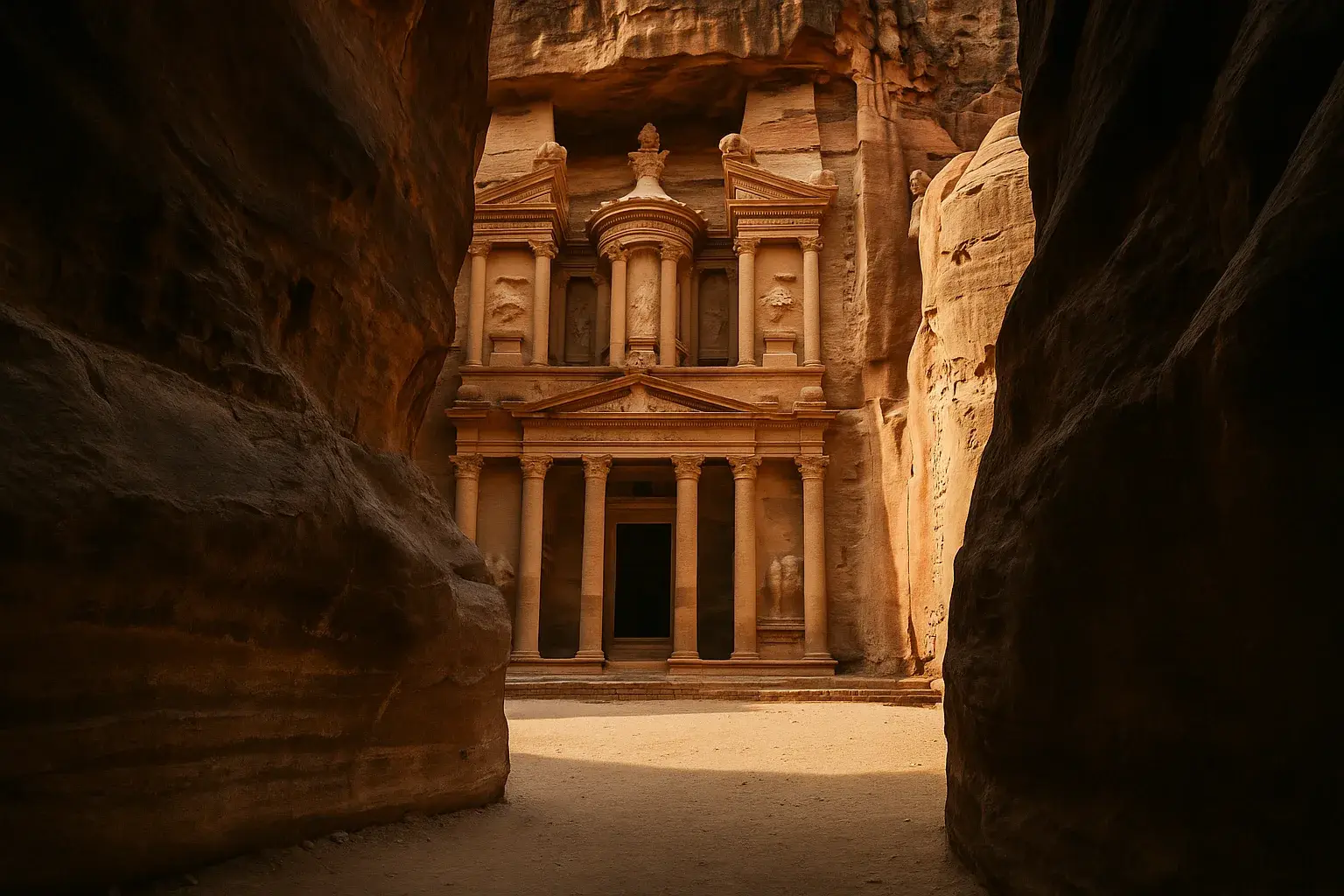
Petra Jordan Travel Guide: Treasury, Monastery & Best Hikes
NabataeanUnlock the secrets of Petra with our comprehensive guide. Walk the Siq to the Treasury, hike to the ...