Quick Info
At a glance
Banteay Chhmar in Cambodia feels less like a polished monument and more like a discovery. Deep in the country’s northwest, far from the heavy tour circuits of Siem Reap, this immense Khmer temple complex rises from a flat rural landscape of rice fields, ponds, sugar palms, and villages where daily life still moves with the rhythm of the seasons. The approach is part of the experience: roads stretch through open countryside, the traffic thins, and eventually the stone walls and broken towers of one of the Khmer Empire’s great provincial temples begin to appear.
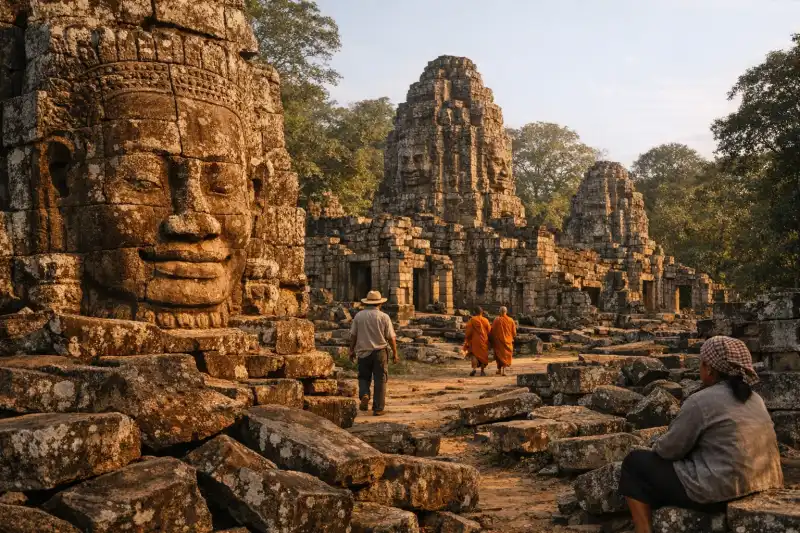
What makes Banteay Chhmar memorable is not only its scale, though the temple is huge, nor only its age, though it belongs to the remarkable era of Jayavarman VII. It is the atmosphere. Here, galleries have collapsed into sculptural heaps, strangler roots push through sandstone, and long bas-reliefs survive in fragments that still convey power, motion, and religious intensity. Faces carved in stone look outward with the calm expression familiar from Bayon-style architecture, yet the site feels altogether quieter, more remote, and more fragile than the famous monuments of Angkor. For travelers interested in Khmer history, archaeology, or simply the emotional pull of ruins beyond the main trail, Banteay Chhmar offers one of Cambodia’s most rewarding ancient places.
History
Origins in the age of Jayavarman VII
Banteay Chhmar was built during the late 12th to early 13th century, in the transformative reign of King Jayavarman VII, one of the most ambitious rulers of the Khmer Empire. This was a period when Khmer architecture and royal ideology shifted in visible ways. After conflict and political instability, Jayavarman VII launched a huge building program that included temples, roads, reservoirs, rest houses, and hospitals across the empire. Mahayana Buddhism became strongly associated with kingship, and temple art increasingly emphasized compassion, protection, and the bodhisattva Avalokiteshvara.
Banteay Chhmar belongs to this world. Its style links it closely to Bayon, Ta Prohm, and Preah Khan, all major monuments tied to the same ruler. The temple’s vast enclosure, face towers, and narrative reliefs suggest a royal foundation of unusual importance, perhaps serving both religious and political aims in a strategic frontier zone of the empire. Scholars often connect the site to military victories and to royal commemoration, especially because some of its carvings appear to depict battle scenes and processions with notable realism and force.
Dedication, memory, and imperial symbolism
The exact dedication of Banteay Chhmar remains debated, but many researchers believe it was associated with memorial purposes. Some inscriptions and iconographic clues have led to suggestions that it honored members of the royal family or military leaders connected with Jayavarman VII’s consolidation of power. In the Khmer world, temples were not simply places of worship. They were statements of legitimacy, cosmic order, and dynastic memory. To found a great temple was to inscribe authority into the landscape.
The temple’s art reinforces this larger symbolism. Images of Avalokiteshvara, face towers, and extensive narrative carvings reveal a monument intended to project both sacred power and royal benevolence. This was architecture as empire: a fusion of ritual devotion, political messaging, and territorial presence. Because Banteay Chhmar stands far from the Angkor heartland, its sheer size suggests it mattered greatly within the regional network of Khmer administration and belief.
Decline after the Angkorian height
Like many large Khmer monuments, Banteay Chhmar gradually declined as the political center of the empire shifted and the Angkorian system weakened. Changes in religious practice, regional warfare, environmental pressures, and political fragmentation all contributed to the fading of monumental temple life. As state resources diminished, upkeep of distant complexes became harder to sustain. Wooden structures disappeared, walls collapsed, and moats and reservoirs filled with sediment.
Over time, the temple entered a different phase of existence, no longer the focal point of royal ritual but part of a local sacred geography. Rural communities remained around the area, and the ruins continued to hold spiritual significance. This pattern is common across Cambodia: abandoned as imperial centers, temples were never entirely forgotten. They became places of memory, occasional worship, and local legend.
Rediscovery, damage, and conservation
In the modern era, Banteay Chhmar drew scholarly attention because of its exceptional artistic and architectural value, but its remoteness also made it vulnerable. During the late 20th century, Cambodia’s years of conflict limited archaeological work and left many ancient sites at risk. Looting was especially destructive. Sections of carved wall, devatas, and relief panels were removed or damaged, with some pieces trafficked through the illicit antiquities market. For a monument whose artistic power lies in long narrative surfaces and sculpted context, these losses were severe.
Conservation efforts have gradually expanded. Cambodian authorities, international teams, and heritage organizations have worked to document the complex, stabilize masonry, and protect surviving carvings. The challenge at Banteay Chhmar is considerable: the site is huge, heavily ruined, and exposed to weather, vegetation growth, and structural instability. Yet its relative calm has also preserved something precious. Unlike heavily reconstructed monuments, Banteay Chhmar still conveys the texture of a genuine archaeological landscape, where fallen stone, partial walls, and surviving towers allow visitors to sense both the ambition of the Khmer builders and the long centuries of decay that followed.
Key Features
The first impression of Banteay Chhmar is scale. The temple complex spreads across a large area enclosed by walls and moats, creating the sense of a sacred city rather than a single shrine. This broad plan recalls the imperial confidence of the Khmer state at its height. Approaching the complex, you move through an architectural sequence of causeways, gateways, galleries, courts, and subsidiary structures that once framed ceremonial movement. Even in ruined form, the spatial planning remains powerful.
One of the most striking features is the presence of face towers, those serene, enigmatic stone faces associated with the Bayon style of Jayavarman VII. At Banteay Chhmar, they emerge in fragments and silhouettes, softened by time but still unmistakable. Their expression gives the site a contemplative mood. Seen in morning or late afternoon light, the faces seem less monumental than intimate, almost as if the temple is still quietly watching the plain around it.
The bas-reliefs are among the site’s greatest treasures. Though not all survive intact, the remaining panels reveal remarkable narrative energy. Battle scenes, processions, mythic imagery, and devotional figures appear in compositions that combine movement with detail. Some reliefs are particularly valued for their representations of military action, giving scholars clues about dress, weapons, and the visual language of royal conquest in the Khmer world. Elsewhere, carvings of Avalokiteshvara embody the compassionate Buddhist currents that marked Jayavarman VII’s reign. These artistic programs make Banteay Chhmar more than an architectural ruin; they make it a document of ideology, devotion, and imperial self-representation.
Another memorable aspect is the site’s state of preservation, or more precisely its beautiful incompleteness. Banteay Chhmar has not been cleaned into neat legibility. Blocks lie where towers fell. Galleries open abruptly to sky. Tree roots thread through joints in the sandstone. This gives the complex an atmosphere many travelers find more affecting than more famous, more stabilized monuments. You can still read the temple, but you also feel its vulnerability. The ruin itself becomes part of the experience.
Beyond the main temple, the wider archaeological zone includes satellite shrines and related features that reward a slower visit. These smaller structures help reveal how extensive the sacred landscape once was. They also shift the experience from monumental sightseeing to exploration. A full visit often involves walking or driving between dispersed remains, passing ponds, homes, and fields that connect the ancient and modern landscape in a particularly visible way.
What many visitors remember most, however, is the quiet. At major Angkor sites, the eye is often drawn to crowds, tour groups, and movement. At Banteay Chhmar, the surrounding sounds are more likely to be birds, wind in the trees, or the distant noise of village life. This calm allows the architecture to register differently. Doorways frame emptiness. Collapsed galleries suggest absent rituals. Broken carvings invite sustained attention. The site feels less like a stop on an itinerary and more like an encounter with a place still partly hidden from the modern world.
Getting There
Banteay Chhmar is in northwestern Cambodia, in Banteay Meanchey Province, and the usual gateway for independent travelers is Siem Reap, though Sisophon and Battambang are also practical starting points. The simplest option is to hire a private car or taxi. From Siem Reap, the journey typically takes around 3.5 to 4.5 hours depending on road conditions and the exact route. Expect to pay roughly $70 to $120 one way for a private taxi, or more if you arrange a round trip with waiting time included. From Sisophon, travel time is shorter, often around 1.5 to 2 hours, with private transport commonly costing about $25 to $50.
Shared transport can reduce costs, but it requires more patience. Some visitors take a bus or minivan from Siem Reap to Sisophon first, usually around $6 to $12, then continue by moto, local taxi, or arranged pickup to Banteay Chhmar village. This last segment varies in price, often around $15 to $30 depending on vehicle type and bargaining. Travel from Battambang is possible by private car in roughly 3 to 4 hours, with fares often in the $50 to $90 range.
Roads are better than they once were, but conditions can still change, especially in the wet season. If you want flexibility to explore the wider archaeological area, a private driver is usually worth the extra cost. Some travelers stay overnight in or near Banteay Chhmar village, which allows an early start at the temple and avoids rushing the return trip.
When to Visit
The best time to visit Banteay Chhmar is generally during Cambodia’s dry season, from November to February, when temperatures are more comfortable and roads are usually at their most reliable. Mornings are cooler, the light is gentle for photography, and walking around the large complex is noticeably easier than in the hottest months. This is the most pleasant period for travelers who want to spend several hours exploring on foot.
March to May brings much hotter weather. Midday heat can be intense, and because Banteay Chhmar is expansive and relatively exposed in places, sightseeing becomes more tiring. If you visit during these months, arrive early, carry plenty of water, and plan a break during the hottest hours. The advantage is that visitor numbers remain low, and the site can feel especially quiet.
The rainy season, usually from May or June through October, transforms the landscape. Rice fields turn vivid green, moats and ponds regain water, and the surrounding countryside becomes especially beautiful. Cloud cover can soften the light and make photography dramatic. The drawback is transport: rural roads may be muddy or slower, and sudden heavy showers can interrupt a visit. Even so, for travelers who do not mind unpredictability, the wet season offers a lush and atmospheric experience that suits the ruined character of the temple.
Whenever you go, try to visit in the early morning or late afternoon. The stone is more expressive in angled light, the temperature is kinder, and the serenity of the place feels at its strongest.
| Quick Facts | Details |
|---|---|
| Location | Banteay Meanchey Province, northwestern Cambodia |
| Civilization | Khmer Empire |
| Date | Late 12th to early 13th century CE |
| Associated ruler | Jayavarman VII |
| Architectural style | Bayon-style late Angkor architecture |
| Religious background | Primarily Mahayana Buddhist with royal commemorative elements |
| Best base | Sisophon or Siem Reap |
| Suggested visit length | Half day to full day |
| Best season | November to February |
| Why visit | Remote atmosphere, major bas-reliefs, face towers, and a less-crowded Khmer temple experience |
Banteay Chhmar rewards a different kind of traveler than the one racing between famous postcard monuments. It asks for time, curiosity, and a willingness to appreciate incompleteness. In return, it offers one of Cambodia’s most compelling ancient landscapes: vast but intimate, damaged yet dignified, and rich with traces of the late Khmer Empire’s artistic and political imagination. If Angkor Wat displays Khmer civilization at its most iconic, Banteay Chhmar reveals it in a quieter, more haunting key. Here, among ruined galleries and half-standing towers, the past does not feel staged. It feels present in fragments, waiting for careful attention.
Guided tours: worth it?
A guide can be genuinely useful at Banteay Chhmar, especially if you want help with transport, timing, tickets, or understanding a large site without losing half the day to logistics.
Best for
- First-time visitors who want context, not just photos
- Travelers who want transport, timing, or entry logistics handled
- Short visits where a planned route saves time
When to go self-guided
Go independently if you already have transport and tickets sorted, enjoy moving at your own pace, and are comfortable checking the latest official rules before you arrive.
What I’d avoid
Skip paid tours that bundle unrelated stops you do not actually want. The best option should either save meaningful planning time or add historical context you would miss on your own.
Banteay Chhmar tours
Useful when: you want to compare guided formats before deciding
Siem Reap to Banteay Chhmar tours
Useful when: you want to compare guided formats before deciding
Cambodia temple tours
Useful when: you want to compare guided formats before deciding
Some tour links are affiliate links, which may earn Ancient Travel a small commission at no extra cost to you. I try to surface options that make practical sense for the site—not just anything bookable.
Frequently Asked Questions
What is Banteay Chhmar?
Banteay Chhmar is a large Khmer temple complex in northwestern Cambodia, best known for its vast enclosure walls, Bayon-style faces, and finely carved bas-reliefs from the late Angkor period.
Where is Banteay Chhmar located?
The temple stands in Banteay Meanchey Province in northwestern Cambodia, near the Thai border and far from the main Angkor monuments around Siem Reap.
How do you get to Banteay Chhmar?
Most visitors arrive by private car or taxi from Siem Reap, Sisophon, or Battambang. Roads have improved, but travel still takes time because the site is in a remote rural area.
How much time should I spend at Banteay Chhmar?
A half day is enough for a quick visit, but a full day is better if you want to explore the main temple, satellite shrines, moats, and surrounding village at a relaxed pace.
What makes Banteay Chhmar special?
Its scale, relative isolation, atmospheric ruins, and exceptional carvings make it unique. The temple also preserves rare battle scenes and Avalokiteshvara imagery linked to the reign of Jayavarman VII.
Is Banteay Chhmar crowded?
No. Compared with Angkor Wat and Angkor Thom, Banteay Chhmar receives far fewer visitors, which gives the site a quieter and more contemplative atmosphere.
Nearby Ancient Sites
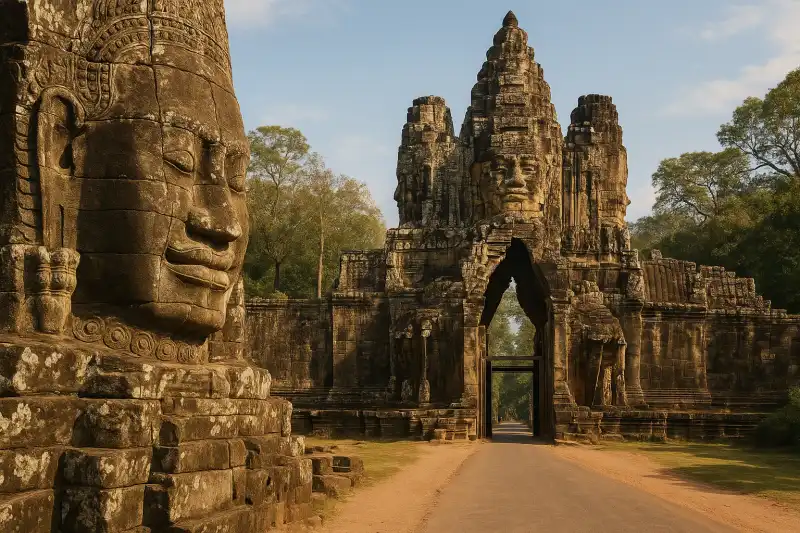
Angkor Thom Travel Guide 2026: Bayon Faces, Gates, and the Khmer Royal City
KhmerAngkor Thom was the last great capital of the Khmer Empire. This guide covers how to visit Bayon, th...
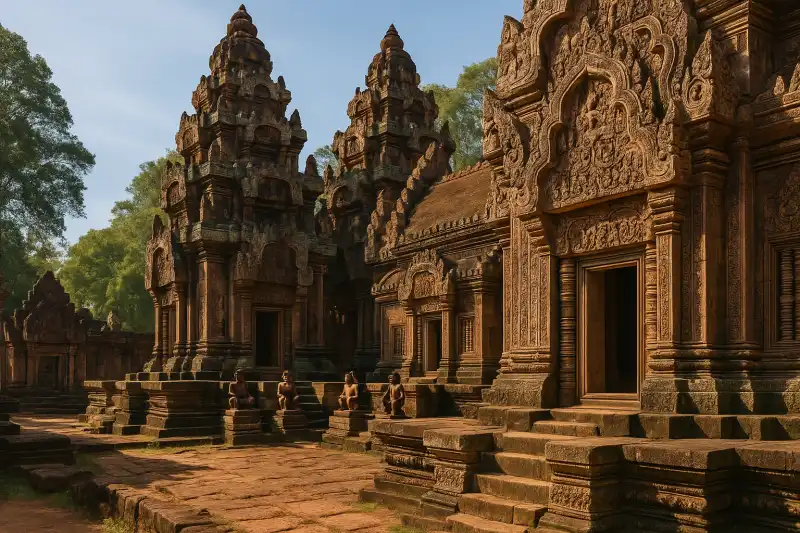
Banteay Srei Travel Guide 2026: Pink Sandstone Temple, Carvings, and Visit Tips
KhmerBanteay Srei is one of Cambodia’s most detailed Khmer temples, known for fine pink sandstone carving...
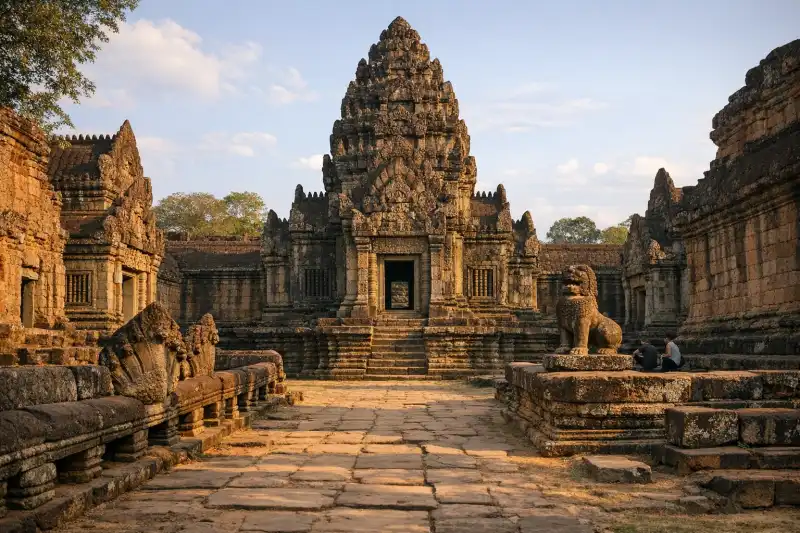
Banteay Samré
Banteay Samré is a beautifully preserved 12th-century Hindu temple in Cambodia’s Siem Reap province,...
Angkor Wat Travel Guide 2026: Everything You Need to Know
KhmerAngkor Wat, the world's largest religious monument, spans over 400 acres in the heart of Cambodia. T...