Quick Info
At a glance
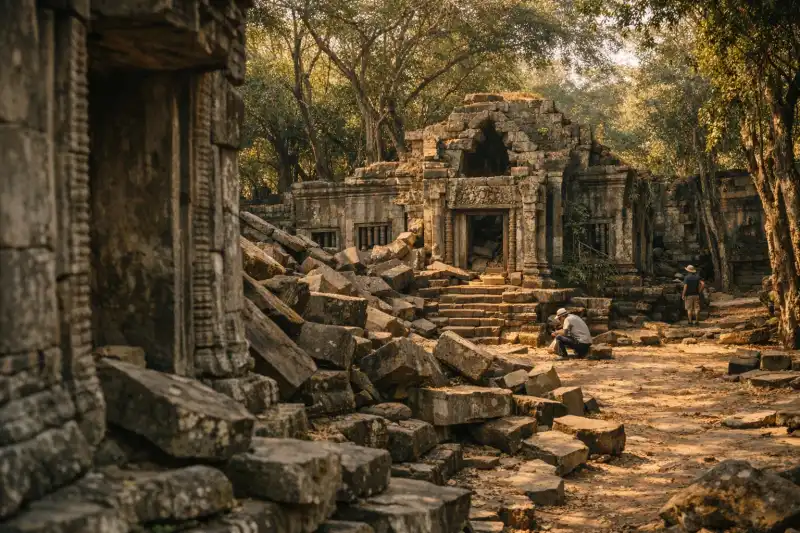
Beng Mealea in Cambodia feels less like a monument placed neatly in a guidebook and more like a temple still half-claimed by the forest. Approaching it from the plains east of Siem Reap, you leave behind the most familiar Angkor circuits and arrive at a site where sandstone blocks lie in giant heaps, galleries lean at uncertain angles, and long shadows gather under broken lintels. There is grandeur here, but it is not the polished grandeur of a fully conserved masterpiece. Instead, Beng Mealea offers something more atmospheric: the sensation of encountering a sacred complex in a state closer to rediscovery.
For many travelers, that mood is exactly the appeal. Trees push through walls, courtyards open suddenly after dark passageways, and carved surfaces emerge through lichen and age. The temple’s scale is striking, yet its details often reveal themselves slowly: a devata tucked beside a doorway, a naga balustrade slipping into ruin, or a corridor where the stone still hints at formal symmetry beneath centuries of collapse. Although often compared to Angkor Wat because of its broad plan and likely date, Beng Mealea has its own character—wilder, quieter, and more haunting. It rewards visitors who enjoy texture as much as architecture and who are willing to trade postcard perfection for a more immersive sense of time, weather, and survival.
History
Early 12th-century foundations
Beng Mealea is generally dated to the early 12th century, during the height of the Khmer Empire. Most scholars link it to the reign of King Suryavarman II, the powerful ruler best known for commissioning Angkor Wat. The similarities are not accidental. Beng Mealea shares certain planning principles and stylistic features with major state temples of the period, including an emphasis on axial design, extensive galleries, and refined sandstone carving. Its large scale suggests that it was not a minor provincial shrine but an important religious foundation connected to the political and ceremonial world of the empire.
The original name of the temple is uncertain, and like many Khmer monuments, its exact historical role is still debated. Inscriptions from the site are limited, so archaeologists rely on architecture, decoration, and comparison with better-documented temples to understand its place in Khmer history. The temple likely served a Hindu function at first, probably associated with Vishnu, reflecting the religious preferences of Suryavarman II’s court. This would align Beng Mealea with the broader state ideology of the era, when temple building expressed royal authority, cosmological order, and the union of kingship with the divine.
Temple, landscape, and network
Beng Mealea was not built in isolation. It stood within a wider Angkorian landscape of roads, reservoirs, settlements, and shrines that connected distant points of the empire. Its location east of the main Angkor core may seem remote to modern visitors, but in the 12th century it likely occupied a strategic and integrated position. Ancient routes linked temples, administrative centers, and agricultural zones, allowing religion, labor, and political control to work together. A temple of this size would have required immense organization, from quarrying stone to transporting materials and coordinating skilled artisans.
The site was also enclosed by a moat and designed according to symbolic principles that reflected Khmer ideas of sacred space. Like other great temples, Beng Mealea can be read as both a devotional structure and a model of the universe. Its concentric enclosures, elevated sanctuary, and processional pathways embody cosmic hierarchy. Yet because so much of the structure has collapsed, visitors today often experience this design through fragments rather than complete lines. Even so, the underlying order remains visible enough to reveal the ambition of its builders.
Religious shifts and later use
As Khmer state religion changed over time, many temples passed through different devotional phases. Beng Mealea was no exception. Although likely Hindu in origin, it may later have seen Buddhist use, especially as Theravada Buddhism spread through Cambodia in the centuries after the Angkorian peak. Such transitions were common in the region. Temples were rarely frozen in a single ritual moment; they evolved as political power shifted, court patronage changed, and local religious practices adapted old spaces to new meanings.
At some stage, however, Beng Mealea ceased to function as a major active monument. The reasons were probably gradual rather than dramatic. Changes in settlement patterns, royal priorities, environmental conditions, and the reorientation of political centers all contributed to the decline of various Angkorian sites. As regular maintenance ended, vegetation, monsoon water, and structural weakness began their long work. Roofs fell, galleries cracked, and walls gave way. By the time outside observers recorded the site in modern history, Beng Mealea had become famous not for uninterrupted worship but for its romantic ruin.
Rediscovery, conservation, and modern visitation
French explorers and scholars working in Cambodia during the colonial era helped bring Beng Mealea to wider international attention, as they did with many monuments of Angkor. Yet unlike some temples that underwent extensive clearance and reconstruction, Beng Mealea retained much of its untamed appearance. This partly shaped its reputation. Travelers came not simply to study Khmer architecture, but to experience a temple where the jungle atmosphere remained palpable.
Modern conservation has focused on visitor access and structural safety rather than complete restoration. Wooden walkways and controlled routes have been introduced in places to help people move through the temple while reducing risk and limiting damage to fragile stonework. Even so, Beng Mealea still feels comparatively raw. That balance—between preservation, access, and authenticity—is central to its modern identity. Today it is visited by historians, photographers, architecture enthusiasts, and travelers looking for an Angkor-era temple that communicates collapse and continuity at the same time. Its history is therefore not only medieval; it also includes the modern choice to preserve a ruin as a ruin, allowing age to remain visible rather than trying to erase it.
Key Features
What makes Beng Mealea memorable is the combination of scale and disintegration. This is not a small temple swallowed by vines. It is an immense complex, laid out with the confidence of major Khmer architecture, yet now broken open in ways that expose its bones. The first impression is often one of mass: long causeways, expansive courtyards, and piles of sandstone blocks that seem almost geological. But as you move deeper inside, the temple begins to reveal a sophisticated plan of galleries, libraries, courtyards, and sanctuary spaces.
The moat and outer enclosure establish the monumental ambition of the site before you even enter the central ruins. Khmer temple builders used water and enclosure walls not only for practical and symbolic purposes, but also to stage the visitor’s movement from the ordinary world into a sacred one. At Beng Mealea, that progression remains legible despite damage. Causeways and entrance points still direct the body and the eye. You sense that every threshold once mattered.
Inside, the galleries are among the most atmospheric spaces. Some passages remain dim and enclosed, while others have collapsed into open-air corridors where light pours over scattered stone. This alternation between darkness and brightness heightens the feeling of exploration. Carved lintels and pediments survive in fragmentary but often impressive condition. Floral motifs, mythic forms, and figures associated with Khmer religious art can still be found if you look carefully. The carvings may not always be as cleanly preserved as those at more intensively conserved temples, but their weathered state is part of their power. They look old in the deepest sense—not merely historic, but long exposed to rain, roots, and silence.
One of Beng Mealea’s most striking visual elements is the way nature interacts with the architecture. Trees rise from between stones, roots curl around fallen blocks, and vegetation softens walls that were once severe and geometric. This has led many visitors to compare the temple with the more famous tree-entwined scenes at Ta Prohm, though Beng Mealea usually feels more spacious and less managed. The interplay between engineered form and natural takeover is especially vivid here because so much of the temple has collapsed without losing its identity. You are not looking at random rubble. You are looking at a sophisticated sacred building in a partially undone state.
The central sanctuary area, though heavily ruined, still conveys the vertical and symbolic emphasis of Khmer temple design. The sacred heart of the complex once rose above surrounding enclosures, expressing the cosmic mountain idea that shaped much of Angkorian architecture. Even where towers are damaged or incomplete, the arrangement still points upward in concept. This is architecture that was meant to embody hierarchy: outer to inner, lower to higher, human approach to divine center.
Another important feature is the sense of movement Beng Mealea creates. At heavily restored monuments, routes can feel obvious and controlled. Here, despite modern pathways, the experience remains more exploratory. Angles shift unexpectedly, openings frame sudden views, and collapsed sections create dramatic compositions of line and volume. Photographers are drawn to these contrasts, but so are casual visitors. The temple has a cinematic quality because every turn seems to reveal another scene: a toppled doorway, a bright courtyard beyond shadow, or a tangle of stone that suggests both destruction and endurance.
Finally, Beng Mealea’s relative distance from the busiest Angkor stops contributes to its character. Even when visitor numbers are healthy, the site often feels calmer than the most famous temples near Siem Reap. That extra breathing room allows details to register. You hear wind, birds, and footsteps on timber walkways. You can pause to study masonry joints, worn carvings, or the immense labor embedded in every block. More than many better-known monuments, Beng Mealea lets visitors appreciate the physical reality of Khmer architecture—not just its icon status, but its materiality.
Getting There
Most visitors reach Beng Mealea from Siem Reap, which is the practical base for almost any trip to the temple. The distance is roughly 40 kilometers to the east, and travel time is usually about 1 to 1.5 hours each way depending on traffic, road conditions, and your mode of transport. A private car with driver is the most comfortable option and typically costs around $35 to $60 for a half-day or simple return trip, with higher rates if you combine Beng Mealea with farther sites such as Koh Ker.
Tuk-tuks can also be hired from Siem Reap, often for about $25 to $40 depending on negotiation, fuel prices, and waiting time. This is a popular choice for travelers who want an open-air ride and a lower price, though the journey is long enough that heat, dust, and weather should be considered. If you prefer more context on the way, organized day tours and private guides are widely available and usually bundle transport, site commentary, and occasionally visits to additional temples.
Independent travelers with confidence on Cambodian roads sometimes rent a scooter or motorbike, with daily rental prices often starting around $10 to $15, excluding fuel. This offers flexibility but comes with obvious safety considerations, especially in wet weather. Taxis booked through hotels or ride services may cost slightly more than a prearranged driver but can be convenient.
Entrance arrangements can change over time, so it is wise to confirm current ticket rules before departure from Siem Reap. Bring water, sun protection, and cash for small purchases, as facilities around the site are more limited than in the main Angkor area.
When to Visit
The best time to visit Beng Mealea is generally during Cambodia’s dry season, from about November to early April. During these months, roads are easier to manage, walkways are less slippery, and exploring the temple is more comfortable overall. The coolest period, usually from November through January, is especially pleasant for long walks through the ruins. Morning light can be beautiful on the sandstone, and early visits often provide a quieter, more atmospheric experience before day-trip traffic increases.
The hot season, especially March and April, can still be rewarding if you start early. Beng Mealea includes shaded corridors and broken galleries, but much of the approach and many open sections of the temple can feel intensely warm by late morning. Carry extra water, wear breathable clothing, and plan a slower pace if visiting at this time of year.
The rainy season, typically from May to October, transforms the landscape. Vegetation becomes richer and the site can look especially dramatic, with greener surroundings and a more saturated jungle feel. For photographers and travelers drawn to the romantic side of ruins, this can be an excellent season. However, heavy rains may make paths muddy and stones slick, and transport from Siem Reap can take longer. Good footwear matters much more in wet months.
If your priority is comfort and ease, choose the cooler dry season. If your priority is mood and lush scenery, the rains can be worth the inconvenience. In either case, early morning is usually the best time to appreciate Beng Mealea’s quieter, more mysterious atmosphere.
| Quick Facts | Details |
|---|---|
| Location | Siem Reap Province, Cambodia |
| Nearest city | Siem Reap |
| Built | Early 12th century CE |
| Associated ruler | Commonly linked to Suryavarman II |
| Civilization | Khmer Empire |
| Original religion | Likely Hindu, later Buddhist use possible |
| Main material | Sandstone with laterite elements |
| Style | Angkorian temple architecture |
| Approximate distance from Siem Reap | About 40 km |
| Suggested visit length | 1.5 to 3 hours |
Beng Mealea is best appreciated by travelers who are willing to look beyond completeness. It does not present itself as a perfectly restored jewel. Instead, it offers the grandeur of an Angkorian temple in a condition that makes time visible. The site’s broken galleries, scattered blocks, and forested edges are not distractions from its history; they are part of how that history is experienced. You see not only what Khmer builders achieved, but also what centuries of weather, abandonment, and survival have done to that achievement.
That is why Beng Mealea leaves such a strong impression. It combines the intellectual appeal of major Khmer architecture with the emotional pull of ruin. It can be read as a historical monument, admired as a work of design, or simply felt as a place of atmosphere. For visitors based in Siem Reap, it is one of the most rewarding excursions beyond the standard Angkor circuit—a temple that remains large, mysterious, and unmistakably alive in memory long after the visit ends.
Guided tours: worth it?
A guide can be genuinely useful at Beng Mealea, especially if you want help with transport, timing, tickets, or understanding a large site without losing half the day to logistics.
Best for
- First-time visitors who want context, not just photos
- Travelers who want transport, timing, or entry logistics handled
- Trips where tickets, circuits, or timed entry can shape the day
- Short visits where a planned route saves time
When to go self-guided
Go independently if you already have transport and tickets sorted, enjoy moving at your own pace, and are comfortable checking the latest official rules before you arrive.
What I’d avoid
Skip paid tours that bundle unrelated stops you do not actually want. The best option should either save meaningful planning time or add historical context you would miss on your own.
Beng Mealea tours from Siem Reap
Useful when: transport or pickup logistics matter
Beng Mealea and Koh Ker day trips
Useful when: transport or pickup logistics matter
Angkor and Beng Mealea private tours
Useful when: you want flexible timing or a private guide
Some tour links are affiliate links, which may earn Ancient Travel a small commission at no extra cost to you. I try to surface options that make practical sense for the site—not just anything bookable.
Frequently Asked Questions
Where is Beng Mealea located?
Beng Mealea is in Siem Reap Province, Cambodia, roughly 40 kilometers east of the main Angkor temple zone and commonly visited as a day trip from Siem Reap.
Who built Beng Mealea?
Most scholars associate Beng Mealea with the reign of King Suryavarman II in the early 12th century, the same ruler connected with Angkor Wat.
Is Beng Mealea part of the Angkor archaeological area?
Beng Mealea is often discussed as part of the wider Angkor cultural landscape, though it lies outside the central cluster of temples around Angkor itself.
How much time do you need at Beng Mealea?
Most visitors spend 1.5 to 3 hours exploring the temple, depending on photography stops, walking pace, and whether it is combined with nearby sites.
What makes Beng Mealea different from Angkor Wat?
Beng Mealea is less restored and more overgrown, with collapsed galleries, tree roots, and a rugged atmosphere that feels closer to a rediscovered ruin.
Can you visit Beng Mealea independently?
Yes. Travelers can hire a tuk-tuk, car, taxi, or join a guided tour from Siem Reap, though independent visitors should still check current ticket and transport arrangements.
Nearby Ancient Sites
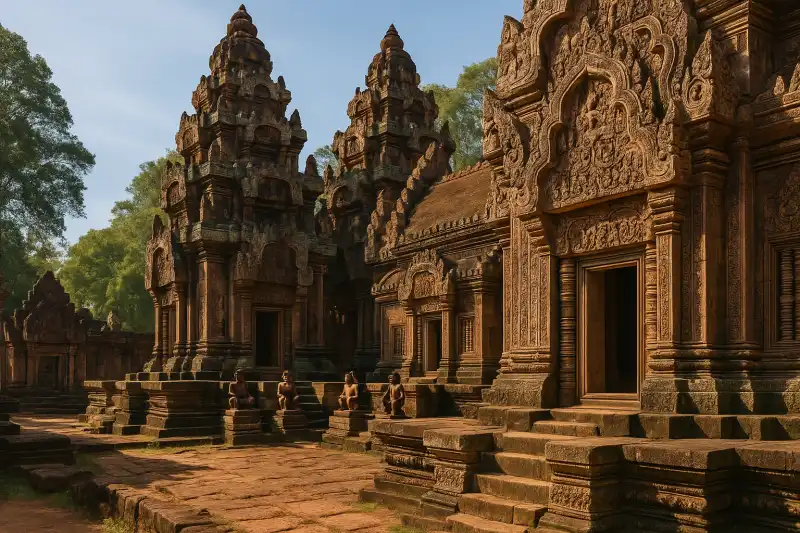
Banteay Srei Travel Guide 2026: Pink Sandstone Temple, Carvings, and Visit Tips
KhmerBanteay Srei is one of Cambodia’s most detailed Khmer temples, known for fine pink sandstone carving...
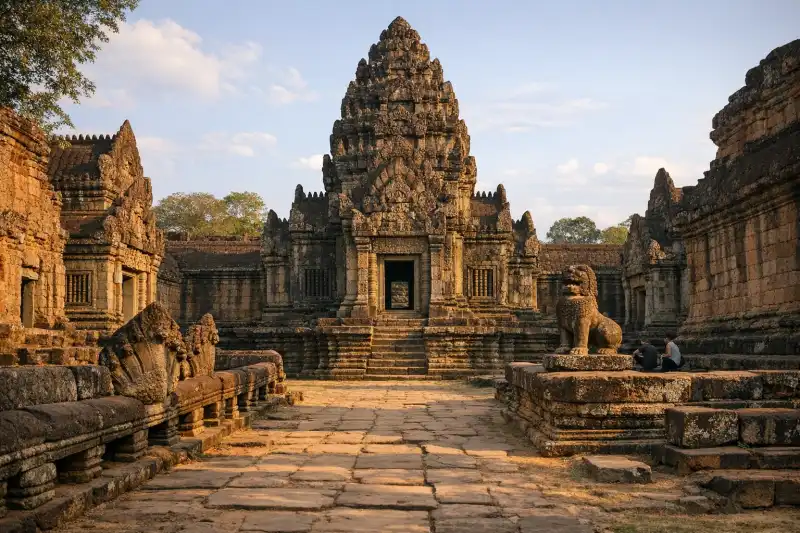
Banteay Samré
Banteay Samré is a beautifully preserved 12th-century Hindu temple in Cambodia’s Siem Reap province,...
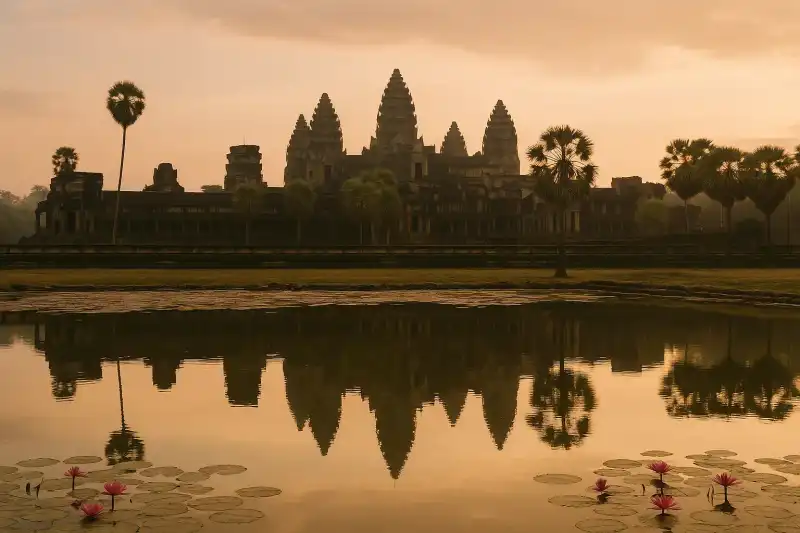
Angkor Wat Travel Guide 2026: Everything You Need to Know
KhmerAngkor Wat, the world's largest religious monument, spans over 400 acres in the heart of Cambodia. T...
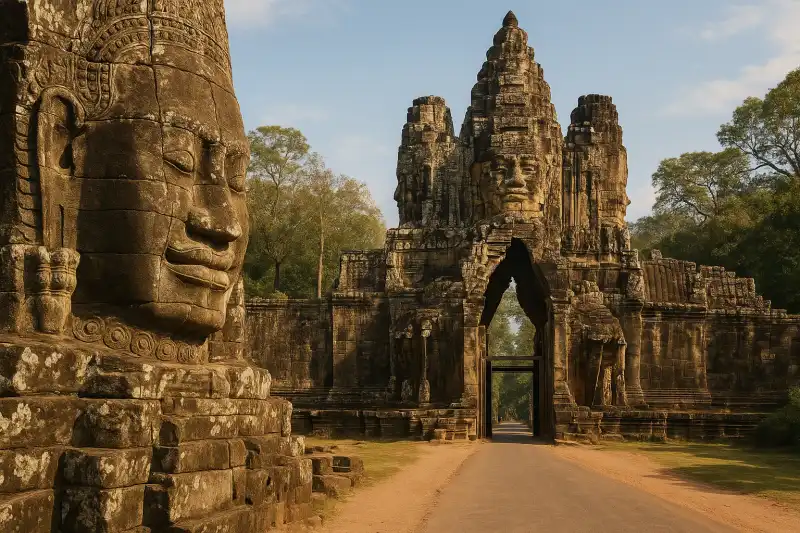
Angkor Thom Travel Guide 2026: Bayon Faces, Gates, and the Khmer Royal City
KhmerAngkor Thom was the last great capital of the Khmer Empire. This guide covers how to visit Bayon, th...