Quick Info
At a glance
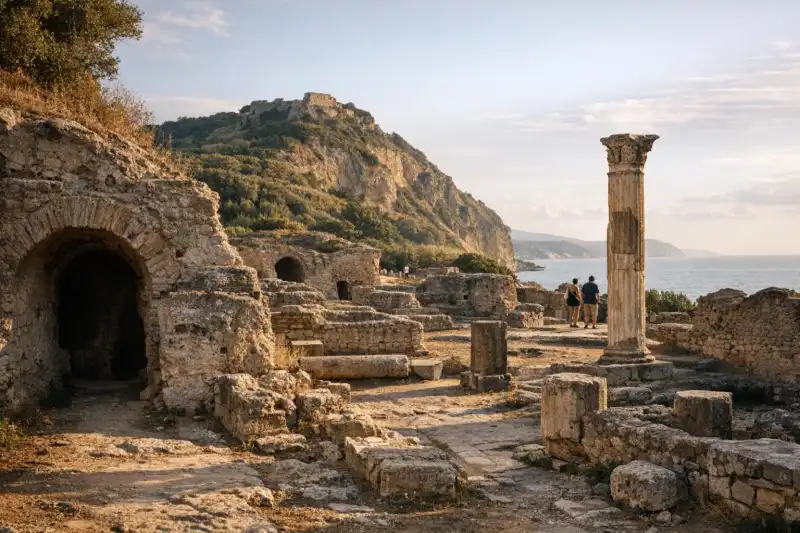
Cumae, Italy, rises from the volcanic landscape of Campania with a presence that feels older than nearly anywhere else on the Italian mainland. North-west of Naples, in the restless and storied terrain of the Phlegraean Fields, this archaeological site combines sea light, tufa hills, myth, and political history in a way few ancient places can. Visitors arrive to find not a single monument dominating the horizon, but an entire layered world: Greek foundations, Roman rebuilding, early Christian traces, and centuries of legend centered on the mysterious Cumaean Sibyl.
What makes Cumae especially memorable is its setting. The acropolis stands on a ridge above the surrounding plain, looking toward the Tyrrhenian coast and the wider Bay of Naples. The wind moves through grasses and broken walls, while long-cut passageways and temple terraces hint at the ambitions of the communities that once ruled here. This was no peripheral outpost. Cumae served as a gateway through which Greek language, religion, urban ideas, and trade entered Italy, influencing cultures far beyond Campania. Later, the Romans absorbed and transformed the city, adding their own architecture and sacred associations to a landscape already old with memory.
For modern travelers, Cumae offers a quieter experience than Pompeii or central Naples, but that is part of its appeal. It rewards patience, walking, and imagination. Here, the story of ancient Italy begins to feel not abstract but physical: carved into yellow volcanic stone, spread across terraces, and framed by one of southern Europe’s most evocative coastal settings.
History
Greek foundation and the first colony on mainland Italy
Cumae was founded in the 8th century BCE by Greek settlers, traditionally associated with colonists from Euboea, especially Chalcis and Eretria, who had already established themselves at Pithekoussai on the island of Ischia. Its importance lies not only in its age but in its role as the earliest major Greek colony on the Italian mainland. From here, Hellenic culture radiated inland and along the coast, introducing new forms of trade, religion, craftsmanship, and political organization.
The location was strategic. The settlers chose a defensible acropolis above fertile land and near coastal routes, allowing them to control movement between sea and interior. The city soon grew wealthy through commerce and agriculture. Ancient literary traditions also connect Cumae with the spread of the Greek alphabet into Italy, a development with immense long-term consequences for the cultures of the peninsula. Even in its earliest phase, Cumae was more than a colony surviving on the edge of a new world; it was a center capable of exerting influence.
Archaic power and regional dominance
During the Archaic period, roughly the 7th and 6th centuries BCE, Cumae emerged as one of the strongest Greek cities in southern Italy. Its power was both military and cultural. The city engaged with neighboring Italic peoples, at times through exchange and at times through conflict. Ancient sources describe Cumae as a formidable player in Campania, and its prestige extended beyond local geography.
This was also the period in which the religious aura of the city developed. The cult associated with Apollo became especially important, and later tradition linked the sanctuary landscape of Cumae to the prophetic Sibyl, a priestess whose oracles entered Greek and Roman imagination. Whether viewed through mythology or archaeology, the city’s sacred identity was already taking shape.
By the late 6th and early 5th centuries BCE, Cumae was involved in wider struggles for maritime and regional control. It is remembered for resisting Etruscan pressure and for participating in naval conflicts that shaped the balance of power in the Tyrrhenian world. Though details in ancient accounts can be difficult to untangle, the broad picture is clear: Cumae stood at the intersection of Greek, Etruscan, and Italic interests.
Samnite and Roman transformation
In the 5th century BCE, the city’s Greek dominance weakened. Campania was changing, and non-Greek groups, especially the Samnites, expanded their influence. Cumae was eventually taken by Campanian or Samnite forces, marking the end of its purely Greek political identity. Yet conquest did not erase the city’s earlier heritage. Instead, Cumae became a place of cultural layering, where Greek sanctuaries, language, and traditions persisted within new political realities.
Roman involvement grew steadily, and by the 4th century BCE Cumae had entered the Roman sphere. As Roman power spread through Campania, the city adapted again. Under Rome, Cumae retained prestige because of its antiquity and sacred associations, even as nearby centers such as Puteoli gained commercial importance. Roman authors, including Virgil, further immortalized the site by linking the Cumaean Sibyl to the Aeneid, where Aeneas consults her before descending to the underworld. Literature ensured that Cumae would occupy a permanent place in the cultural map of the ancient Mediterranean.
Architecturally, the Roman period altered the site significantly. Existing sacred spaces were rebuilt, temples were renewed, and defensive and civic structures evolved. The lower city developed with baths, roads, and service areas, while the acropolis remained the symbolic heart of the settlement.
Late Antiquity, Christianity, and decline
In Late Antiquity, Cumae continued to be inhabited and strategically useful, but its role had changed. Christianity left visible marks on the site, including the adaptation of earlier sacred spaces for new forms of worship. Temples once tied to classical gods were transformed or replaced as the religious landscape of Italy shifted.
The city also faced the instability that affected much of the western Mediterranean after the Roman imperial peak. Trade patterns changed, political authority fragmented, and nearby urban centers drew away people and resources. Yet Cumae never became merely a forgotten ruin overnight. Its acropolis, strong natural position, and symbolic importance ensured continued occupation and reuse for centuries.
Over time, however, urban life contracted and the city’s ancient structures were abandoned, dismantled, or buried. What survives today is the result of both loss and rediscovery: a terrain where excavated monuments stand amid earthworks, vegetation, and the traces of many centuries. Cumae’s history is therefore not a simple rise and fall, but a long sequence of reinvention, memory, and partial survival.
Key Features
The most famous feature at Cumae is the so-called Cave of the Sibyl, a long trapezoidal gallery cut through tufa rock. Even visitors who arrive with scholarly caution often find it unforgettable. Light enters from side openings, creating sharp intervals of brightness and shadow along the passage. The structure has been linked for generations with the prophetic woman of ancient legend, though archaeologists debate whether it originally served a military, religious, or practical purpose. That uncertainty only adds to its power. At Cumae, myth is not separate from the stones; it clings to them.
Above the lower approaches rises the acropolis, the defensible high ground that first attracted settlers. Climbing toward it reveals one of the site’s greatest strengths: the way architecture and landscape work together. This is not an archaeological park organized around a single intact monument, but a broad terrain in which terraces, pathways, and elevated viewpoints help visitors understand how ancient communities inhabited and controlled the area. From the top, the views extend across the Phlegraean Fields and toward the sea, making the strategic logic of the settlement immediately clear.
On the acropolis stand the remains of temples traditionally identified with Apollo and Jupiter. The Temple of Apollo, in particular, reflects the site’s long sacred history. Although heavily altered over time, including later Christian reuse, it preserves the memory of one of Cumae’s most important cult centers. This was a place where Greek religion took root in Italy and where Roman and later communities continued to build upon inherited sanctity. The Temple of Jupiter, occupying a commanding position, emphasizes the acropolis’s role as both fortress and ceremonial zone.
Elsewhere in the site, the lower city preserves traces of Roman urban life, including baths and service structures. These remains may not always be as visually dramatic as the acropolis or the Sibyl’s passage, but they are essential to understanding Cumae as a living city rather than a purely legendary sanctuary. Streets, foundations, and functional spaces reveal how the settlement changed under Roman administration, responding to shifting economic and political circumstances.
Another striking quality of Cumae is the material itself. Much of the site is shaped from local volcanic tufa, a warm-toned stone that absorbs and reflects the southern light in distinctive ways. Walls, tunnels, retaining structures, and stairways emerge from the same geological substance as the hill, giving the ruins a sense of having grown from the landscape rather than being imposed upon it. This is especially apparent in the cut passages and defensive sectors, where engineering and terrain are almost inseparable.
The surrounding environment matters as much as the ruins. Cumae belongs to the wider volcanic district known as the Campi Flegrei, or Phlegraean Fields, an area of craters, thermal activity, and ancient settlements. Understanding that context enriches the visit. The city was established in a region shaped by fire beneath the earth, fertile soils above it, and a coastline ideal for maritime exchange. Standing among the ruins, visitors can appreciate why this place became both a strategic settlement and a center of myth. Volcanoes, caves, prophecy, and underworld journeys all made intuitive sense in such a landscape.
Unlike more crowded headline destinations, Cumae often feels spacious and contemplative. You can pause on a terrace, look across the fields and sea, and hear mostly wind and birds rather than tour groups. That atmosphere is one of its defining features. The site asks for active imagination, but rewards it richly. Cumae is not only about what survives in stone; it is about the conversation between archaeology, text, legend, and topography that still unfolds there.
Getting There
Cumae is most easily visited from Naples, which serves as the main gateway for travelers. By car, the drive typically takes around 45 to 60 minutes from central Naples, though traffic can extend this. A rental car or taxi offers the most flexibility, especially if you want to combine Cumae with nearby sites in the Phlegraean Fields such as Baia or Pozzuoli. Expect taxi fares from Naples to be roughly €60 to €90 one way, depending on pickup point and time of day.
Public transport is possible and more budget-friendly. One common option is to take the Cumana railway from Naples toward the western coast, getting off at a nearby station such as Fusaro or Torregaveta depending on current schedules and onward bus availability. From there, local buses or a short taxi ride can complete the journey to the archaeological area. Combined public transport costs are often in the range of €3 to €8 one way, making this the best option for independent travelers watching costs.
If you are staying in Pozzuoli or the northern Bay of Naples area, reaching Cumae is even easier by local road or bus. Guided day tours from Naples occasionally include transport to Cumae along with other Campanian highlights, and these can be a convenient choice if you prefer not to coordinate train and bus connections yourself. Tour prices vary widely, but shared excursions often begin around €70 to €120 per person depending on inclusions.
Because local transport schedules can change, it is wise to check current train and bus times before departure. Comfortable walking shoes are essential once you arrive, as the site involves slopes, uneven surfaces, and some exposed paths.
When to Visit
Spring is arguably the best time to visit Cumae. From March to May, temperatures are usually mild, vegetation is greener, and the archaeological landscape feels especially vivid under clear light. This season suits the site well because much of the visit takes place outdoors, on exposed paths and elevated terraces. Spring also tends to offer a good balance between pleasant weather and manageable visitor numbers.
Autumn is another excellent choice. September through early November can bring warm days without the intense heat of midsummer, and the lower angle of the sun often gives the tufa stone and surrounding fields a soft, atmospheric glow. For photographers and travelers who enjoy walking at a slower pace, autumn can be especially rewarding.
Summer is certainly possible, but it requires planning. The Campanian sun can be strong, and Cumae offers relatively little shade in some areas. If you visit in June, July, or August, aim for the earliest part of the day, carry plenty of water, and wear sun protection. The advantage of summer is longer daylight and easy pairing with coastal or regional travel, but midday heat can make the acropolis climb tiring.
Winter is the quietest season and can be surprisingly appealing for those interested in history more than beach weather. Temperatures are often cool rather than severe, and crowd levels are low. Rain and wind are the main drawbacks, as exposed ridges can feel harsh in bad weather and some views are less impressive under heavy cloud. Still, on a bright winter day, Cumae can feel hauntingly beautiful.
Whenever you go, try to allow enough time for an unhurried visit. Cumae is best experienced not as a checklist site but as a place to walk, pause, and absorb.
| Quick Facts | Details |
|---|---|
| Location | Campania, Italy, in the Phlegraean Fields near Naples |
| Founded | 8th century BCE |
| Civilizations | Greek, Samnite, Roman, Late Antique Christian |
| Best Known For | The Cumaean Sibyl, acropolis, and early Greek colonization |
| Main Highlights | Cave of the Sibyl, Temple of Apollo, Temple of Jupiter, lower city remains |
| Recommended Visit Length | 2 to 4 hours |
| Nearest Major City | Naples |
| Terrain | Volcanic tufa hills, archaeological terraces, uneven walking paths |
| Best Seasons | Spring and autumn |
| Ideal For | Ancient history enthusiasts, archaeology travelers, mythology lovers |
Guided tours: worth it?
Self-guided works here, but a guide can add real value if you want the ruins explained as a living place rather than just a sequence of monuments.
Best for
- First-time visitors who want context, not just photos
- Trips where tickets, circuits, or timed entry can shape the day
- Short visits where a planned route saves time
When to go self-guided
Go independently if you prefer setting your own pace, reading as you go, and checking official hours or ticket rules directly before you arrive.
What I’d avoid
Skip paid tours that bundle unrelated stops you do not actually want. The best option should either save meaningful planning time or add historical context you would miss on your own.
Cumae Archaeological Park Tours
Useful when: you want to compare guided formats before deciding
Phlegraean Fields and Cumae Day Tours
Useful when: you want to compare guided formats before deciding
Naples to Cumae and Baia Tours
Useful when: you want to compare guided formats before deciding
Some tour links are affiliate links, which may earn Ancient Travel a small commission at no extra cost to you. I try to surface options that make practical sense for the site—not just anything bookable.
Frequently Asked Questions
What is Cumae best known for?
Cumae is best known as the earliest Greek colony on mainland Italy and for the legendary Cumaean Sibyl, whose cave-like sanctuary is one of the site’s most famous attractions.
How much time should I plan for visiting Cumae?
Most visitors spend 2 to 4 hours exploring the lower city, the Sibyl’s cave, and the acropolis terraces, though history enthusiasts can easily stay longer.
Can I visit Cumae from Naples as a day trip?
Yes. Cumae is a practical day trip from Naples, reachable by regional train and local bus or by car in roughly 45 to 75 minutes depending on traffic and connections.
Is the Cave of the Sibyl really ancient?
The passage traditionally identified as the Sibyl’s cave is ancient, though scholars debate its exact function and date; it remains closely tied to the site’s long literary and religious tradition.
Is Cumae suitable for families and casual visitors?
Yes, but the site includes uneven paths, slopes, and exposed areas, so sturdy shoes, water, and sun protection are recommended, especially in warmer months.
What else can I see near Cumae?
Nearby highlights include Baia Archaeological Park, the wider Phlegraean Fields, Pozzuoli, and coastal viewpoints across the Bay of Naples.
Nearby Ancient Sites
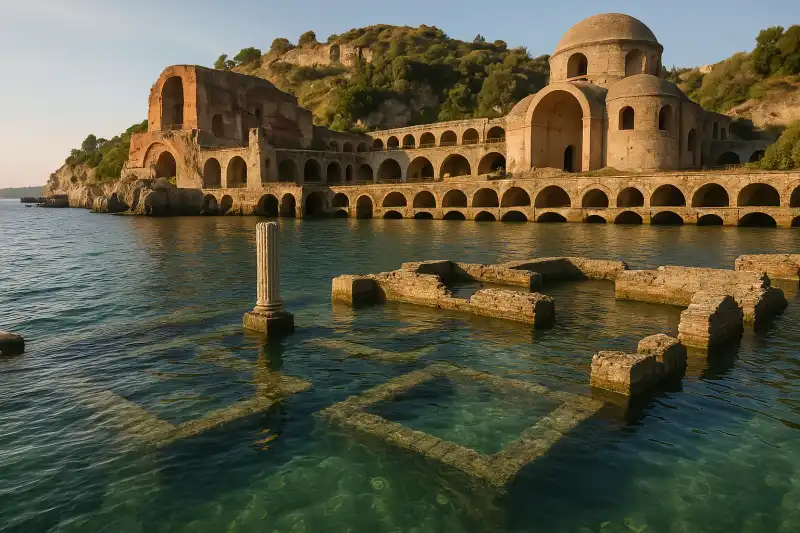
Baia Archaeological Park Guide 2026: Underwater Ruins, Thermal History, and Smart Visit Planning
RomanPlan a focused visit to Baia Archaeological Park near Naples with route strategy, what to prioritize...
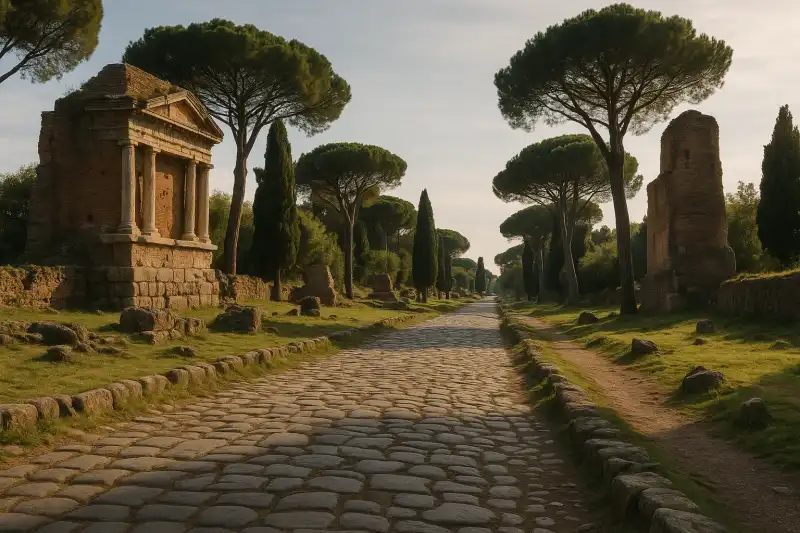
Appian Way Rome Guide 2026
RomanPlan a smart visit to the Appian Way with route choices, catacomb logistics, bike-vs-walk strategy, ...
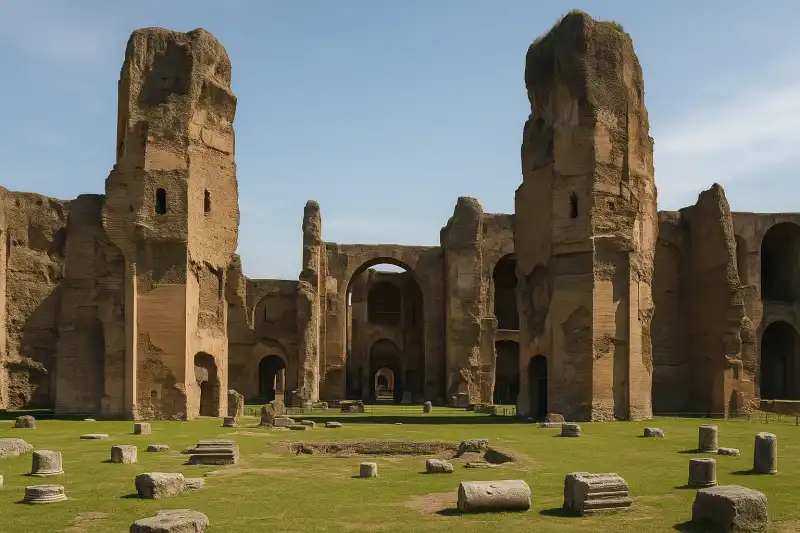
Baths of Caracalla Rome Guide 2026
RomanPlan your visit to the Baths of Caracalla with practical route advice, history context, timing, and ...