Quick Info
At a glance
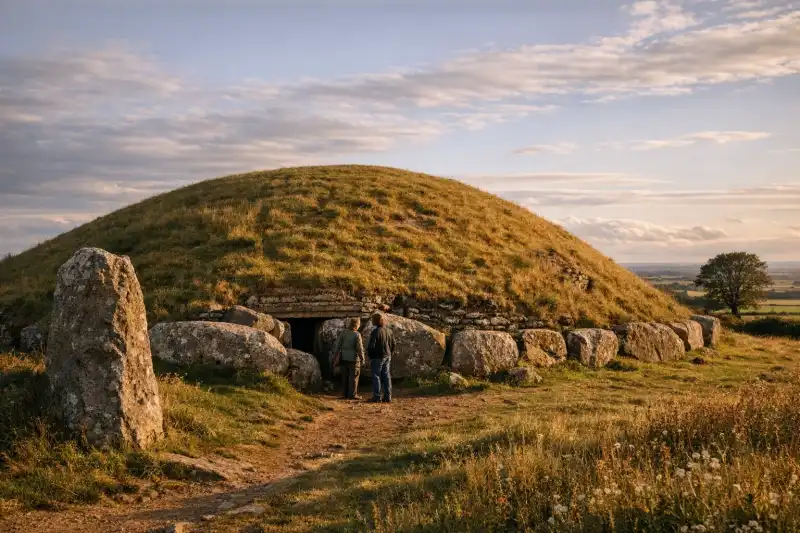
Dowth in Ireland stands on a low ridge above a bend of the River Boyne, where fields, hedgerows, and soft green slopes create a landscape that feels at once ordinary and deeply ancient. At first glance, the monument can seem quieter and less theatrical than some of its better-known neighbors in the Boyne Valley. Yet that understated character is part of its power. This is a place where the age of the earth feels close to the surface, where every rise in the mound and every decorated stone hints at a ceremonial world that flourished more than five thousand years ago.
Part of the wider Brú na Bóinne complex in County Meath, Dowth belongs to one of Europe’s most important concentrations of prehistoric monuments. Visitors often arrive already familiar with Newgrange, but Dowth offers a different mood: less polished, less crowded, and often more contemplative. Here the emphasis is on atmosphere as much as architecture. You approach not only a burial mound, but a carefully designed ritual space created by Neolithic builders with a striking awareness of terrain, light, and stone. Whether you are interested in archaeology, mythology, landscape photography, or simply a memorable day trip from Dublin, Dowth rewards patient attention. It is a monument that reveals itself gradually, through its carvings, its alignments, and the broad valley views that connect it to the surrounding sacred landscape.
History
Neolithic origins
Dowth was built in the late Neolithic period, probably around 3200 BCE, placing it broadly in the same era as the other great passage tombs of Brú na Bóinne. By the time its builders raised the mound, prehistoric communities in the Boyne Valley had already developed remarkable skill in organizing labor, moving huge stones, and shaping ceremonial landscapes. Dowth was not an isolated monument. It formed part of a wider ritual zone whose tombs, enclosures, and routeways suggest long-term planning and social coordination.
The mound itself was constructed from layers of earth and stone and encircled by kerbstones, some of which bear megalithic art. Inside, passages led to chambers where human remains were placed, likely along with offerings and objects of symbolic meaning. Archaeologists generally understand passage tombs not simply as graves, but as complex ritual monuments tied to memory, ancestor veneration, and cosmological ideas. At Dowth, as elsewhere in the Boyne Valley, the relationship between built form and the movement of the sun appears to have been significant. The monument’s orientation has often been linked with winter solstice sunset, reinforcing the idea that these structures engaged with cycles of darkness and return.
Ritual use and prehistoric significance
For centuries after its construction, Dowth likely remained a meaningful place in local ritual life. Passage tombs were durable monuments, but they were also active settings where communities gathered, commemorated the dead, and perhaps marked seasonal events. Human cremated remains found within the chambers indicate funerary use, though burial was only one aspect of the site’s importance.
The decorated stones at Dowth connect it to the visual language of Irish Neolithic art. Spirals, circles, arcs, and abstract motifs carved into stone surfaces are not decorative in any modern sense; they seem to belong to a symbolic system that remains only partly understood. Some scholars interpret these motifs as references to movement, celestial cycles, or altered states associated with ritual. Others stress that the carvings may have worked through placement and experience: seen by torchlight, touched in darkness, or encountered at threshold points within the monument.
Over time, the Boyne Valley accumulated layer upon layer of sacred and political meaning. Even after the original builders were long gone, the great mounds would have remained conspicuous landmarks in the landscape, inviting stories and reinterpretation by later communities.
Medieval legends and later memory
By the early medieval period, Dowth had entered Irish legend. In medieval literature, it appears under names associated with darkness and interrupted sunlight, stories that likely preserve echoes of the monument’s winter solar associations. One tale tells of a king who tried to halt the sun in order to complete the construction of a great tower or monument, only for the effort to fail catastrophically. Such stories are not historical records, but they are valuable evidence of how later societies understood prehistoric sites: as places of supernatural force, ancient kingship, and cosmic disturbance.
These legends helped ensure that Dowth was never entirely forgotten. While the practical meanings attached to the tomb had changed, the mound still commanded attention. In a countryside shaped by farming and settlement, it remained a visible reminder of a remote antiquity beyond ordinary explanation.
Excavation and modern archaeology
Dowth entered modern archaeological study in the nineteenth century, though early investigations did not always meet the standards now expected in heritage management. Excavations in the 1840s opened parts of the monument and revealed chambers, carvings, and cremated remains, but they also disturbed original contexts. Like many major prehistoric sites in Europe, Dowth has had to endure both the benefits and the damage of early antiquarian curiosity.
Later archaeological work placed Dowth within the broader significance of Brú na Bóinne, now recognized as a UNESCO World Heritage landscape. Research on the site has helped scholars refine understandings of Neolithic monument construction, ceremonial practice, and megalithic art. Even so, Dowth remains in some ways more enigmatic than Newgrange, partly because it has received less public interpretation and partly because prehistoric symbolism resists certainty.
Today, Dowth stands at an intersection of archaeology, conservation, and public heritage. It is appreciated not only as a remarkable tomb, but as part of an interconnected sacred landscape in which topography, astronomy, and communal memory were woven together on a monumental scale.
Key Features
The first thing many visitors notice about Dowth is its mound: broad, grassy, and massive without appearing overly dramatic. Rather than soaring sharply from the ground, it sits with a kind of settled authority in the landscape, as if it has grown from the ridge itself. This visual integration matters. Passage tomb builders in Ireland often chose positions that linked monument and horizon, and at Dowth the views over the Boyne Valley are central to the experience. The river’s broad corridor, the open fields, and the distant slopes create a setting in which the monument feels connected to a larger ceremonial geography.
Around the base of the mound are kerbstones, some of them carved with megalithic motifs. These stones are among Dowth’s most compelling details. Unlike later figurative art, the carvings here are abstract: circles, spirals, radial forms, and sweeping lines cut into the stone surface. Their meanings remain debated, but their effect is immediate. They suggest intention, repetition, and coded significance. Seen up close, the carvings also reveal the physical labor involved in creating them with simple tools on hard stone. They are not casual marks; they are deliberate statements made for a ritual setting.
Dowth contains two known passages and chambers, commonly referred to as western and northern components. This internal complexity distinguishes it from simpler mound structures and hints at a more elaborate ceremonial design. The chambers themselves, formed with upright stones and corbelled techniques, belong to the sophisticated architectural tradition of Irish passage tombs. Even when interior access is limited, understanding that such spaces lie within the mound changes how one sees the monument from outside. It is not simply a hill of earth, but a constructed container of movement, darkness, and revelation.
One of the site’s most discussed features is its relationship with the winter solstice. While Newgrange is famous for the sunrise illumination of its chamber, Dowth has long been associated with sunset around the solstice period. This gives the site a distinctive symbolic identity. The dying light of the year, touching the western passage, would have resonated strongly in a tomb associated with ancestors and cyclical renewal. Whether you visit in midwinter or another season, the awareness of this alignment adds depth to the monument. It speaks to a Neolithic worldview in which architecture was inseparable from timekeeping and celestial observation.
The quieter atmosphere of Dowth is also one of its defining features. Because it is less heavily visited than some nearby sites, the experience can feel more spacious and reflective. You are often more aware of wind, birdsong, and the texture of the land. That sensory setting matters when visiting an ancient ceremonial site. The monument was meant to be approached, circled, and encountered within a living landscape, not isolated from it. Dowth still allows a glimpse of that relationship.
Another notable aspect is the way the site embodies the scale of Brú na Bóinne without overwhelming first-time visitors. At major prehistoric complexes, it can sometimes be difficult to grasp how individual monuments relate to one another. Dowth makes that connection easier. From its position, you sense the valley as a network rather than a single destination. The tomb becomes part of a broader conversation with Newgrange, Knowth, and the surrounding archaeological remains.
For photographers, the mound is especially rewarding in low light, when the slope of the earth and the relief of the stones become more pronounced. For historians and archaeology enthusiasts, the appeal lies in the layers of evidence: construction technique, funerary use, symbolic carving, and later folklore. For general travelers, the most memorable feature may simply be the combination of scale and serenity. Dowth feels ancient in a direct, unforced way. It does not need spectacle to make its impression.
Getting There
Dowth is in County Meath, roughly 45 to 60 minutes by car from Dublin, depending on traffic and your starting point. Driving is the simplest option, especially if you want to combine the visit with other Boyne Valley sites. From central Dublin, a rental car can cost from about €35 to €70 per day, while fuel for the round trip is usually modest. Parking arrangements can vary by season and site management, so it is wise to check current local guidance before arrival.
Public transport is possible, though less convenient. One common approach is to travel from Dublin to Drogheda by train or regional bus, then continue by taxi to Dowth. Train fares from Dublin to Drogheda often start around €10 to €18 each way, depending on service and booking time. Buses can be similar or slightly cheaper, often in the €8 to €15 range. A taxi from Drogheda to Dowth may cost approximately €20 to €35 each way, so this option works best if shared.
Organized day tours from Dublin are often the easiest choice for visitors without a car. Many Boyne Valley tours focus on Newgrange and the wider Brú na Bóinne area, sometimes including additional stops such as the Hill of Tara or Monasterboice. Prices commonly range from €45 to €95 per person, depending on the itinerary and inclusions. Even if Dowth itself is not always the main advertised stop, tours centered on the Boyne Valley can provide useful access and context.
Because local access conditions and opening arrangements can change, confirm the latest visitor information before setting out. Comfortable walking shoes are recommended, as the ground can be uneven and muddy after rain.
When to Visit
Dowth can be visited year-round, but the best season depends on what you value most. Late spring and summer offer the easiest conditions for walking and photography. From May through September, the Boyne Valley is at its greenest, daylight lasts longer, and temperatures are usually mild. This is the most comfortable time for combining Dowth with other regional sites in a single day. Summer also tends to bring more tourists to the broader area, though Dowth itself often remains calmer than better-known monuments.
Autumn is an especially attractive time for travelers who prefer quieter landscapes. The softer light suits the mound and carved stones beautifully, and cooler temperatures make walking more pleasant. Fields in the valley take on muted gold and green tones, giving the site a reflective mood that matches its ancient character.
Winter has a special resonance because of Dowth’s association with the winter solstice sunset. While access to specific experiences may be limited and the weather can be cold, damp, and unpredictable, this season carries strong symbolic appeal. Short days and low-angle light make it easier to imagine how important the sun’s return may have been to Neolithic communities. If you visit in winter, bring waterproof layers and sturdy footwear, as paths and grassy areas can be slippery.
Early mornings and late afternoons are generally the best times of day for atmosphere and photography. Midday light can flatten the earthworks and carvings, while lower light brings out texture in the stones and the surrounding landscape. Whenever you go, check weather forecasts in advance. Irish conditions can shift quickly, and a dry, bright morning can turn windy or wet by afternoon. A flexible schedule helps.
| Quick Facts | Details |
|---|---|
| Location | County Meath, Ireland |
| Region | Leinster |
| Cultural Landscape | Brú na Bóinne / Boyne Valley |
| Type | Neolithic passage tomb |
| Date | c. 3200 BCE |
| Civilization | Neolithic communities of the Boyne Valley |
| Known For | Passage tomb architecture, megalithic art, winter solstice associations |
| UNESCO Context | Part of the Brú na Bóinne World Heritage landscape |
| Nearest City | Drogheda |
| Typical Visit Length | 45 minutes to 1.5 hours |
| Best For | Archaeology, landscape views, prehistoric Ireland, quieter heritage visits |
| Access Note | Check current visitor arrangements before travel |
Guided tours: worth it?
A guide can be genuinely useful at Dowth, especially if you want help with transport, timing, tickets, or understanding a large site without losing half the day to logistics.
Best for
- Travelers who want transport, timing, or entry logistics handled
- Short visits where a planned route saves time
When to go self-guided
Go independently if you already have transport and tickets sorted, enjoy moving at your own pace, and are comfortable checking the latest official rules before you arrive.
What I’d avoid
Skip paid tours that bundle unrelated stops you do not actually want. The best option should either save meaningful planning time or add historical context you would miss on your own.
Boyne Valley and Newgrange Day Tours
Useful when: you want to compare guided formats before deciding
Brú na Bóinne and County Meath Tours
Useful when: you want to compare guided formats before deciding
Dublin to Newgrange and Hill of Tara Tours
Useful when: you want to compare guided formats before deciding
Some tour links are affiliate links, which may earn Ancient Travel a small commission at no extra cost to you. I try to surface options that make practical sense for the site—not just anything bookable.
Frequently Asked Questions
What is Dowth?
Dowth is a large Neolithic passage tomb in County Meath, Ireland, forming part of the Brú na Bóinne archaeological landscape in the Boyne Valley.
Is Dowth part of the same complex as Newgrange and Knowth?
Yes. Dowth is one of the three principal passage tombs of Brú na Bóinne, alongside Newgrange and Knowth, though it is less visited and feels quieter.
Can you go inside Dowth?
Access conditions can vary, and entry to the interior is not always available in the same way as at Newgrange. Check the latest visitor information before planning your visit.
How do you get to Dowth from Dublin?
The easiest way is by car or organized tour from Dublin. Public transport usually involves a bus or train toward Drogheda or County Meath followed by a taxi.
How much time should you spend at Dowth?
Most visitors spend 45 minutes to 1.5 hours at Dowth, though those interested in archaeology, photography, or walking the surrounding landscape may stay longer.
What is special about Dowth?
Dowth is notable for its ancient passage tomb architecture, carved megalithic stones, strong links to solstice alignments, and its atmospheric setting above the River Boyne.
Nearby Ancient Sites
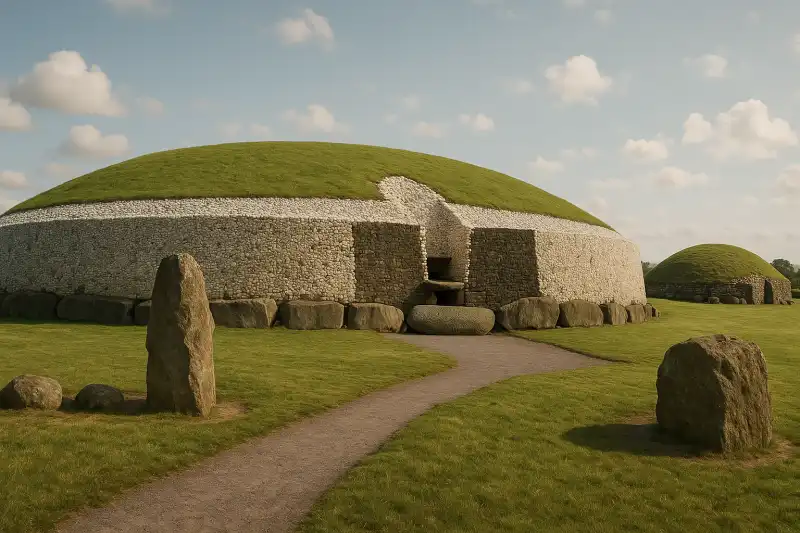
Boyne Valley Passage Tombs Travel Guide 2026: Newgrange, Knowth, and Dowth Visit Strategy
Neolithic IrelandPlan your first Boyne Valley passage tombs visit with practical timing, Brú na Bóinne access flow, a...
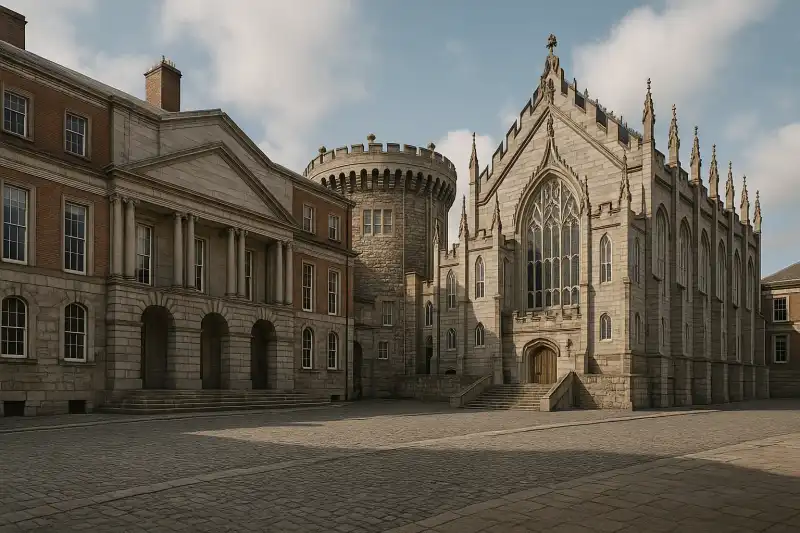
Dublin Castle Travel Guide 2026: State Apartments, Viking Layers, and City-Center Route
Medieval and Early Modern IrelandPlan a first visit to Dublin Castle with practical timing, ticket strategy, and clear context on the...
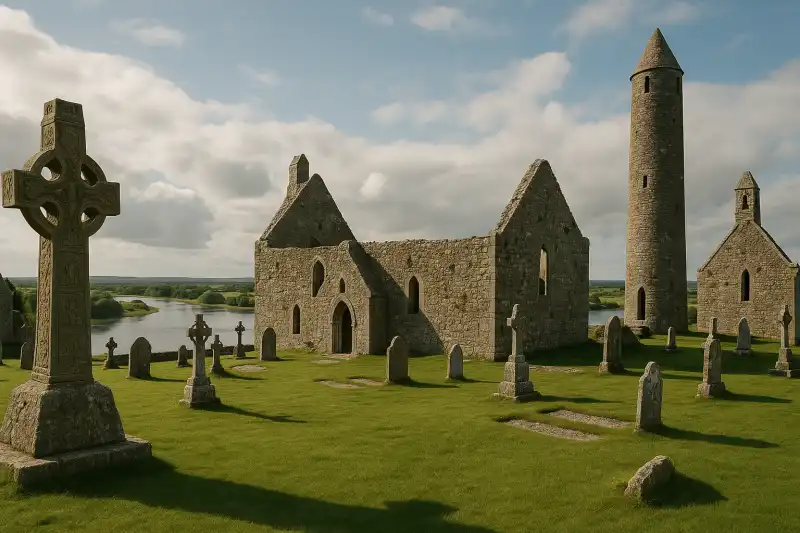
Clonmacnoise Travel Guide 2026: Monastic Ruins, High Crosses, and River Shannon Context
Early Medieval IrelandPlan a first visit to Clonmacnoise with practical timing, monastic-site context, and clear route adv...