Quick Info
At a glance
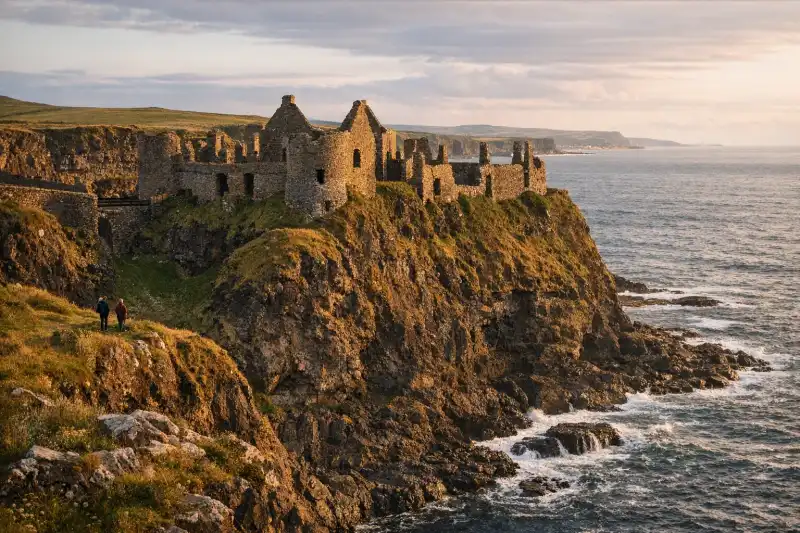
Dunluce Castle in Ireland rises from a jagged basalt headland as if the land itself had thrust up a fortress to challenge the Atlantic. Few historic places on the island combine architecture, legend, and landscape so completely. Waves hammer the cliffs below, seabirds wheel over the sea, and the broken walls hold their ground against weather that seems determined to erase them. Even before you cross the approach to the ruins, the setting feels theatrical: a stone stronghold suspended between green fields and dark water, where history appears less like a chapter in a book and more like something still unfolding in the salt air.
For many travelers, Dunluce Castle is one of the defining images of the north coast. It is not simply a medieval ruin, but a site where political rivalry, family ambition, maritime trade, and local folklore all left their mark. The castle occupies a naturally defensive outcrop near today’s Causeway Coast route, and that strategic position once mattered as much as its beauty does now. From here, powerful families could watch the sea lanes, defend their territory, and project authority across the region. For modern visitors, the same vantage point offers some of the most memorable coastal views in Ireland, with the Atlantic stretching outward and the fractured geometry of the ruins creating a dramatic silhouette. Dunluce is both romantic and severe, a place where history has survived in fragments but atmosphere remains whole.
History
Early fortification and the de Burgh era
The rocky promontory at Dunluce was almost made to be fortified. Long before the castle became a famous landmark, this section of coastline offered a naturally defensible site, protected on most sides by steep drops to the sea. The first major stone castle here is generally associated with Richard de Burgh, the Anglo-Norman Earl of Ulster, in the 13th century. Like many Norman strongholds, it was built to assert control over land and movement, not merely to provide shelter. In a frontier landscape where allegiances shifted and military pressure was constant, a clifftop fortress sent a clear message.
This early phase likely established the essential logic of the place: a gatehouse securing the landward side, enclosed spaces arranged on the summit, and reliance on the natural cliff edges as part of the castle’s defense. Yet power on the north coast never remained static for long. Anglo-Norman authority fluctuated, and Gaelic families would increasingly shape the region’s political story. Dunluce, as a stronghold, changed hands in line with those broader changes.
The MacQuillans and regional struggle
By the late medieval period, Dunluce Castle had become closely associated with the MacQuillans, a family that dominated parts of the Route, as this district of north Antrim was known. Their hold over the castle reflected the fragmented nature of lordship in medieval Ulster, where local dynasties balanced warfare, alliances, and competition for influence. Dunluce’s location allowed its rulers to command attention both from inland territories and from the sea.
The MacQuillans did not enjoy unchallenged control. The north coast was contested ground, and rival families sought both land and legitimacy. Dunluce therefore became part of a larger political struggle rather than an isolated fortress. Its story from this era is one of regional power politics, with the castle serving as an anchor for authority in an uncertain landscape.
The MacDonnells and the height of Dunluce
The most famous chapter in Dunluce Castle’s history began when the MacDonnells, a branch of the powerful Clan Donald with connections to the western Scottish isles, took control in the 16th century. Sorley Boy MacDonnell is the key figure in this transformation. Through persistence, military skill, and shrewd adaptation to changing circumstances, he established MacDonnell power in Antrim and made Dunluce one of the family’s chief seats.
Under the MacDonnells, the castle entered its grandest period. Existing structures were adapted and expanded, and the site became more than a defensive refuge. It served as a noble residence and symbol of prestige. The family navigated a complex political world involving Gaelic traditions, Scottish links, English crown authority, and local rivalries. Dunluce stood at the center of that web.
One of the most remarkable developments associated with this period was the settlement near the castle, often described as an early modern planned town. Archaeological work has revealed paved streets and traces of an urban community established under MacDonnell patronage. This suggests that Dunluce was not merely a lonely fortress on a cliff, but the focal point of a wider economic and social landscape. Trade, craft activity, and domestic life all clustered around aristocratic power.
Decline, collapse, and abandonment
Dunluce’s most enduring legends often concern dramatic destruction, including the famous tale that part of the castle kitchen collapsed into the sea. While the details are often retold with embellishment, coastal erosion and structural instability were certainly real issues at a site exposed to relentless Atlantic weather. The same cliff-edge position that made Dunluce so striking also made it vulnerable.
The 17th century brought further change. Political upheaval across Ireland and Britain, shifting patterns of power, and the fortunes of the MacDonnells all affected the castle’s future. By the late 1600s, the family’s principal residence moved elsewhere, and Dunluce began to lose its role as an active noble household. Once a residence ceases to be maintained, decline can be swift, especially in such an exposed location. Roofs disappear, timber decays, masonry weakens, and weather takes over.
Over time, the castle became a ruin, though never an anonymous one. Artists, antiquarians, and travelers were drawn to it for precisely the qualities that still captivate visitors today: the dramatic setting, the sense of lost power, and the visible meeting of human construction with raw nature. Modern conservation has stabilized the remains and opened them to the public, preserving Dunluce as one of the most evocative historic sites on the island.
Key Features
Dunluce Castle is defined first by its setting. The ruin occupies a rocky outcrop almost detached from the mainland, linked by a narrow approach that immediately gives the visitor a sense of entering somewhere both strategic and precarious. This geography is not decorative background; it is the foundation of the site’s identity. The cliffs fall steeply to the Atlantic, and the sea is present in every view, every gust of wind, and every echo from below. Even on a calm day, the castle feels exposed to forces much larger than itself.
The entrance sequence is one of the most memorable parts of the visit. As you move toward the gatehouse, the castle seems to gather itself from a scatter of walls into a coherent stronghold. Defensive design becomes easy to read here. The narrow access point could be controlled, and the thickness of surviving masonry still conveys the seriousness of the site’s military purpose. Yet once inside, the castle reveals more than fortification. The internal remains point to domestic and ceremonial life as well: halls, chambers, service areas, and circulation routes that remind you this was also a residence of status.
One of the most photographed elements is the bridge-like approach over the chasm separating the headland from the mainland. It embodies the castle’s dual character. To cross it is to understand both the practical medieval need for defense and the modern emotional appeal of the ruin. The crossing is short, but it sharpens the transition from ordinary landscape to enclosed stronghold. It is easy to imagine how impressive this approach would have been to allies, rivals, or tenants arriving in earlier centuries.
Within the ruins, visitors often notice how the surviving walls frame the sea. Windows, doorways, and broken upper levels create shifting compositions of stone and horizon. These are among the site’s greatest visual pleasures. Dunluce is not a heavily restored castle where interiors are neatly re-created; it is a place where absence is part of the experience. Missing roofs and incomplete walls allow light, weather, and ocean views to enter the architecture. The result is atmospheric rather than polished, and especially appealing to travelers who prefer authenticity over reconstruction.
The kitchen area, tied to the famous collapse legend, is another feature that captures attention. Whether visitors arrive already knowing the story or hear it on site, this part of the castle embodies the precarious relationship between the structure and the cliff edge. Tales of disaster persist because they fit the place so well. Dunluce seems like the kind of castle where a storm could rewrite the map overnight.
Another important aspect of the site is what lies beyond the visible core. Archaeological investigation has revealed the remains of the town associated with the castle, giving a fuller picture of Dunluce as a center of lordship rather than an isolated ruin. This context deepens the experience. The castle was supported by workers, traders, households, and local networks, and its power extended into a living community.
Finally, Dunluce’s views are not just scenic extras. Looking east and west along the Causeway Coast helps explain why the site mattered. It watched over movement along shore and sea, and today those same panoramas connect the castle to the wider landscape of north Antrim. In practical terms, this also makes Dunluce a superb place for photography. Early or late light can turn the stone warm against a steel-blue sea, while mist and cloud often add drama rather than obscuring it. Many castles are historically important; few are so visually complete in their ruin.
Getting There
Dunluce Castle is easiest to reach by car. It sits off the A2 Causeway Coastal Route between Portrush and Bushmills, one of the most scenic drives in Ireland. From Belfast, the drive usually takes around 1.5 to 2 hours depending on traffic, while from Derry/Londonderry it is often about 1.25 to 1.5 hours. If you are renting a car, expect fuel costs of roughly £15 to £30 for a return journey from Belfast, depending on vehicle type and current prices. Parking is generally available at the site or nearby.
Public transport is possible, though less flexible. The nearest rail hub for many visitors is Coleraine, reached by train from Belfast. Standard fares can vary, but a one-way journey commonly falls in the roughly £15 to £20 range if bought near travel time, sometimes less with advance booking. From Coleraine, local buses serve Portrush, Bushmills, and sections of the Causeway Coast. Depending on route and operator, a local bus fare is often around £2 to £6. From Portrush or Bushmills, a taxi to Dunluce Castle may cost about £10 to £20.
Many travelers choose organized day tours from Belfast or Dublin that combine Dunluce Castle with the Giant’s Causeway and other coastal stops. These remove the hassle of connections and usually offer the best value if you want to see several places in one day. Expect typical full-day tour prices from Belfast to start around £35 to £70, with Dublin departures often higher. Always check current opening hours before setting out, especially in winter.
When to Visit
Dunluce Castle can be rewarding in every season, but your experience will vary dramatically with weather and daylight. Late spring through early autumn, especially May to September, offers the easiest conditions for most visitors. Days are longer, the surrounding grass is vivid green, and coastal light can be superb for photography. Summer also brings the best chance of milder temperatures, though “mild” on this coast still often means wind, cloud, and quickly shifting conditions. The downside is busier parking, more tour groups, and less solitude at the main viewpoints.
Spring and early autumn are often the sweet spot. In April, May, September, and early October, you may get a good mix of manageable crowds, decent daylight, and atmospheric skies. These months are particularly appealing if you want photos with texture and mood rather than flat midsummer brightness. Bring layers regardless of forecast: windproof outerwear matters more here than many first-time visitors expect.
Winter visits can be striking if you are prepared. The castle looks especially dramatic under heavy cloud or low sun, and the reduced visitor numbers create a quieter, more reflective mood. However, shorter opening hours, colder winds, and occasional weather disruption make planning more important. Rain can arrive quickly, and exposed viewpoints can feel severe.
For the best experience, aim for a clear or partly cloudy morning or late afternoon. Midday can work well, but lower-angle light tends to bring out the contours of the masonry and the drama of the cliffs. If your itinerary allows, pair the visit with other nearby coast stops and keep your schedule flexible enough to adapt to the weather.
| Quick Facts | Details |
|---|---|
| Location | County Antrim, north coast of Ireland |
| Nearest town | Portrush |
| Historical period | 13th century origins, expanded in the 16th–17th centuries |
| Best known for | Cliff-edge ruins, MacDonnell history, dramatic Atlantic views |
| Typical visit length | 45 minutes to 1.5 hours |
| Best paired with | Giant’s Causeway, Bushmills, Causeway Coastal Route |
| Access style | Managed heritage site with ticketed entry |
| Ideal visitors | History lovers, photographers, coastal road-trippers |
| Main caution | Strong winds and wet surfaces in exposed weather |
| Photography tip | Visit in early morning or late afternoon for softer light and fewer crowds |
Dunluce Castle endures because it offers more than a checklist stop. It is historically important, visually unforgettable, and emotionally immediate in a way many ruins are not. You do not need to know every dynasty or date to feel the force of the place. The cliffs, the sea, the fractured walls, and the stories attached to them do much of the work. Still, the more you understand its layers, the richer the visit becomes. This was once a center of power on a contested coast, then a fading noble residence, and finally a ruin that became more famous in decay than it may ever have been in full strength.
That transformation is part of its appeal. Dunluce has not been frozen into an overly neat monument. It remains visibly shaped by time, weather, and loss, which makes it feel honest. For travelers exploring northern Ireland’s coast, it is one of the places most likely to linger in memory after the trip ends. The wind may be sharp, the weather uncertain, and the visit relatively brief, but the impression is lasting. On this headland above the Atlantic, Ireland’s medieval past still seems close enough to hear in the surf.
Guided tours: worth it?
Most travelers can visit Dunluce Castle independently. Compare a tour only if you want a tighter history-focused visit, easier logistics, or a guide who can answer questions on the spot.
Best for
- Short visits where a planned route saves time
When to go self-guided
Go independently if you prefer setting your own pace, reading as you go, and checking official hours or ticket rules directly before you arrive.
What I’d avoid
Skip paid tours that bundle unrelated stops you do not actually want. The best option should either save meaningful planning time or add historical context you would miss on your own.
Dunluce Castle tours
Useful when: you want to compare guided formats before deciding
Causeway Coast and Dunluce Castle tours
Useful when: you want to compare guided formats before deciding
Giant's Causeway and Dunluce Castle day tours
Useful when: you want to compare guided formats before deciding
Some tour links are affiliate links, which may earn Ancient Travel a small commission at no extra cost to you. I try to surface options that make practical sense for the site—not just anything bookable.
Frequently Asked Questions
Where is Dunluce Castle located?
Dunluce Castle stands on the north coast of County Antrim in Northern Ireland, between Portrush and Bushmills, overlooking the Atlantic Ocean.
Do you need a ticket to visit Dunluce Castle?
Yes, the main castle site is a managed heritage attraction and usually requires an admission ticket, though prices and opening times can vary by season.
How much time do you need at Dunluce Castle?
Most visitors spend 45 minutes to 1.5 hours exploring the ruins, viewpoints, and visitor interpretation, though photographers may want longer.
Is Dunluce Castle easy to reach without a car?
It is possible by combining train or bus to Portrush or Coleraine with local bus services or a taxi, but a car is the easiest option for most travelers.
What is Dunluce Castle famous for?
Dunluce Castle is famous for its spectacular cliff-edge setting, turbulent medieval history, links to the MacDonnells and O’Neills, and one of the most photogenic ruins in Ireland.
Can you visit Dunluce Castle in bad weather?
The site often remains open in unsettled weather, but strong winds and rain can affect comfort and occasionally access, so checking conditions before visiting is wise.
Nearby Ancient Sites
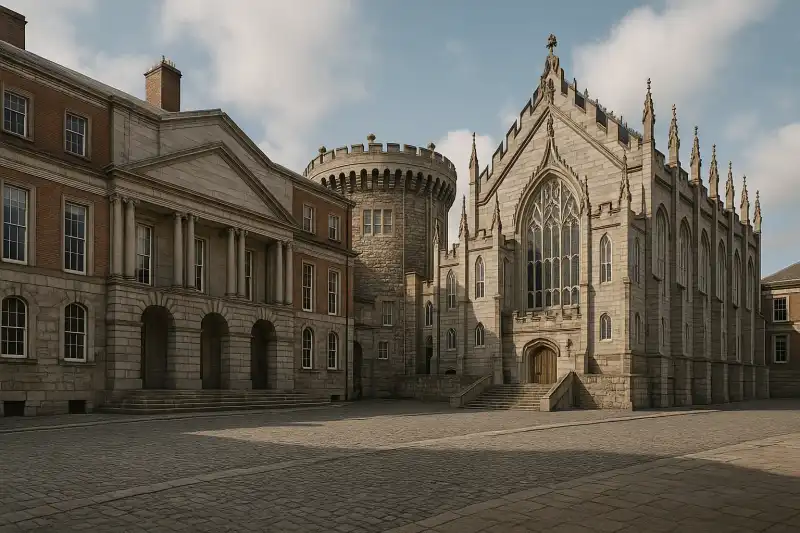
Dublin Castle Travel Guide 2026: State Apartments, Viking Layers, and City-Center Route
Medieval and Early Modern IrelandPlan a first visit to Dublin Castle with practical timing, ticket strategy, and clear context on the...
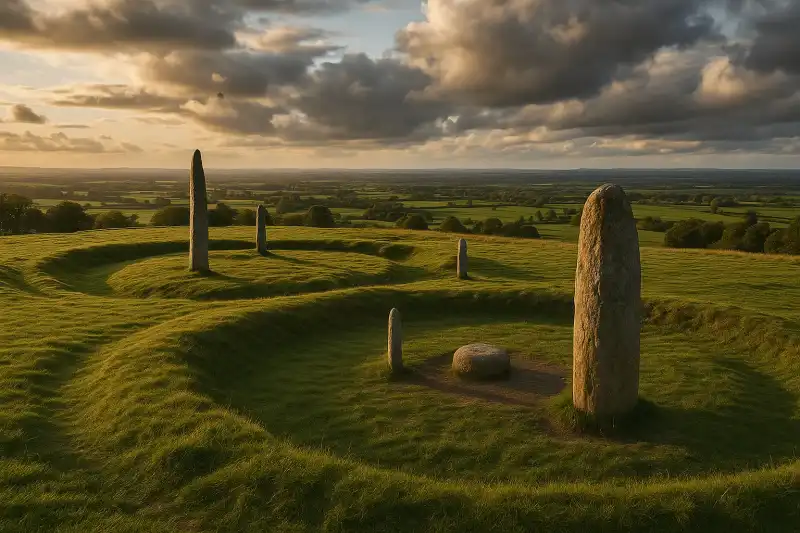
Hill of Tara Travel Guide 2026: Sacred Kingship Landscape, Site Highlights, and Meath Planning
Celtic IrelandPlan a first visit to the Hill of Tara with practical route tips, key myth-and-history context, and ...
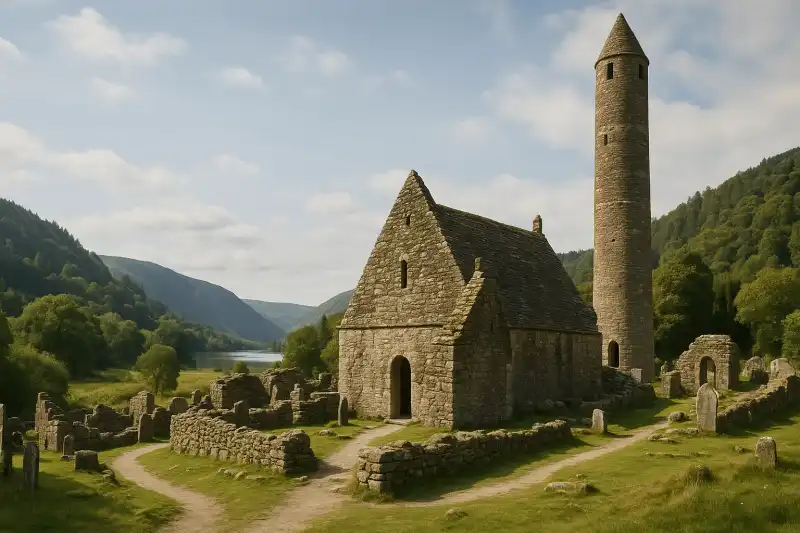
Glendalough Travel Guide 2026: Monastic Ruins, Lakes, and Wicklow Day-Trip Plan
Early Medieval IrelandPlan a clear first visit to Glendalough with route advice, monastic-site context, and practical timi...