Quick Info
At a glance
Emperor Augustus’s Villa (Capri) in Italy occupies one of the most evocative settings in the ancient Mediterranean: an island of cliffs, sea light, fragrant gardens, and sudden views across the Bay of Naples. Even before you reach the surviving remains, Capri encourages a kind of historical imagination. Narrow lanes open onto terraces suspended above brilliant water; sheer rock faces drop to coves that seem almost inaccessible; and every breeze carries a reminder that this was once not simply a resort island, but a place favored by the Roman elite. For Augustus, the first emperor, Capri represented both retreat and opportunity—a secure, beautiful, and symbolically powerful setting where nature and authority could meet.
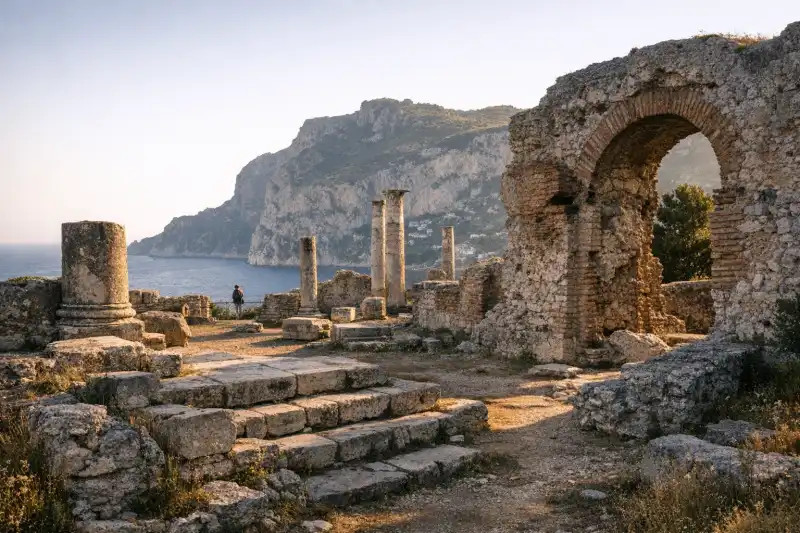
Today, the villa remains are fragmentary, and visitors should not expect a single intact palace rising dramatically from the cliffs. What survives is subtler than that: terraces, masonry, archaeological traces, and a historical landscape strongly connected with Augustus’s presence on the island. Yet that very incompleteness has its own appeal. Standing among the ruins, it becomes easier to imagine how Roman architecture once framed the sea, how imperial households moved through shaded porticoes, and how Capri’s position between mainland Italy and open water made it ideal for privacy without total isolation. A visit here is therefore less about monumental scale than atmosphere, context, and the early history of emperors shaping private space into political theater.
History
Capri Before the Emperors
Long before Augustus became associated with Capri, the island already held strategic and cultural value. Its dramatic geography gave it a natural defensibility, while its position in the Bay of Naples connected it to maritime networks running along the Campanian coast. Greek influence reached this region early, and later Roman expansion absorbed both the island and the surrounding coastal settlements into a larger political world centered on Rome.
By the late Republic, the Bay of Naples had become one of the preferred landscapes of elite villa culture. Roman aristocrats built residences around the coast at places like Baiae, Misenum, and along the shores opposite Capri. These villas were not merely holiday homes. They acted as social stages, intellectual retreats, and declarations of status. Architecture, gardens, water features, and commanding views all expressed a cultivated command over landscape. Capri, although more remote than some mainland sites, fit perfectly into this pattern.
Augustus and the Island
The connection between Augustus and Capri belongs to the formative period of the Roman Empire. Ancient sources record that Augustus developed a marked attachment to the island. According to the tradition preserved in Roman writing, he exchanged the larger island of Ischia for Capri with the Neapolitans, bringing Capri more directly into the sphere of imperial possession. Whether viewed as a pragmatic arrangement or an expression of personal preference, the story captures the emperor’s interest in the island’s special qualities.
Augustus, who carefully balanced public authority with carefully staged restraint, often sought residences that offered both seclusion and symbolic control. Capri suited this need. Far enough from Rome to provide distance from political pressure, yet close enough to remain linked to the heart of Italy, it was an imperial refuge with strategic advantages. The villa associated with him was likely part of a broader pattern of development on the island rather than an isolated structure. Roman villas commonly expanded in phases, incorporating terraces, service areas, bath facilities, and reception spaces as needs changed.
Although direct surviving remains are incomplete, the site traditionally identified as Augustus’s villa reflects the broader architectural logic of elite Roman coastal residences. Such villas exploited difficult terrain through retaining walls and stepped construction, turning cliffside topography into a sequence of dramatic viewpoints. For Augustus, whose political image depended on blending moderation with supremacy, a Capri residence would have expressed refinement, order, and privileged access to one of Italy’s most beautiful environments.
From Augustus to Later Imperial Capri
Capri’s imperial importance did not end with Augustus. The island became even more closely tied to the Roman court under his successor Tiberius, who famously spent extended periods there and developed several villas across the island. This later concentration of imperial residence sometimes overshadows Augustus’s earlier role, but in many ways Augustus established the precedent. He was the emperor who recognized Capri’s potential as an imperial landscape.
As later emperors and members of the elite adapted and reused structures, architectural layers likely shifted. Ancient villas were not static monuments; they evolved as tastes, technologies, and practical requirements changed. The remains visitors see today therefore belong to a history of construction, modification, partial decay, and rediscovery rather than to a single frozen moment in the Augustan age.
Decline, Survival, and Rediscovery
With the decline of the Western Roman Empire and the transformation of settlement patterns in late antiquity and the medieval period, many Roman villas on Capri fell into ruin. Valuable materials were frequently quarried away for reuse elsewhere. Earthquakes, weather, vegetation, and centuries of rebuilding altered the island’s ancient fabric. Coastal villas were especially vulnerable because their retaining systems and exposed positions required continued maintenance.
Modern archaeological interest in Capri revived attention to these remains. Scholars, travelers, and local historians worked to identify ancient structures, compare surviving masonry, and relate topography to literary descriptions. In many cases, certainty is impossible. The term “Emperor Augustus’s Villa” reflects a strong traditional attribution rather than a perfectly preserved and fully documented palace. Still, the site remains historically meaningful because it captures a genuine imperial connection, an early chapter in Capri’s development as a place of Roman power, luxury, and retreat.
Key Features
What makes Emperor Augustus’s Villa (Capri) compelling is not a single monumental façade, but the interplay between archaeological trace and extraordinary landscape. The site belongs to a class of ancient places where setting is itself a primary feature. Roman architects did not choose Capri despite its steep terrain; they chose it because of that terrain. Heights, ledges, and sea-facing plateaus offered precisely the kind of layered visual drama that imperial architecture could intensify.
One of the most striking aspects is the villa’s relationship to the island’s contours. Surviving walls and terraces suggest a structure carefully adapted to sloping ground. Rather than imposing a flat inland plan, Roman builders engineered retaining walls and platforms to create usable space while preserving commanding views. This approach was common in luxury coastal villas, but on Capri it acquired a special intensity. The result would have been a residence unfolding in levels, where each movement through the complex revealed another prospect over water, cliff, or distant shoreline.
The masonry remains, though fragmentary, invite attention to Roman construction techniques. In a site like this, even modest stretches of wall can reveal much about design ambition. Builders had to manage weight, drainage, and erosion while creating elegant living and reception spaces. The surviving archaeological fabric hints at a residence that balanced comfort with spectacle. Elite Roman villas often included porticoes for shaded walking, open terraces for dining or conversation, and carefully positioned rooms that framed the sea as if it were part of the architecture itself.
Another key feature is the villa’s role within a larger imperial landscape. Augustus’s Capri should not be imagined as a lone ruin detached from the island around it. Its significance grows when considered alongside paths, gardens, lookouts, and nearby later imperial sites. Capri’s built environment in the early empire was a network of villas and adapted natural spaces, linked to harbors, roads, and service infrastructure. The villa associated with Augustus therefore represents both a physical residence and a broader statement that the island had become a place fit for the ruler of Rome.
The views are essential to understanding the site. Looking out from the villa area, visitors grasp why Roman elites invested so heavily in coastal architecture. The Bay of Naples offers shifting color, changing weather, and a sense of expansive openness that contrasts with the enclosed spaces of urban life. For Augustus, whose public career unfolded amid civil war, constitutional experimentation, and the creation of a new imperial order, a residence with such horizons may have held more than aesthetic appeal. It projected calm, mastery, and distance from disorder.
There is also a quieter feature that many travelers appreciate only after arriving: the sense of incompletion. Unlike heavily reconstructed monuments, the villa encourages interpretation. You are not directed by a perfect surviving plan. Instead, you move through traces, alignments, and archaeological suggestions. This can make the experience especially rewarding for travelers interested in ancient architecture, because it calls for close observation. A terrace edge, a surviving foundation, or a change in ground level becomes evidence of how the villa once functioned.
Finally, the villa’s atmosphere is enhanced by Capri itself. Light reflecting off white stone, the sound of wind and distant boats, Mediterranean vegetation, and the island’s mixture of elegance and ruggedness all shape the experience. Even where masonry is sparse, the setting preserves the logic of Roman site selection. This is a place where politics, leisure, engineering, and natural beauty met—and where the first emperor of Rome chose to spend time away from the mainland.
Getting There
Reaching Emperor Augustus’s Villa (Capri) usually begins from Naples or Sorrento. From Naples, hydrofoils to Capri commonly take around 50 minutes and often cost roughly €25-€32 one way, while slower ferries may take longer but can sometimes be slightly cheaper. From Sorrento, crossings are shorter, often about 20-30 minutes, with fares frequently in the €22-€28 range depending on season and operator. In summer, services are frequent, but booking ahead is wise.
Once you arrive at Marina Grande on Capri, you have several options. A taxi ride toward Capri town is the fastest uphill choice and may cost around €20-€30 depending on distance and luggage. Public buses are cheaper, generally a few euros per person, but they can be crowded in peak season. The funicular from Marina Grande to Capri town is often the easiest first step, usually costing around €2.50-€3.00.
From Capri town, the final approach to the villa area is typically on foot through the island’s pedestrian streets and lanes. Walking allows you to appreciate the scale of the island and its dramatic topography, but comfortable shoes are essential. Expect some slopes, steps, and uneven paving. If you are combining this site with other historical viewpoints or villa remains, it is worth setting aside at least half a day on Capri. Guided island tours may simplify logistics, especially if you want transport connections organized from Naples.
When to Visit
The best times to visit Emperor Augustus’s Villa (Capri) are generally late April through early June and again in September through mid-October. During these shoulder-season months, the island usually offers warm but manageable weather, clearer walking conditions, and fewer crowds than the high summer peak. This matters on Capri because transport bottlenecks, packed streets, and midday heat can affect the quality of any archaeological visit.
Summer, especially July and August, brings the fullest ferry schedules and longest daylight hours, but also the highest visitor numbers and the most intense heat. If you come then, aim to arrive early in the morning and visit the villa before the island is busiest. Light is often beautiful at that time, and walking is far more pleasant. Carry water, a hat, and sunscreen, since exposed terraces and paths can become hot quickly.
Spring is especially attractive because the landscape feels fresh and the sea views are often exceptionally clear. Wildflowers and greenery soften the ruins and make the island feel alive in a way that complements the ancient setting. Early autumn has similar advantages, with warm sea air and slightly calmer conditions after the main holiday rush.
Winter visits are possible, and some travelers enjoy the island’s quieter atmosphere, but reduced ferry frequency and the possibility of rough seas can complicate plans. Some services and businesses may also operate on shorter schedules. If your priority is atmosphere and reflection rather than beach weather, winter can be rewarding, but flexibility is important. In all seasons, weekdays are usually better than weekends for a more relaxed experience.
| Quick Facts | Details |
|---|---|
| Site | Emperor Augustus’s Villa (Capri) |
| Location | Capri, Campania, Italy |
| Civilization | Roman |
| Period | Early Roman Empire |
| Traditional Date | 1st century BCE to early 1st century CE |
| Best For | Roman history, island archaeology, scenic viewpoints |
| Time Needed | 45 minutes to 1.5 hours at the site; longer with surrounding walks |
| Access | Via ferry/hydrofoil to Capri, then funicular, bus, taxi, and walking |
| Terrain | Slopes, steps, uneven surfaces |
| Best Season | Late spring and early autumn |
A visit to Emperor Augustus’s Villa (Capri) is ultimately about combining historical understanding with place. The remains may be partial, but the island preserves the deeper meaning of the site: this was an imperial retreat chosen not only for luxury, but for its commanding beauty and strategic seclusion. In Capri, the Roman world feels less like a distant abstraction and more like a lived landscape, one in which emperors sought privacy, prestige, and control amid some of the finest scenery in Italy. For travelers willing to look beyond the fragment and imagine the complete setting, the villa offers one of the most atmospheric encounters with early imperial Rome anywhere in the Bay of Naples.
Guided tours: worth it?
Most travelers can visit Emperor Augustus's Villa (Capri) independently. Compare a tour only if you want a tighter history-focused visit, easier logistics, or a guide who can answer questions on the spot.
Best for
- Short visits where a planned route saves time
When to go self-guided
Go independently if you prefer setting your own pace, reading as you go, and checking official hours or ticket rules directly before you arrive.
What I’d avoid
Skip paid tours that bundle unrelated stops you do not actually want. The best option should either save meaningful planning time or add historical context you would miss on your own.
Capri ancient history tours
Useful when: you want to compare guided formats before deciding
Capri island day trips
Useful when: transport or pickup logistics matter
Naples to Capri tours
Useful when: you want to compare guided formats before deciding
Some tour links are affiliate links, which may earn Ancient Travel a small commission at no extra cost to you. I try to surface options that make practical sense for the site—not just anything bookable.
Frequently Asked Questions
What is Emperor Augustus's Villa on Capri?
It refers to the remains traditionally linked to the first Roman emperor, Augustus, on the island of Capri, where he is known to have spent time and where imperial residences once stood.
Can you visit Emperor Augustus's Villa today?
You can visit the archaeological remains associated with the imperial villa area on Capri, though what survives is fragmentary rather than a fully preserved palace.
How do you reach the site?
Travel first by ferry or hydrofoil to Capri from Naples, Sorrento, or nearby ports, then continue on foot, by taxi, or by local bus depending on your starting point on the island.
How much time should you allow for a visit?
Most visitors should allow 45 minutes to 1.5 hours for the villa area itself, or longer if combining it with nearby viewpoints, the town center, and other historical spots on Capri.
Is Emperor Augustus's Villa suitable for all travelers?
Capri's steep streets, steps, and uneven archaeological surfaces can be challenging, so visitors with limited mobility should plan carefully and confirm current access conditions.
When is the best time to visit Capri for ancient sites?
Late spring and early autumn usually offer the best balance of pleasant weather, open transport links, and lighter crowds compared with the summer peak.
Nearby Ancient Sites
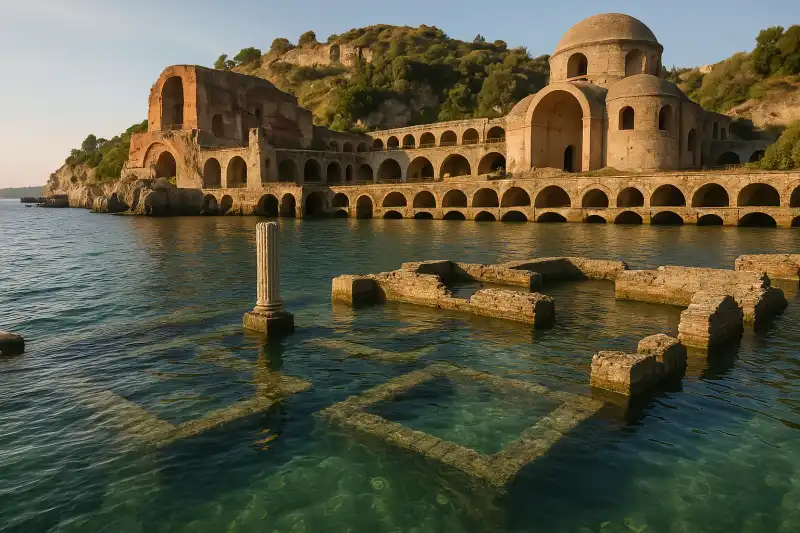
Baia Archaeological Park Guide 2026: Underwater Ruins, Thermal History, and Smart Visit Planning
RomanPlan a focused visit to Baia Archaeological Park near Naples with route strategy, what to prioritize...
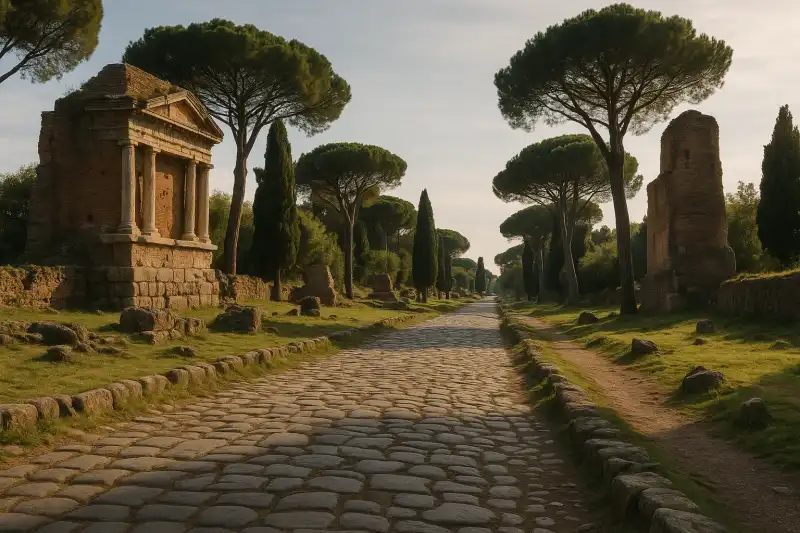
Appian Way Rome Guide 2026
RomanPlan a smart visit to the Appian Way with route choices, catacomb logistics, bike-vs-walk strategy, ...
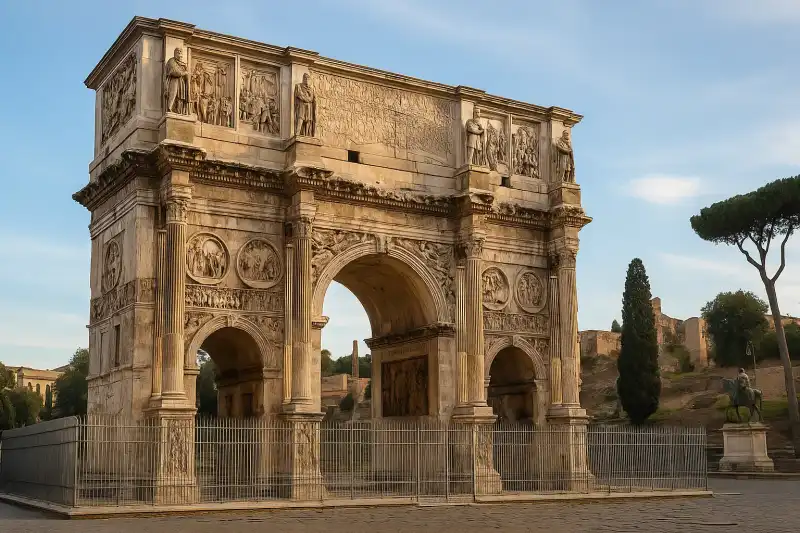
Arch of Constantine Rome: Triumph Over Maxentius Guide
Roman EmpireThe Arch of Constantine commemorates Constantine's 312 CE victory. Spolia details, best photo angles...
Baths of Caracalla Rome Guide 2026
RomanPlan your visit to the Baths of Caracalla with practical route advice, history context, timing, and ...