Quick Info
At a glance
The Etruscan Necropolis of Populonia in Italy is one of those rare archaeological places where landscape and history seem to explain each other at a glance. Above rises the old settlement of Populonia, the only major Etruscan city founded directly on the sea; below spreads the Gulf of Baratti, a wide curve of water whose calm surface once received ships carrying ore, iron, and trade goods across the Tyrrhenian world. Between them lies the necropolis, where tombs of different shapes and dates preserve the memory of a community that grew wealthy from maritime exchange and metallurgy.
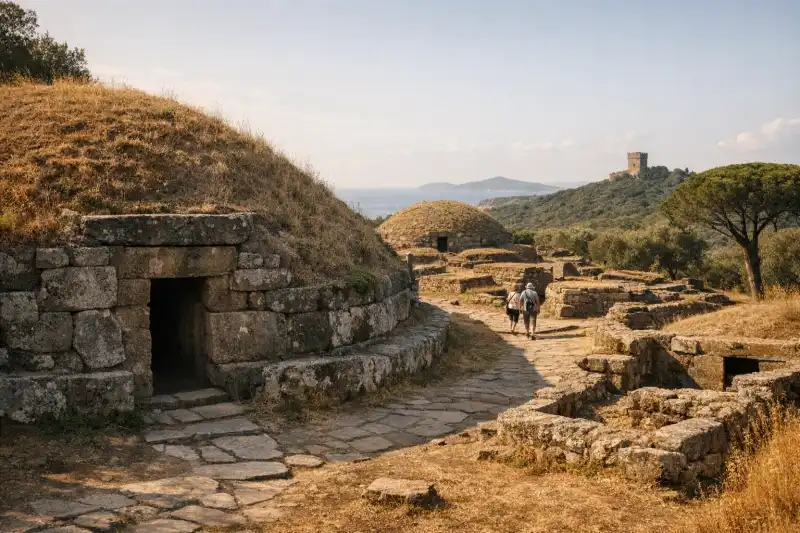
For many visitors, the first surprise is how open and atmospheric the site feels. This is not a confined museum ruin hemmed in by modern streets, but a broad archaeological landscape shaped by low hills, Mediterranean vegetation, and views toward the coast. The tombs emerge from the ground in different forms: great earthen mounds, stone-built burial chambers, and later tombs cut into the rock. Walking here, you do not just encounter individual monuments; you move through an entire funerary district that reflects centuries of change in Etruscan society.
Populonia was unusual in the ancient world. It was both a political center and a place tied closely to industry, especially the working of iron from nearby Elba. That connection gave the necropolis particular richness, because the people buried here belonged to a community deeply linked to trade, status display, and evolving ideas about the afterlife. Today, the site offers one of the clearest ways to experience Etruscan Tuscany beyond the better-known inland centers, with the added power of a coastal setting that still feels ancient.
History
Early Etruscan Populonia
The story of the Etruscan Necropolis of Populonia begins with the rise of Populonia itself, known in antiquity as Fufluna or Pupluna. By the 7th century BCE, the settlement had become an important Etruscan center on the Tuscan coast. Its location was strategic in every sense. It overlooked a natural harbor, faced the mineral-rich island of Elba, and stood within a network of maritime routes linking central Italy to Corsica, Sardinia, and the wider Mediterranean.
Unlike many Etruscan cities that developed inland, Populonia owed much of its importance to seaborne connections and to metal production. The nearby hills and coast provided access to materials and routes, while imported goods and artistic ideas could arrive by ship. As the city prospered, its elite invested in funerary monuments that projected wealth, lineage, and social standing. The earliest parts of the necropolis belong to this phase of expanding power, when burial architecture became a lasting sign of identity.
These early centuries saw the development of monumental tumulus tombs, large circular mounds covering built burial chambers. Such tombs were not merely practical places of interment; they were visible landmarks in the landscape. Their scale announced the prestige of the families within and reflected a wider Etruscan concern with commemoration and ancestral memory.
The Age of Monumental Tombs
Between the 7th and 5th centuries BCE, the necropolis around Populonia grew into a substantial funerary zone. This was the classic phase of the site’s most famous burials, especially in the area now known as the Necropolis of San Cerbone. Here, tombs vary in design, but several are especially striking for their monumentality. Earthen mounds were raised over stone drum-like bases or carefully built chambers, creating tombs that were meant to endure and to be seen.
The variety of forms speaks to social distinction and changing funerary customs. Some tombs were likely intended for prominent family groups across generations, while others may reflect narrower or later usage. Grave goods discovered during excavations showed the breadth of Populonia’s connections: ceramics, ornaments, weapons, and imported objects reveal a community engaged with the artistic and commercial currents of the Mediterranean.
This period also reflects the city’s confidence. The necropolis was not hidden away but set in relation to the living settlement, the coast, and the routes of movement around Baratti. As in other Etruscan centers, the city of the dead formed a kind of parallel world to the city of the living, ordered and structured according to social memory.
Hellenistic Change and Rock-Cut Burials
From the 4th century BCE onward, Etruscan society entered a more complex political era as pressure from other Italian powers increased and Roman expansion began reshaping the peninsula. At Populonia, burial customs changed as well. Later tombs are often more modest in outward appearance than the great earlier tumuli, and some are cut directly into the rock, creating a different visual language of funerary space.
These Hellenistic-era burials suggest both continuity and adaptation. Populonia remained an important place, still connected to trade and industry, but the character of elite display evolved. Tomb architecture became more varied, and the necropolis expanded in ways that reflected practical, cultural, and perhaps economic changes. Rather than one static cemetery, the site records centuries of adjustment in how people represented family status and honored the dead.
Archaeologists can trace these shifts through construction methods, funerary objects, and the organization of burial areas. The necropolis is therefore valuable not only because of its most dramatic monuments, but because it preserves long-term evidence for how an Etruscan community changed over time.
Roman Rule, Decline, and Rediscovery
By the late 3rd and 2nd centuries BCE, Roman power had become dominant in the region. Populonia continued to play a role under Roman influence, especially because of its industrial importance, but the Etruscan political world that had produced the earliest monumental tombs was fading. Burial traditions altered further, and over the centuries many parts of the necropolis fell out of use, were buried, or were affected by later activity.
One especially distinctive aspect of the broader Populonia area is its industrial legacy. Massive deposits of iron slag accumulated over time from metalworking, and these later layers obscured or transformed parts of the ancient landscape. For centuries, the necropolis was not understood in anything like its original form.
Modern rediscovery and excavation gradually brought the site back into view. Archaeological work in the 19th and 20th centuries identified and studied the tombs, revealing the richness of the cemetery and its importance within Etruscan studies. Conservation and interpretation have since made it possible for visitors to explore the necropolis as part of the Parco Archeologico di Baratti e Populonia, where the relationship between tombs, industry, settlement, and seascape can once again be appreciated.
Key Features
What makes the Etruscan Necropolis of Populonia memorable is not just a single tomb, but the way several different funerary landscapes coexist within one archaeological park. The best-known zone, San Cerbone, contains some of the site’s most iconic monuments. Here, large tumulus tombs rise as grassy or earth-covered forms edged with stone. Their rounded masses immediately distinguish them from later Roman cemeteries or Greek-style temple tombs. They feel ancient in a very direct way, almost like natural hills shaped by human intention.
Among these, the most imposing structures reveal the ambition of Populonia’s elite. Beneath the mound, burial chambers were carefully constructed from stone blocks, with passages and internal spaces meant to house the dead and the objects that accompanied them. Even when interiors are not fully accessible, the outer forms convey status and permanence. You can sense that these tombs were statements as much as graves.
The necropolis also includes a fascinating range of chamber tombs and aedicule-like monuments that show how burial practices diversified over time. Instead of one standardized plan, the site presents a spectrum of architectural solutions. Some tombs appear compact and severe, while others have a more ceremonial character. This variation helps visitors understand that Etruscan funerary culture was dynamic and socially expressive.
Another key feature is the setting near the Gulf of Baratti. Many ancient burial grounds are experienced as isolated ruins, but here the sea remains part of the story. From different points in the archaeological area, the surrounding landscape explains why Populonia mattered. The harbor, the coastal plain, the wooded slopes, and the distant island of Elba all form part of the historical backdrop. The necropolis was created by a maritime people who looked outward as well as inward.
The broader archaeological park deepens this experience by linking the necropolis to other remains. If you continue beyond the cemetery zones, you can connect the funerary monuments with the acropolis of Populonia and with traces of industrial activity associated with iron production. This is especially important because Populonia was not simply a ceremonial center; it was a working city whose wealth depended on extraction, smelting, and trade. The tombs gain meaning when seen in relation to that economy. The power commemorated in burial was grounded in real control of resources and exchange networks.
Visitors often notice how accessible the architecture feels at ground level. Rather than gazing only from a platform or behind barriers, you follow paths among the tombs, seeing them in changing light and from different angles. Mediterranean shrubs, pines, and open clearings create a rhythm of shade and exposure, while the forms of the tombs emerge gradually. This movement is part of the appeal. The site rewards slow walking, because each turn reveals another variation in construction or another view toward the sea.
The archaeological interpretation on site also matters. Even for travelers without a background in Etruscan studies, the necropolis is understandable because the main forms are visually distinct. The difference between tumulus tombs, rock-cut burials, and later funerary architecture is evident enough to make the chronology legible. For those more deeply interested in archaeology, Populonia offers a valuable case study in the relationship between funerary display, urban power, and industrial wealth.
Perhaps the most distinctive feature of all is the sense of continuity between nature and monument. The tombs do not dominate the environment so much as settle into it. Earth-covered structures merge with the hills, and stone elements emerge from vegetation in a way that feels almost organic. That quality gives the necropolis an atmosphere very different from more urban archaeological sites. It is a place where memory survives not only in masonry, but in topography.
Getting There
The Etruscan Necropolis of Populonia is easiest to reach via Piombino, the main nearby town and transport hub on this stretch of the Tuscan coast. If you are traveling by train, take a regional or intercity service to Piombino Marittima or Campiglia Marittima, depending on your route. From Campiglia Marittima, onward local rail or bus connections continue toward Piombino. Train fares from Pisa or Florence typically range from about €10 to €25 one way, depending on the service and how far in advance you book.
From Piombino, the necropolis and the Gulf of Baratti are best reached by car, taxi, or seasonal local bus. A taxi from central Piombino to Baratti usually costs around €25 to €40, depending on time of day and exact drop-off point. If you are driving, the route is straightforward, and parking is generally available near the archaeological park, though fees may apply in peak season. Rental cars are often the most practical option if you also want to explore beaches, hill towns, or other Etruscan sites in southern Tuscany.
In summer, some local bus services connect Piombino and Baratti, with single fares often in the €2 to €4 range, but schedules can be limited and should be checked in advance. If you are staying in San Vincenzo, Castagneto Carducci, or nearby coastal resorts, a short drive is usually the simplest approach. Organized day tours are less common than in Rome or Florence, but private Tuscany archaeology itineraries sometimes include Populonia.
Wear comfortable shoes, as the paths inside the park are uneven in places. Bring water, especially from late spring through early autumn, since the site is exposed and can become very warm by midday.
When to Visit
Spring and early autumn are the best times to visit the Etruscan Necropolis of Populonia. From April to June and again from September to October, the weather is usually mild, the vegetation is attractive, and walking conditions are far more comfortable than in the height of summer. These months are ideal if you want to spend time moving slowly through the necropolis and also enjoy the Gulf of Baratti without the busiest beach crowds.
Summer has obvious advantages if you plan to combine archaeology with swimming or a longer coastal holiday. The sea is inviting, services are fully open, and the long daylight hours make it easy to fit in both cultural visits and time by the water. The drawback is heat. Midday temperatures can be intense, and the exposed archaeological paths offer limited shade in some sections. If visiting in July or August, aim for early morning or later afternoon, carry plenty of water, and use sun protection.
Winter visits can be rewarding for travelers who prefer quiet and clearer views, but opening hours may be reduced and some services in the surrounding area may be limited. The site itself remains atmospheric in the cooler months, especially on bright days when the coast is crisp and uncrowded. Rain can make paths less pleasant, so checking the forecast helps.
If your main goal is photography, late spring and early autumn usually provide the best balance of soft light, green or golden vegetation, and manageable visitor numbers. For travelers interested in archaeology rather than beach time, these shoulder seasons offer the most satisfying overall experience.
| Quick Facts | Details |
|---|---|
| Location | Gulf of Baratti, near Piombino, Tuscany, Italy |
| Region | Province of Livorno |
| Ancient Culture | Etruscan |
| Main Period | 7th century BCE to Hellenistic era |
| Known For | Tumulus tombs, chamber tombs, coastal Etruscan landscape |
| Archaeological Context | Part of the Parco Archeologico di Baratti e Populonia |
| Best Visit Length | 2 to 3 hours, longer with acropolis and museum stops |
| Nearest City | Piombino |
| Best Seasons | Spring and early autumn |
| Typical Access | Car, taxi, seasonal bus, or regional rail plus local transfer |
The Etruscan Necropolis of Populonia rewards visitors who want more than a checklist stop. It offers archaeology in context: tombs in the earth, a city on the hill, industry in the background, and the sea always nearby. That combination is rare. Many ancient sites preserve architecture, and many coastal places preserve beauty, but few unite the two so clearly. At Populonia, the dead were laid to rest in view of the same maritime world that had made their city prosperous, and that relationship still defines the visit today.
For anyone curious about Etruscan civilization, this necropolis is one of the most evocative places in Italy to grasp how power, trade, memory, and landscape came together. Even after the details of names and dates fade, the image remains: rounded tombs under Tuscan light, the scent of pine and salt air, and the feeling that an ancient harbor civilization is still legible in the ground.
Guided tours: worth it?
Self-guided works here, but a guide can add real value if you want the ruins explained as a living place rather than just a sequence of monuments.
Best for
- First-time visitors who want context, not just photos
- Short visits where a planned route saves time
When to go self-guided
Go independently if you prefer setting your own pace, reading as you go, and checking official hours or ticket rules directly before you arrive.
What I’d avoid
Skip paid tours that bundle unrelated stops you do not actually want. The best option should either save meaningful planning time or add historical context you would miss on your own.
Populonia and Baratti Gulf Archaeological Area Tours
Useful when: you want to compare guided formats before deciding
Piombino and Populonia Day Tours
Useful when: you want to compare guided formats before deciding
Tuscany Etruscan Sites Tours
Useful when: you want to compare guided formats before deciding
Some tour links are affiliate links, which may earn Ancient Travel a small commission at no extra cost to you. I try to surface options that make practical sense for the site—not just anything bookable.
Frequently Asked Questions
Where is the Etruscan Necropolis of Populonia located?
The necropolis lies near the Gulf of Baratti in the municipality of Piombino, Province of Livorno, Tuscany, Italy, below the ancient hilltop city of Populonia.
What is the Etruscan Necropolis of Populonia known for?
It is best known for its monumental tumulus tombs, rock-cut chamber tombs, and its connection to Populonia, one of the major Etruscan coastal and metalworking centers.
Do I need a ticket to visit?
Yes, the archaeological park generally requires an admission ticket, with different options for access to the necropolis, acropolis, and museum areas. Check current official pricing before visiting.
How much time should I allow for a visit?
Most visitors should allow at least 2 to 3 hours to explore the necropolis comfortably, and longer if combining it with the acropolis and the museums around Baratti and Populonia.
Is the site suitable for families and casual visitors?
Yes, it can work well for families and non-specialists thanks to marked paths and open landscapes, though some uneven ground and sun exposure mean sturdy shoes and water are recommended.
Can I visit the necropolis and the beach on the same day?
Yes, many travelers combine the archaeological park with time at the nearby beaches of the Gulf of Baratti, making it one of Tuscany’s easiest history-and-coast day trips.
Nearby Ancient Sites
Appian Way Rome Guide 2026
RomanPlan a smart visit to the Appian Way with route choices, catacomb logistics, bike-vs-walk strategy, ...
Baths of Caracalla Rome Guide 2026
RomanPlan your visit to the Baths of Caracalla with practical route advice, history context, timing, and ...
Arch of Constantine Rome: Triumph Over Maxentius Guide
Roman EmpireThe Arch of Constantine commemorates Constantine's 312 CE victory. Spolia details, best photo angles...