Quick Info
At a glance
Glasnevin Cemetery is not an ancient ruin, and that distinction is the point. Founded in 1832, this large Dublin burial ground is a nineteenth-century institution that became a record of modern Ireland: political movements, famine and migration, religious change, military service, public life, and ordinary family loss. The monuments make a powerful first impression, but the real value of a visit is historical literacy. This is a place to move slowly, use the museum and official interpretation, and remember that the cemetery remains a working space for commemoration and burial.
History: a cemetery built for a changing Ireland
Daniel O’Connell established Glasnevin in 1832, in a period when burial practice and religious equality were deeply contested in Ireland. The cemetery was intended to provide burial without the sectarian exclusions that shaped many earlier arrangements. Its creation therefore belongs to the history of civil rights as well as funerary architecture.
Over the following decades, Glasnevin expanded into a major national burial ground. Dublin Cemeteries Trust describes the site as 124 acres with more than 1.5 million people buried there. Those scale figures are not simply trivia. They explain why the cemetery can hold so many overlapping stories, from nationally known figures to people whose names survive only in the registers. The landscape also records changing tastes in monuments, inscriptions, and family commemoration.
The cemetery is connected with the social shocks that shaped nineteenth- and twentieth-century Ireland. Famine, emigration, epidemics, political imprisonment, nationalist campaigns, and the ordinary growth of Dublin all appear in its records and grave markers. A visit should resist the temptation to reduce that complexity to a list of famous names. The cemetery is more useful as a place to understand how public history and private grief occupy the same ground.
What to focus on
The visitor experience and museum
Start with the official visitor facilities and museum interpretation when available. It provides the context that a self-guided walk can miss: why the cemetery was founded, how the burial registers work, and how individual lives connect to wider events. The Prospect Gallery and changing exhibitions are managed by the Trust, so confirm current access directly before you go.
Monuments and landscape
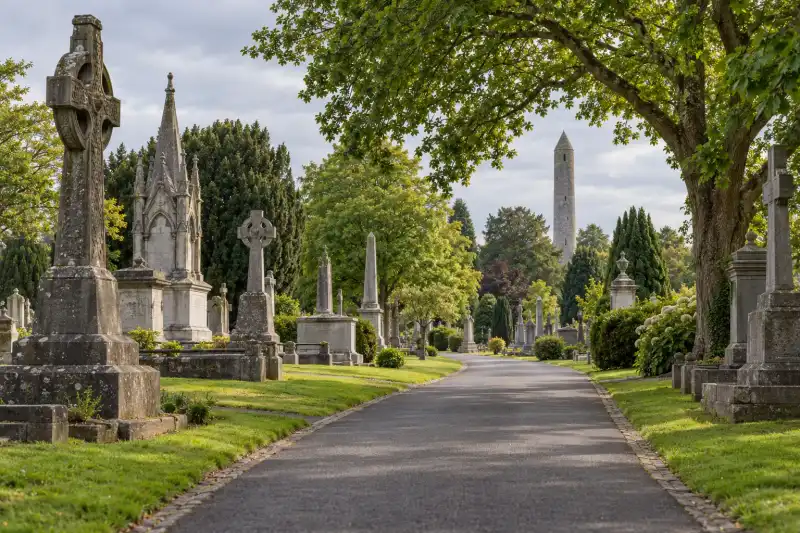
Glasnevin’s visual language is unusually rich. Tall Celtic crosses, carved angels, family vaults, military memorials, and modest markers sit along paths and larger avenues. Do not treat the site as an outdoor sculpture park detached from its purpose. Inscriptions and symbols can be read as evidence of religious affiliation, family aspiration, public reputation, and the period in which a memorial was made.
Genealogy and archives
For travelers with family connections, the Trust’s genealogy service may be as important as the physical visit. It offers digitised burial-register searching for the cemeteries under its care. Research in advance, note the exact name variants you are seeking, and use the official service’s current guidance rather than assuming every record will be complete or freely viewable.
Practical planning and etiquette
Glasnevin is north of central Dublin and is best visited as a focused half-day rather than squeezed between unrelated attractions. Check the Trust’s official visitor page for current opening, guided-tour, museum, accessibility, and booking details. These arrangements can change, particularly when services or commemorations take place.
Wear weatherproof layers and walking shoes. Paths can be uneven, and Dublin weather does not need much help to turn a calm walk wet. Photography should be discreet. Do not interrupt mourners, cross barriers, climb on monuments, or block access routes. If staff ask you to alter your route, do it without making it a whole thing. The dead have enough administrative trouble already.
Pairing Glasnevin with Dublin history
Glasnevin offers a useful counterweight to the city’s state rooms and medieval fragments. Dublin Castle traces the changing seat of authority in the capital. Kilmainham Gaol, visited with its own current booking rules, examines imprisonment and political struggle. Taken together, these places make a coherent modern-Ireland day, but do not overpack it. Glasnevin needs room for reflection.
For a much older archaeological horizon, Newgrange and Trim Castle extend the story beyond Dublin. They are separate day trips, not nearby add-ons, and should be planned around their own official visitor systems.
How to make the visit meaningful
A useful first visit has three stages. Begin with the official interpretation, whether that is a museum exhibition, visitor material, or a scheduled guided tour. Next, walk a limited area rather than attempting to cover the whole cemetery. Finally, leave time for a small amount of individual research: a monument, a family name, a historical event, or a question raised by the tour. This sequence keeps the scale manageable and avoids treating the cemetery as a scavenger hunt for famous graves.
If you are researching relatives, prepare before arriving. Record known names, approximate dates, and spelling variants. Irish records can be complicated by repetition, migration, changing addresses, and the simple fact that families reuse names with astonishing commitment. The Trust’s digitised registers are an important starting point, but an index entry is not the whole story. Treat it as a lead that can be checked against other family and public records.
Reading monuments with care
A cemetery monument tells a story, but usually a curated one. A grand memorial may reflect status, family resources, public role, or the survival of descendants able to pay for it. A modest marker does not indicate an unimportant life. Look at dates, occupations, inscriptions, religious imagery, and the grouping of graves, while recognizing what is absent. That combination makes Glasnevin a strong place for thinking about historical evidence itself.
The cemetery’s national associations can make individual losses seem abstract. Keep the order right. These are graves before they are historical content. Photograph only where appropriate, avoid intrusive poses, and leave space for people who are there for personal reasons rather than heritage tourism. Respectful behavior is not a side note. It is the minimum price of admission to a place built around remembrance.
Seasonal and accessibility notes
Dublin weather can move from sunlight to rain with the confidence of a bureaucrat changing a form. Bring a waterproof outer layer and allow extra time on wet paths. The cemetery landscape is large, with varying surfaces and gradients, so travelers with mobility needs should contact the Trust before travel for current accessibility advice and assistance arrangements. The official visitor page is more reliable than an influencer declaring somewhere “totally accessible” after walking ten meters in clean trainers.
A place within Dublin, not outside it
Glasnevin works particularly well for travelers who want to understand Dublin beyond a narrow list of central monuments. It can be paired with the city’s museums, archives, or historic neighborhoods, but it is not interchangeable with them. The cemetery makes national narratives personal, while its registers make personal research part of a wider historical record. That dual role explains why the Trust’s current visitor and genealogy resources are both worth consulting.
Build in a pause after the visit rather than marching immediately to the next attraction. A café, a park bench, or a short bus ride back toward the center gives space to process the experience. This is not performative solemnity. It is simply a better way to avoid converting a cemetery into another timed consumption unit on a map.
Visitors traveling with children can make the site meaningful by focusing on art, symbols, public history, and how communities remember people, rather than sensational stories about death. Adults can do the same, frankly. The best takeaway is that historical evidence comes in many forms: a formal record, a carved name, a shared grave, an absence, and a landscape maintained across generations.
Keep the scale human
It is tempting to focus only on national figures, particularly if a guide or map highlights them. Balance that with a look at ordinary markers and shared graves. The contrast is an honest part of the cemetery’s historical record. Public commemoration is uneven, while loss is not.
A quiet, attentive hour at Glasnevin will usually teach more than trying to photograph every famous memorial. It is a place for names and connections, not scorekeeping.
Quick Facts
| Attribute | Details |
|---|---|
| Location | Glasnevin, Dublin, Ireland |
| Founded | 1832 |
| Historical focus | Modern Irish social, political, and family history |
| Managed by | Dublin Cemeteries Trust |
| Best visit style | Museum or official tour followed by a respectful walk |
| Research resource | Trust genealogy service and digitised burial registers |
| Important note | Active cemetery: follow staff guidance and respect services |
Glasnevin is one of Dublin’s clearest reminders that history is not only made in parliaments, castles, and battlefields. It is also accumulated in names, dates, family plots, and the physical work of remembering.
Frequently Asked Questions
Is Glasnevin Cemetery an ancient site?
No. Glasnevin is a nineteenth-century cemetery, founded in 1832. It belongs on a history itinerary because its graves, monuments, records, and tours illuminate modern Irish social and political history.
Can visitors enter the cemetery independently?
Visitor arrangements, tours, and access conditions are managed by Dublin Cemeteries Trust. Check its official visitor information before travelling, especially around services and commemorations.
Are guided tours worthwhile?
A guided tour can add context because Glasnevin's significance is spread across many graves and national stories. The Trust publishes current tour and booking information.
Can I research family burials at Glasnevin?
Dublin Cemeteries Trust provides a genealogy service with digitised burial registers. Search access and record details are subject to the Trust's current terms.
How should visitors behave?
This is an active cemetery. Keep voices low, follow staff directions, respect funerals and memorial activity, and do not treat graves as photo props.
Nearby Ancient Sites
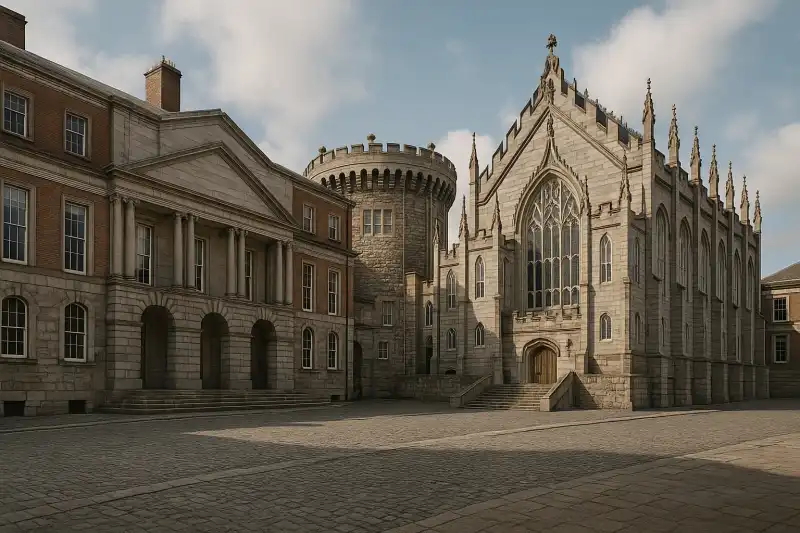
Dublin Castle Travel Guide 2026: State Apartments, Viking Layers, and City-Center Route
Medieval and Early Modern IrelandPlan a first visit to Dublin Castle with practical timing, ticket strategy, and clear context on the...
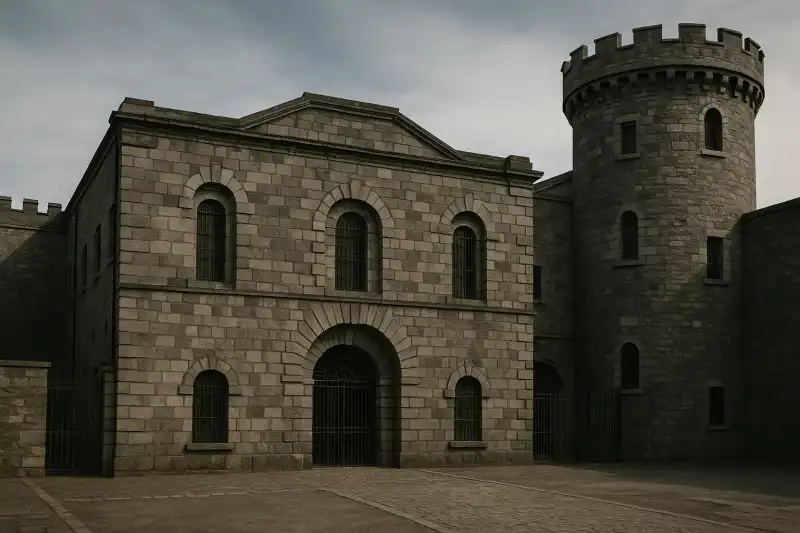
Kilmainham Gaol Travel Guide 2026: Independence History, Ticket Timing, and Dublin Visit Plan
Modern IrelandPlan a first visit to Kilmainham Gaol with practical booking advice, historical context, and easy pa...
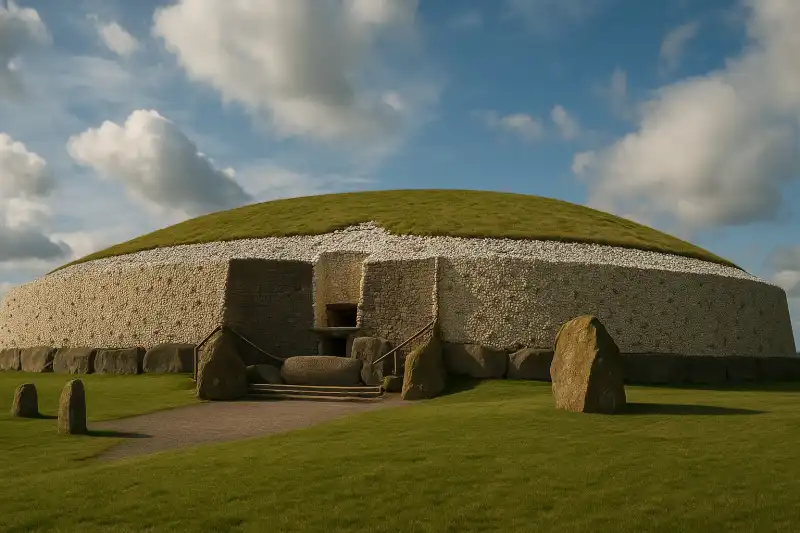
Newgrange Travel Guide 2026: Passage Tomb Access, Solstice Context, and Boyne Valley Planning
Neolithic IrelandPlan a first visit to Newgrange with practical access logistics, what to expect inside the passage t...

Trim Castle Travel Guide 2026: Norman Keep, Curtain Walls, and County Meath Plan
Anglo-Norman IrelandPlan a first visit to Trim Castle with practical timing, keep-tour logistics, and clear context for ...