Quick Info
At a glance
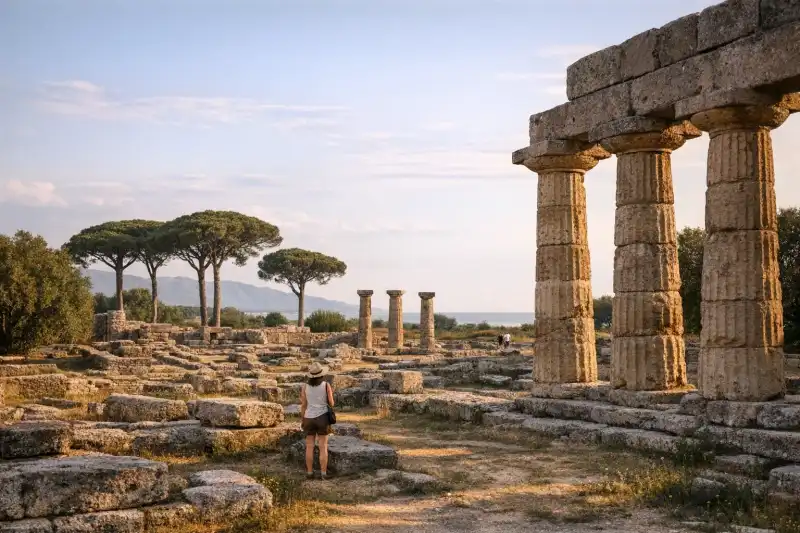
Heraion at Foce del Sele in Italy sits in a landscape that feels both open and quietly sacred: flat river plain, distant mountains, coastal light, and the lingering memory of ancient pilgrims approaching a goddess’s sanctuary from land and sea. Near the mouth of the Sele River and closely tied to the Greek city of Poseidonia, later Paestum, this archaeological site is not a place of towering surviving temples like its famous neighbor. Instead, it is subtler, more atmospheric, and in many ways more evocative. Here, the importance of the sanctuary emerges through context: its place beyond the city walls, its ritual role in the territory, and the remarkable art that once adorned it.
For travelers interested in Magna Graecia, the Heraion offers a different perspective on the ancient Greek world in southern Italy. It reveals how religion shaped the countryside as much as the city, and how sanctuaries could define borders, identities, and communal memory. The site is especially celebrated for its archaic metopes, among the most important sculptural finds from Greek Italy, now largely housed in the archaeological museum at Paestum. Visiting the Heraion therefore becomes an exercise in imagination as well as observation. You are not only looking at foundations and landscape archaeology; you are stepping into a ritual zone that connected water, fertility, power, and one of the principal goddesses of the Greek pantheon.
History
Origins in the Greek colonial landscape
The Heraion at Foce del Sele emerged within the colonial world of Magna Graecia, when Greek settlers established cities and religious centers along the coasts of southern Italy. Poseidonia, founded by Greeks from Sybaris in the 7th or early 6th century BCE, developed into one of the major centers of the region. Outside the urban core, sanctuaries helped organize the surrounding territory, marking roads, river crossings, agricultural zones, and symbolic frontiers. The Heraion by the Sele belonged to this wider pattern.
Its location was strategic and meaningful. Set near the river mouth, the sanctuary occupied a transitional place between inland and coast, cultivated plain and watery threshold. Hera, often associated in the Greek world with marriage, fertility, and civic order, was also honored in sanctuaries that stood at edges and boundaries. This made the Sele site ideal for a cult that likely served not just city residents but also rural communities, merchants, travelers, and pilgrims moving through the territory.
Archaeological evidence suggests that cult activity began in the archaic period, probably in the 6th century BCE. Offerings, architectural fragments, and the famous sculpted metopes point to a flourishing sanctuary that attracted resources and artistic investment. The sanctuary was not merely a local shrine; it was an institution integrated into the political and religious life of Poseidonia.
The archaic sanctuary and its artistic flowering
The 6th century BCE was the defining era of the Heraion. During this period, temple structures and altars were established or monumentalized, and the site gained the decorative sculptural program for which it is best known today. The metopes discovered here, carved in local stone, are extraordinary documents of archaic Greek art in Italy. They depict mythological scenes with a bold, somewhat austere style that reflects both Greek models and local interpretation.
These reliefs are invaluable because they show the quality of artistic production in the western Greek world at an early date. They also indicate that the sanctuary enjoyed patronage substantial enough to support ambitious architectural embellishment. The myths represented on the metopes likely reinforced the sacred prestige of the site and connected local worship with the wider Greek mythic universe.
At the same time, the sanctuary functioned ritually. Pilgrims would have arrived with offerings, perhaps participating in seasonal ceremonies linked to fertility, protection, and communal identity. Like other extra-urban sanctuaries, the Heraion may have been a place where civic religion met rural life, uniting colonists and surrounding populations within a shared sacred framework.
Lucanian and Roman continuity
From the late 5th century BCE onward, the political situation in southern Italy changed significantly. Lucanian peoples came to dominate parts of the region, and Poseidonia itself was transformed before later becoming the Roman Paestum. Yet the sanctuary’s story did not abruptly end with these shifts. Archaeological evidence indicates continuity and adaptation, a common pattern at long-lived sacred places.
Religious sites often outlasted political regimes because they held deep local significance. Buildings were repaired, cult spaces modified, and ritual practices adjusted to new circumstances. The Heraion appears to have retained importance through changing cultural layers, even as the balance between Greek, Italic, and later Roman identities evolved around it.
Under Roman influence, older sanctuaries could be reinterpreted rather than abandoned. In some cases, traditional cults continued; in others, ritual emphasis changed while the sacred status of the place remained. The Heraion’s persistence reflects the durable authority of landscape sanctity: once a location was recognized as holy, generations tended to preserve that memory.
Rediscovery and modern archaeology
The modern significance of the Heraion owes much to 20th-century excavation and scholarship. Archaeologists identified and investigated the sanctuary, clarifying its relationship to Paestum and bringing to light its sculptural treasures. The metopes in particular transformed scholarly understanding of archaic art in Magna Graecia.
Today, the site is appreciated not only for its visible remains but for what it contributes to the historical map of ancient southern Italy. It demonstrates that Paestum’s religious world extended beyond the city’s famous Doric temples into a broader territorial network. It also reminds visitors that ancient worship often happened in places where city, river, and coastline met. The Heraion survives as both archaeological site and cultural key: modest in appearance, but essential for understanding the religious geography of Greek Italy.
Key Features
The first thing many visitors notice about the Heraion at Foce del Sele is the landscape itself. Unlike urban ruins framed by later buildings, this sanctuary occupies a low plain shaped by water, agriculture, and distance. The Sele River and its surrounding environment are not incidental background; they are central to the site’s meaning. Ancient worship here was inseparable from geography. The river mouth created a liminal setting, a place of passage and fertility, where fresh water met the wider maritime world. Even in its quieter modern form, the site retains that threshold quality.
The surviving structural remains are not monumental in the way the temples at Paestum are. Instead, foundations, traces of sacred architecture, and excavated zones invite a more interpretive kind of visit. You are looking for layout, orientation, and ritual logic rather than dramatic standing elevation. This is exactly what makes the Heraion rewarding for travelers who enjoy archaeology beyond postcard ruins. The sanctuary’s plan helps explain how extra-urban worship worked: there were built spaces for cult, open areas for gathering, and architectural markers that organized sacred movement through the site.
One of the most important features of the Heraion is, paradoxically, something many visitors will encounter more fully off-site: the archaic metopes discovered here and now preserved in the museum at Paestum. These relief panels are fundamental to understanding the sanctuary. Their mythological scenes, stylized figures, and early sculptural language place the Heraion among the major artistic sites of Magna Graecia. If you see the sanctuary without seeing the museum, you only grasp half the story; if you see the museum without visiting the sanctuary landscape, you miss the physical setting that gave those sculptures meaning. Together, they create a complete experience.
Another key feature is the sanctuary’s relationship to Poseidonia-Paestum. The Heraion was not an isolated holy place but part of a religious network tied to a Greek colonial city. This connection helps explain why Hera was so important here. She was deeply venerated in the Paestum area, and her cult linked civic identity, fertility, territory, and social order. The famous great temples at Paestum themselves are often associated with Hera, so the sanctuary at the Sele expands that devotion beyond the urban center into the surrounding land.
The site’s archaeological value also lies in how it illustrates continuity across cultures. Layers of Greek, Lucanian, and Roman engagement suggest that the sanctuary remained meaningful long after its foundation. For visitors, this means the Heraion is not frozen in a single era. It tells a long story of adaptation, persistence, and reverence. Sacred places in antiquity were rarely static, and the Sele sanctuary offers a clear example of how worship could survive political change.
Finally, the atmosphere of the Heraion is one of its strongest features. This is not a site crowded with visual spectacle. It rewards slowness. The open sky, the broad plain, and the sense of a once-busy pilgrimage point create a reflective mood. Travelers interested in ancient religion, landscape archaeology, and the quieter edges of the classical world often find the Heraion more memorable than larger sites because it feels discovered rather than consumed. It asks you to reconstruct the past, and that active engagement is part of its appeal.
Getting There
The Heraion at Foce del Sele is most easily reached from Paestum, Salerno, or Naples. If you are driving, Paestum is the best base. From central Paestum, the journey typically takes around 20 to 30 minutes depending on your exact route and traffic. A rental car offers the greatest flexibility, especially if you plan to combine the sanctuary with the Paestum archaeological park and museum. Daily car rental rates in Campania often begin around €35 to €60, with fuel extra.
From Salerno, the drive usually takes about 45 to 60 minutes. A taxi from Salerno can cost roughly €70 to €110 one way, so this is practical mainly for small groups or travelers prioritizing convenience. From Naples, expect a drive of about 1.5 to 2 hours, with tolls and fuel on top of rental costs.
Public transport is possible but less straightforward. Trains run regularly from Naples and Salerno to Paestum station, with regional fares often around €4 to €10 from Salerno and €8 to €15 from Naples, depending on service. From Paestum, you may need a local taxi to reach the sanctuary area, usually costing around €20 to €35 each way. Bus links can exist seasonally or locally, but schedules are limited and should be checked in advance.
Many visitors treat the Heraion as part of a broader day trip focused on Paestum. That is usually the smartest approach: visit the museum first or afterward to see the metopes, then go out to the sanctuary with a clearer sense of what once stood there.
When to Visit
Spring and early autumn are the best times to visit Heraion at Foce del Sele. From April to June, the Sele plain is usually green, temperatures are pleasant, and the light is ideal for walking outdoor archaeological areas. Expect daytime temperatures commonly between 18°C and 26°C. September and October are similarly attractive, with warm but less intense conditions than midsummer and generally fewer crowds than peak holiday weeks.
Summer, especially July and August, can be very hot in Campania. Temperatures often rise above 30°C, and the exposed nature of the site means there may be limited shade. If you visit in summer, go early in the morning or late in the afternoon, bring water, and combine the outing with indoor time at the Paestum museum during the hottest part of the day. Coastal tourism in the region also increases at this time, which can affect accommodation prices and local traffic.
Winter offers a quieter experience and softer light, and temperatures are often still manageable compared with northern Europe. However, rain can make the landscape feel muddy or subdued, and shorter daylight hours reduce flexibility. If your priority is atmosphere and solitude rather than ideal weather, winter can still be rewarding.
In practical terms, the best visit is often a half-day in late spring or early autumn, paired with Paestum. The sanctuary’s meaning is deeply tied to open landscape, so mild weather significantly improves the experience. Comfortable walking shoes are recommended year-round, and checking local opening conditions in advance is always wise.
| Quick Facts | Details |
|---|---|
| Site Name | Heraion at Foce del Sele |
| Location | Near the mouth of the Sele River, Campania, Italy |
| Nearest Major Archaeological Hub | Paestum |
| Ancient Affiliation | Sanctuary linked to Greek Poseidonia |
| Main Deity | Hera |
| Earliest Major Phase | 6th century BCE |
| Cultural Periods | Greek, Lucanian, Roman |
| Best Known For | Archaic metopes and extra-urban sanctuary landscape |
| Best Combined Visit | Paestum Archaeological Park and Museum |
| Recommended Visit Length | 1–2 hours, longer with Paestum |
| Best Season | April–June and September–October |
| Best Transport Option | Rental car or taxi from Paestum/Salerno |
The Heraion at Foce del Sele may not be the most visually imposing ancient site in Italy, but it is one of the most revealing. It shows how Greek religion shaped territory beyond city walls, how sanctuaries anchored memory in the landscape, and how archaeology can recover importance even where monumental remains are sparse. For travelers already drawn to Paestum, the sanctuary adds depth and nuance. For those especially interested in Magna Graecia, it is essential. The open plain, the river setting, and the connection to the metopes in the museum all combine to create a visit that is intellectually rich and quietly powerful. In a region filled with famous ruins, the Heraion stands apart by reminding you that sacred significance does not always survive in grand columns. Sometimes it survives in place, in context, and in the enduring pull of a landscape once dedicated to a goddess.
Guided tours: worth it?
Most travelers can visit Heraion at Foce del Sele independently. Compare a tour only if you want a tighter history-focused visit, easier logistics, or a guide who can answer questions on the spot.
Best for
- Short visits where a planned route saves time
When to go self-guided
Go independently if you prefer setting your own pace, reading as you go, and checking official hours or ticket rules directly before you arrive.
What I’d avoid
Skip paid tours that bundle unrelated stops you do not actually want. The best option should either save meaningful planning time or add historical context you would miss on your own.
Paestum Archaeological Park and Museum Tours
Useful when: you want to connect a site and museum visit
Salerno Day Trips to Paestum
Useful when: transport or pickup logistics matter
Campania Ancient Sites Tours
Useful when: you want to compare guided formats before deciding
Some tour links are affiliate links, which may earn Ancient Travel a small commission at no extra cost to you. I try to surface options that make practical sense for the site—not just anything bookable.
Frequently Asked Questions
What is the Heraion at Foce del Sele?
It is an ancient Greek sanctuary dedicated to Hera, located near the mouth of the Sele River in Campania, not far from Paestum.
Can you visit the original temple remains on site?
Yes, the archaeological area can be visited, but many of the most famous sculpted metopes from the sanctuary are preserved in the museum at Paestum.
How much time should I allow for a visit?
Most travelers should allow 1 to 2 hours for the sanctuary itself, or longer if combining it with Paestum and the local museum collections.
Is the Heraion at Foce del Sele easy to reach without a car?
It is possible but less convenient by public transport; most visitors find it easiest to visit by car, taxi, or as part of a Paestum-area excursion.
When was the sanctuary built?
The sanctuary developed from the archaic period, with major activity beginning in the 6th century BCE and continuing through later Greek and Roman phases.
Why is the site important?
The Heraion is one of the most significant extra-urban sanctuaries of Magna Graecia and is especially important for its archaic relief metopes and evidence of regional cult practice.
Nearby Ancient Sites
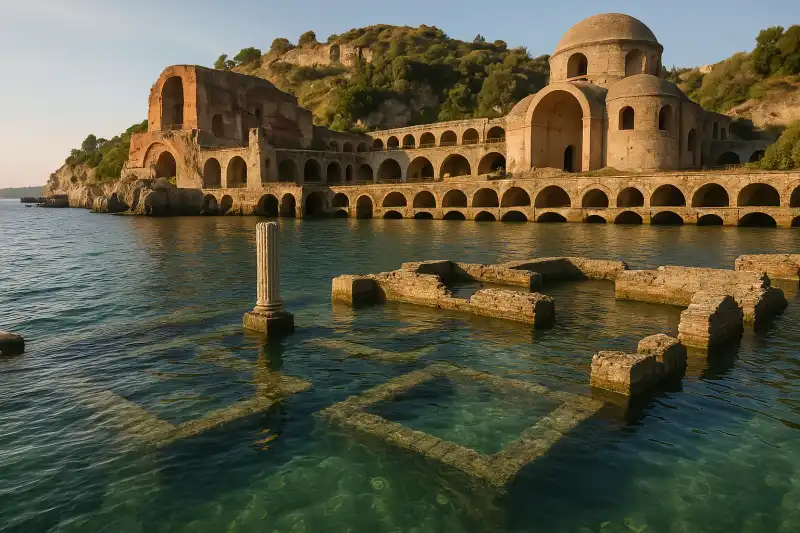
Baia Archaeological Park Guide 2026: Underwater Ruins, Thermal History, and Smart Visit Planning
RomanPlan a focused visit to Baia Archaeological Park near Naples with route strategy, what to prioritize...
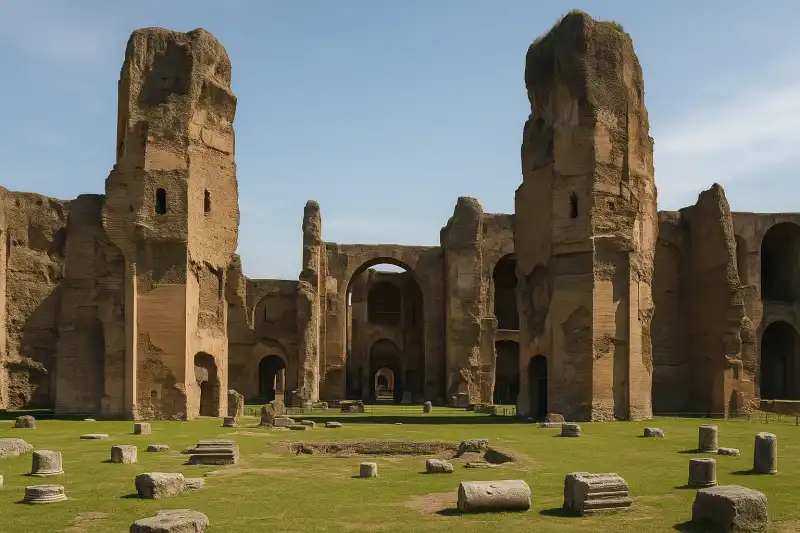
Baths of Caracalla Rome Guide 2026
RomanPlan your visit to the Baths of Caracalla with practical route advice, history context, timing, and ...
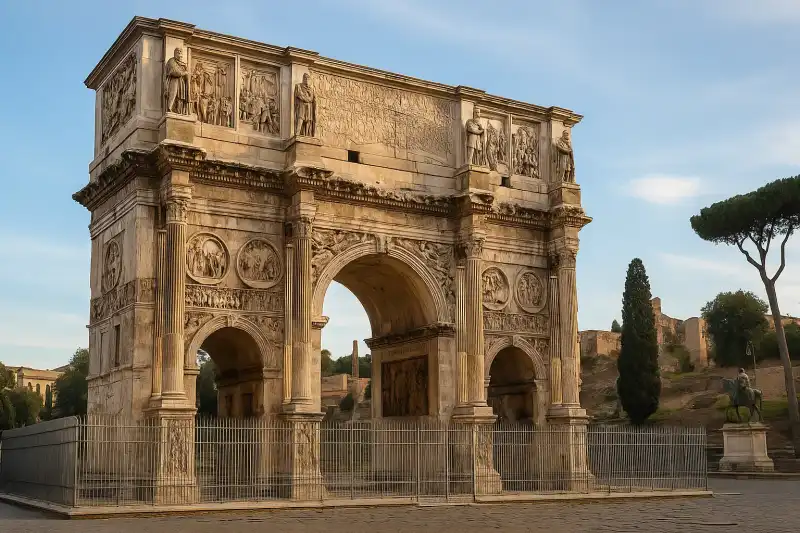
Arch of Constantine Rome: Triumph Over Maxentius Guide
Roman EmpireThe Arch of Constantine commemorates Constantine's 312 CE victory. Spolia details, best photo angles...