Quick Info
At a glance
Quick Facts
- Location: On white travertine cliffs near Pamukkale, southwestern Anatolia
- Best for: Combined nature and archaeology, thermal spring experience
- When to visit: April-May, September-October
- Entry fee: Around 300 Turkish Lira (includes Pamukkale terraces)
- Crowds: Moderate to high - major tourist destination but still rewarding
- What to see: Apollo temple, theater, baths, travertine formations, sacred spring
Where Stone Flows Like Water
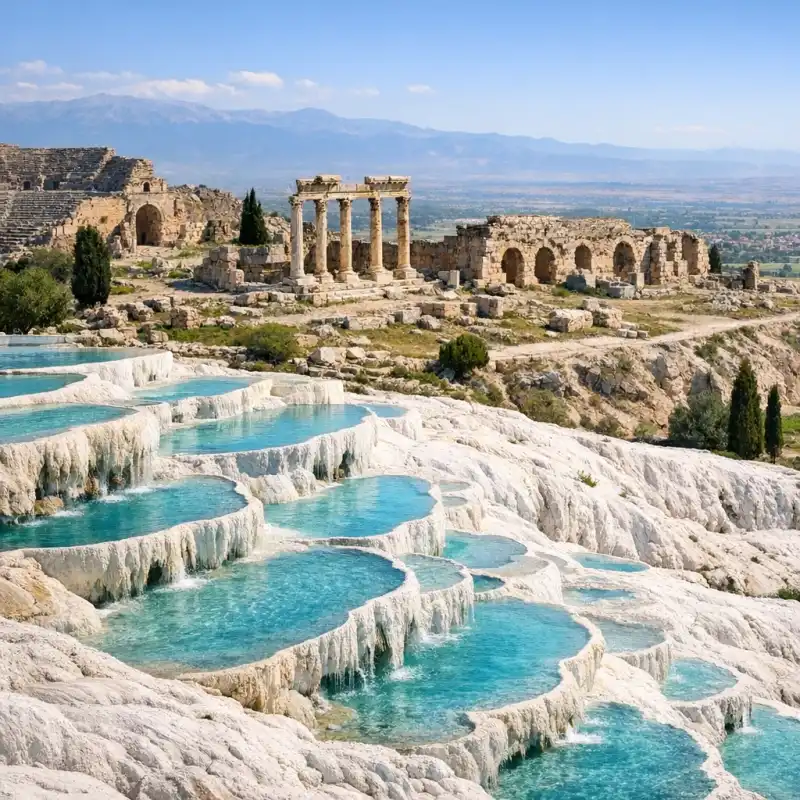
You approach Hierapolis not overland but across white—an expanse of calcified travertine that looks like snow, ice, or something that shouldn’t exist. Mineral-rich water flowing from underground springs emerges at the surface, cools, and deposits calcium and minerals in cascading terraces that are simultaneously otherworldly and geologically familiar.
This geological wonder is Pamukkale, “Cotton Castle.” But above it, crowning the white cliffs, is Hierapolis—the “Holy City”—an ancient sanctuary built explicitly because the thermal springs held healing power that ancients understood as divine. The combination is extraordinary: a city dedicated to the god Apollo, built above natural evidence of sacred presence.
A Healing Sanctuary
Hierapolis was founded in the 2nd century BCE, initially as a relatively small sanctuary dedicated to the worship of Apollo and serving the mineral springs that flowed from underground. The thermal water was considered sacred, believed to possess healing powers for both physical illness and spiritual contamination.
The city grew because of this reputation. Pilgrims journeyed to Hierapolis seeking cure or spiritual renewal. They bathed in the sacred pools. They made offerings at the temple. Some were healed (or convinced they were healed). Others returned home empty, attributing failure to insufficient piety. The belief persisted and intensified.
Under the Hellenistic dynasties and later under Rome, Hierapolis expanded far beyond a simple sanctuary. It became a city: streets were built, houses constructed, a theater erected, civic institutions developed. But it remained fundamentally a pilgrimage destination—a place where ordinary people came seeking healing, transformation, or divine encounter.
The Temple of Apollo
The Apollo temple is the architectural centerpiece of Hierapolis, though significant portions have been destroyed or rebuilt. What remains shows the temple’s Hellenistic origins and later Roman reconstruction. The temple was not large—fit for a local sanctuary—but it occupied sacred ground that pilgrims reverenced.
The temple’s positioning is significant: it overlooks the sacred spring, the source of the thermal waters. Worshippers could see the water emerging, watch it flow downward and transform the landscape into white travertine. The connection between the visible natural phenomenon and the invisible god was made visible in architecture.
The Theater and Civic Space
Beyond religious function, Hierapolis was a functional city with civic institutions. The theater is well-preserved, built into the hillside with seating for thousands. It was used for traditional dramatic performances, but also for religious spectacles and processions. The theater’s position provides panoramic views across the Lycus valley—a setting of extraordinary beauty.
Below the theater, the city spread downward: markets, shops, houses, administrative buildings. The city plan shows a community of real substance—not a shrine with a few buildings, but an actual urban center where people lived, worked, and built families. The presence of civic institutions (council hall, markets) alongside religious structures tells the story of a society in which religion and daily life were thoroughly intertwined.
The Thermal Complex
Adjacent to the sacred spring is an elaborate thermal complex—Roman baths designed to deliver water heated underground to public bathing chambers. These are among the best-preserved baths in the Mediterranean, with hypocaust heating systems, hot and cold chambers, and marble veneering that testifies to Hierapolis’s prosperity.
Pilgrims would have bathed here, believing that the therapeutic properties of the heated mineral water worked both on body and soul. The baths were not simply practical infrastructure but ritual spaces—extensions of the sacred mission of healing that drew pilgrims to Hierapolis.
The Travertine Landscape
The travertine terraces are inseparable from the city’s meaning. Walking through Pamukkale, you experience the geological process that ancient people interpreted as divine. Water emerges warm from the earth, calcium-rich and slightly alkaline. As it cools and flows downward, calcium precipitates, building up the white mineral deposits that characterize the landscape.
The ancient population managed this landscape deliberately. They built channels to direct the water, created pools for bathing, and probably understood the travertine formation as a visible manifestation of the god’s power. The white color was striking—connected to purity, to purification, to the cleansing function of the healing waters.
Death and the Plutonium
Below the temple lies something darker: the Plutonium, a cave entrance that was sacred to Pluto (god of the underworld). The cave emits noxious volcanic gases—carbon dioxide and hydrogen sulfide. In antiquity, these gases were understood as evidence of the underworld’s presence. The gases killed birds and small animals that ventured near; pilgrims understood this as divine power.
The Plutonium was incorporated into religious ritual. Priests demonstrated the power by standing at a distance while lesser visitors approached and died (or were harmed). The danger was real. The interpretation was divine. And the site became another element in Hierapolis’s reputation for sacred power.
Necropolis and Death
Hierapolis had an extensive necropolis—a city of the dead—reflecting the population that lived above. Tombs are carved from stone, inscribed with epitaphs in Greek and Phrygian. Many inscriptions record individuals’ lives: merchants, soldiers, enslaved people who gained freedom, women of property and significance. These names and stories make Hierapolis feel real in a way that reconstructed temples alone cannot.
The extensive necropolis also indicates that Hierapolis was a substantial city—a necropolis this large implies a living population of thousands.
Visiting Hierapolis
Access: Pamukkale/Hierapolis is served by regular buses and organized tours. It’s one of Turkey’s most accessible archaeological sites, with a good museum and clear signage.
Best time: April-May or September-October. Summers are hot; winters bring occasional rain and snow at elevation.
Duration: 1-2 days to explore both the travertine terraces and the archaeological city thoroughly.
What to bring: Comfortable shoes for travertine walking (surfaces can be slippery), sun protection, water, swimsuit if you plan to bathe in thermal pools.
Museum: The site museum is excellent, with finds from the city including sculpture, inscriptions, and artifacts illustrating daily life.
Crowds: Hierapolis is popular. Visit early morning to avoid the largest groups.
Connecting to Other Sites
Laodicea (Laodicea ad Lycum) is nearby—a Hellenistic city in the same valley. Tripolis and other Phrygian sites complete a regional picture of how different communities in interior Anatolia developed.
The Convergence of Healing and Geology
Hierapolis teaches that ancient spirituality was grounded in genuine natural phenomena. The thermal springs are real. The minerals do have health effects (or at least can be believed to). The geological processes visible in travertine formation are remarkable enough to be interpreted as divine.
The ancients didn’t separate nature from the sacred. A site that produces healing waters is, by definition, holy. A landscape transformed by geological processes is visible evidence of divine power. Building a city around such a site was not naïve—it was theologically sophisticated.
Hierapolis was where ancient people went to be healed, renewed, and transformed. Modern visitors come for the travertine cliffs and find themselves moved by the ambition and faith that built a city around them.
The integration of natural geology with human spirituality makes Hierapolis distinctive. The travertine formations are not merely backdrop for the city—they are active evidence of the divine forces that the city’s population believed were at work. The flowing water, the accumulating minerals, the constant transformation of landscape are visible expressions of spiritual power. Building a city around such a site was theologically appropriate—the place itself testified to divine presence.
Walking through Hierapolis today, you experience the convergence of natural wonder and human ambition. The white travertine glows in sunlight. Mineral-rich water flows and deposits its burden, creating new terraces even now. The city’s remains testify to centuries of human faith in this place’s healing and spiritual significance. The combination makes Hierapolis unforgettable—a site where nature and culture converge in ways that move visitors across two thousand years of time.
Guided tours: worth it?
Self-guided works here, but a guide can add real value if you want the ruins explained as a living place rather than just a sequence of monuments.
Best for
- First-time visitors who want context, not just photos
- Short visits where a planned route saves time
When to go self-guided
Go independently if you prefer setting your own pace, reading as you go, and checking official hours or ticket rules directly before you arrive.
What I’d avoid
Skip paid tours that bundle unrelated stops you do not actually want. The best option should either save meaningful planning time or add historical context you would miss on your own.
Hierapolis and Pamukkale Full Day Tour
Useful when: you want to compare guided formats before deciding
Pamukkale Thermal Pools and Ancient City Combo
Useful when: you want to connect a site and museum visit
Phrygia Historical Sites Tour
Useful when: you want to compare guided formats before deciding
Some tour links are affiliate links, which may earn Ancient Travel a small commission at no extra cost to you. I try to surface options that make practical sense for the site—not just anything bookable.