Quick Info
At a glance
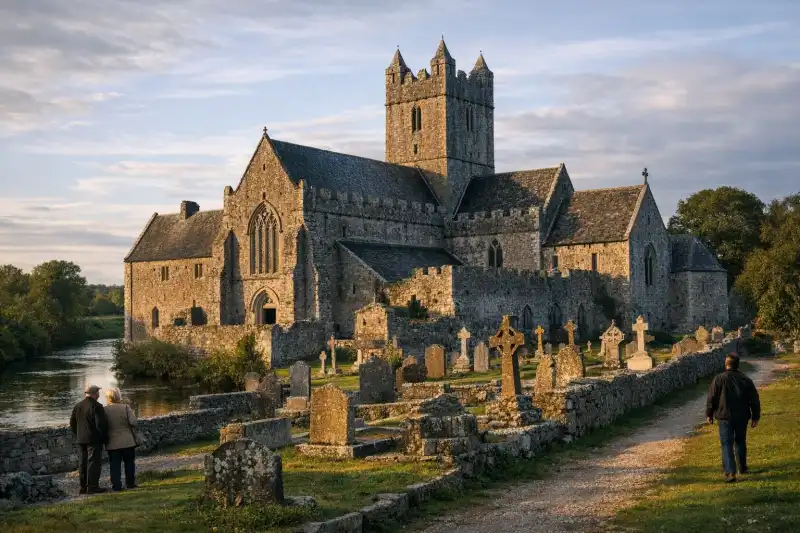
Holy Cross Abbey in Ireland rises from the gentle landscape of County Tipperary with a quiet dignity that feels both intimate and monumental. Set beside the River Suir near the village of Holycross, this medieval Cistercian foundation is not perched dramatically on a cliff or ringed by urban bustle. Instead, it belongs to fields, hedgerows, low skies, and the rhythm of rural Munster. That setting is part of its appeal. The abbey seems discovered rather than announced, and when its limestone walls, traceried windows, and elegant tower come into view, the impression is one of continuity rather than ruin.
For travelers interested in Ireland’s older sacred places, Holy Cross Abbey offers something distinctive: a building that preserves the atmosphere of a major medieval pilgrimage shrine while still functioning as a living church. It is neither a remote archaeological shell nor a purely restored museum piece. Centuries of devotion, neglect, repair, and revival are visible in its stonework. Visitors come for the architecture, but they often remember the feeling of the place just as strongly—the cool interior, the carved detail that rewards close attention, and the sense that generations have arrived here with hopes, prayers, and questions not so different from our own. Whether you are touring Ireland’s monastic heritage, tracing Gothic architecture in the countryside, or simply looking for a meaningful stop beyond the best-known tourist circuit, Holy Cross Abbey is one of Tipperary’s most compelling historic destinations.
History
Early foundation and the Cistercian arrival
Holy Cross Abbey was founded in the late 12th century, a period when monastic reform and Anglo-Norman influence were reshaping parts of Ireland’s religious landscape. The earliest establishment here is usually dated to around 1169 or shortly after, with the abbey becoming a Cistercian house in the 1180s. The Cistercians, who emphasized disciplined communal life, agricultural management, and architectural restraint, were one of medieval Europe’s most influential monastic orders. Their abbeys often transformed local economies as well as devotional life, and Holy Cross was no exception.
Its location in fertile Tipperary was practical and symbolic. The river valley supported farming, while the site connected to the network of patrons and ecclesiastical institutions that underpinned monastic success. The abbey was linked to the powerful Butler family in later centuries, and such aristocratic sponsorship helped sustain construction, embellishment, and religious prestige. Like many monastic foundations in medieval Ireland, Holy Cross began as a spiritual enterprise deeply tied to landholding, patronage, and regional authority.
The relic of the True Cross and pilgrimage fame
Holy Cross Abbey’s importance expanded dramatically because of a relic associated with the True Cross. According to long-held tradition, a fragment of the cross on which Christ was crucified was brought to the abbey, possibly by a member of the de Clare or Plantagenet circles and eventually enshrined here. Whether viewed through the lens of faith, political symbolism, or medieval relic culture, this object transformed the abbey’s status.
By the later Middle Ages, Holy Cross had become one of Ireland’s notable pilgrimage destinations. Pilgrims traveled here seeking spiritual merit, healing, intercession, or thanksgiving. The relic elevated the abbey from a regional monastic house to a shrine of broad renown. This influx of pilgrims likely contributed to major phases of rebuilding and embellishment, especially during the 15th century, when many of the striking Gothic elements visible today were created.
Pilgrimage shaped the architecture. Churches that housed important relics needed to accommodate movement, ceremonial display, and devotional focus. At Holy Cross, the richly articulated chancel, sculptural details, and carefully planned liturgical spaces reflect this role. The abbey became not simply a monastery but a destination in the spiritual geography of late medieval Ireland.
Late medieval rebuilding and artistic flowering
The abbey’s most impressive surviving features largely belong to the 15th century, when rebuilding and enhancement gave the church much of its present character. This was a period of artistic confidence despite wider political and ecclesiastical tensions. The result is a remarkable blend of Cistercian inheritance and later Gothic elaboration.
Carved stonework, traceried windows, sedilia, tomb recesses, and decorative vaulting speak to skilled craftsmanship and significant financial support. Holy Cross Abbey is especially valued because these features survive in a relatively coherent whole. While many Irish medieval churches are evocative ruins, Holy Cross preserves enough fabric to communicate both structure and ceremony. It allows modern visitors to imagine how architecture, liturgy, and pilgrimage once interacted.
This was also the era in which noble patronage became particularly visible. The Butler family, among the most influential dynasties in the region, is strongly associated with the abbey’s development. Their involvement reflects the medieval tendency for elite families to invest in monasteries for prestige, piety, memorialization, and local influence.
Dissolution, decline, and survival
The 16th century brought upheaval. Like other religious institutions in Ireland and Britain, Holy Cross Abbey was affected by the Tudor-era dissolution of monasteries. Formal monastic life ended, revenues were disrupted, and the abbey’s institutional role changed irrevocably. Yet unlike some sites that were rapidly quarried away or abandoned beyond recognition, Holy Cross retained local religious significance.
That significance mattered. Even as the medieval monastic system collapsed, the church remained embedded in local devotion. Parts of the structure deteriorated over time, and centuries of neglect took their toll. Roofs failed, fabric decayed, and the once-famous pilgrimage center faded from its medieval prominence. Still, memory persisted. The very name Holycross preserved the shrine’s identity in the landscape.
Restoration and modern life
In the 19th and 20th centuries, growing interest in Ireland’s medieval heritage and renewed Catholic devotional life encouraged restoration efforts. Holy Cross Abbey underwent substantial conservation and rebuilding, especially in the latter half of the 20th century. These works sought not merely to stabilize a ruin but to return the church to liturgical use while respecting its historic character.
Today, the abbey stands as both monument and parish church. This dual role is central to understanding its atmosphere. Visitors encounter a site that belongs to history without being sealed off from the present. Masses, pilgrimages, and local ceremonies still take place here, linking contemporary practice to an unbroken tradition of sacred use. For many travelers, that living continuity is what distinguishes Holy Cross Abbey from other medieval sites in Ireland.
Key Features
Holy Cross Abbey rewards slow looking. Its appeal is not based on one overwhelming spectacle but on the cumulative power of architecture, proportion, carving, and setting. The church exterior, built in pale grey limestone, has the balanced, upright elegance characteristic of late medieval ecclesiastical architecture in Ireland. The tower gives the complex a vertical emphasis, but the overall silhouette remains harmonious rather than imposing. In soft light or under rain-heavy skies, the stone can seem almost silver, giving the abbey a restrained beauty that suits its monastic origins.
Inside, the nave and chancel reveal the site’s greatest strengths. The spatial sequence is legible enough to feel authentic yet intact enough to be immersive. Visitors can appreciate how medieval worshippers experienced the building: processional movement, changing light, and the gradual revelation of sacred focal points. The chancel is especially notable, reflecting the abbey’s status as a pilgrimage church. Decorative stonework here goes beyond pure utility, suggesting a desire to impress and inspire those who approached the shrine and altar.
Among the most admired details are the carved sedilia and piscina, both practical liturgical furnishings elevated by craftsmanship. Their arches and moldings draw the eye, showing how even secondary features were treated with artistic care. Tomb recesses and memorial elements also hint at the abbey’s connection with elite patrons, especially the Butlers. These details remind visitors that medieval abbeys were not isolated religious enclaves; they were tied to families, wealth, memory, and local politics.
The east window and other traceried openings contribute significantly to the abbey’s atmosphere. Even when glazing is limited or modern, the window forms frame daylight in ways that animate the interior. Medieval builders understood how stone tracery could both articulate structure and shape spiritual experience. At Holy Cross, the filtered light softens the mass of the masonry and draws attention to altar spaces and carved surfaces.
Another key feature is the surviving cloister area and the traces of the larger monastic complex. Although not all conventual buildings remain complete, enough survives to suggest the rhythms of Cistercian life. Monks moved between church, chapter house, dormitory, refectory, and work spaces according to a disciplined daily cycle of prayer and labor. Standing in or near these remains, visitors can imagine the abbey not as an isolated church but as a functioning community embedded in its agricultural and devotional landscape.
The abbey’s connection to pilgrimage remains one of its defining interpretive themes. Even though the original medieval cult of the relic belongs to a different religious world, its legacy lingers in the building’s design and reputation. Holy Cross was shaped by expectation: pilgrims hoped to encounter sanctity here, and the architecture met that expectation through beauty, order, and ceremonial emphasis. That layer of purpose is still perceptible. The church feels made for arrival.
The surrounding grounds add another dimension. Holy Cross Abbey is not hemmed in by dense development, so views outward to village and countryside help preserve its historic context. The nearby river, green fields, and open sky root the abbey in a landscape that has sustained worship and settlement for centuries. This rural setting also makes the visit calmer than at many of Ireland’s more crowded heritage sites. You can often hear birds, wind, and distant traffic rather than continuous tourist noise.
Perhaps the most important feature, though, is the abbey’s unusual balance between restoration and age. It is not a pristine reconstruction, and it is not a bare ruin. You can still see weathering, irregularities, and the layered effects of centuries. Yet the building is coherent enough to communicate its original ambition. For travelers who want to understand medieval Irish religion through architecture rather than just information panels, Holy Cross Abbey is exceptionally rewarding.
Getting There
Holy Cross Abbey is located in Holycross village, about 6 kilometers northwest of Thurles in County Tipperary. The easiest way to reach it is by car. From Thurles, the drive usually takes around 10 to 15 minutes via the R661, while from Cashel it takes roughly 30 to 40 minutes. Drivers coming from Dublin should allow about 2 hours, depending on traffic, usually via the M7 and regional roads. Parking in the village is generally straightforward and typically free or low-cost.
If you are using public transport, the most practical route is to travel by Irish Rail to Thurles. Trains from Dublin Heuston to Thurles commonly take about 1 hour 20 minutes to 1 hour 40 minutes, with standard fares often ranging from around €20 to €40 depending on timing and booking conditions. From Cork, fares and travel times vary, but direct or connecting services also make Thurles accessible.
Once in Thurles, you can take a taxi to Holy Cross Abbey. A one-way taxi fare is usually about €12 to €20, depending on time of day and local rates. Local bus options may exist seasonally or on limited schedules, but they are not always the most convenient choice for independent travelers. If you want flexibility, especially to combine Holy Cross Abbey with the Rock of Cashel or other Tipperary heritage sites, renting a car is the best option. Organized private tours from Dublin or broader Munster heritage tours can also include the abbey, though it is less commonly a standard stop than larger attractions.
When to Visit
Holy Cross Abbey can be visited year-round, but late spring through early autumn is the most rewarding period for most travelers. From May to September, longer daylight hours and milder temperatures make it easier to appreciate both the interior and the surrounding village landscape. Summer brings the green countryside for which Ireland is famous, and the abbey’s pale stone looks particularly beautiful against bright grass and shifting blue-grey skies. Average daytime temperatures typically range from 15°C to 20°C, though rain is possible at any time.
Spring is an especially pleasant season if you want fewer visitors and softer light. The grounds begin to brighten, and the atmosphere feels peaceful without being empty. Autumn is also a strong choice, with cooler air, fewer crowds, and rich color in the landscape. For photographers, these shoulder seasons often provide the best mix of mood and manageable weather.
Winter visits have their own charm. The abbey can feel even more contemplative on a cold or misty day, and the lower visitor numbers make for a quiet experience. However, daylight is limited, and rain or damp conditions can make regional driving slower. If you are planning a winter trip, start earlier in the day and confirm opening access if a church service or local event is scheduled.
Because Holy Cross Abbey remains an active place of worship, the best time to visit is usually outside service hours. Mid-morning to mid-afternoon on weekdays often works well. If you are especially interested in atmosphere rather than photography, attending a service or pilgrimage event may offer a deeper sense of the abbey’s continuing religious role, provided you do so respectfully.
| Quick Facts | Details |
|---|---|
| Location | Holycross village, near Thurles, County Tipperary, Ireland |
| Region | Munster |
| Founded | Late 12th century, with Cistercian establishment in the 1180s |
| Historical Role | Cistercian abbey and major medieval pilgrimage site |
| Famous For | Association with a relic of the True Cross |
| Architectural Style | Medieval Gothic with Cistercian origins |
| Best Visit Length | 45 minutes to 1.5 hours |
| Nearest Town | Thurles |
| Best Season | Late spring to early autumn |
| Current Status | Active church and historic monument |
A visit to Holy Cross Abbey is rarely about ticking off Ireland’s most famous landmark. Its power lies elsewhere: in the survival of a sacred place that has known monastic discipline, noble patronage, pilgrimage devotion, suppression, decay, and renewal. It stands not as a theatrical ruin but as a witness. In its carved stone, liturgical fittings, and still-used interior, the medieval world remains unusually close. For travelers willing to look beyond the busiest routes, Holy Cross Abbey offers one of the most satisfying encounters with Ireland’s religious and architectural past.
Guided tours: worth it?
Most travelers can visit Holy Cross Abbey independently. Compare a tour only if you want a tighter history-focused visit, easier logistics, or a guide who can answer questions on the spot.
Best for
- Short visits where a planned route saves time
When to go self-guided
Go independently if you prefer setting your own pace, reading as you go, and checking official hours or ticket rules directly before you arrive.
What I’d avoid
Skip paid tours that bundle unrelated stops you do not actually want. The best option should either save meaningful planning time or add historical context you would miss on your own.
Tipperary and Rock of Cashel Day Tours
Useful when: you want to compare guided formats before deciding
Medieval Ireland Heritage Tours
Useful when: you want to compare guided formats before deciding
Private Tours from Dublin to Tipperary
Useful when: you want flexible timing or a private guide
Some tour links are affiliate links, which may earn Ancient Travel a small commission at no extra cost to you. I try to surface options that make practical sense for the site—not just anything bookable.
Frequently Asked Questions
Where is Holy Cross Abbey located?
Holy Cross Abbey is located in the village of Holycross near Thurles in County Tipperary, in the province of Munster, Ireland.
Is Holy Cross Abbey still an active church?
Yes. Although it is a major historic monument, Holy Cross Abbey also functions as an active Roman Catholic church and pilgrimage site.
Do you need to pay to enter Holy Cross Abbey?
Entry is generally free, though donations are appreciated. Visitors should check local parish information for any special event restrictions.
What is Holy Cross Abbey famous for?
The abbey is best known for its well-preserved medieval Gothic architecture and for its association with a relic of the True Cross that made it an important pilgrimage destination.
How much time should you spend at Holy Cross Abbey?
Most visitors spend 45 minutes to 1.5 hours exploring the church, cloister remains, carvings, and surrounding grounds.
Can you visit Holy Cross Abbey on a day trip?
Yes. Holy Cross Abbey is well suited to a day trip from Thurles, Cashel, Kilkenny, Limerick, or even Dublin with a car or organized tour.
Nearby Ancient Sites
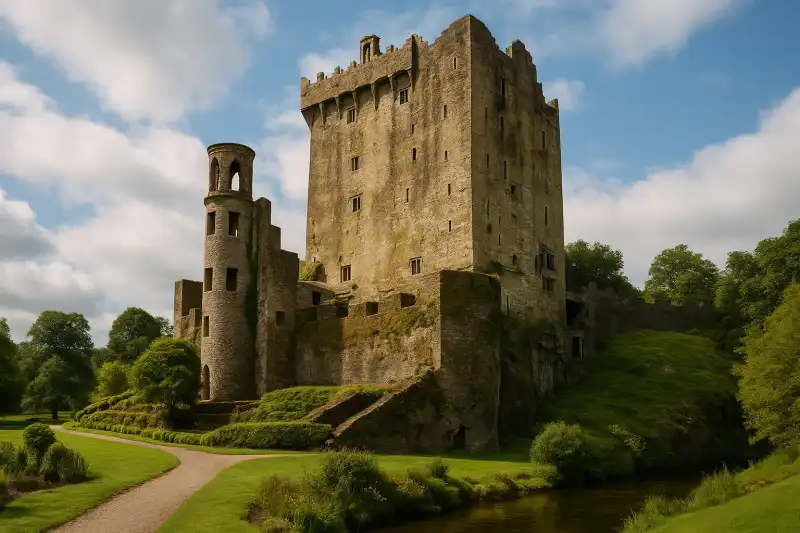
Blarney Castle Travel Guide 2026: Cork Day-Trip Timing, Gardens, and Stone Access
Medieval IrelandPlan a practical first visit to Blarney Castle with timing for the Stone queue, garden route priorit...
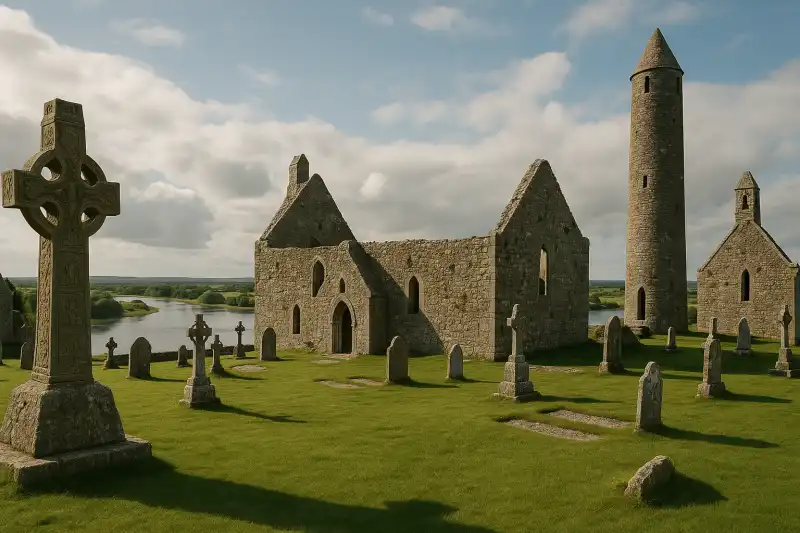
Clonmacnoise Travel Guide 2026: Monastic Ruins, High Crosses, and River Shannon Context
Early Medieval IrelandPlan a first visit to Clonmacnoise with practical timing, monastic-site context, and clear route adv...
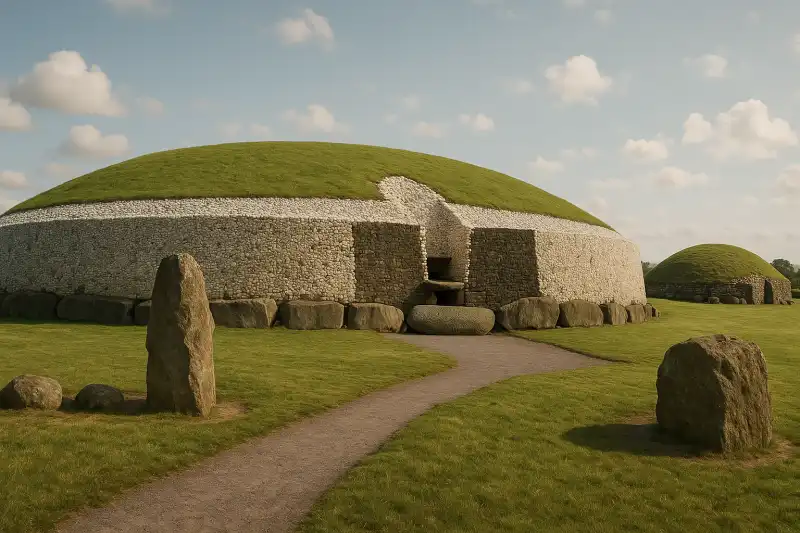
Boyne Valley Passage Tombs Travel Guide 2026: Newgrange, Knowth, and Dowth Visit Strategy
Neolithic IrelandPlan your first Boyne Valley passage tombs visit with practical timing, Brú na Bóinne access flow, a...