Quick Info
At a glance
Quick Facts
- Location: Hillside above Fethiye in southwestern Lycia
- Best for: History buffs, photographers, contemplative experience
- When to visit: April-May, September-October
- Entry fee: Around 40 Turkish Lira
- Crowds: Moderate but usually peaceful, especially off-peak
- What to see: Hundreds of stone houses, churches, narrow streets, cemetery
The Village That Time Forgot
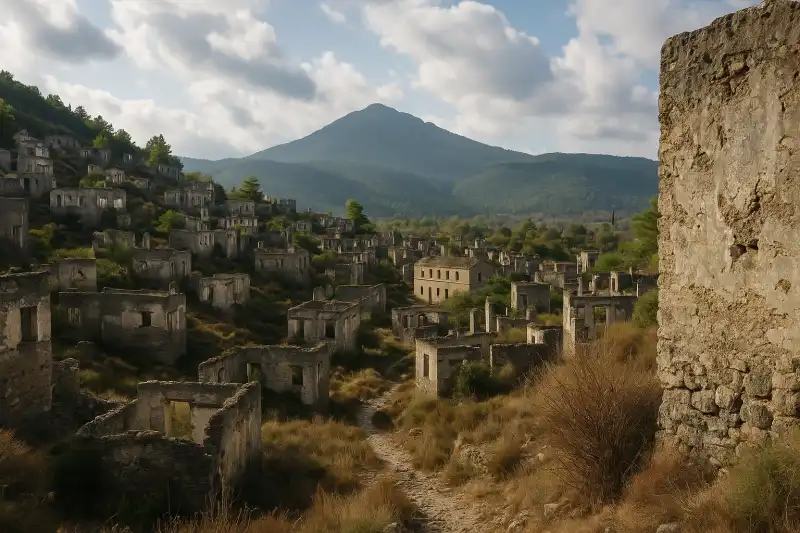
You walk up a hillside above Fethiye and enter a ghost town. Not an ancient ruin, but something different: a place where people lived recently enough that you can read their stories in the architecture. Kayaköy (formerly known as Levissi) is not thousands of years old—it’s decades old. Abandoned around 1923 during the exchange of populations between Greece and Turkey. The town was left behind almost intact, frozen at the moment of departure.
Hundreds of stone houses line narrow streets climbing the hillside. Windows without glass stare toward the valley below. Doors hang partially open on their hinges. Churches stand roofless, their interiors exposed to sky. Cemetery stones mark graves of people who lived and died here, their names in Greek now slowly being reclaimed by weathering stone and advancing vegetation.
Kayaköy is not an archaeological site in the traditional sense—there is no famous battle, no ancient empire, no golden age of classical civilization. But it is profoundly archaeological: a community’s material culture left undisturbed for a century, telling the story of ordinary people and ordinary lives.
The History of Kayaköy
The village was established in medieval times, probably in the 15th century, as a settlement of Greek Christian families. It grew under Ottoman rule, developing into a substantial community. Craftspeople, farmers, merchants—the town supported itself through trade with surrounding regions and farming in the valley below.
The transformation came in the 1920s. Greece and Turkey, exhausted by war, agreed to exchange their populations: Greeks living in Turkey would be repatriated to Greece; Turks living in Greece would be sent to Turkey. Kayaköy’s Greek population was evacuated. They left, expecting perhaps to return someday. They never did.
The Ottoman authorities settled Turkish families in the abandoned town, but it never recovered its previous prosperity. Environmental challenges—water scarcity, isolation—made settlement difficult. By the 1950s, most Turkish inhabitants had moved elsewhere. Kayaköy was abandoned again, now by both communities.
Walking the Streets
When you walk through Kayaköy, you’re moving through a specific moment in history. The stone houses show Mediterranean architecture: thick walls for insulation, small windows for protection against heat and enemies, flat roofs. Courtyards are enclosed by walls. Streets are narrow, designed for the climate and for the social expectation that women would not be observed by strangers.
The houses were built to last, and they have. Walls remain standing. Staircases are intact. Chimneys rise from roofs. In some houses, you can see the division into living spaces, storage areas, animal shelters—the integrated habitation that characterized Mediterranean villages. Stone is simply stacked without mortar in many walls, a building technique that allows houses to move slightly and resist earthquakes.
The Churches
Kayaköy contained several churches—evidence of organized Christian community life. The churches are roofless now, their interiors filled with the same rubble and vegetation that covers the rest of the town. But the architecture is readable: apses indicate the orientation toward the east, where the altar would have been positioned.
One church is better preserved, allowing you to imagine the interior space where villagers gathered for Orthodox liturgy. The stone that built these churches was quarried locally—the same stone used for houses. The community mobilized resources to build churches alongside homes, prioritizing religious life alongside practical habitation.
The Cemetery
Kayaköy’s cemetery is particularly affecting. Gravestones are carved with names, dates, and often decorative elements. Some are in Greek, some in Turkish—evidence of multiple populations using the same burial ground. You read names, calculate ages at death, note when someone died during the wars or in childbirth.
These are not ancient burials. These are people who died within living memory. Their descendants may still be alive elsewhere—in Athens, in Istanbul, in America. The cemetery makes you confront the specific human cost of population exchange and displacement.
Photography and Atmosphere
Kayaköy has become popular with photographers, and deservedly so. The geometry of roofless houses, the stone textures, the interplay of light and shadow in narrow streets—all are visually compelling. Late afternoon light, striking from the west, casts dramatic shadows and highlights the stone’s warm color.
But the appeal is not only photographic. There’s something contemplative about walking through an abandoned village. You move slowly, aware that you’re observing someone else’s former life. The emptiness is not eerie (though it can be), but rather reflective. This is what happens when people leave. This is what remains when human presence withdraws.
Access and Visiting
Kayaköy is just outside Fethiye—a 20-minute walk uphill from the town center, or a short minibus ride. The site is well-marked and frequently visited. There’s a small museum at the entrance with photographs and artifacts from the village.
Best time: April-May or September-October. Summers are hot; winters occasional bring rain.
Duration: 1-2 hours to walk through the main village and explore accessible houses.
Physical demands: The site is on a hillside with steep streets. Comfortable shoes are essential. It’s not strenuous, but the terrain is uneven.
Accessibility: Upper parts of the town are easier to navigate than lower sections.
Safety: Structures are partially collapsed. Avoid entering buildings that appear unstable.
Connecting to Regional History
Kayaköy should be experienced alongside other sites that tell the story of Lycia and the eastern Mediterranean. Myra shows the rock-cut tombs of an earlier Christian culture. Xanthos demonstrates the Lycian cities that preceded the medieval period. Together, these sites show how the same geography supported different peoples across centuries.
What Kayaköy Teaches
Kayaköy is about displacement, loss, and the material traces of ordinary lives. It reminds us that archaeological sites are not only about ancient empires and famous people. They’re about the everyday—the houses people built, the streets they walked, the cemeteries where they were buried.
It’s also a reminder that abandonment is part of history. People build, thrive, and then leave—sometimes voluntarily, sometimes forced by circumstance. The buildings remain, empty but eloquent, telling the story of what was.
Kayaköy offers the unusual experience of walking through a village where you can imagine the daily lives of its inhabitants. Not through pottery shards and foundations, but through intact houses, streets, and churches. It’s recent enough to feel immediate, old enough to feel vanished. That tension is part of its haunting power.