Quick Info
At a glance
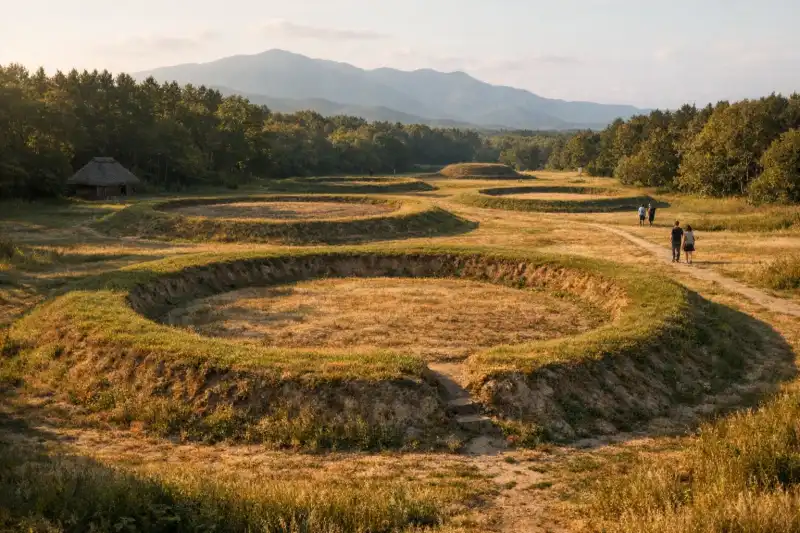
Kiusu Earthwork Burial Circles in Japan offer one of Hokkaido’s most unusual ancient landscapes: broad rings of earth rising quietly from the ground, hinting at ceremonies, burial customs, and community memory from thousands of years ago. Unlike the towering stone monuments that often dominate popular images of prehistoric ritual sites, Kiusu is subtle. Its power lies in shape, scale, and setting. Grass, trees, and open sky frame a group of circular embankments that can seem almost natural at first glance, until the eye recognizes their deliberate design.
Located in Chitose, not far from modern transport links and New Chitose Airport, the site connects travelers with the Late Jomon world of northern Japan. This was a period when communities in Hokkaido developed sophisticated ritual traditions and strong ties to their environment, leaving behind traces that survive in the earth itself. Kiusu stands out because these burial circles are both rare and visually legible: even for non-specialists, the geometry is easy to understand and the ceremonial purpose easy to imagine.
A visit here feels different from touring a castle, temple, or palace ruin. There are no surviving walls, no grand roofs, no reconstructed interiors. Instead, Kiusu invites a slower kind of attention. You walk the contours, look across the rings, and picture processions, mourning rituals, and collective acts of remembrance. For travelers interested in archaeology, prehistoric Japan, or sacred landscapes beyond the standard itinerary, Kiusu Earthwork Burial Circles is one of the most rewarding ancient sites in Hokkaido.
History
Late Jomon Origins
The Kiusu Earthwork Burial Circles were created during the Late Jomon period, broadly between around 1200 and 400 BCE, a time when communities across Hokkaido and northern Honshu were shaping increasingly complex ceremonial landscapes. The Jomon culture is often known for its pottery, pit dwellings, and deep relationship with forests, rivers, and coastal resources, but sites like Kiusu reveal another side of that world: formalized ritual architecture built in earth.
The burial circles were not casual accumulations of graves. They were planned monuments. Earthen banks were arranged in circular forms, enclosing spaces used for burials and funerary rites. Archaeological investigation has shown that these circles were associated with graves, including jar burials and other interments, suggesting an organized approach to honoring the dead. Their construction required labor, planning, and communal agreement, indicating that ritual and remembrance played a central role in social life.
In Hokkaido, where preservation conditions and settlement patterns differ from other parts of Japan, earthwork cemeteries such as Kiusu are especially valuable for understanding how regional Jomon societies expressed identity. The circles likely served not only as burial grounds but also as places where lineages, social ties, and ancestral memory were reinforced.
Ceremonial Landscape and Community Meaning
Kiusu did not exist in isolation. During the Jomon period, ritual places often formed part of wider inhabited and symbolic landscapes that included settlements, resource zones, and other ceremonial sites. The choice to build circular burial earthworks suggests a strong concern with spatial order. Circles can define sacred space, separate the world of the living from that of the dead, and create an arena for communal gatherings. At Kiusu, the surviving forms imply repeated use over time rather than a single burial event.
Archaeologists interpret the site as evidence of a community with durable traditions. The labor involved in building embankments and arranging burials points to cooperation across generations. The circles may have marked the resting places of individuals or groups regarded as important within the community, though prehistoric societies do not always leave behind clear written clues about rank or office. What is clear is that burial at Kiusu was materially and symbolically significant.
This broader ritual role helps explain why the site remains compelling today. Even without written records, visitors can read the landscape as a designed place of ceremony. The earthworks are not random topography. They are architecture in the oldest sense: humanly shaped ground made meaningful through repeated use.
From Ancient Monument to Archaeological Site
After the Jomon period ended, the original meanings of Kiusu would gradually have faded from living memory. Generations passed, vegetation changed, and the circles became part of the local terrain. Like many prehistoric sites, Kiusu survived not because it remained continuously famous, but because enough of its physical form endured to be recognized later.
Modern archaeological interest brought the burial circles into sharper focus. Survey and excavation helped identify the scale of the monument group and confirmed its funerary character. As scholars studied Jomon mortuary customs more closely, Kiusu gained importance as a rare example of large earthwork burial architecture in northern Japan. It became part of a wider reevaluation of Jomon societies, which are now understood to have been far more socially and ritually complex than older stereotypes suggested.
Preservation efforts have aimed to protect the earthworks from erosion, development, and accidental damage. Because the site’s significance lies in low earthen forms rather than dramatic standing structures, careful management is essential. Interpretation for visitors also matters: once travelers understand what they are looking at, the landscape becomes far more vivid.
Recognition in the Present
Today, Kiusu Earthwork Burial Circles is recognized as an important archaeological and cultural heritage site in Hokkaido. It is frequently discussed in connection with other Jomon locations in northern Japan, where recent decades have brought greater national and international attention to prehistoric heritage. This recognition has helped situate Kiusu within a broader story of ancient Japan that extends beyond imperial capitals and medieval religious monuments.
For modern visitors, the history of Kiusu is therefore layered. It is the story of a Late Jomon burial ground, of centuries of silence in the landscape, of rediscovery through archaeology, and of ongoing preservation in contemporary Japan. That long timeline is part of what makes the site memorable. You are not simply visiting a ruin; you are entering a place where memory was built into the ground itself.
Key Features
The defining feature of Kiusu Earthwork Burial Circles is, of course, the circles themselves. These are not stone rings but earthen embankments—broad, low rises shaped into near-circular forms that remain visible in the landscape. Their scale is striking when you approach on foot. What may first seem like gentle undulations resolves into a carefully planned monument. The circles create enclosed zones that feel set apart from ordinary ground, and this sense of separation is central to their impact. Even in silence, the forms communicate ritual purpose.
One of the most impressive aspects of the site is how clearly it expresses prehistoric design through topography rather than architecture in the conventional sense. There are no surviving buildings to distract from the shape of the land. As a result, visitors experience Kiusu through movement. Walking around the embankments helps reveal their geometry; looking across them from different angles shows how the circles organize space. This is a site best appreciated slowly, allowing the eye to adjust and the imagination to work.
The burial function of the circles is another key feature, though much of it is archaeological rather than immediately visible. Excavations have revealed burials associated with the earthworks, helping scholars understand that this was a funerary complex rather than merely a symbolic enclosure. The relationship between grave, boundary, and ceremonial space gives Kiusu its depth. It was not only a cemetery but likely a place where rites took place, where communities gathered, and where the dead were integrated into collective memory.
The natural setting also contributes greatly to the experience. In Hokkaido, broad skies, seasonal grasses, and surrounding greenery make the site feel open and contemplative. Unlike enclosed museum environments, Kiusu remains embedded in the outdoors, which is appropriate for a culture so closely tied to the rhythms of land and season. On a clear day, the soft contours of the earthworks can appear almost serene; in mist or shifting weather, they can feel more solemn and mysterious. This changing atmosphere is part of the site’s appeal.
Interpretive panels and site management features, where present, help visitors understand the archaeological context. These explanations are important because Kiusu’s subtleness can be easy to miss if you expect dramatic ruins. Once the purpose of the embankments is explained, however, details become meaningful: the height of a bank, the width of a circular boundary, the spacing between monuments. The site rewards informed observation.
Kiusu is also significant as a rare example of Jomon mortuary architecture that remains legible in situ. Many prehistoric sites are known mainly through artifacts displayed elsewhere, but here the monument itself is the main artifact. The earthworks preserve the scale of communal labor in a direct way. You can sense how much effort it took to shape these circles and maintain them as places of remembrance.
Another notable feature is the contrast Kiusu offers with more famous Japanese heritage destinations. Travelers accustomed to temples, shrines, and castles may find the site refreshingly different. Its ancientness is not expressed through ornament but through simplicity and endurance. The circles have survived because the landscape retained their form, and that survival gives them unusual authenticity. Nothing here feels theatrical. The experience depends on the original terrain and on your willingness to engage with it.
Finally, Kiusu’s importance lies in what it reveals about prehistoric social organization. Monumental burial grounds suggest communities capable of planning, cooperation, and shared ritual meaning. The site therefore acts as physical evidence against any notion that Jomon life was simple or socially unstructured. The circles show memory made communal and visible. That combination of archaeological significance and emotional atmosphere is what makes Kiusu one of Hokkaido’s most distinctive ancient destinations.
Getting There
Kiusu Earthwork Burial Circles is most conveniently reached via Chitose in Hokkaido, making it relatively accessible compared with many remote archaeological sites. The easiest gateway is New Chitose Airport, one of northern Japan’s major air hubs. From the airport, local rail and taxi connections make it possible to visit the site on a half-day or full-day outing. A taxi from New Chitose Airport or central Chitose typically costs around ¥2,500 to ¥5,000 depending on distance, traffic, and exact drop-off point.
If you are coming from Sapporo, take a JR train to Chitose or Minami-Chitose. Rapid airport trains from Sapporo usually take about 30 to 40 minutes and cost roughly ¥1,150 to ¥1,300 one way. From the station, the final leg generally requires a taxi or local driving route, since public bus coverage to archaeological sites can be limited and schedules may not suit independent travelers. Expect a station-to-site taxi fare of about ¥2,000 to ¥4,000.
Renting a car is often the most practical option in Hokkaido, especially if you plan to combine Kiusu with museums, parks, or other regional heritage stops. Rental rates commonly start around ¥6,000 to ¥10,000 per day for a compact vehicle, excluding fuel and tolls. Roads in the Chitose area are straightforward, and parking is generally easier than in major Japanese cities.
Before setting out, check current access information through local tourism or heritage sources. Some archaeological sites have limited visitor facilities, seasonal opening considerations, or paths that are easier to navigate in good weather. Comfortable walking shoes are recommended, as the ground can be uneven and grassy.
When to Visit
The best time to visit Kiusu Earthwork Burial Circles is from late spring to autumn, when the ground is easier to walk and the shape of the earthworks is clearly visible. From May through October, temperatures are generally comfortable by Hokkaido standards, and the site’s open-air setting is at its most inviting. Late spring brings fresh greenery and relatively mild weather, making it ideal for visitors who want clear views without midsummer heat.
Summer, especially June through August, offers lush grass and long daylight hours. This is a pleasant season for photography and for combining Kiusu with other Hokkaido attractions. Temperatures are usually cooler than in much of mainland Japan, though rainy days and insects can still affect comfort. Bringing water, sun protection, and light layers is sensible, especially because open archaeological landscapes offer limited shade.
Early autumn is arguably the most rewarding season for many travelers. September and October often provide crisp air, stable visibility, and attractive seasonal color in surrounding vegetation. The cooler weather also makes walking more comfortable and encourages a slower visit. For travelers interested in reflective landscapes and quieter conditions, this is an excellent time.
Winter visits are possible in principle, but snow and ice can obscure the earthworks and make paths difficult to use. Since Kiusu’s meaning depends heavily on reading low contours in the land, heavy snow cover can reduce the visual impact. If you are traveling in winter, confirm accessibility in advance and be prepared for cold conditions.
For the best experience, aim for a clear or lightly overcast day. Strong sunlight can flatten subtle features at certain angles, while soft light often makes the circular forms easier to perceive.
| Quick Facts | Details |
|---|---|
| Site name | Kiusu Earthwork Burial Circles |
| Location | Chitose, Hokkaido, Japan |
| Cultural period | Late Jomon period |
| Date | c. 1200-400 BCE |
| Site type | Earthwork burial and ceremonial complex |
| Best gateway | New Chitose Airport |
| Typical visit length | 45-90 minutes |
| Best season | Late spring to autumn |
| Suitable for | Archaeology lovers, Jomon history enthusiasts, day-trippers from Sapporo |
| Main appeal | Rare circular earthen burial monuments in an open Hokkaido landscape |
Guided tours: worth it?
Most travelers can visit Kiusu Earthwork Burial Circles independently. Compare a tour only if you want a tighter history-focused visit, easier logistics, or a guide who can answer questions on the spot.
Best for
- Short visits where a planned route saves time
When to go self-guided
Go independently if you prefer setting your own pace, reading as you go, and checking official hours or ticket rules directly before you arrive.
What I’d avoid
Skip paid tours that bundle unrelated stops you do not actually want. The best option should either save meaningful planning time or add historical context you would miss on your own.
Hokkaido Cultural Sites Tour
Useful when: you want to compare guided formats before deciding
Sapporo Day Trips
Useful when: transport or pickup logistics matter
Chitose and Hokkaido History Tours
Useful when: you want to compare guided formats before deciding
Some tour links are affiliate links, which may earn Ancient Travel a small commission at no extra cost to you. I try to surface options that make practical sense for the site—not just anything bookable.
Frequently Asked Questions
What are the Kiusu Earthwork Burial Circles?
They are a group of large circular earthen burial monuments in Chitose, Hokkaido, dating to the Late Jomon period and associated with ceremonial and funerary practices.
Where are the Kiusu Earthwork Burial Circles located?
The site is in Chitose in Hokkaido, Japan, within reach of New Chitose Airport and accessible from Sapporo by train and local transport.
Is there an entrance fee?
The outdoor archaeological area is generally visited as a public heritage site, but travelers should confirm current access conditions and any local visitor facility charges before going.
How much time should I allow for a visit?
Most visitors spend 45 minutes to 1.5 hours exploring the earthworks, reading interpretation panels, and walking the paths around the circles.
What is the best season to visit?
Late spring through autumn offers the clearest paths and best weather, while summer gives the greenest views and autumn provides cooler temperatures and seasonal color.
Can I visit from Sapporo as a day trip?
Yes. The burial circles can be visited on a day trip from Sapporo, especially when combined with Chitose or other Hokkaido cultural stops.
Nearby Ancient Sites
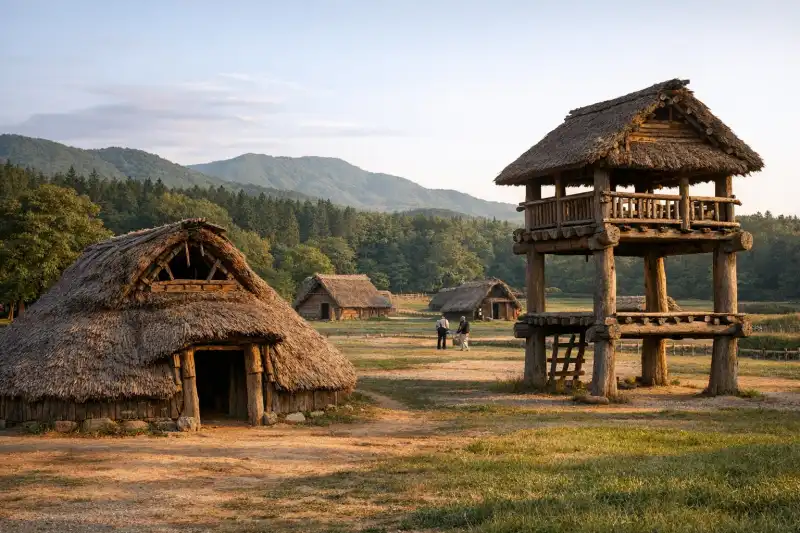
Goshono Jomon Site
Goshono Jomon Site in Japan is a remarkable archaeological park preserving a mid-Jomon period settle...
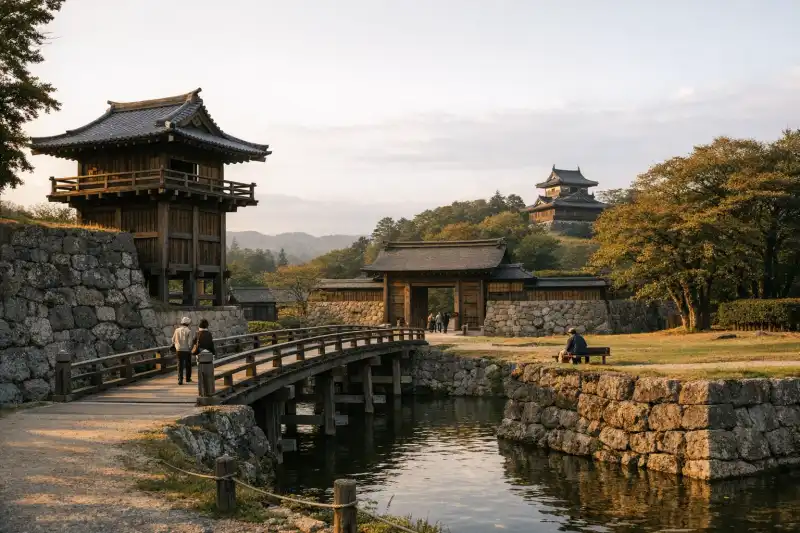
Akita Castle Site
Explore the Akita Castle Site, a historic Japanese fortification in Akita Prefecture that reveals th...
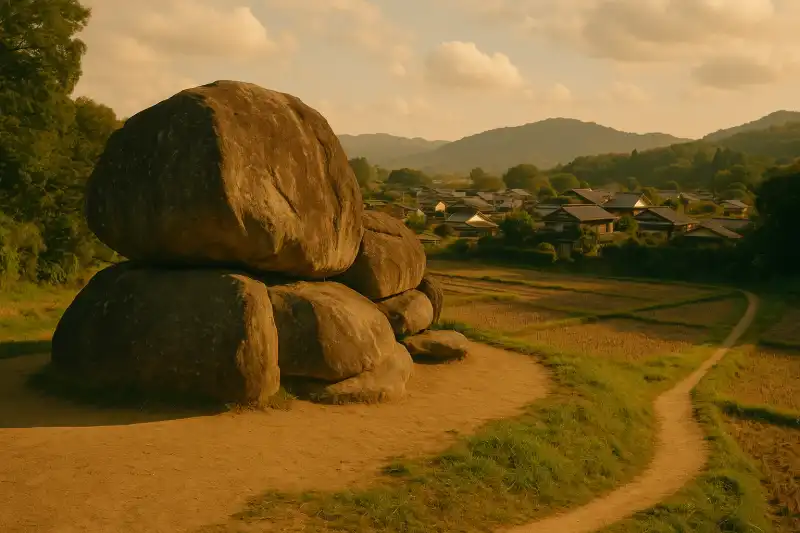
Asuka Historical Sites
Yamato CourtDiscover Asuka's ancient tombs, Buddhist temples, and enigmatic stone monuments — Japan's cradle of ...