Quick Info
At a glance
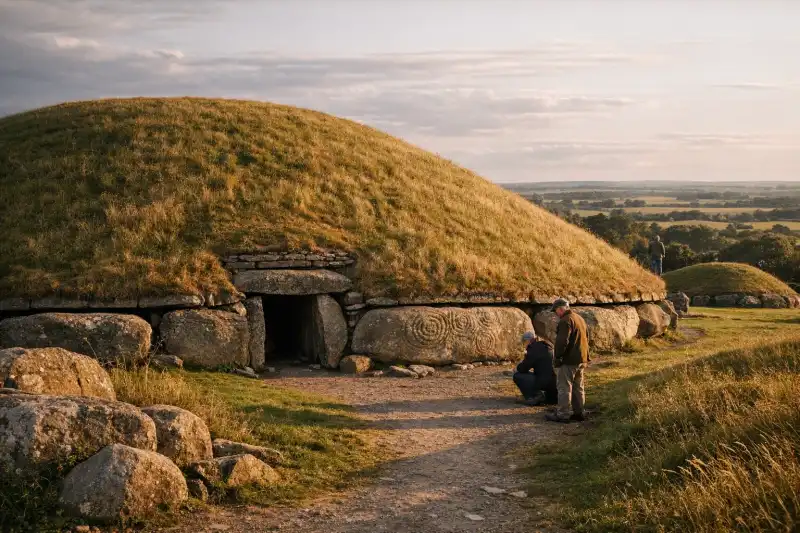
Knowth in Ireland sits within one of Europe’s most extraordinary prehistoric landscapes, a place where low green fields suddenly rise into a monumental statement of human ambition from more than five millennia ago. In the Boyne Valley, County Meath, the great mound of Knowth appears at first almost deceptively gentle: a broad grassy dome ringed with kerbstones and surrounded by smaller satellite tombs. Yet this calm exterior hides a story of engineering, ritual, memory, and reinvention that spans from the Neolithic to the Middle Ages. For travelers interested in ancient places, Knowth offers something especially rewarding: not simply a single tomb, but an entire ceremonial complex that reveals how deeply the first farming communities of Ireland shaped the land around them.
Part of the UNESCO-listed Brú na Bóinne landscape, Knowth is often visited alongside Newgrange and Dowth, but it has a character all its own. It is larger in diameter than Newgrange, more expansive in layout, and particularly famous for its megalithic carvings. Spirals, lozenges, lines, and abstract forms are etched across many of its stones, creating one of the richest surviving bodies of Neolithic art in western Europe. A visit here is not just about seeing an ancient mound. It is about standing inside a cultural landscape where astronomy, ceremony, burial, power, and later settlement all left their marks, layer upon layer, on one remarkable site.
History
Neolithic origins
Knowth was built around 3200 BC, during the Neolithic period, when communities across Ireland were transitioning to settled farming life. The monument’s main mound is immense, covering roughly an acre and edged by large kerbstones, many of them decorated with carvings. Two passages lead into the mound from east and west, each ending in a chamber. Around the central monument, smaller satellite tombs were also constructed, creating a carefully planned complex rather than an isolated burial place.
The scale of the undertaking is striking. Building Knowth required not only labor, but organization, planning, and shared purpose. Earth, stone, and turf had to be gathered and shaped; stones had to be transported; alignments had to be chosen. Like other passage tombs in the Boyne Valley, Knowth was almost certainly more than a tomb in the narrow sense. It was a ceremonial focus, a landmark, and perhaps a symbol of ancestral authority. The passages and chambers imply ritual use, while the artistry on the stones suggests a rich symbolic world that scholars are still trying to interpret.
Ceremonial significance and megalithic art
The carved stones at Knowth make it one of the most important prehistoric art sites in Europe. More than a quarter of all known megalithic art in western Europe has been associated with the site. These carvings include circles, arcs, serpent-like lines, chevrons, and repeated geometric patterns. Their meanings remain uncertain. Some may have held cosmological or spiritual significance; others might have marked boundaries, identities, or ritual sequences. Their mystery is part of Knowth’s enduring power.
There is also evidence that the passages were aligned with celestial events. The eastern passage is associated with sunrise around the equinoxes, while the western passage relates to sunset. Although Knowth is less famous for this than nearby Newgrange is for the winter solstice, these alignments show that the builders closely observed the sky and embedded that knowledge into architecture. The site was therefore not just a place of burial or remembrance, but one that linked the living community to cycles of time, season, and light.
Reuse in later prehistory and the Iron Age
Knowth did not remain frozen in its original Neolithic context. Like many powerful ancient places, it was reused by later communities. During the later prehistoric period, especially in the Iron Age, people returned to the mound and altered parts of it. Archaeological excavations have revealed ditches, enclosures, and evidence that the site retained importance long after its first builders were gone.
This continued use suggests that Knowth remained visible in cultural memory. Its massive mound dominated the local landscape and would have been impossible to ignore. Later groups may not have fully understood its original purpose, but they clearly recognized it as a place of significance. Across Europe, monumental prehistoric sites were often adopted and reinterpreted by successive societies, and Knowth fits that broader pattern.
Early medieval settlement and political importance
By the early medieval period, roughly from the first millennium AD onward, Knowth had become the site of settlement activity. Excavations uncovered evidence of houses and souterrains, indicating that people lived on and around the mound. The monument had evolved from a Neolithic ceremonial center into a place folded into everyday and political life.
At some stage, Knowth may also have served as an important royal or elite center connected with the kingship landscapes of Meath. The nearby Hill of Tara and other ancient sites formed part of a region where sacred authority and political power were deeply intertwined. Occupying Knowth may have helped later rulers claim prestige through association with an ancient and commanding place.
Excavation and modern understanding
Modern archaeological work at Knowth, especially from the 1960s onward under Professor George Eogan, transformed understanding of the site. Excavations revealed the two passages, chambers, extensive decorated stones, and complex sequence of later reuse. The work showed that Knowth was not a simple tomb but a long-lived ceremonial and settlement landscape with many phases.
Today Knowth forms part of the wider Brú na Bóinne World Heritage Site. Conservation efforts, visitor management, and ongoing research continue to refine what is known about the monument. Even so, many questions remain unresolved. That combination of careful scholarship and lingering mystery is part of what makes Knowth so compelling. It is both well studied and still, in many respects, undeciphered.
Key Features
The most obvious feature of Knowth is the great central mound itself, broad and imposing without being dramatically steep. Its size becomes clearer as you approach on foot. Rather than rising like a pointed hill, it spreads outward with quiet authority, a human-made landform integrated into the contours of the valley. Around its base stand kerbstones, some plain and many richly decorated. These stones are among the first details that draw close attention, because they compress astonishing artistic complexity into surfaces that have weathered thousands of Irish seasons.
Knowth’s megalithic art is perhaps its greatest distinction. The carvings do not present clear narratives or figures in the way travelers might expect from later historical monuments. Instead, they work through rhythm, repetition, and abstraction. Spirals turn inward; arcs echo each other; straight and wavering lines intersect in patterns that seem deliberate but elusive. Seen in person, they have a tactile quality that photographs often flatten. The art appears inseparable from the monument itself, not mere decoration but part of its meaning, as if the stones were made to carry ideas too important to leave unmarked.
Another defining feature is the pair of passages running into the mound from opposite sides. This dual arrangement is unusual and important. The eastern and western passages suggest that movement through the monument, and the relation of those spaces to light, formed part of a carefully designed ritual program. Visitors may not always have access to every interior area, depending on conservation and tour arrangements, but even learning about the internal layout changes how the mound is understood. It ceases to be simply a hill and becomes an engineered architecture of controlled space.
The ring of smaller satellite tombs around the main mound is also essential to the experience. These structures make clear that Knowth is a complex, not a lone monument. The surrounding tombs create the sense of a sacred precinct, a planned environment where multiple burials or ritual activities took place under the shadow of the central mound. Their presence suggests community scale: this was a place designed for repeated use and for collective memory, not a one-time construction detached from wider social life.
Just as striking as the architecture is the setting. The Boyne Valley is fertile, softly contoured, and visually gentle, qualities that make the huge labor of prehistoric construction even more impressive. Knowth does not occupy a wild mountain summit or a dramatic cliff edge. Instead, it rises from productive land, reminding visitors that this monument was built by farming communities deeply rooted in seasonal cycles. The landscape around it feels lived in, cultivated, and connected to everyday existence. That may be precisely why ceremonial architecture here had such force: it transformed ordinary terrain into sacred geography.
Archaeological interpretation at Knowth adds another layer. Unlike sites where little is visible beyond ruins, here the excavation history helps visitors imagine changing phases of use. The mound is Neolithic, but evidence of Iron Age and early medieval activity gives the place unusual chronological depth. Knowth is therefore not only a monument to the dead or to ritual. It is also an example of how later communities reuse older landscapes to gain status, continuity, and legitimacy. For travelers who enjoy sites with layered meaning, this is one of its greatest attractions.
Finally, the atmosphere of Knowth tends to be quieter than first-time visitors expect. There is grandeur, certainly, but not the theatrical grandeur of soaring classical ruins or towering temples. Knowth impresses through scale, age, and persistence. Its power is cumulative. The more you notice—the carvings, alignments, satellite tombs, settlement traces, and relationship to the wider Brú na Bóinne complex—the more extraordinary it becomes. It is a place that rewards patience and close observation rather than rushing from one photo stop to the next.
Getting There
Knowth is reached via the Brú na Bóinne Visitor Centre near Donore in County Meath, which manages access to the major monuments in the complex. The easiest base for most travelers is Dublin, about 50 kilometers away. By car, the drive usually takes around 45 minutes to 1 hour via the M1 and local roads, depending on traffic. Parking is available at the visitor centre, and from there visitors typically join a shuttle bus or guided transfer to the site.
If you are using public transport from Dublin, the most practical option is to take a Bus Éireann or other regional service toward Drogheda. Standard one-way fares are often around €10 to €16 depending on route and booking method. From Drogheda, a taxi to the Brú na Bóinne Visitor Centre generally costs about €20 to €30 each way. Some visitors also combine a train from Dublin Connolly to Drogheda, usually around €12 to €18 one way if booked close to departure, with a taxi onward.
Guided day tours from Dublin are another convenient choice, especially if you want interpretation included and prefer not to navigate rural transport connections. Organized tours covering Newgrange, Knowth, and the Boyne Valley commonly range from about €45 to €90 per person, depending on duration and inclusions. These can be particularly good value in high season when timed-entry tickets are in demand.
Because access arrangements can change, it is wise to reserve ahead through the official visitor centre and check whether your chosen ticket includes Knowth specifically, as some itineraries rotate between monuments.
When to Visit
The best time to visit Knowth is usually from late spring through early autumn, when daylight is longer and the Boyne Valley is at its greenest. From May to September, the landscape looks especially lush, and walking around the site is more pleasant in milder temperatures. Summer offers the highest chance of dry weather, but it also brings more visitors, especially on weekends and school holidays. If you prefer a calmer atmosphere, aim for a weekday morning.
Spring and early autumn are often ideal compromises. In April, May, September, and early October, the fields and trees still look vibrant, but crowd levels are usually lower than in peak summer. The softer light at these times of year can also be excellent for appreciating the textures of the mound and the carved stones. Since Knowth is an outdoor experience for much of the visit, a dry day makes a noticeable difference.
Winter visits can be rewarding if you enjoy stark landscapes and fewer crowds, but conditions are less predictable. Rain, wind, and cold can make the exposed parts of the site feel challenging, and shorter daylight hours compress visiting schedules. That said, the ancient connection between these monuments and the movement of light can make even a gray winter visit feel atmospheric.
Whatever the season, bring waterproof layers and sturdy shoes. Irish weather can change quickly, and the ground may be damp even after a clear morning. If photography matters to you, early or late light tends to give the mound more relief and depth than the flatter light of midday.
| Quick Facts | Details |
|---|---|
| Location | Brú na Bóinne, County Meath, Ireland |
| Type | Neolithic passage tomb complex |
| Date | c. 3200 BC |
| UNESCO Status | Part of the Brú na Bóinne World Heritage Site |
| Famous For | Megalithic art, twin passages, satellite tombs |
| Nearest City | Drogheda |
| Best Base | Dublin or Drogheda |
| Access | Via Brú na Bóinne Visitor Centre guided entry |
| Suggested Visit Time | 2 to 3 hours |
| Best Season | Spring to early autumn |
Knowth rewards travelers who are willing to look beyond the obvious and imagine deep time written into the land. It is not just one of Ireland’s finest prehistoric monuments, but one of the clearest demonstrations of how ancient communities shaped landscape, memory, and ritual into enduring form. The great mound, its carved stones, and its surrounding tombs speak of technical skill and symbolic ambition on a remarkable scale. Yet what lingers longest after a visit is often the sense of continuity: generation after generation returned to this place, reusing it, reinterpreting it, and preserving its presence in the valley.
For visitors exploring ancient Ireland, Knowth offers a more layered encounter than many famous sites. It stands at the intersection of archaeology, art, astronomy, and political history, all within an accessible day trip from Dublin. Whether you come for the UNESCO prestige, the megalithic carvings, or the wider landscape of Brú na Bóinne, Knowth delivers a rare kind of experience: one that grows richer the more you learn about it, and more mysterious the longer you stand before it.
Guided tours: worth it?
A guide can be genuinely useful at Knowth, especially if you want help with transport, timing, tickets, or understanding a large site without losing half the day to logistics.
Best for
- First-time visitors who want context, not just photos
- Travelers who want transport, timing, or entry logistics handled
- Short visits where a planned route saves time
When to go self-guided
Go independently if you already have transport and tickets sorted, enjoy moving at your own pace, and are comfortable checking the latest official rules before you arrive.
What I’d avoid
Skip paid tours that bundle unrelated stops you do not actually want. The best option should either save meaningful planning time or add historical context you would miss on your own.
Knowth and Boyne Valley tours
Useful when: you want to compare guided formats before deciding
Newgrange and Knowth day trips from Dublin
Useful when: transport or pickup logistics matter
Br%C3%BA na B%C3%B3inne archaeological tours
Useful when: you want to compare guided formats before deciding
Some tour links are affiliate links, which may earn Ancient Travel a small commission at no extra cost to you. I try to surface options that make practical sense for the site—not just anything bookable.
Frequently Asked Questions
Can you visit Knowth independently?
Access to Knowth is managed through the Brú na Bóinne Visitor Centre, and visits are usually by guided tour rather than fully independent entry.
Is Knowth older than the pyramids?
Yes. Like nearby passage tombs in the Boyne Valley, Knowth dates to the Neolithic period around 3200 BC, making it older than the Great Pyramids of Giza.
How long does a visit to Knowth take?
Most visitors should allow at least 2 to 3 hours including the visitor centre transfer, guided interpretation, and time to explore the mound exterior and surrounding tombs.
What is Knowth famous for?
Knowth is especially known for its huge central mound, two passage tombs, and the largest concentration of megalithic art in western Europe.
Can you go inside the tomb at Knowth?
Some guided visits include access to parts of the passages or interior spaces, but access conditions can vary depending on conservation needs and site management.
Is Knowth suitable for children?
Yes, many families visit Knowth, though the experience is best for children who enjoy outdoor walking, archaeology, and guided storytelling about ancient Ireland.
Nearby Ancient Sites
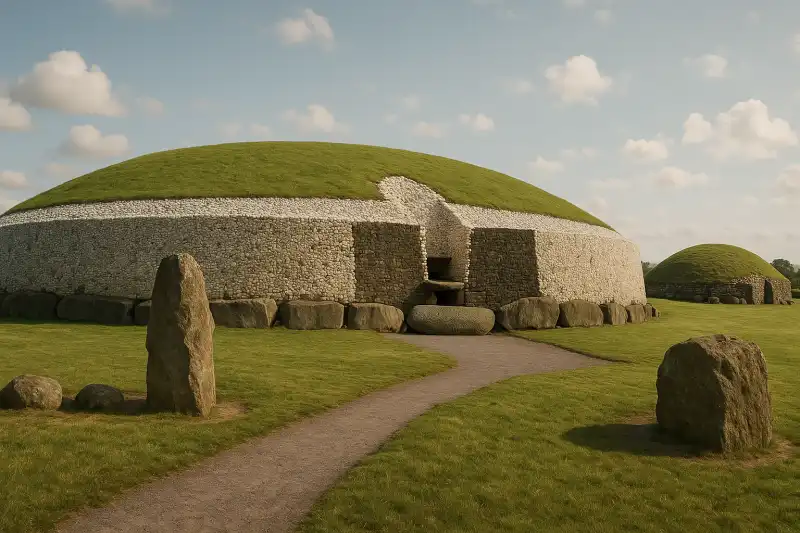
Boyne Valley Passage Tombs Travel Guide 2026: Newgrange, Knowth, and Dowth Visit Strategy
Neolithic IrelandPlan your first Boyne Valley passage tombs visit with practical timing, Brú na Bóinne access flow, a...
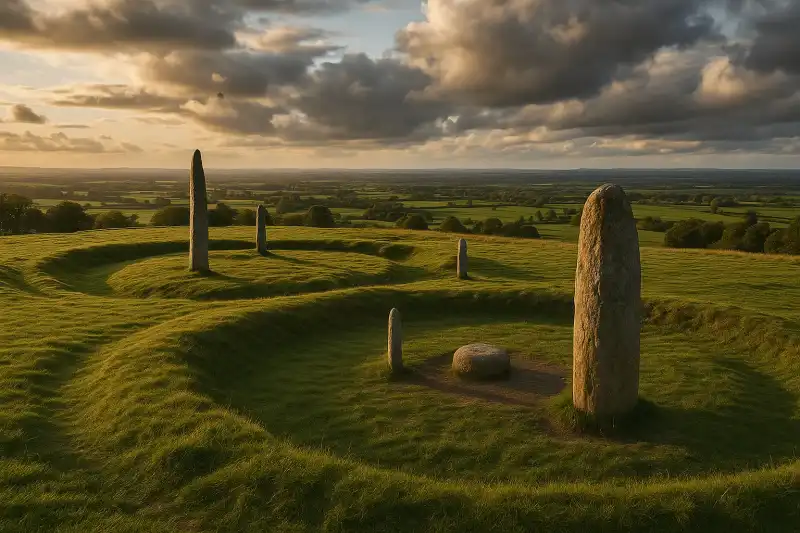
Hill of Tara Travel Guide 2026: Sacred Kingship Landscape, Site Highlights, and Meath Planning
Celtic IrelandPlan a first visit to the Hill of Tara with practical route tips, key myth-and-history context, and ...
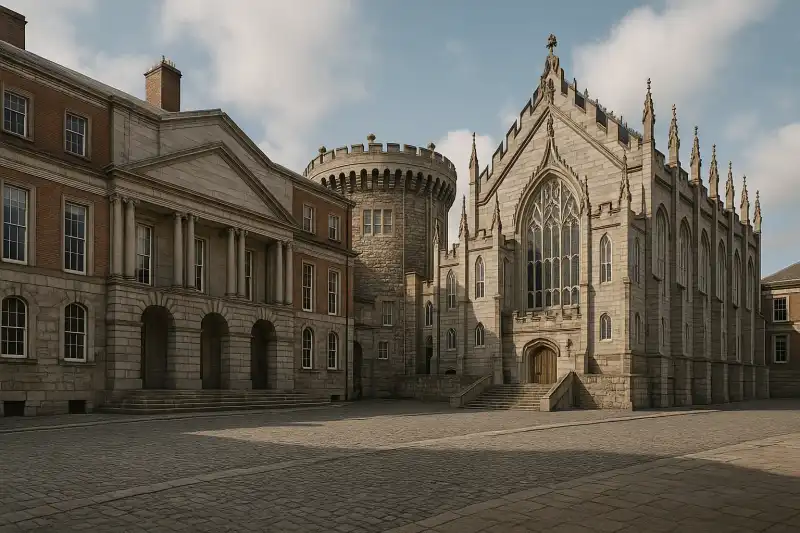
Dublin Castle Travel Guide 2026: State Apartments, Viking Layers, and City-Center Route
Medieval and Early Modern IrelandPlan a first visit to Dublin Castle with practical timing, ticket strategy, and clear context on the...
Glendalough Travel Guide 2026: Monastic Ruins, Lakes, and Wicklow Day-Trip Plan
Early Medieval IrelandPlan a clear first visit to Glendalough with route advice, monastic-site context, and practical timi...