Quick Info
At a glance
Koh Ker in Cambodia feels different from the better-known temple landscapes around Angkor. Far from the crowds and ringed by dry forest, this former royal center appears with a sense of suddenness: sandstone towers, linga shrines, and the striking stepped mass of Prasat Thom rising above the trees. The site’s atmosphere is part of its appeal. Roads lead through rural villages and fields before the remains of a once-ambitious capital emerge, scattered across a broad archaeological zone that still feels wild at the edges. While Angkor often overwhelms with density and grandeur, Koh Ker fascinates by contrast, offering a rarer glimpse of a Khmer city that flourished intensely, briefly, and with remarkable confidence.
For travelers interested in ancient Cambodia, Koh Ker offers more than a side trip. It reveals a chapter of the Khmer Empire when political authority shifted away from Angkor and monumental building followed. The temples here are not arranged as a compact urban park but spread through woodland, reservoirs, and clearings, encouraging a slower, more exploratory visit. Massive stone blocks, elegant carvings, and unfinished surfaces all hint at a capital built with extraordinary speed. The result is a destination that combines historical importance with a real sense of discovery, where the silence between monuments can be as memorable as the architecture itself.
History
The rise of a new royal center
Koh Ker, known in inscriptions as Chok Gargyar, rose to prominence in the early 10th century during a turbulent phase of Khmer history. The site is most closely associated with King Jayavarman IV, who established his court here around 928 CE. Before that move, the center of Khmer power had been tied more closely to the Angkor region. Jayavarman IV’s decision to rule from Koh Ker was both political and symbolic. By creating a new capital, he was asserting legitimacy and projecting royal authority through architecture, ritual, and landscape design.
The selection of Koh Ker was not random. The area offered room for extensive planning, and like other Khmer centers, it was shaped through a combination of temples, reservoirs, roads, and ceremonial spaces. Inscriptions suggest that the king sponsored major religious foundations here, especially those linked to the worship of Shiva. This was not simply a provincial outpost but a royal city intended to rival older centers in splendor and ritual importance.
Jayavarman IV and monumental ambition
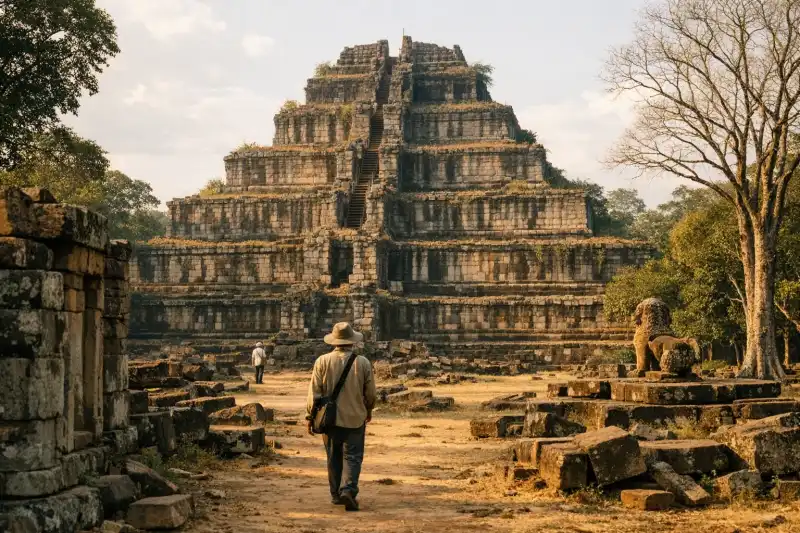
The most dynamic building phase at Koh Ker took place under Jayavarman IV and continued into the reign of his son, Harshavarman II. In only a short period, craftsmen and laborers created dozens of sanctuaries across a large area. The best known is Prasat Thom, the main state temple, paired with the imposing stepped pyramid often called Prang. This structure is unlike most temple mountains in Cambodia, with a stark, powerful profile that emphasizes height and geometry rather than the more ornate visual rhythm seen at later Angkor monuments.
Koh Ker’s monuments reveal a style that is recognizably Khmer but distinct in execution. Sculptures from the site were once especially celebrated for their scale and energy, including giant guardian figures and finely worked deities. Many original statues have been removed over time, some through looting, but surviving fragments and museum collections confirm the artistic sophistication of the capital. The city appears to have been designed with a strong ritual axis, and the temples reflect both royal devotion and a political message: the king had the power to reorder sacred space itself.
Return of the capital to Angkor
Koh Ker’s time as the center of the empire was brief. After the reign of Harshavarman II, the royal court shifted back toward the Angkor area under Rajendravarman II in the mid-10th century. This change did not erase Koh Ker from the map, but it did reduce its central importance. Some temples remained active, and the area likely continued to support local religious and economic life, yet it was no longer the heart of imperial administration.
This short lifespan as a capital is one reason Koh Ker is so historically compelling. It captures a concentrated moment when political rivalry, royal ambition, and sacred architecture aligned to create a city of unusual intensity. Because the site did not continue to develop in the same way as Angkor, it preserves a more focused architectural horizon, one dominated by 10th-century experimentation and confidence.
Survival, neglect, and rediscovery
Like many ancient Khmer sites, Koh Ker was gradually reclaimed by the forest. Later generations knew of its ruins, but for long periods it remained remote and difficult to access. In the modern era, instability in Cambodia and the presence of landmines in some surrounding areas limited research and tourism. Looting also damaged the site, with sculptures and architectural fragments removed illegally and dispersed through the international antiquities market.
In recent decades, conservation and archaeological work have brought Koh Ker greater recognition. Improved roads made visits more practical from Siem Reap, and scholars have continued to study the settlement’s scale, water management, and artistic program. International attention increased further after the site gained UNESCO World Heritage status in 2023, recognizing its significance as an archaeological testament to the Khmer Empire. Today, Koh Ker stands not only as a remarkable remnant of a former capital but also as a reminder of the need to protect vulnerable heritage landscapes beyond the most famous tourist circuits.
Key Features
The defining image of Koh Ker is the stepped pyramid of Prasat Thom, and for good reason. Rising in seven tiers above the plain, it commands the surrounding forest with a severity that feels almost architectural in the modern sense. Unlike the more intricate silhouette of Angkor Wat, this monument impresses through mass and clarity. Each level draws the eye upward toward what was once the summit sanctuary, creating a strong visual metaphor for ascent and sacred elevation. Approached on foot, the structure seems to emerge from the trees with startling force, and from the upper levels the landscape stretches outward in muted greens and browns depending on the season.
Yet Koh Ker is much more than its pyramid. The wider complex contains numerous temples, shrines, enclosures, and waterworks spread across several kilometers. This dispersed layout gives the site a sense of archaeological breadth. Some monuments stand relatively intact, while others survive as brick towers half hidden by roots and vegetation. At places such as Prasat Pram, giant strangler fig roots grip the masonry in ways that immediately evoke the romance of jungle ruins. Elsewhere, laterite walls and sandstone lintels show the technical variety of Khmer construction, from precise carved decoration to monumental engineering.
One of the most striking characteristics of Koh Ker is the scale of its stones and the boldness of its design. Doorways, platforms, and sanctuary bases often feel oversized, as though conceived to match the ambitions of a court eager to announce its power. The carvings that remain include floral motifs, divine imagery, and decorative bands characteristic of the period. Even when sculptures are missing, the pedestals and empty chambers hint at the ceremonial richness these spaces once held. The site was especially associated with Shaivism, and inscriptions refer to significant lingas, including one famed for its size and sanctity.
Water also played a central role in the landscape. The enormous baray, or reservoir, linked the city to the Khmer tradition of shaping hydraulic environments as both practical and symbolic systems. These works supported settlement and ritual while expressing royal control over resources and cosmology. At Koh Ker, the baray and associated channels help visitors understand that this was not just a cluster of temples but a planned capital integrated into a larger urban and sacred landscape.
Another feature that sets Koh Ker apart is its atmosphere. Because the monuments are separated by stretches of road and woodland, each stop feels self-contained. You do not simply move from one temple to the next in a continuous stream of visitors; instead, the site invites pauses, drives through quiet countryside, and moments of near solitude. Birds, insects, and wind in the trees become part of the experience. In the early morning, the light can soften the red tones of brick and laterite, while in late afternoon the pyramid catches stronger shadow and definition. This changing natural frame adds emotional depth to the architecture.
For photographers and history-focused travelers alike, Koh Ker offers a balance of landmark drama and textural detail. The famous pyramid provides the headline image, but the site’s real richness lies in its variety: tower sanctuaries, vine-covered ruins, fragments of carving, broad clearings, and the sense of a city only partially revealed. It is this combination of royal monumentality and forested quiet that makes Koh Ker one of Cambodia’s most memorable ancient destinations.
Getting There
Most travelers visit Koh Ker from Siem Reap, which is the most practical base and has the best range of hotels, guides, and transport options. The drive is usually around 120 kilometers and takes roughly 2.5 to 3.5 hours each way, depending on traffic, road conditions, and whether you combine the trip with other sites such as Beng Mealea. A private car with driver is the easiest option and typically costs about $70 to $120 for a day trip, depending on vehicle type, fuel prices, and how many stops are included. Hiring a licensed guide adds to the cost but can make the scattered temples much easier to understand.
Shared tours from Siem Reap are also common and can be a good value for solo travelers. Group day tours generally start around $35 to $70 per person, though pricing varies by season, group size, and whether entrance fees or lunch are included. Tuk-tuks are usually not recommended for the full journey because of the long distance and heat, though they may be possible for adventurous travelers in dry weather. Renting a motorbike offers flexibility but should only be considered by confident riders comfortable with Cambodian roads and remote conditions.
There is no direct public transport option that is especially convenient for most visitors. If you are traveling independently, arrange transport in advance and bring water, sun protection, and cash for tickets and snacks, as facilities are limited compared with Angkor. Mobile signal is generally available but may be weaker in some parts of the route. Starting early from Siem Reap helps avoid the hottest midday hours and leaves enough time to explore several monuments at a relaxed pace.
When to Visit
The best time to visit Koh Ker is during Cambodia’s dry season, especially from November to February. These months usually bring the most comfortable weather, with lower humidity, clearer skies, and cooler mornings. For a site that requires walking in open areas and moving between widely spaced monuments, this matters a great deal. The light is also excellent for photography, particularly early in the day when the pyramid and temple towers stand out crisply against the sky.
March to May is the hottest period. Visits are still possible, but midday temperatures can be intense, and the exposed stone around Prasat Thom can feel especially harsh under direct sun. If you come during these months, leave Siem Reap before sunrise if possible, carry plenty of water, and plan on a slower pace with shade breaks. The advantage of the hot season is that visitor numbers can be lower, creating an even quieter atmosphere at the ruins.
The rainy season, from roughly June to October, transforms the countryside. Forest growth becomes lush, moats and reservoirs look fuller, and the ruins can appear especially atmospheric in the green landscape. However, showers can be heavy and sudden, paths may become muddy, and road conditions can be less predictable in rural areas. If you enjoy dramatic skies and do not mind some logistical uncertainty, this season can be rewarding. For most travelers seeking the easiest and most comfortable visit, though, the cool dry months remain the ideal choice. Whenever you go, aim to arrive early or later in the afternoon, as the softer light and lower heat make the site far more enjoyable.
| Quick Facts | Details |
|---|---|
| Location | Preah Vihear Province, northern Cambodia |
| Ancient name | Chok Gargyar |
| Main period | Early to mid-10th century CE |
| Civilization | Khmer Empire |
| Most famous monument | Prasat Thom and its seven-tiered pyramid |
| Historical role | Brief capital of the Khmer Empire under Jayavarman IV |
| Distance from Siem Reap | About 120 km |
| Typical visit length | Half day to full day |
| Best season | November to February |
| UNESCO status | World Heritage Site since 2023 |
Koh Ker rewards travelers who want to look beyond Cambodia’s most famous skyline and encounter a place where royal ambition, spiritual purpose, and remoteness still shape the experience. Its monuments do not form a polished museum landscape; they remain part of a broader terrain of forest, reservoirs, and quiet roads, which makes the ancient city feel unusually alive. A visit here deepens any understanding of Khmer history by showing that imperial power was not fixed in one place but could shift, build rapidly, and leave behind a distinct architectural language. For many visitors, the memory that lasts longest is not only the sight of the pyramid itself, but the feeling of reaching a lost capital that still stands slightly apart from the modern tourist map.
Guided tours: worth it?
A guide can be genuinely useful at Koh Ker, especially if you want help with transport, timing, tickets, or understanding a large site without losing half the day to logistics.
Best for
- First-time visitors who want context, not just photos
- Travelers who want transport, timing, or entry logistics handled
- Short visits where a planned route saves time
When to go self-guided
Go independently if you already have transport and tickets sorted, enjoy moving at your own pace, and are comfortable checking the latest official rules before you arrive.
What I’d avoid
Skip paid tours that bundle unrelated stops you do not actually want. The best option should either save meaningful planning time or add historical context you would miss on your own.
Koh Ker tours from Siem Reap
Useful when: transport or pickup logistics matter
Koh Ker and Beng Mealea day trips
Useful when: transport or pickup logistics matter
Cambodia temple tours including Koh Ker
Useful when: you want to compare guided formats before deciding
Some tour links are affiliate links, which may earn Ancient Travel a small commission at no extra cost to you. I try to surface options that make practical sense for the site—not just anything bookable.
Frequently Asked Questions
What is Koh Ker best known for?
Koh Ker is best known for Prasat Thom, a dramatic seven-tiered pyramid temple, and for serving briefly as the capital of the Khmer Empire in the 10th century.
How far is Koh Ker from Siem Reap?
Koh Ker is about 120 kilometers northeast of Siem Reap, and most visitors reach it by car in roughly 2.5 to 3.5 hours depending on road conditions and stops.
Is Koh Ker part of the Angkor Archaeological Park?
No. Koh Ker is a separate archaeological zone in northern Cambodia, distinct from the main Angkor park near Siem Reap.
How much time do you need to visit Koh Ker?
A half day is enough to see the main monuments, but a full day allows time for multiple temples, forested ruins, and a slower visit from Siem Reap.
Can you climb the pyramid at Koh Ker?
Access rules can change, but visitors are often able to ascend via a modern wooden staircase or designated route at Prasat Thom when conditions are considered safe.
When is the best time to visit Koh Ker?
The dry season from November to February is usually the most comfortable, with cooler temperatures, less rain, and easier road access.
Nearby Ancient Sites
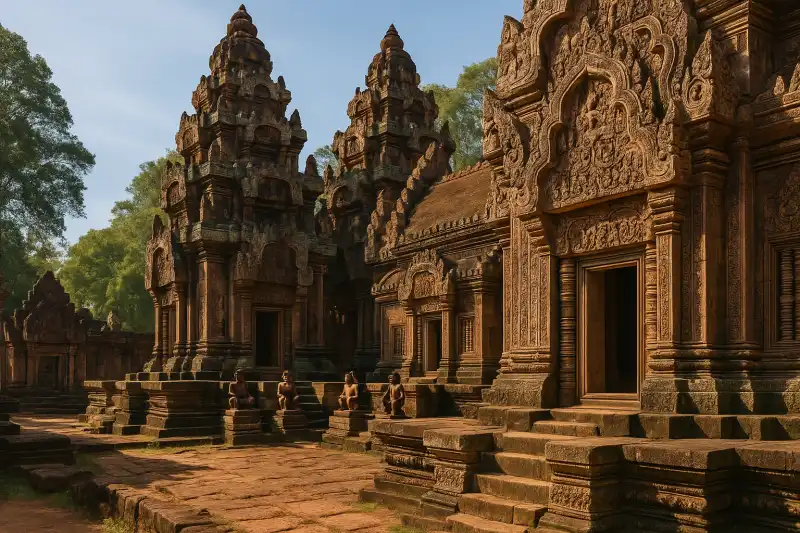
Banteay Srei Travel Guide 2026: Pink Sandstone Temple, Carvings, and Visit Tips
KhmerBanteay Srei is one of Cambodia’s most detailed Khmer temples, known for fine pink sandstone carving...
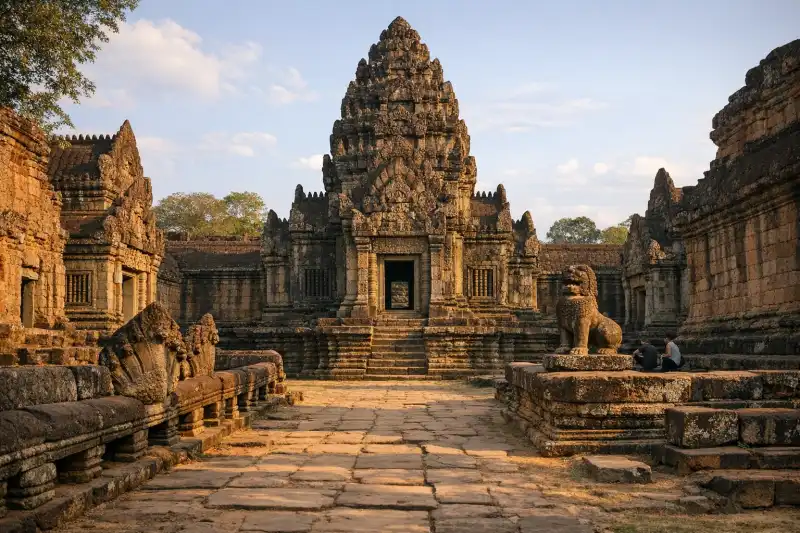
Banteay Samré
Banteay Samré is a beautifully preserved 12th-century Hindu temple in Cambodia’s Siem Reap province,...
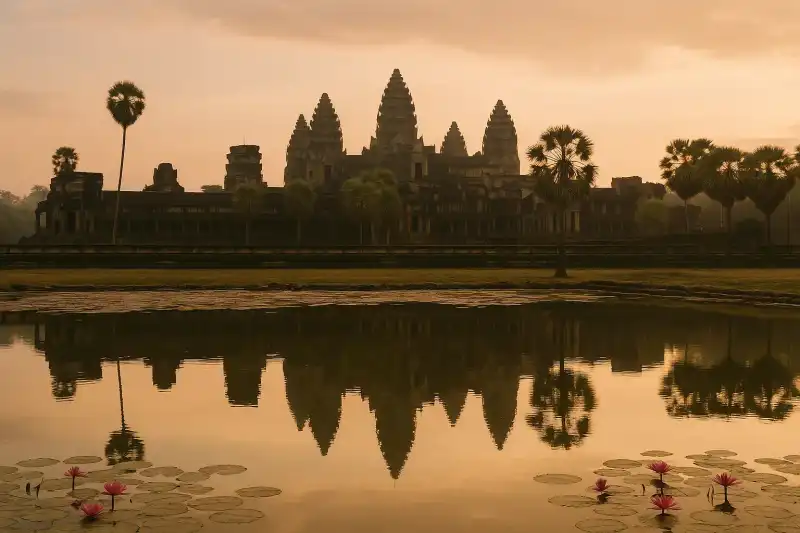
Angkor Wat Travel Guide 2026: Everything You Need to Know
KhmerAngkor Wat, the world's largest religious monument, spans over 400 acres in the heart of Cambodia. T...
Angkor Thom Travel Guide 2026: Bayon Faces, Gates, and the Khmer Royal City
KhmerAngkor Thom was the last great capital of the Khmer Empire. This guide covers how to visit Bayon, th...