Quick Info
At a glance
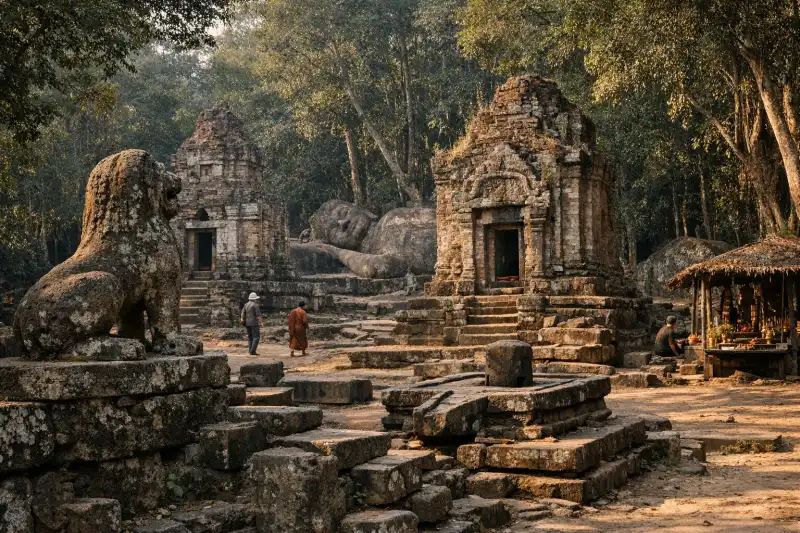
Kulen Mountain temples in Cambodia sit within one of the most sacred landscapes in Khmer history, where forested ridges, sandstone riverbeds, and weathered shrines come together high above the plains of Siem Reap Province. More than a single monument, this is a mountain sanctuary: a network of ancient religious sites, archaeological traces, and ritual places spread across Phnom Kulen, a plateau long associated with royal authority, Hindu symbolism, and later Buddhist devotion. Travelers who know Cambodia mainly through Angkor often find Kulen surprisingly different. Instead of monumental walls rising from a formal city plan, the mountain offers fragments, carvings, sanctuaries, and natural features that blend into jungle, streams, and cliff edges.
That mixture of nature and antiquity is precisely what makes Kulen memorable. Here, the landscape itself feels designed for worship. Water runs over carved lingas in river channels, hilltop temples overlook thick forest, and living religious practice continues around statues and shrines that have drawn reverence for centuries. Visiting Kulen Mountain temples is therefore not only about checking off ruins. It is about understanding how the Khmer world first anchored kingship, cosmology, and sacred geography in a mountain setting before the great urban splendor of Angkor fully emerged on the plain. For anyone interested in the deep origins of Cambodia’s classical civilization, Kulen is one of the most evocative places in the country.
History
Early sacred significance of Phnom Kulen
Long before the monumental zenith of Angkor, Phnom Kulen already held exceptional spiritual importance. The mountain massif, rising above the surrounding lowlands, naturally invited association with cosmic high places. In South and Southeast Asian religious thought, mountains often represented the axis between earthly and divine realms, and Phnom Kulen appears to have been understood in similar terms. Streams descending from the plateau also gave the area practical as well as symbolic value, since water was essential to settlement, ritual, and later the hydraulic systems for which the Khmer world became famous.
Archaeological remains across Kulen suggest that this was not simply an isolated pilgrimage zone but an early center of state formation and royal ritual. The temples and carved riverbeds found here belong to a landscape where kingship, religion, and the natural environment were tightly interconnected. Rather than creating one single ceremonial complex, early builders sacralized multiple points across the mountain, shaping a dispersed but coherent sacred territory.
Jayavarman II and the foundation of Khmer kingship
Phnom Kulen is most famous for its connection to Jayavarman II, the ruler traditionally associated with the founding of the Khmer Empire in the early 9th century. Historical inscriptions and later interpretations link the mountain with ceremonies that affirmed royal sovereignty and the divine status of kingship. Although scholars continue to debate certain details, Kulen is widely regarded as one of the key stages in the emergence of an independent Khmer polity distinct from external influences.
This association gives the mountain enormous historical weight. Before Angkor Wat, before Bayon, before the grand capitals of later centuries, there was this upland realm where political theology was articulated in lasting form. The idea of the god-king, often discussed in relation to Khmer statecraft, was grounded not only in inscriptions and temples but in ritual landscapes such as Kulen. The mountain therefore stands at the threshold of empire, marking a moment when sacred authority and territorial power were being fused.
The early temples here were likely modest compared with later Angkorian masterpieces, but their significance lies in function and setting rather than scale. They belonged to a world in transition, when rulers were establishing legitimacy and sacralizing territory. In that sense, Kulen’s ruins are among the most meaningful in Cambodia even when they appear architecturally restrained.
Development in the Angkorian period
As the Khmer Empire expanded and monumental building shifted toward the Angkor plain, Phnom Kulen did not lose its importance. Instead, it remained a sacred hinterland tied to the ideological and ritual life of the empire. The mountain’s rivers, shrines, and sanctified spaces continued to attract patronage, and carvings such as the celebrated riverbed lingas demonstrate how the natural environment itself was integrated into temple religion.
These carvings, often grouped under the popular name “River of a Thousand Lingas,” likely date from the Angkorian period when the symbolism of Shiva, fertility, kingship, and water management overlapped powerfully. By carving lingas and related imagery into the streambed, Khmer artisans transformed flowing water into ritually charged water. As it moved downhill toward the plain, it became not only physically useful but spiritually potent. This union of geography and religion is one of the defining ideas of Khmer civilization, and Kulen presents it in unusually direct form.
Other temple remains on the mountain, though fragmentary, show continued religious activity over generations. Sanctuaries were built, altered, reused, and reinterpreted. As elsewhere in Cambodia, religious life was never static. Hindu devotion remained important, but Buddhist practice increasingly took root over time, layering new meanings onto older sacred spaces.
Buddhist continuity and modern rediscovery
In later centuries, Phnom Kulen became especially associated with Buddhist worship. One of its best-known religious monuments today is the great reclining Buddha, a revered image carved from sandstone and sheltered within a modern pagoda structure. This monument reflects the long continuity of pilgrimage on the mountain. Rather than being abandoned relics, many Kulen sites have remained spiritually active, even as dynasties changed and forests reclaimed older masonry.
Modern history added further complexity. Like many Cambodian heritage zones, the region suffered from conflict, insecurity, and limited access during the 20th century. For years, visits were difficult, and archaeological study proceeded unevenly. In more recent decades, improved security, tourism infrastructure, and heritage interest have brought Kulen back into broader public awareness. Yet it still feels different from the highly visited Angkor core. The experience is less urban, less monumental, and more landscape-based.
Today, Kulen Mountain temples are appreciated both as archaeological remains and as elements of a sacred living environment. That dual identity is essential to understanding the site. The mountain is not merely a prelude to Angkor; it is a key chapter in its own right, preserving early Khmer political memory, ritual practice, and a striking vision of how temples could be embedded within nature.
Key Features
The most compelling feature of Kulen Mountain temples is the way architecture and landscape merge. Visitors do not encounter a single dominant complex rising from open ground. Instead, they move through a sacred plateau where shrines, carvings, boulders, stairways, springs, and wooded paths form parts of a broader ritual geography. This gives the mountain an exploratory quality. Even when individual structures are small or damaged, the whole environment carries a sense of sanctity and historical depth.
Among the most remarkable features are the carvings in the riverbed, often described as the River of a Thousand Lingas. Here, the sandstone floor beneath shallow running water is incised with repeated lingas, yoni forms, and other sacred imagery. In some places the carvings are geometric and ordered; in others they appear as patterned fields beneath the moving current. The effect is unlike that of a conventional temple. Water becomes the medium through which sculpture is seen and understood. Depending on the season, the carvings may be more exposed or more partially submerged, but their symbolic force remains clear. They reflect a Khmer religious imagination in which rivers could be consecrated as surely as sanctuaries.
Another major feature is the reclining Buddha, one of the most active devotional sites on the mountain. Carved from a massive sandstone outcrop, the figure lies within a later Buddhist complex where pilgrims offer incense, flowers, and prayers. The sculpture’s setting reveals a great deal about Kulen’s long history. Even if the image postdates the earliest phase of the mountain’s sacred role, it demonstrates continuity rather than rupture. New forms of worship settled into old holy ground. For travelers, the site also offers a reminder that Cambodian heritage is not only archaeological but devotional. You may find monks, local worshippers, and domestic pilgrims sharing the space with international visitors.
Scattered temple remains across Phnom Kulen further enrich the experience. Some consist of brick or sandstone towers in partial ruin, while others survive as terraces, foundations, or isolated architectural fragments reclaimed by vegetation. Their scale can feel intimate compared with Angkor Wat or Angkor Thom, but that intimacy is part of their appeal. These are places where you can closely observe masonry techniques, weathered carvings, and the way tree roots and lichen have softened ancient stone. In some spots, the remains seem almost hidden, reinforcing the sense that Kulen is a mountain of sacred traces rather than monumental spectacle.
The natural setting itself is also a key feature. Dense greenery, elevated viewpoints, and flowing streams give Kulen a freshness absent from some of the hotter, more exposed temple zones on the plain. Many visitors combine archaeological stops with nearby waterfalls and forest walks, which helps explain why the mountain appeals to both heritage travelers and those seeking a broader day in nature. This does not diminish the temples; instead, it restores them to the ecological setting in which they were conceived. Sacred mountains were meant to be experienced as mountains, not merely as stone architecture.
Finally, Kulen’s atmosphere distinguishes it from almost any other major Khmer site. The mountain feels foundational. There is a strong sense here of beginnings: the beginnings of empire, of sacred kingship, of water ritual, and of a Khmer vision linking mountain sanctity with political order. Even where structures are fragmentary, that atmosphere remains intact. For travelers interested in meaning as much as scale, Kulen can be one of the most rewarding sites in Cambodia.
Getting There
Most travelers reach Kulen Mountain temples from Siem Reap, the main base for visiting Angkor and other historic sites in northwestern Cambodia. The mountain lies roughly 50 to 60 kilometers from the city, but travel time is usually around 1.5 to 2.5 hours each way depending on traffic, road conditions, and the exact stops included. Because the temples are spread across Phnom Kulen rather than concentrated at one gate, private transport is usually the easiest option.
A private car or taxi from Siem Reap is the most comfortable choice and typically costs about $45 to $70 for a full-day trip, depending on season, vehicle type, and whether you negotiate directly or book through a hotel. Shared or private guided tours often range from $35 to $90 per person, with higher prices for small-group experiences that include a guide, hotel pickup, and multiple stops such as Banteay Srei. Motorbike taxis can be cheaper, but the trip is long and less comfortable in heat or rain; expect roughly $20 to $35 if available and negotiated locally. Self-drive scooters are not always the most practical option for all travelers due to road conditions, distance, and park access rules, so check current local regulations before relying on that plan.
Entrance to Phnom Kulen National Park is usually charged separately from the Angkor pass. Fees change, but international visitor admission is often around $20 per person. Bring cash unless you have confirmed card acceptance in advance. Start early in the morning, especially if you want time for multiple temple stops, river carvings, the reclining Buddha, and a relaxed lunch. Road access up the mountain has historically involved one-way traffic patterns at certain times of day, so a local driver familiar with current rules is useful.
When to Visit
The best time to visit Kulen Mountain temples is generally during Cambodia’s dry season, from about November to February, when temperatures are more comfortable and roads are usually easier to navigate. This period offers the most pleasant conditions for walking between temple remains and spending time outdoors along the riverbeds. Morning visits are especially rewarding, with softer light, cooler air, and fewer crowds at the most popular devotional and natural stops.
The hot season, roughly March to May, can still be a good time to go if you start early and pace your day carefully. Temperatures often rise quickly by late morning, and exposed areas can feel intense. Bring water, sunscreen, a hat, and clothing suitable for both temple etiquette and heat management. The advantage of this season is that visitor numbers may be lower on some days, and the forested mountain environment can still feel refreshing compared with the plains.
The rainy season, from around May or June through October, transforms Phnom Kulen into a lush and dramatic landscape. Streams and waterfalls are fuller, and the forest appears especially vibrant. This can make the mountain exceptionally beautiful, particularly for photographers and travelers who enjoy green scenery. However, rain can also complicate travel, create muddy paths, and reduce visibility of some riverbed carvings if water levels are high. If you visit during these months, allow extra transit time and wear reliable footwear with grip.
For a balanced experience, late November through January is often ideal: cooler weather, relatively clear roads, and enough water in the landscape to keep the mountain visually striking. If your main interest is the sacred river carvings, ask locally about current water levels before choosing your date.
| Quick Facts | Details |
|---|---|
| Site | Kulen Mountain temples |
| Location | Phnom Kulen, Siem Reap Province, Cambodia |
| Nearest city | Siem Reap |
| Cultural context | Early Khmer and Angkorian sacred landscape |
| Best known for | River carvings, hilltop shrines, reclining Buddha, origins of Khmer kingship |
| Typical visit length | Full-day trip from Siem Reap |
| Access | By private car, taxi, guided tour, or arranged motorbike transport |
| Separate ticket needed | Yes, usually Phnom Kulen park admission separate from Angkor pass |
| Best season | November to February |
| Terrain | Forest paths, temple ruins, stone steps, riverbed areas |
Guided tours: worth it?
A guide can be genuinely useful at Kulen Mountain temples, especially if you want help with transport, timing, tickets, or understanding a large site without losing half the day to logistics.
Best for
- First-time visitors who want context, not just photos
- Travelers who want transport, timing, or entry logistics handled
- Short visits where a planned route saves time
When to go self-guided
Go independently if you already have transport and tickets sorted, enjoy moving at your own pace, and are comfortable checking the latest official rules before you arrive.
What I’d avoid
Skip paid tours that bundle unrelated stops you do not actually want. The best option should either save meaningful planning time or add historical context you would miss on your own.
Kulen Mountain Cambodia tours
Useful when: you want to compare guided formats before deciding
Phnom Kulen National Park day trips
Useful when: transport or pickup logistics matter
Siem Reap to Kulen Mountain tours
Useful when: you want to compare guided formats before deciding
Some tour links are affiliate links, which may earn Ancient Travel a small commission at no extra cost to you. I try to surface options that make practical sense for the site—not just anything bookable.
Frequently Asked Questions
Where are the Kulen Mountain temples located?
The Kulen Mountain temples are in Phnom Kulen, Siem Reap Province, Cambodia, northeast of the Angkor area and reachable on a day trip from Siem Reap.
Are the Kulen Mountain temples part of Angkor history?
Yes. Phnom Kulen is closely tied to the origins of the Khmer Empire and is considered one of the most important sacred landscapes connected to Angkor.
How long should I spend visiting Kulen Mountain temples?
Most travelers allow a full day from Siem Reap to see the main highlights, including temple remains, river carvings, the reclining Buddha, and nearby natural sites.
Do I need a separate ticket for Kulen Mountain temples?
Visitors usually need an entrance ticket for Phnom Kulen National Park, which is separate from the standard Angkor pass. Check current pricing before travel.
Can I visit Kulen Mountain temples independently?
Yes, many travelers hire a taxi, tuk-tuk for part of the route, motorbike, or join a guided tour from Siem Reap. Guided visits help explain the site's historical importance.
What should I wear when visiting Kulen Mountain temples?
Wear lightweight clothing that covers shoulders and knees for sacred areas, plus sturdy footwear for uneven paths and weather-appropriate rain or sun protection.
Nearby Ancient Sites
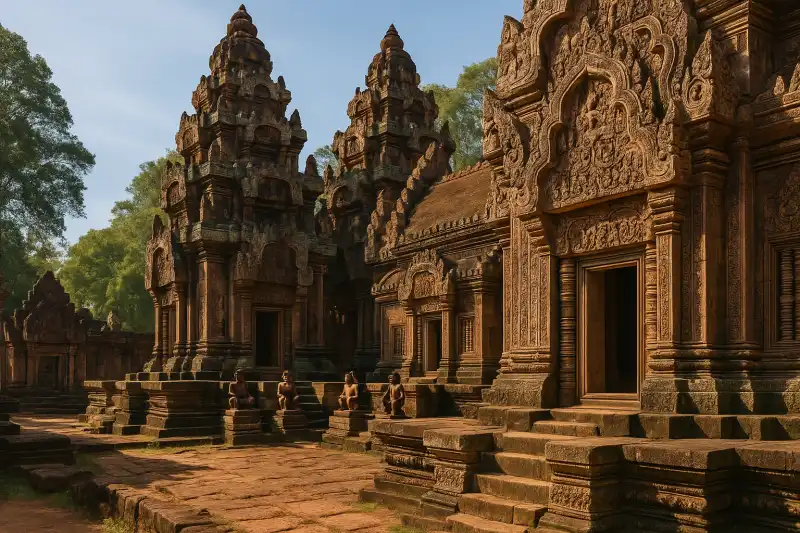
Banteay Srei Travel Guide 2026: Pink Sandstone Temple, Carvings, and Visit Tips
KhmerBanteay Srei is one of Cambodia’s most detailed Khmer temples, known for fine pink sandstone carving...
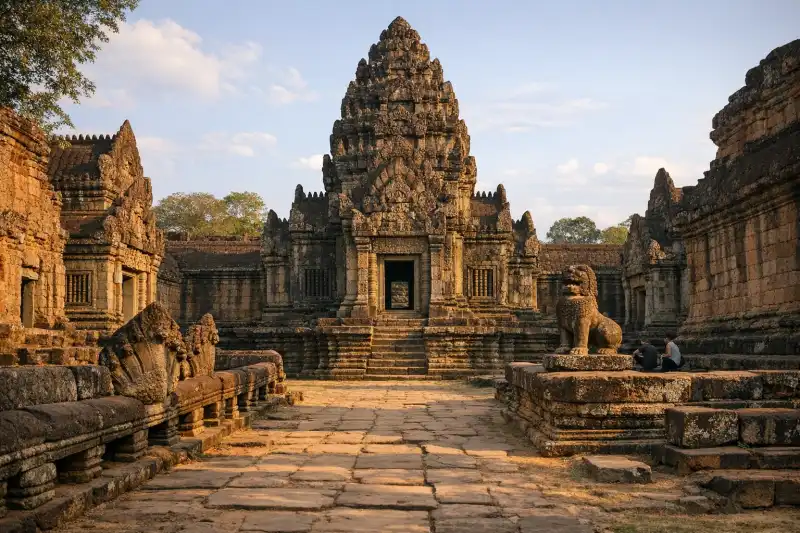
Banteay Samré
Banteay Samré is a beautifully preserved 12th-century Hindu temple in Cambodia’s Siem Reap province,...
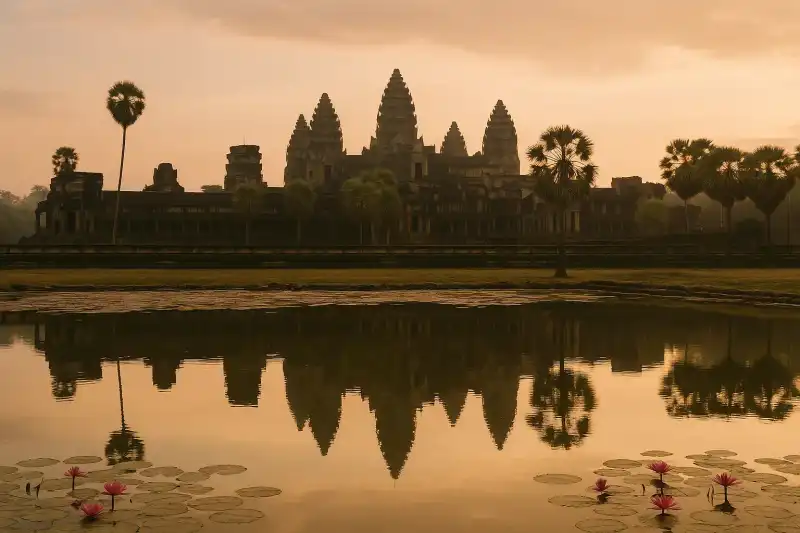
Angkor Wat Travel Guide 2026: Everything You Need to Know
KhmerAngkor Wat, the world's largest religious monument, spans over 400 acres in the heart of Cambodia. T...
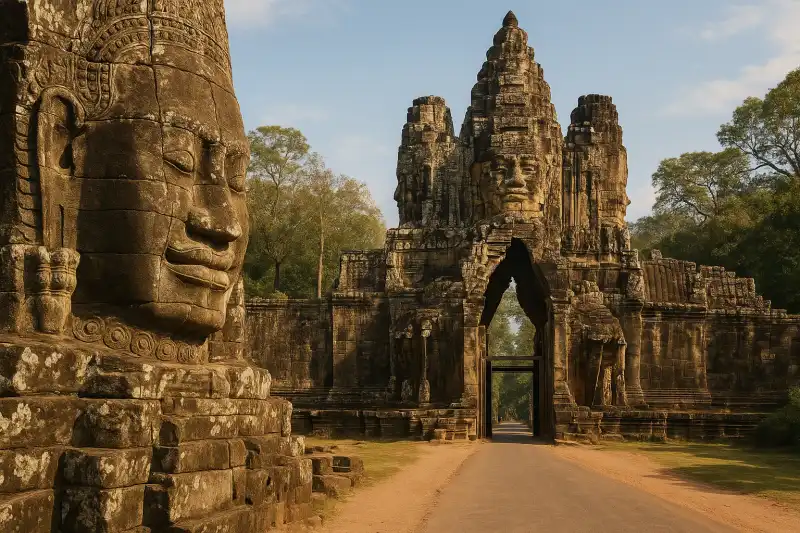
Angkor Thom Travel Guide 2026: Bayon Faces, Gates, and the Khmer Royal City
KhmerAngkor Thom was the last great capital of the Khmer Empire. This guide covers how to visit Bayon, th...