Quick Info
At a glance
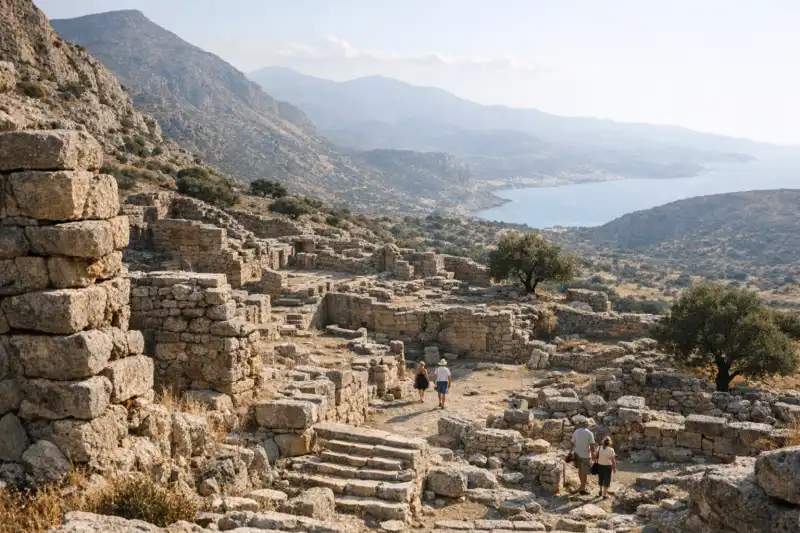
Lato in Greece is one of those ancient places that feels both grand and intimate at the same time. Set high in the hills of eastern Crete, far from the noise of modern resort strips, the ruined city rises from a saddle between two peaks and looks outward over rugged valleys, olive country, and distant glints of the sea. Even before you begin to identify a temple platform, a stairway, or the outline of the agora, the landscape explains why a community chose this location. It is strong, defensible, and commanding, but it is also unexpectedly beautiful.
For travelers used to the monumental scale of Athens or the polished museum presentation of larger archaeological parks, Lato offers a different kind of encounter with the ancient world. Here, the stones are not just relics arranged for display; they still suggest the rhythm of a living city. Streets climb and bend with the terrain. Public buildings occupy a deliberate civic core. Terraces and retaining walls reveal how the inhabitants adapted architecture to the mountain slopes. The silence adds to the effect. Wind, birds, and the crunch of gravel often replace the sounds of tour groups, making it easier to imagine the daily routines of the people who once governed, worshipped, traded, and argued here.
Though smaller and less famous than many Greek destinations, Lato is one of Crete’s most rewarding archaeological sites. It preserves the plan and atmosphere of a Doric city unusually well, and for anyone interested in ancient urbanism, Cretan history, or simply dramatic ruins in a memorable setting, it leaves a lasting impression.
History
Early foundations and the rise of a Cretan city
Lato was founded in the Archaic period, probably in the 7th century BCE, during a time when Crete was divided among numerous independent city-states. Unlike the great palace centers of the earlier Minoan world, Lato belonged to a later political landscape shaped by Greek-speaking communities, local identities, and strong regional rivalries. It developed inland rather than on the coast, a choice that reflects both defensive concerns and the long-standing pattern of Cretan settlement in elevated positions.
The city’s name may be connected to the goddess Leto, mother of Apollo and Artemis, though the exact relationship between the place-name and cult practice remains debated. What is clearer is that Lato became one of the most important poleis in eastern Crete. Its citizens controlled agricultural territory and maintained links with nearby settlements and ports, particularly the harbor town later known as Lato pros Kamara, the precursor to modern Agios Nikolaos.
As the city grew, its planners made effective use of the steep natural terrain. Public architecture was concentrated in a central area that included an agora and official structures, while houses and streets spread across terraces. This practical urban design, visible even today, reflects a settled and organized civic life rather than a temporary refuge.
Classical and Hellenistic prosperity
Lato reached its greatest prosperity during the Classical and especially the Hellenistic periods. In these centuries, Cretan cities were deeply involved in shifting alliances, local wars, and wider Mediterranean politics. Lato was no exception. Inscriptions and literary references suggest a community active in diplomacy, religion, and military affairs. The city minted its own coins, an important sign of civic identity and relative autonomy.
Its architecture from this period speaks of a functioning and self-confident urban center. The agora served as the focal point of political and commercial life. Nearby stood civic buildings, stoas, and sanctuaries that underlined the city’s institutions. A temple often identified with a cult of Apollo, along with other sacred structures, points to the centrality of religion in public life. Steps, retaining walls, and carefully organized approaches reveal that access and movement through the city were structured and meaningful.
The Hellenistic age also brought pressure. Crete was a patchwork of competing states, and conflict between neighboring communities could be intense. Lato had to defend its interests against rival cities and navigate the involvement of external powers. Yet it endured, suggesting both military resilience and economic viability. Its inland acropolis-like position must have been a significant advantage in uncertain times.
Roman transformation and decline
By the 1st century BCE, the political world of Crete was changing dramatically. Roman intervention in the eastern Mediterranean eventually brought the island under Roman control. Like many independent Greek cities, Lato lost the degree of autonomy it had enjoyed in earlier centuries. This shift did not necessarily bring immediate abandonment, but it altered the city’s role.
One of the most important developments was the increasing significance of coastal settlements. Ports became more valuable within Roman trade networks, while many inland strongholds gradually declined in importance. Lato’s associated harbor settlement gained prominence, and the balance of regional life moved toward easier maritime access. Over time, the hill city diminished.
Archaeological evidence suggests that occupation continued into the Roman period, but at a reduced level. Public investment waned, and the urban center no longer functioned as it had in the Hellenistic era. Eventually the site was abandoned, leaving behind a remarkably legible plan of streets, walls, and civic spaces.
Rediscovery and modern archaeology
In modern times, Lato drew the attention of travelers, scholars, and archaeologists interested in Crete beyond its better-known Bronze Age sites. Systematic excavations in the late 19th and early 20th centuries revealed a city of exceptional importance for understanding the historical periods of Cretan civilization. While Knossos often dominates public imagination, Lato provides a vital counterpoint: a clear example of a Greek polis on Crete after the age of the Minoan palaces.
Today, the site is valued not only for specific finds but also for its overall preservation. Visitors can still follow the city’s topography and sense its structure in a way that is difficult at many ancient settlements. Lato remains one of the best places in Greece to appreciate how a smaller but influential city-state actually occupied its landscape.
Key Features
The first feature that defines Lato is its setting. The city was built on a mountain saddle between two hills, and this dramatic location is not incidental background but part of the site’s identity. The inhabitants chose a place that offered natural protection and broad visibility over the surrounding countryside. As you walk through the ruins, the views repeatedly remind you that politics, defense, agriculture, and religion were all tied to geography. The slopes are steep enough to feel strategic, but the setting is also graceful, giving the city a theatrical quality.
At the heart of the site lies the agora, the civic center and most striking open space. This was the area where public life unfolded, where citizens gathered for discussion, exchange, and ceremony. The agora at Lato is especially evocative because its surrounding architecture still suggests how the space functioned. The retaining walls, steps, and adjacent structures create a sense of order and hierarchy. You can see how movement was channeled and how the city presented itself ceremonially in its most important public zone.
Closely related to the agora are the civic buildings, including what are often interpreted as a prytaneion or official administrative spaces. These remains matter because they show Lato was not simply a cluster of houses around a shrine; it was a fully formed political community with institutions. Inscriptions found at the site reinforce this image of an organized polis with magistrates, decrees, and communal responsibilities. Even when the architectural remains are fragmentary, the layout conveys the seriousness of the civic sphere.
The temple area is another major highlight. Though the surviving stonework is incomplete, the sacred architecture reveals the religious dimension of urban life. A temple associated by some scholars with Apollo is among the most discussed remains, and nearby sacred spaces may have supported additional cult activity. The exact identification of every structure is less important for visitors than the broader impression: religion was integrated into the city’s central life, not isolated from it. Sacred and civic spaces stood close together, reflecting a world in which political authority and divine favor were deeply connected.
Lato is also notable for its streets and housing terraces. Rather than presenting a flat, gridded city plan, the site demonstrates how ancient urbanism adapted to difficult terrain. Paths rise sharply, staircases connect levels, and walls support platforms for buildings. This creates a very physical experience of the city. You do not merely look at Lato; you climb it, feel its gradients, and understand how daily life involved constant movement up and down stone routes. For many visitors, this bodily sense of the site becomes one of its strongest memories.
Defensive elements contribute further character. The city’s position itself was a form of fortification, but there are also traces of walls and controlled entrances that speak to the need for security. In a landscape of rival Cretan states, such protection was essential. The architecture communicates vigilance without overshadowing the civic life of the settlement.
Finally, one of Lato’s greatest features is what it lacks: heavy modern intrusion. Because no later town grew directly over the ancient city, the archaeological remains are relatively coherent. There is space to read the contours, imagine the neighborhoods, and appreciate the relationship between architecture and landscape. This makes Lato unusually satisfying for independent travelers, photographers, students of history, and anyone who enjoys sites where atmosphere and structure remain closely linked.
Getting There
Lato is located in eastern Crete, roughly 15 to 20 minutes by road from Agios Nikolaos and close to the village of Kritsa. The easiest way to reach the site is by rental car, which gives you the most flexibility and allows you to combine Lato with other stops in the region. From Agios Nikolaos, taxi fares typically range from about €20 to €30 each way depending on season and exact pickup point. From Heraklion, the drive usually takes around 1 hour 15 minutes to 1 hour 30 minutes, and a taxi can cost well over €100 one way, so self-drive is usually better value.
Public transport is possible but less direct. Intercity KTEL buses connect Heraklion and Agios Nikolaos frequently, with fares often in the range of €8 to €12 depending on route and timing. From Agios Nikolaos, you may be able to catch a local bus toward Kritsa, though schedules can be limited and may not align neatly with the site’s opening hours. From Kritsa, you would typically need a taxi or be prepared for a long uphill walk, which is not ideal in summer heat.
Guided excursions from Heraklion or Agios Nikolaos can be a convenient alternative, especially for travelers who prefer not to drive on Cretan mountain roads. These often bundle transport and commentary, though they may not focus exclusively on Lato. If you drive yourself, expect a final approach on scenic but curving roads, and bring water, sun protection, and sturdy shoes, as the archaeological site itself involves uneven walking.
When to Visit
The best times to visit Lato are spring and autumn, when Crete is warm but not oppressive and the landscape is at its most appealing. From April to early June, temperatures are usually comfortable for walking, wildflowers often brighten the hillsides, and the air is clear enough for especially rewarding views across the countryside. September and October are also excellent, with lingering warmth, fewer crowds, and softer light for photography.
Summer, especially July and August, is the most challenging season. Lato offers little natural shade, and the stone terrain reflects heat. Midday temperatures can become exhausting, particularly because the site requires walking uphill and navigating steps. If summer is your only option, aim to arrive as close to opening time as possible or later in the afternoon if schedules allow. Bring more water than you think you need, wear a hat, and avoid treating the site as a quick stop in beachwear; the terrain deserves proper preparation.
Winter visits can be rewarding for travelers who like quiet conditions and dramatic skies. Crete remains milder than much of Europe, but rain and wind are more likely, and slippery stones can make walking slower. Some days may also have reduced visitor services or quieter regional transport options. Still, a clear winter day can make Lato feel especially atmospheric.
In practical terms, the ideal visit is often a morning in late spring or early autumn. You get manageable temperatures, calmer light, and enough time to explore without rushing. Lato is not a site that rewards speed. A slower pace lets the city’s terraces, views, and civic spaces reveal themselves gradually, which is exactly how this mountain settlement is best experienced.
| Quick Facts | Details |
|---|---|
| Location | Near Kritsa and Agios Nikolaos, Lasithi, Crete, Greece |
| Type | Ancient Greek city-state archaeological site |
| Main Periods | Archaic, Classical, Hellenistic, Roman |
| Best Known For | Well-preserved Doric urban plan, agora, temple remains, hilltop setting |
| Nearest City | Agios Nikolaos |
| Ideal Visit Length | 1.5 to 2.5 hours |
| Best Seasons | Spring and autumn |
| Terrain | Uneven stone paths, steps, and sloping ground |
| Access Style | Best reached by car or taxi |
| What to Bring | Water, sun protection, sturdy walking shoes, camera |
Guided tours: worth it?
A guide can be genuinely useful at Lato, especially if you want help with transport, timing, tickets, or understanding a large site without losing half the day to logistics.
Best for
- First-time visitors who want context, not just photos
- Travelers who want transport, timing, or entry logistics handled
- Short visits where a planned route saves time
When to go self-guided
Go independently if you already have transport and tickets sorted, enjoy moving at your own pace, and are comfortable checking the latest official rules before you arrive.
What I’d avoid
Skip paid tours that bundle unrelated stops you do not actually want. The best option should either save meaningful planning time or add historical context you would miss on your own.
Crete Archaeological Sites Tours
Useful when: you want to compare guided formats before deciding
Agios Nikolaos Ancient History Tours
Useful when: you want to compare guided formats before deciding
Heraklion to Ancient Sites Day Tours
Useful when: you want to compare guided formats before deciding
Some tour links are affiliate links, which may earn Ancient Travel a small commission at no extra cost to you. I try to surface options that make practical sense for the site—not just anything bookable.
Frequently Asked Questions
What is Lato?
Lato is an ancient city-state in eastern Crete, Greece, known for its well-preserved urban plan, agora, temple remains, and dramatic hilltop setting.
Where is Lato located?
Lato is located in the regional unit of Lasithi on the island of Crete, between the modern towns of Kritsa and Agios Nikolaos.
How much time should I allow to visit Lato?
Most visitors spend 1.5 to 2.5 hours exploring the site, though history enthusiasts may want longer to study the layout and inscriptions.
Is Lato difficult to walk around?
Lato includes uneven stone paths, steps, and sloping terrain, so sturdy shoes are recommended and visitors with limited mobility may find parts challenging.
Can I visit Lato from Agios Nikolaos?
Yes, Lato is a practical half-day trip from Agios Nikolaos by car or taxi, and it can also be combined with visits to Kritsa and other eastern Cretan sites.
What makes Lato special compared with other ancient Greek sites?
Lato stands out for preserving the character of a Doric city in Crete, including its civic center, defensive position, and mountain landscape largely free from later urban overbuilding.
Nearby Ancient Sites
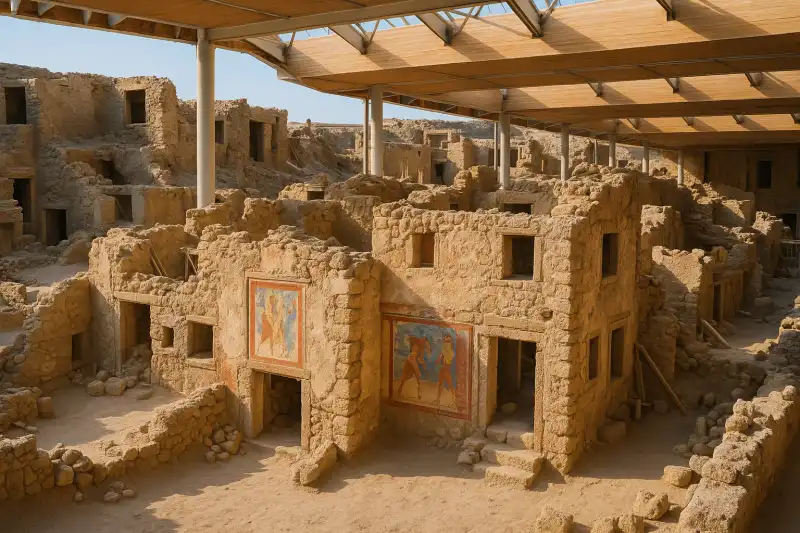
Akrotiri
Minoan / CycladicExplore Akrotiri, the Bronze Age Minoan city buried under volcanic ash on Santorini around 1613 BCE ...
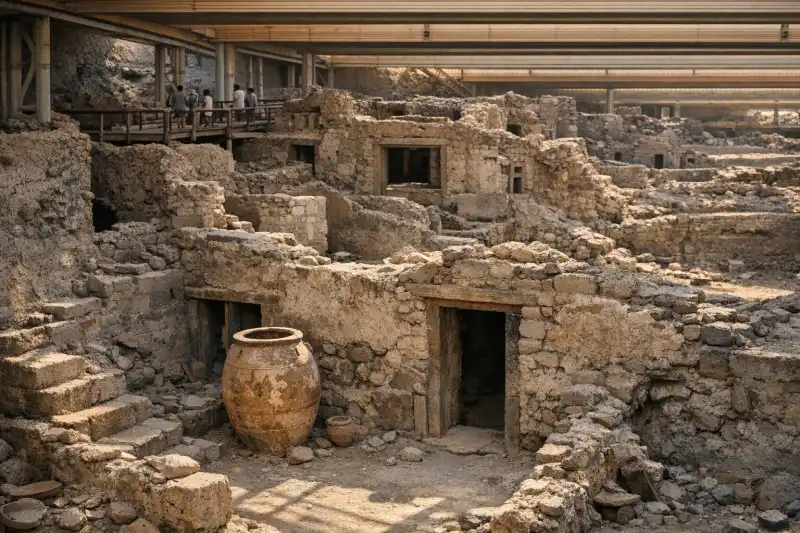
Ancient Akrotiri (Santorini)
Explore Ancient Akrotiri, the breathtaking Bronze Age settlement preserved in volcanic ash on Santor...
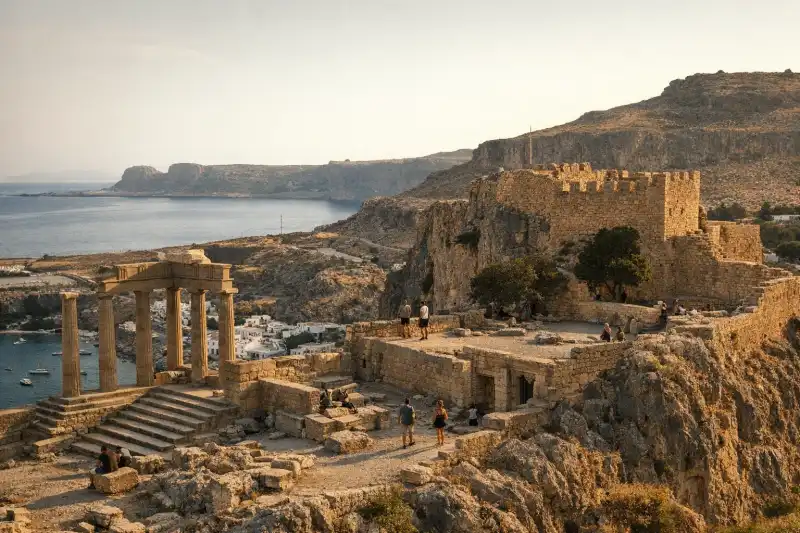
Acropolis of Lindos
Ancient Greek, Hellenistic, Roman, Byzantine, Knights HospitallerThe Acropolis of Lindos on Rhodes, Greece, is a spectacular ancient citadel blending Classical and m...