Quick Info
At a glance
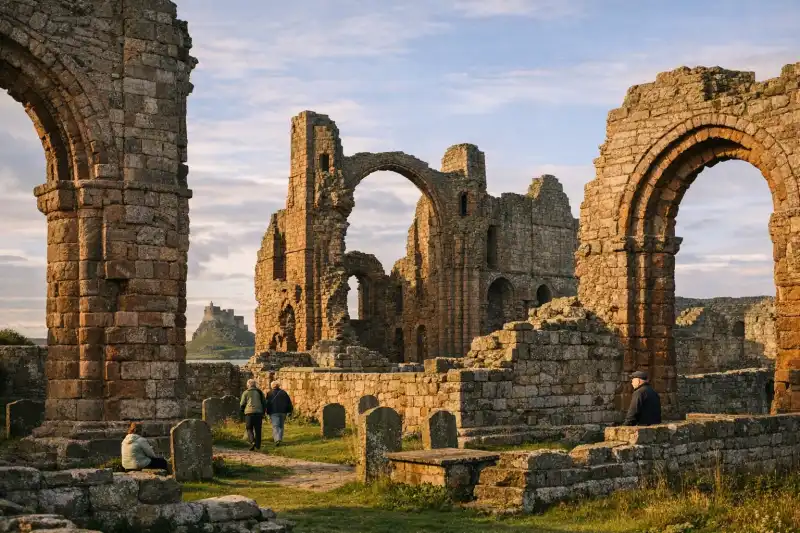
Lindisfarne Priory in the United Kingdom rises from Holy Island’s grassy slope as a weathered silhouette of red stone, sea wind, and prayer. Even before you step through its remains, the place feels set apart. The road across the sands disappears beneath the tide twice a day, and that changing access gives every visit a sense of timing and ceremony. Gulls wheel overhead, the village sits low against the coast, and beyond the priory the North Sea stretches out in a shifting blue-grey sheet. This is not a ruin hidden in a city or tucked behind modern streets; it is part of a whole landscape shaped by isolation, faith, and centuries of memory.
For many travelers, Lindisfarne is one of those rare places where history, legend, and atmosphere seem to meet naturally. It is bound up with the early spread of Christianity in northern Britain, with saints whose names still carry weight in English history, and with the Viking raid of 793 that shocked the medieval world. Yet the priory is not only a site of dramatic events. It is also a deeply human place, once filled with daily routines of worship, copying texts, tending land, receiving pilgrims, and surviving difficult coastal conditions. Today, the surviving arches, walls, and tracery invite visitors to imagine all of that against a backdrop of salt air and open sky.
History
Early Christian foundations
The story of Lindisfarne begins in 635 CE, when King Oswald of Northumbria invited the Irish monk Aidan to establish a monastery on the island. Oswald had spent time in exile among the Irish and had embraced Christianity there. When he regained power, he wanted a religious center that could help convert and instruct his kingdom. Lindisfarne, close enough to the royal center at Bamburgh yet separated by water and tide, was an ideal location: accessible, but set apart.
Aidan founded a community that combined missionary purpose with monastic discipline. From this island base, monks traveled across Northumbria preaching, teaching, and establishing churches. The monastery quickly became one of the most influential spiritual centers in Anglo-Saxon England. Its prestige grew further through its association with Cuthbert, first a monk and later bishop, whose austere piety and reported miracles made him one of the most revered saints of the early medieval north.
Lindisfarne also became a place of learning and artistic production. The most famous surviving object connected with the community is the Lindisfarne Gospels, a brilliantly illuminated manuscript produced around the late 7th or early 8th century. Although the manuscript is no longer on the island, it remains one of the clearest expressions of the monastery’s cultural importance.
Viking raids and disruption
Lindisfarne entered broader historical memory through violence. In 793, Viking raiders attacked the monastery in an event recorded with horror by contemporary chroniclers. The raid was not the first Scandinavian attack on Britain, but it became emblematic because of the site’s sacred status and the shock it caused in Christian Europe. Monks were killed, valuables were taken, and the image of a holy island violated by seaborne warriors acquired near-mythic force.
The attack did not mean immediate abandonment, but it marked the start of a dangerous period. Repeated raids and instability made life increasingly precarious along exposed coasts. By the 9th century, the community’s monks carried the relics of St. Cuthbert away from Lindisfarne in search of safety. Their long journey eventually ended at Durham, where Cuthbert’s shrine became one of medieval England’s major pilgrimage destinations.
Even so, Lindisfarne’s sacred reputation did not vanish. The memory of the saints, the prestige of the old monastery, and the symbolic power of the island kept it alive in religious imagination long after its first monastic phase had ended.
Norman refoundation and medieval rebuilding
The visible ruins at Lindisfarne Priory belong mostly to a later chapter. After the Norman Conquest, the site was refounded as a Benedictine priory linked to Durham. This was part of a wider movement in which older religious centers were reorganized, often under new monastic rules and under stronger institutional control. The Norman and later medieval builders reshaped the site in stone, creating the church and claustral ranges whose remains still define the priory today.
Construction took place in stages from the late 11th and 12th centuries onward. The priory church displayed Romanesque strength in its massive forms, while later additions introduced more refined Gothic elements. Though no longer the isolated missionary outpost of Aidan’s day, the priory remained a place of devotion and regional significance. Pilgrims came because of its saintly associations, and the monastic community maintained worship, hospitality, and agricultural management in the face of the island’s challenging environment.
Because the priory stood near the Anglo-Scottish frontier, it was also affected by wider political tensions. Border warfare and raids shaped life in Northumberland for centuries, and Lindisfarne could not escape that reality. Yet despite insecurity and changing fortunes, the priory endured through the high and late Middle Ages.
Dissolution, ruin, and preservation
The priory’s monastic life ended in the 16th century during the Dissolution of the Monasteries under Henry VIII. Like so many English religious houses, it lost its institutional purpose, its lands were reorganized, and its buildings were stripped or repurposed. Stone from the site was used elsewhere, roofs disappeared, and the church gradually became the open ruin seen today.
In later centuries, the ruined priory took on a different significance. Antiquarians, artists, and travelers were drawn to its picturesque setting. The romantic appeal of arches open to the sky and walls standing above coastal grass made Lindisfarne a subject for paintings, sketches, and early heritage writing. By the modern period, preservation efforts increasingly focused on stabilizing the remains and interpreting their layered history for visitors.
Today Lindisfarne Priory is valued not just as a medieval ruin, but as a place where early Christian history, monastic tradition, Viking-age memory, and the drama of the Northumbrian coast all converge.
Key Features
The priory’s most striking feature is the nave of the church, where surviving arcades and high wall sections create a powerful sense of vertical space even in ruin. You do not need a complete building to feel its scale. The remaining arches frame pieces of sky, and the reddish stone seems to change character with the weather: warm and glowing under sunlight, austere and heavy in mist, almost theatrical at sunset. This play between architecture and open air is one of the site’s greatest strengths. Lindisfarne Priory is not experienced as an enclosed monument but as a structure in conversation with wind, clouds, and sea light.
Another memorable aspect is the combination of Romanesque solidity and later medieval refinement. Some sections feel massive and weight-bearing, rooted in Norman ideas of strength and permanence. Elsewhere, more delicate detailing hints at later Gothic tastes. Even fragmentary carvings and window forms reveal how the priory evolved over centuries rather than being built all at once. Visitors interested in architecture will notice that the ruin preserves evidence of multiple phases, making it more than simply a scenic shell.
The setting matters just as much as the stonework. The priory lies within the village of Holy Island, yet it still feels spiritually and geographically distinct. The low-lying landscape around it allows the ruins to dominate views in a way many urban monasteries no longer can. Grass, gravestones, nearby church structures, and distant glimpses of water create a layered setting in which sacred and ordinary life once overlapped. Medieval monks here would have lived with sea weather constantly pressing in from the horizon, and modern visitors sense that immediately.
Close by stands the parish church of St Mary the Virgin, whose origins preserve connections to the older monastic site. Its celebrated “rainbow arch” and other early features help visitors understand that Lindisfarne’s religious story extends beyond the priory ruin itself. Together, church and priory give a more complete picture of continuity and change on the island. If you only look at the grand church remains, you miss the quieter architectural evidence of earlier worship and long local devotion.
The priory’s interpretive value is also one of its strengths. Because Lindisfarne is associated with St. Aidan, St. Cuthbert, and the Lindisfarne Gospels, the site resonates well beyond its surviving stones. Visitors often arrive with those names in mind, and the ruin becomes a physical anchor for stories that might otherwise feel abstract. Standing among the walls, it becomes easier to imagine monks at prayer, the movement of pilgrims, or the fear that accompanied seaborne raids. Few places in Britain connect so many foundational narratives in such a compact space.
There is also a visual relationship between the priory and the rest of Holy Island that rewards slow exploration. The village lanes, the harbor, the distant outline of Lindisfarne Castle, and the broad tidal flats all contribute to the visit. The priory is not an isolated ticket stop but part of a complete historic landscape. Many travelers find that the most memorable moments come between major sights: hearing the wind move through the grass, noticing how the ruin appears from a side path, or watching light shift over stone near the end of the day.
Finally, the emotional texture of Lindisfarne Priory sets it apart. Some ancient sites impress through scale or ornament. Lindisfarne impresses through atmosphere. It feels contemplative, exposed, and slightly remote, even when other visitors are present. The tides enforce respect for time; the ruin suggests endurance after loss; and the long history of worship gives the island a seriousness that many travelers feel instinctively. It is this blend of beauty, vulnerability, and historical depth that makes the priory unforgettable.
Getting There
Reaching Lindisfarne Priory is part of the experience because Holy Island is accessible only when the tidal causeway is safe to cross. If you are driving, the most common approach is from the A1 in Northumberland, turning east toward the island near Beal. From there, the causeway leads directly to Holy Island. Parking on the island is typically paid, with day rates often around £4 to £6 depending on season and location. Before setting out, always check the official safe crossing times, since the road is covered at high tide.
For travelers using public transport, the nearest major rail stop is Berwick-upon-Tweed, with additional options via Newcastle upon Tyne. From Berwick, buses or seasonal services may connect toward Holy Island, though frequencies can be limited and timetables may be designed around tides. A local bus fare from Berwick is often in the range of £3 to £8 one way, depending on route and operator. Taxi fares from Berwick to the island approach can be roughly £25 to £40, again varying by time and season.
Guided day tours from Newcastle, Edinburgh, or other Northumberland hubs can be the simplest option if you do not want to manage tide schedules yourself. These are commonly priced from about £45 to £90 per person, depending on itinerary length and whether castles or other regional sites are included. Once on Holy Island, the priory is easy to reach on foot from the village parking area. The island is compact, and walking between the priory, parish church, village center, and harbor is straightforward.
When to Visit
Lindisfarne Priory can be rewarding in any season, but your experience will change dramatically with weather, daylight, and visitor numbers. Late spring through early autumn is the most comfortable period for most travelers. From May to September, the island usually has longer days, milder temperatures, and better conditions for combining the priory with walks around Holy Island. Summer brings the fullest village atmosphere and the best chance of clear views, though it also attracts the largest crowds and busiest parking.
Spring is an especially appealing time if you want a balance between comfort and quiet. Fresh coastal light, cool air, and fewer peak-season visitors can make the priory feel more contemplative. Autumn is also excellent, with softer colors, changing skies, and a calmer pace after school holidays. The ruined church can look particularly dramatic under low autumn sun.
Winter visits are possible and can be deeply atmospheric, but they require more planning. Short daylight hours, stronger winds, rain, and occasional icy conditions make the island feel far more exposed. Services may be reduced, and the weather can change quickly. Still, for travelers who enjoy quiet historic landscapes, a crisp winter day on Holy Island can be memorable.
Whatever the season, the single most important planning factor is the tide. Build your day around safe crossing times rather than around ideal arrival hours. If possible, visit early or late in the available access window, when the priory often feels less crowded. Checking the forecast matters too: even in summer, North Sea weather can turn cool and windy, so layers and waterproofs are wise.
| Quick Facts | Details |
|---|---|
| Location | Holy Island, Northumberland, England, United Kingdom |
| Original foundation | 635 CE |
| Founder of early monastery | St. Aidan, under King Oswald of Northumbria |
| Main historical associations | St. Cuthbert, Lindisfarne Gospels, Viking raid of 793 |
| Visible remains | Mostly Norman and later medieval Benedictine priory ruins |
| Best access point | Via tidal causeway from the mainland near Beal |
| Time needed | 1-2 hours for the priory; half a day for the island |
| Nearby base | Berwick-upon-Tweed |
| Visit caution | Always check official safe crossing times before traveling |
| Atmosphere | Coastal, spiritual, windswept, and highly photogenic |
Lindisfarne Priory is one of those rare places where the journey, setting, and history all carry equal weight. The ruin itself is beautiful, but its full power comes from being exactly where it is: on a tidal island at the edge of Northumbria, tied to saints, scholarship, invasion, and centuries of devotion. If you arrive with time to walk slowly, watch the light, and let the island’s rhythm shape your visit, the priory becomes more than a historic monument. It becomes a landscape of memory, still marked by faith and by the sea.
Guided tours: worth it?
A guide can be genuinely useful at Lindisfarne Priory, especially if you want help with transport, timing, tickets, or understanding a large site without losing half the day to logistics.
Best for
- Travelers who want transport, timing, or entry logistics handled
- Short visits where a planned route saves time
When to go self-guided
Go independently if you already have transport and tickets sorted, enjoy moving at your own pace, and are comfortable checking the latest official rules before you arrive.
What I’d avoid
Skip paid tours that bundle unrelated stops you do not actually want. The best option should either save meaningful planning time or add historical context you would miss on your own.
Holy Island and Lindisfarne day tours
Useful when: you want to compare guided formats before deciding
Northumberland castles and Holy Island tours
Useful when: you want to compare guided formats before deciding
Bamburgh, Alnwick, and Lindisfarne tours
Useful when: you want to compare guided formats before deciding
Some tour links are affiliate links, which may earn Ancient Travel a small commission at no extra cost to you. I try to surface options that make practical sense for the site—not just anything bookable.
Frequently Asked Questions
Where is Lindisfarne Priory?
Lindisfarne Priory stands on Holy Island off the coast of Northumberland in northeast England. The island is reached by a tidal causeway from the mainland, so visit times depend on safe crossing hours.
Do I need to pay to enter Lindisfarne Priory?
The priory ruins are generally managed as a ticketed historic attraction, while the surrounding village and island are free to explore. Prices can change seasonally, so check the official site before traveling.
Can I drive to Lindisfarne Priory at any time?
No. Holy Island is connected to the mainland by a tidal road that is submerged at high tide. Always use the official safe crossing timetable and never attempt the causeway outside those hours.
How much time should I allow for a visit?
Most visitors spend 1 to 2 hours at the priory itself, but a half day is ideal if you also want to see Lindisfarne Castle, the parish church, harbor views, and the island's walking trails.
What is Lindisfarne Priory famous for?
It is famous as one of the most important early Christian centers in Britain, associated with St. Aidan and St. Cuthbert. The monastery's history is also closely linked with the Viking raid of 793, often cited as a turning point in British history.
Is Lindisfarne Priory suitable for families?
Yes, families often enjoy the open ruins, sea views, and village setting. Parents should still watch children closely around uneven stonework, exposed edges, and changing coastal weather.
Nearby Ancient Sites
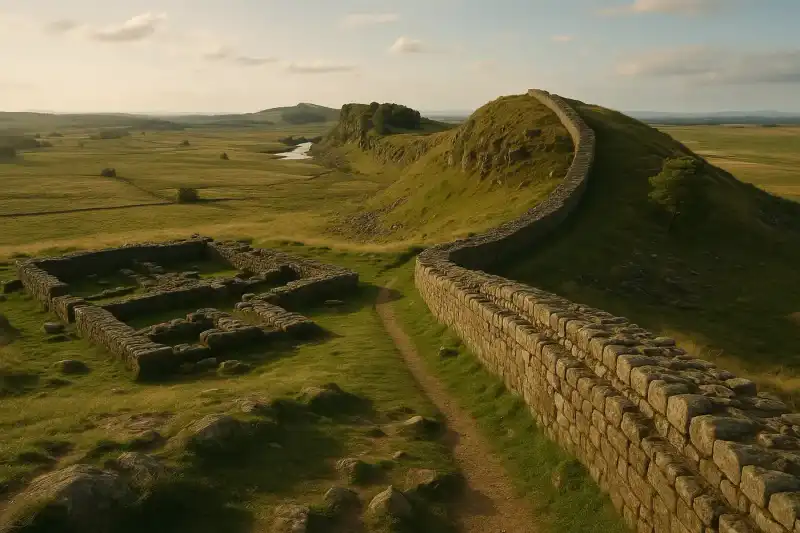
Hadrian's Wall Travel Guide 2026: Best Sections, Roman History, and Practical Planning
Roman BritainPlan a UK frontier-heritage day at Hadrian's Wall with clear section priorities, practical one-day r...
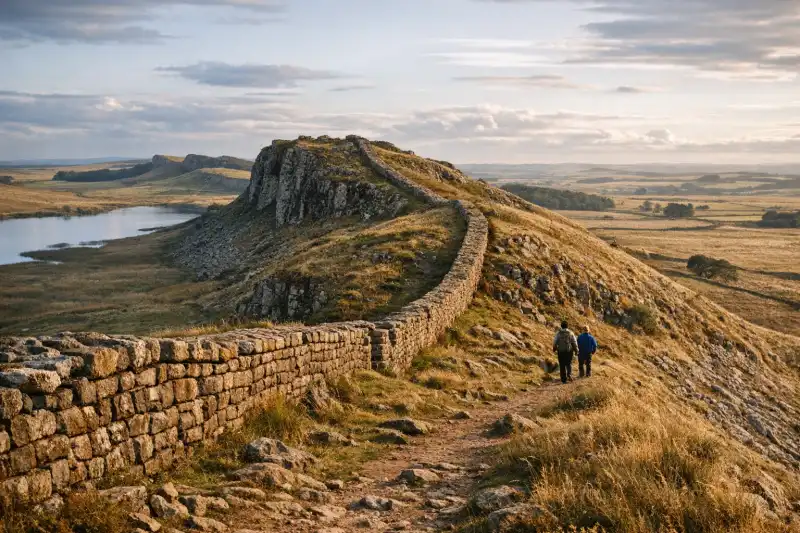
Hadrian's Wall
RomanExplore Hadrian’s Wall in the United Kingdom, Rome’s great northern frontier of forts, milecastles, ...
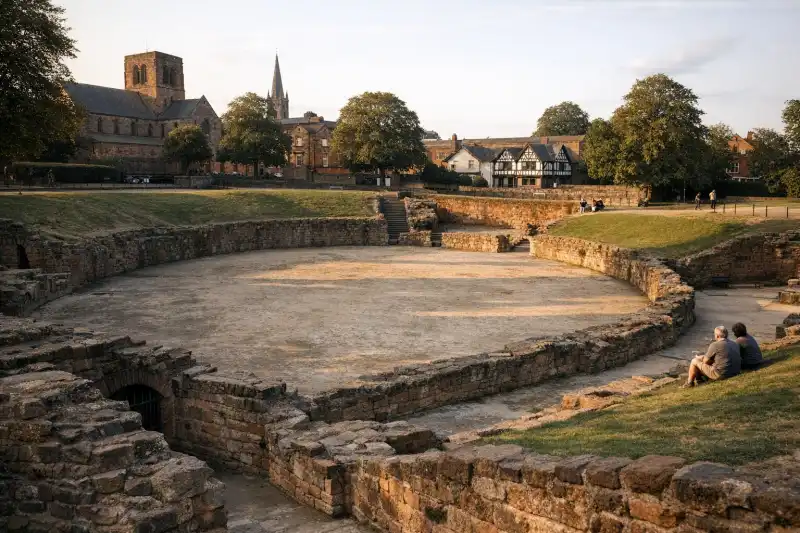
Chester Roman Amphitheater
Explore Chester Roman Amphitheater in the United Kingdom, the largest known Roman amphitheater in Br...