Quick Info
At a glance
Metaponto, Italy, lies in a landscape where fertile plains meet the Ionian Sea, and where the memory of Magna Graecia still feels close to the surface. Today the site is quieter than more famous ancient destinations, yet that calm is part of its appeal. Instead of monumental crowds and heavily urbanized surroundings, you find open skies, fields, low coastal light, and archaeological remains that seem to emerge directly from the countryside. This was once one of the most prosperous Greek colonies in southern Italy, a city whose wealth depended on agriculture and trade, and whose reputation was tied to its grain-filled plains and intellectual life.
For modern travelers, Metaponto offers a different rhythm from Italy’s headline destinations. Here, a visit is less about rushing through a checklist and more about piecing together the shape of an ancient city: the sacred areas, fragments of public buildings, roads, defensive works, and the surviving temple columns that have become the site’s visual signature. The experience is strengthened by the local museum, where objects found in the area help turn broken stone into a richer story of daily life, belief, and political ambition. If you are interested in Greek colonization, the world of Pythagorean thought, or the long overlap between Greek and Roman southern Italy, Metaponto rewards time and attention far beyond its modest profile.
History
Greek foundation and the rise of a colony
Metaponto was founded as an Achaean Greek colony in the late 7th century BCE, during the broader wave of settlement that created the network of cities known as Magna Graecia in southern Italy. The colony occupied a strategically valuable position on a fertile coastal plain, an environment that quickly gave it an economic strength many rival settlements would have envied. Grain production became central to its identity; ancient writers linked Metaponto closely with agricultural wealth, and the ear of barley that appears on its coinage was no decorative accident. It was a civic symbol that advertised prosperity, territory, and control over productive land.
Like other Greek colonies, Metaponto was not simply a transplant of mainland customs but a city adapting to Italian geography and local realities. It developed urban institutions, sanctuaries, and political structures modeled on the Greek world while interacting with indigenous communities of the region. Its success depended on managing both coastal access and inland farmland. This dual strength allowed the city to build monumental religious architecture and to sustain a public identity larger than one might expect from its location in what is now a relatively quiet corner of Basilicata.
Intellectual prestige and the Classical period
By the 6th and 5th centuries BCE, Metaponto had become one of the notable Greek cities of the region. It is especially associated with Pythagoras, the philosopher and mathematician who spent his final years in southern Italy after leaving Samos and then Croton. Ancient traditions connect him with Metaponto, and the city later cultivated this link as part of its cultural prestige. Whether as a true center of philosophical activity or as a place eager to preserve that memory, Metaponto gained an intellectual aura uncommon among ancient colonial settlements.
This was also the period in which its sacred architecture and urban organization matured. Temples were raised in the Doric style, and the city’s religious spaces became markers of civic identity. The territory around Metaponto included both the urban center and extra-urban sanctuaries, creating a sacred landscape tied to agricultural cycles and the community’s relationship with the land. The city’s prosperity during the Classical period was supported by trade as well as farming, with coinage and imported goods indicating broad connections across the Greek Mediterranean.
Conflict, shifting alliances, and Roman influence
The history of southern Italy in the late Classical and Hellenistic periods was marked by competition, shifting alliances, and increasing pressure from both neighboring Italian peoples and expanding external powers. Metaponto, like other cities of Magna Graecia, had to navigate a difficult political environment. It was affected by the struggles that involved Tarentum, the Lucanians, and eventually Rome. During the wars of the 4th and 3rd centuries BCE, Greek cities in the region often sought military support from outside rulers, most famously Pyrrhus of Epirus, in attempts to resist Roman expansion.
Metaponto eventually came under Roman control, though not all traces of its Greek identity vanished at once. As in many cities of Magna Graecia, language, religion, and urban traditions persisted for generations even after political independence weakened. The city’s strategic significance declined as Roman systems of administration and communication reorganized the region. Yet its agricultural territory remained valuable, and some aspects of the settlement continued into the Roman period.
Hannibal, decline, and archaeological survival
One of the dramatic episodes in Metaponto’s later history came during the Second Punic War. Ancient sources indicate that Hannibal used the city after the Battle of Cannae as part of his operations in southern Italy. This association placed Metaponto on the wrong side of Rome’s eventual victory and contributed to its decline. Like several communities that had supported Hannibal, it suffered politically and economically in the aftermath.
Over time the urban center contracted. Environmental change, malaria in the marshy coastal surroundings, and broader regional shifts likely played roles in its diminishing importance. The city did not disappear in a single moment, but its monumental life faded, and many of its structures collapsed, were quarried, or were buried. What survived did so unevenly: columns standing in isolation, foundations outlining public spaces, and layers of material culture preserved underground. Modern archaeology has gradually reconstructed the city’s plan and significance, allowing visitors today to encounter not a complete ancient metropolis but the eloquent remains of one of Magna Graecia’s most revealing sites.
Key Features
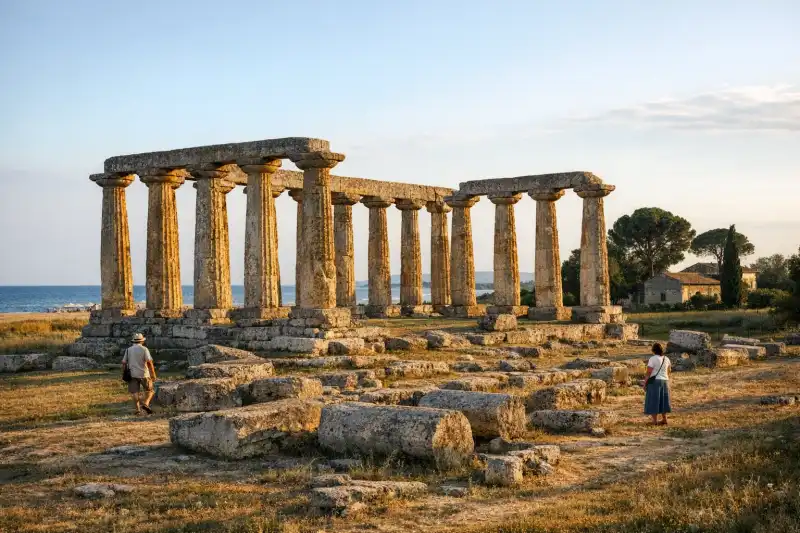
Metaponto is best understood not as one single monument but as a cluster of connected places that together tell the story of an ancient Greek city and its territory. The most famous image is the Tavole Palatine, a row of standing Doric columns that once formed part of a temple often associated with Hera. Rising from the plain with a dramatic simplicity, these columns are the kind of ruin that captures the imagination immediately. Their power lies in contrast: severe geometry against open landscape, cut stone against sky and cultivated fields. They are not the entirety of Metaponto, but they are its emblem, a compact expression of the city’s Greek architectural identity.
The main archaeological area offers a broader understanding of the urban settlement. Here visitors encounter traces of sanctuaries, streets, domestic zones, and public structures that reveal how the city was organized. Although much survives at foundation level, the site is rich for travelers who enjoy reading plans and imagining space. You can see where sacred areas structured movement through the city, how open zones related to more built-up sections, and how Greek urban principles were adapted to local terrain. The remains require some interpretive patience, but they reward anyone willing to look beyond the absence of towering walls.
Particularly important are the sacred precincts, which show how religion shaped civic life. In Greek colonies, temples were never merely decorative landmarks. They expressed the protection of the gods, the legitimacy of the community, and the wealth required to build in stone. At Metaponto, these sanctuaries also speak to the agricultural foundation of the city. The land made the colony prosperous, and sacred architecture helped convert that prosperity into public prestige. The surviving Doric remains preserve the disciplined proportions of Greek design while also reflecting the regional variations of Magna Graecia.
The National Archaeological Museum of Metaponto is essential for making sense of the ruins outdoors. There, pottery, architectural fragments, inscriptions, tools, sculpture, grave goods, and everyday objects reconnect the site to the people who lived in it. Coins bearing the barley ear motif are especially striking because they condense the city’s identity into a single symbol. Vases and imported ceramics reveal participation in wider Mediterranean exchange, while local artifacts show the texture of ordinary and ritual life. Without the museum, the archaeological park can feel fragmentary; with it, the remains become far more legible.
Another key feature of Metaponto is the surrounding landscape itself. Unlike many ancient sites now enclosed by dense modern development, Metaponto still communicates something of the environmental setting that shaped its history. The plain explains the city’s agricultural wealth better than any text panel can. The nearness of the coast hints at maritime exchange, while the openness of the territory makes clear why control of land mattered so much. This setting also gives the visit an unusual atmosphere. You are not only seeing ruins; you are reading the relationship between city, sanctuary, and countryside.
For travelers interested in Magna Graecia more broadly, Metaponto also serves as a reference point for understanding the network of Greek settlements in southern Italy. It is less overwhelming than larger archaeological complexes, which can make it more approachable. The site allows you to focus on architectural style, urban layout, and long-term historical change without the distractions of an enormous modern tourism infrastructure. In that sense, one of Metaponto’s greatest features is its clarity. The remains may be incomplete, but the themes they illuminate are unusually coherent: colonization, agriculture, religion, cultural exchange, and gradual transformation under Roman rule.
Getting There
Metaponto is most easily reached by car, especially if you want to combine the archaeological park, the museum, and the Tavole Palatine in one smooth visit. From Matera, the drive usually takes about 50 to 60 minutes, depending on traffic and the exact starting point. From Taranto, allow roughly an hour. Car rental in southern Italy often starts around €35 to €60 per day for a small vehicle, though prices rise in summer. Parking near the main archaeological areas is generally easier than at Italy’s major urban sites.
By train, Metaponto has a station on regional and intercity lines serving southern Italy. Regional fares from Taranto are often in the range of €5 to €9, while connections from Bari can vary from roughly €12 to €25 depending on route and train type. From the station, however, you may need a taxi or local bus to reach specific parts of the archaeological zone, as the ruins are spread out rather than concentrated in one compact center. Local taxi rides can cost about €10 to €20 depending on distance and waiting time.
Bus services also connect Metaponto with nearby towns and coastal resorts, though schedules can be limited outside peak season. If you are staying in Matera, guided day tours sometimes include transport and can be a convenient option for visitors who prefer not to drive. Expect organized excursions to vary widely in price, often from €60 to €140 per person depending on group size and inclusions. For independent travelers, a car remains the most flexible and efficient choice.
When to Visit
Spring is the best overall time to visit Metaponto. From April through early June, temperatures are usually pleasant, wildflowers may appear around the countryside, and the archaeological areas are more comfortable for walking than in midsummer. Daytime temperatures often range from about 18°C to 26°C, ideal for combining outdoor ruins with time in the museum. This season also tends to offer clearer light for photography, especially in the morning and late afternoon.
Early autumn, especially September and October, is another excellent window. The sea is still nearby if you want to combine archaeology with the coast, but the worst heat has usually passed. Temperatures commonly settle between 20°C and 28°C in September, cooling further in October. The landscape can feel especially attractive at this time, with softer light and fewer peak-summer visitors.
Summer is possible, but it requires planning. July and August can be hot, with temperatures often above 30°C and sometimes significantly higher. Since much of Metaponto is exposed with limited shade, midday visits can become tiring quickly. If you come in summer, arrive early, bring water, wear a hat, and consider breaking the day between the museum and outdoor areas.
Winter is the quietest season. It can be rewarding for travelers who prefer solitude and cooler walking conditions, but opening hours may be shorter and some services in the wider area may be reduced. Rain is also more likely. Whatever the season, morning visits usually provide the best balance of comfort, light, and calm.
| Quick Facts | Details |
|---|---|
| Location | Metaponto, Basilicata, southern Italy |
| Ancient Culture | Greek colony of Magna Graecia, later Roman |
| Founded | Late 7th century BCE |
| Best Known For | Tavole Palatine temple remains and archaeological park |
| Nearest Major Base | Matera |
| Ideal Visit Length | 2 to 4 hours |
| Best Seasons | Spring and early autumn |
| Main Experience | Greek ruins, museum collections, and open agricultural landscape |
| Access | Best by car; rail connections available to Metaponto station |
| Family Suitability | Good for older children interested in history and open-air sites |
Metaponto is not the kind of place that overwhelms with sheer scale. Its appeal is quieter and, for many travelers, deeper. It invites you to think about how Greek settlers remade a foreign shore into a prosperous city, how sacred architecture expressed civic ambition, and how even a powerful ancient community could slowly fade into the landscape that once sustained it. In a region full of better-known destinations, Metaponto remains a rewarding choice for visitors willing to seek out the subtler masterpieces of southern Italy.
Guided tours: worth it?
Self-guided works here, but a guide can add real value if you want the ruins explained as a living place rather than just a sequence of monuments.
Best for
- First-time visitors who want context, not just photos
- Short visits where a planned route saves time
When to go self-guided
Go independently if you prefer setting your own pace, reading as you go, and checking official hours or ticket rules directly before you arrive.
What I’d avoid
Skip paid tours that bundle unrelated stops you do not actually want. The best option should either save meaningful planning time or add historical context you would miss on your own.
Metaponto Archaeological Area Tours
Useful when: you want to compare guided formats before deciding
Basilicata Ancient Sites Day Trips
Useful when: transport or pickup logistics matter
Matera and Metaponto Tours
Useful when: you want to compare guided formats before deciding
Some tour links are affiliate links, which may earn Ancient Travel a small commission at no extra cost to you. I try to surface options that make practical sense for the site—not just anything bookable.
Frequently Asked Questions
What is Metaponto known for?
Metaponto is best known as an important Greek colony of Magna Graecia, with temple remains, urban ruins, and an excellent archaeological museum.
Where is Metaponto located?
Metaponto is located in Basilicata in southern Italy, near the Ionian coast between Taranto and Matera.
How much time do I need to visit Metaponto?
Most visitors need between two and four hours to see the main archaeological park, the Tavole Palatine temple remains, and the museum.
Is Metaponto suitable for a day trip?
Yes, Metaponto works well as a day trip from Matera, Taranto, or the Ionian coast resorts, especially if you have a car.
When is the best time to visit Metaponto?
Spring and early autumn are ideal, with mild temperatures, fewer crowds, and better conditions for walking around the open archaeological areas.
Can you visit Metaponto without a car?
Yes, it is possible by train and regional bus, but a car makes it much easier to move between the museum, archaeological park, and outlying temple remains.
Nearby Ancient Sites
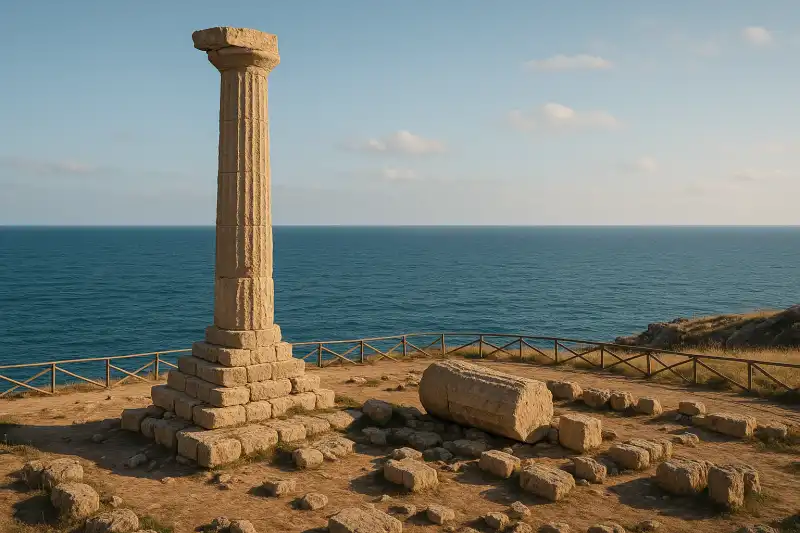
Capo Colonna Guide 2026: Calabria’s Coastal Temple Ruins
GreekVisit Capo Colonna with a practical plan: what remains to see, when to go, and how to pair this coas...
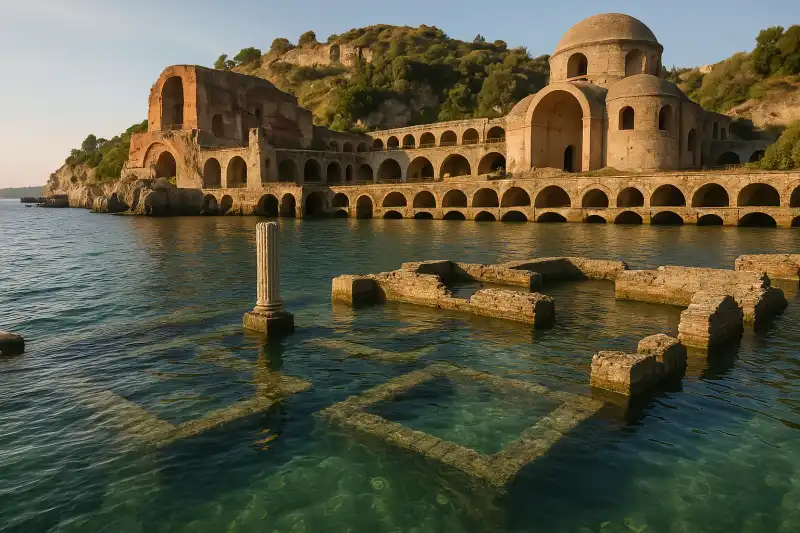
Baia Archaeological Park Guide 2026: Underwater Ruins, Thermal History, and Smart Visit Planning
RomanPlan a focused visit to Baia Archaeological Park near Naples with route strategy, what to prioritize...
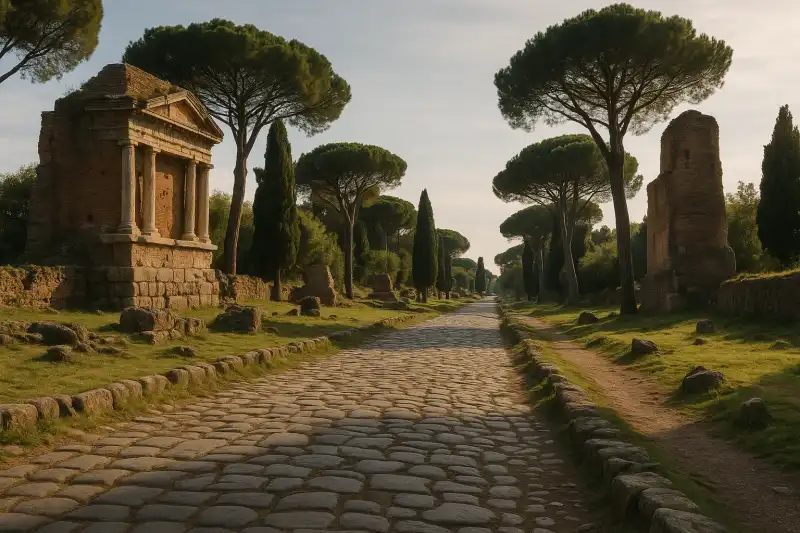
Appian Way Rome Guide 2026
RomanPlan a smart visit to the Appian Way with route choices, catacomb logistics, bike-vs-walk strategy, ...