Quick Info
At a glance
Monasterboice in Ireland sits quietly in the green countryside of County Louth, yet few places on the island preserve the artistic and spiritual power of the early medieval world so vividly. A short distance from Drogheda and within easy reach of Dublin, this old monastic settlement does not overwhelm with sheer size. Instead, it draws visitors in through atmosphere: weathered stone crosses rising over grass, a round tower standing above church ruins, and a sense that the site has been shaped as much by prayer, memory, and craftsmanship as by politics or war.
For many travelers, Monasterboice is one of those places that reveals its greatness gradually. At first glance it may seem modest compared with Ireland’s famous castles or dramatic coastal landscapes. Then the carvings come into focus. Biblical scenes, interlace patterns, and finely cut figures emerge from the stone, speaking across more than a thousand years. This was once a major center of religion and learning, founded in the early Christian period and flourishing during centuries when monasteries were among the most important institutions in Ireland. Today, Monasterboice remains one of the country’s finest destinations for anyone interested in Celtic art, sacred landscapes, and the transition from late antiquity into the medieval age.
History
Early foundation in the Christian age
Monasterboice takes its name from the Irish Mainistir Bhuithe, meaning the monastery of Buithe. Tradition holds that Saint Buithe, a respected religious figure, founded a monastery here in the late 5th century or early 6th century CE. This was a transformative era in Irish history, when Christianity was becoming more firmly rooted across the island and monastic communities began to serve not only as spiritual centers but also as hubs of education, manuscript production, and local influence.
Unlike later continental monasteries built on more rigid plans, early Irish monastic settlements often developed organically. A church might be joined by small cells, workshops, boundary features, burial grounds, and eventually stone buildings. Monasterboice likely began in this modest way, but its location in a fertile and connected landscape helped it grow. County Louth was well placed between northern and eastern routes, and the wider Boyne Valley region was already rich in sacred and historical significance long before Christianity arrived.
Growth into a major monastic center
By the early medieval period, Monasterboice had become an important ecclesiastical settlement. Although the exact details of its rise are incomplete, surviving evidence suggests a community of considerable prestige. The round tower, church remains, and especially the high crosses point to a wealthy and artistically ambitious monastery. Such monuments were not casual additions. They required skilled stoneworkers, patronage, theological vision, and a community with enough standing to commission lasting public art.
Irish monasteries in this period often functioned almost like small religious towns. They could host clergy, scholars, craftsmen, and pilgrims. They also maintained links with ruling families and regional powers. Monasterboice was likely woven into these wider networks of patronage and devotion. Its cemetery, still active over the centuries, reinforced the site’s reputation as a place of sanctity and memory.
The great flowering of carved stone sculpture at Monasterboice probably belongs mainly to the 9th and 10th centuries. This was an age when high crosses became one of Ireland’s most distinctive artistic achievements. The crosses were at once devotional objects, public monuments, teaching tools, and status symbols. At Monasterboice, they reached a particularly refined level of execution.
Viking-era pressures and continued importance
Like many monastic communities in Ireland, Monasterboice existed during a period marked by Viking raids and political instability. From the late 8th century onward, monasteries were often attractive targets because they contained valuable metalwork, books, and livestock. Historical records indicate that the wider region experienced repeated disturbance, yet many monasteries survived, adapted, and continued to function. Monasterboice appears to have remained important despite these pressures.
The site’s round tower belongs to this era of uncertainty as well as prosperity. Round towers in Ireland had multiple uses, including acting as bell towers, landmarks, and perhaps temporary refuges or secure storehouses for sacred goods. Their height made them visible statements of monastic presence in the landscape. The Monasterboice tower, still standing impressively today, is one of the clearest signs of the settlement’s former significance.
Decline and legacy after the medieval shift
Over time, Monasterboice was overshadowed by the nearby abbey at Mellifont, founded in the 12th century and associated with newer monastic reforms. As ecclesiastical structures changed in medieval Ireland, older monastic foundations often lost prominence. Monasterboice did not vanish overnight, but its role as a leading center declined. What remained, however, was extraordinary: a sacred enclosure layered with memory, monuments, and burial.
Its greatest gift to later generations has been preservation. While many early Christian sites survive only in fragmentary form, Monasterboice still conveys the outline of a once-thriving religious complex. Antiquarians, historians, artists, and archaeologists have long recognized its importance. In modern Ireland, it stands among the most celebrated early medieval monastic sites, especially for its sculpture. The carvings on Muiredach’s Cross in particular have often been described as among the finest examples of biblical stone art in Europe.
Today, Monasterboice is visited not simply as a ruin but as a witness to the religious, artistic, and intellectual life of early medieval Ireland. It links the world of saints and monastic founders with the craftsmanship of master sculptors and the long continuity of local devotion.
Key Features
What makes Monasterboice unforgettable is the concentration of major monuments within a relatively compact and peaceful setting. The site is not sprawling, but nearly every surviving structure carries significance.
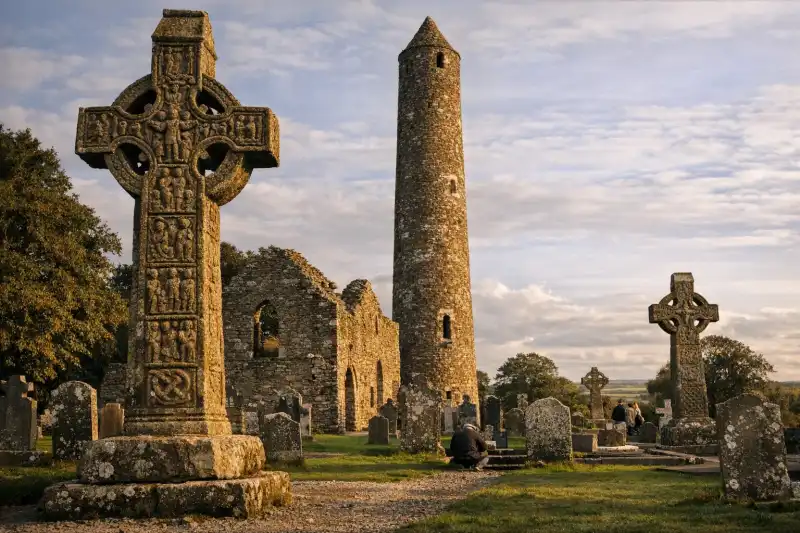
The most famous feature is Muiredach’s Cross, widely considered the masterpiece of the site and one of the greatest high crosses in Ireland. It stands around 5.5 meters tall and is richly decorated on all sides. Rather than presenting a single symbolic image, the cross unfolds like a carved theological narrative. Visitors can see scenes from the Old and New Testaments, figures of saints or clerics, ornamental panels, and dense knotwork. The quality of carving is remarkable: the figures have movement and individuality, and the sculptor organized the stone with both artistic balance and religious purpose. The cross is named for Muiredach, probably an abbot whose name appears in an inscription, offering a rare personal connection to the people behind the monument.
Nearby stands the West Cross, another imposing high cross, though more weathered than Muiredach’s. Even in its eroded state, it conveys the scale and ambition of Monasterboice’s sculptural program. A third important cross, often called the North Cross, survives in fragmentary form. Together, these monuments show that Monasterboice was not defined by a single masterpiece alone but by a broader culture of sacred stone carving.
The round tower is another dominant element of the site. Rising high above the church ruins and gravestones, it immediately signals Monasterboice’s standing in the early medieval period. Built of stone and tapering upward, the tower would once have had upper wooden floors and served practical as well as symbolic functions. Its elevated doorway, a common feature of Irish round towers, remains one of the most distinctive aspects for modern visitors. Looking at it, one can easily imagine bells sounding across the countryside or precious church treasures being stored within during unsettled times.
Around the tower are the ruins of two churches. These remains are modest compared with the dramatic crosses, but they are essential to understanding the site as a living monastic complex rather than an open-air sculpture gallery. The churches likely represent different building phases, reflecting the site’s long use. Their stone walls, though partial, help orient the visitor within what was once a functioning religious precinct of worship, burial, and community life.
The cemetery contributes strongly to Monasterboice’s atmosphere. Generations continued to bury their dead here long after the site’s medieval peak had passed. This continuity matters. It means Monasterboice remained part of local spiritual life even as its institutional role changed. The contrast between ancient crosses, medieval ruins, and later gravestones makes the site feel less frozen in time and more like a place where the past has remained active.
Another key feature, less immediately visible but deeply important, is the setting itself. Monasterboice lies in a gently rolling landscape not far from the Boyne Valley, an area dense with prehistoric tombs, royal centers, monasteries, and later historic landmarks. Visiting Monasterboice within this wider geographical context reveals how different eras of Irish sacred and political history overlap. The monastery did not emerge in an empty space; it became part of an already meaningful landscape and then added its own layer of significance.
Finally, there is the quality of light and texture. The stone surfaces change character depending on the weather. In bright sun, carvings become sharp and architectural. Under cloud, the crosses can seem solemn and almost sculptural in silhouette. In rain, the grooves darken and the ornament becomes more pronounced. For photographers, historians, and casual visitors alike, Monasterboice rewards slow looking. It is a site where details matter and where one monument can hold attention far longer than expected.
Getting There
Monasterboice is easiest to reach from Drogheda, which is the nearest major town, or from Dublin, which makes a practical base for international visitors. By car, the site is about 10 minutes from central Drogheda and roughly 45 to 60 minutes from Dublin, depending on traffic. If you are driving from Dublin, fuel costs are typically modest for a day trip, often around €10 to €20 in total depending on vehicle type and route. Parking is usually straightforward near the site.
Public transport requires a little more planning. The simplest option is to take a train from Dublin Connolly to Drogheda MacBride station. Tickets generally range from about €10 to €20 each way depending on time, booking method, and service type. From Drogheda, a taxi to Monasterboice usually takes around 10 to 15 minutes and may cost roughly €12 to €20. Bus options also connect Dublin and Drogheda, often at slightly lower fares, commonly in the €8 to €15 range one way.
For travelers who prefer not to coordinate train and taxi connections, guided day tours from Dublin can be very convenient. Many Boyne Valley excursions include sites such as Newgrange, the Hill of Tara, and occasionally Monasterboice. These tours often cost from €45 to €90 or more, depending on group size, entry inclusions, and itinerary.
Cycling from Drogheda is possible for confident riders in good weather, though road conditions should be checked in advance. However you arrive, it is wise to wear sturdy shoes, as the ground can be uneven or damp.
When to Visit
Monasterboice can be visited year-round, but the experience changes noticeably with the seasons. Late spring and summer, from May through August, are the easiest months for most travelers. Days are longer, the grass is vibrant, and the site is especially attractive in morning or late-afternoon light. Temperatures are usually mild rather than hot, often in the mid-teens to low 20s Celsius, making it comfortable for walking and photography. This is the best period if you want predictable conditions and to combine Monasterboice with other Boyne Valley stops in a single day.
Early autumn, particularly September, is also an excellent choice. The weather often remains relatively gentle, while crowds begin to thin. The lower angle of the sun can bring out the texture of the high crosses beautifully, giving the carvings added depth.
Winter visits have a different appeal. The site can feel especially atmospheric under gray skies, mist, or light rain, and there are usually fewer visitors. However, daylight hours are shorter, temperatures are colder, and surfaces may be slippery. If you come in winter, aim for the middle of the day and bring waterproof layers.
Rain is possible at any time in Ireland, so flexible planning is essential. A bright but slightly overcast day can actually be ideal for seeing carved details because harsh shadows are reduced. If photography is a priority, try visiting in the morning when the site is quieter. If you enjoy mood and solitude, choose an off-season weekday. For the broadest mix of comfort, scenery, and convenience, late spring and early autumn are hard to beat.
| Quick Facts | Details |
|---|---|
| Location | Monasterboice, County Louth, Ireland |
| Nearest city | Drogheda |
| Founded | Traditionally associated with Saint Buithe, 5th-6th century CE |
| Historical period | Early Medieval Ireland |
| Best known for | Muiredach’s Cross, other high crosses, and a round tower |
| Approximate visit time | 45 minutes to 1.5 hours |
| Best base for visitors | Drogheda or Dublin |
| Ideal season | Late spring to early autumn |
| Suitable for day trip from Dublin | Yes |
| Landscape context | Part of the wider Boyne Valley historical region |
Monasterboice rewards travelers who appreciate places that are quiet yet profound. It does not depend on spectacle in the modern sense. Instead, it offers a rarer kind of impact: the chance to stand among monuments created for devotion, memory, and teaching more than a thousand years ago, and to see that they still communicate with extraordinary clarity. The crosses remain among Ireland’s supreme artistic achievements, but the site’s power comes from the way all its elements work together: the tower, the ruined churches, the graveyard, and the surrounding fields.
For anyone exploring Ireland’s ancient and medieval heritage, Monasterboice is more than a stop between larger attractions. It is one of the clearest windows into the country’s early Christian civilization, where art, faith, and landscape meet. A visit here can be brief, but the impression tends to last.
Guided tours: worth it?
Most travelers can visit Monasterboice independently. Compare a tour only if you want a tighter history-focused visit, easier logistics, or a guide who can answer questions on the spot.
Best for
- Short visits where a planned route saves time
When to go self-guided
Go independently if you prefer setting your own pace, reading as you go, and checking official hours or ticket rules directly before you arrive.
What I’d avoid
Skip paid tours that bundle unrelated stops you do not actually want. The best option should either save meaningful planning time or add historical context you would miss on your own.
Boyne Valley and Monasterboice Tours
Useful when: you want to compare guided formats before deciding
Day Trips from Dublin to Monasterboice
Useful when: transport or pickup logistics matter
Newgrange, Hill of Tara and Monasterboice Tours
Useful when: you want to compare guided formats before deciding
Some tour links are affiliate links, which may earn Ancient Travel a small commission at no extra cost to you. I try to surface options that make practical sense for the site—not just anything bookable.
Frequently Asked Questions
What is Monasterboice famous for?
Monasterboice is best known for its exceptional early medieval high crosses, especially Muiredach's Cross, along with its round tower and the remains of an important Irish monastic settlement.
Where is Monasterboice located?
Monasterboice is in County Louth, Ireland, a short drive west of Drogheda and within easy reach of Dublin and the Boyne Valley.
Is there an entrance fee to visit Monasterboice?
Monasterboice is generally accessible without a major admission charge, but visitors should check current local or heritage guidance before traveling in case of updated access arrangements.
How much time should I spend at Monasterboice?
Most visitors spend 45 minutes to 1.5 hours exploring the crosses, round tower, church ruins, and cemetery, though history enthusiasts may wish to stay longer.
Can you visit Monasterboice on a day trip from Dublin?
Yes, Monasterboice is very suitable for a day trip from Dublin by car or as part of a guided Boyne Valley excursion.
What is the best time of year to visit Monasterboice?
Late spring through early autumn usually offers the best light, mild weather, and easier walking conditions, though winter can be atmospheric and quieter.
Nearby Ancient Sites
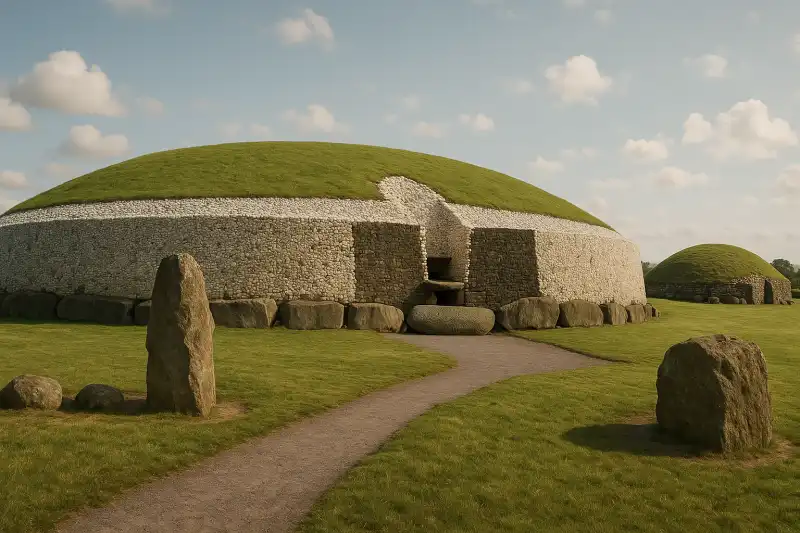
Boyne Valley Passage Tombs Travel Guide 2026: Newgrange, Knowth, and Dowth Visit Strategy
Neolithic IrelandPlan your first Boyne Valley passage tombs visit with practical timing, Brú na Bóinne access flow, a...
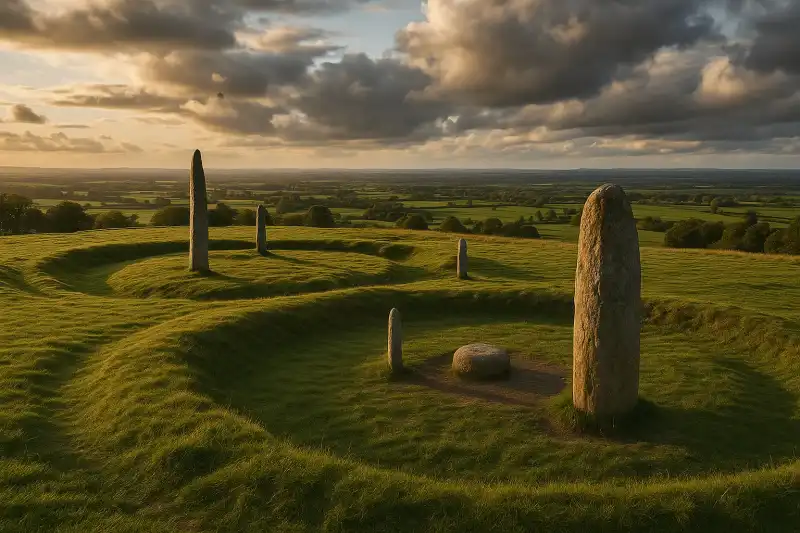
Hill of Tara Travel Guide 2026: Sacred Kingship Landscape, Site Highlights, and Meath Planning
Celtic IrelandPlan a first visit to the Hill of Tara with practical route tips, key myth-and-history context, and ...
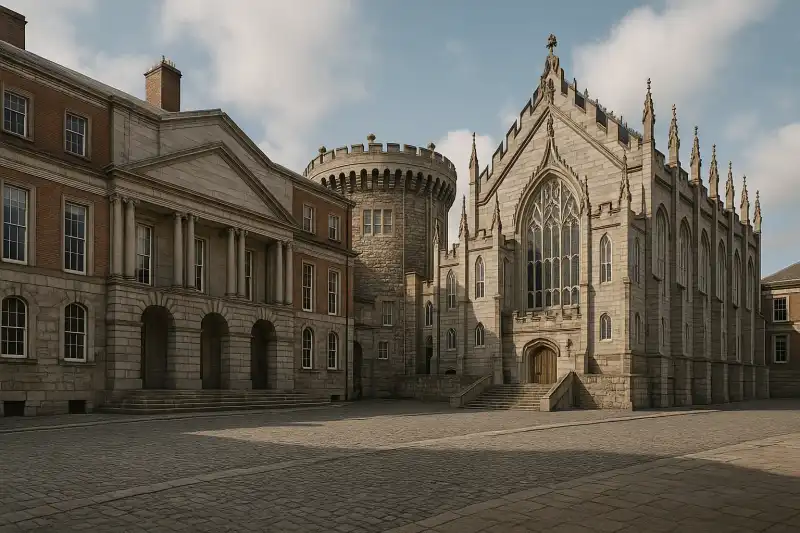
Dublin Castle Travel Guide 2026: State Apartments, Viking Layers, and City-Center Route
Medieval and Early Modern IrelandPlan a first visit to Dublin Castle with practical timing, ticket strategy, and clear context on the...
Glendalough Travel Guide 2026: Monastic Ruins, Lakes, and Wicklow Day-Trip Plan
Early Medieval IrelandPlan a clear first visit to Glendalough with route advice, monastic-site context, and practical timi...