Quick Info
At a glance
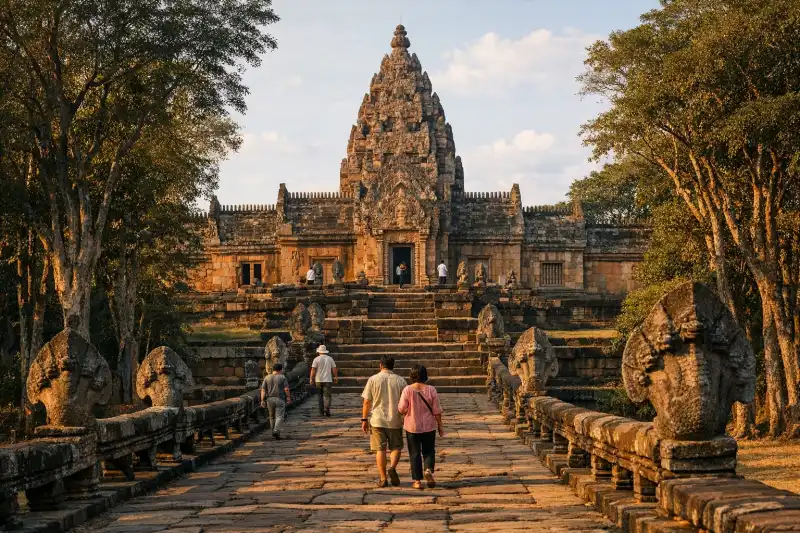
Phanom Rung in Thailand rises from the edge of an extinct volcano, where long stone walkways, carved naga bridges, and a sanctuary of pink sandstone create one of mainland Southeast Asia’s most memorable temple settings. Even before you reach the main tower, the monument announces itself through distance and elevation: a sacred ascent rather than a simple arrival. The approach is deliberate, pulling visitors step by step from the flat agricultural plains of Buriram Province toward a world shaped by Khmer cosmology, royal patronage, and volcanic stone.
For many travelers, Phanom Rung feels both familiar and surprising. It belongs to the broad architectural tradition that produced the great Khmer temples of the region, yet its atmosphere is distinctly its own. There is no tropical jungle swallowing towers here and no dense urban backdrop. Instead, the site sits open to sun, wind, and wide horizons, its geometry sharpened by light. The long causeway, ceremonial stairways, galleries, and central sanctuary are arranged with a confidence that still reads clearly after centuries of weathering and restoration.
What makes the experience especially powerful is the sense of movement encoded into the architecture. You do not simply look at Phanom Rung; you progress through it. Each terrace, doorway, and bridge prepares the next. Along the way, delicate carvings of deities, guardians, lotus motifs, and mythic scenes reveal the artistic sophistication of the Khmer world in what is now northeastern Thailand. Whether you come for archaeology, photography, or a deeper understanding of the region’s layered past, Phanom Rung rewards a slow, attentive visit.
History
Early sacred use of the volcanic hill
Long before the surviving temple took shape, the hill of Phanom Rung was likely regarded as a naturally powerful place. Its location on the rim of an extinct volcano gave it commanding views over the surrounding plain, and high places in South and Southeast Asian religious thought were often associated with spiritual ascent. The very name is thought to derive from the Khmer language and refers to a broad mountain or large hill. In symbolic terms, the setting was ideal for a temple linked to Mount Kailasa, the mythic abode of Shiva.
Archaeological evidence suggests that religious activity here began by around the 10th century CE, when the Khmer cultural and political sphere extended across much of present-day Cambodia, northeastern Thailand, Laos, and beyond. At that stage, the sanctuary was probably more modest than the structure visible today. Early brick elements once stood on the hill, and some remnants indicate that an older sacred complex preceded the mature sandstone monument. As with many Khmer sites, construction was not a single event but a sequence of additions, rebuildings, and embellishments over generations.
Growth under Khmer patronage
Phanom Rung developed most significantly between the 10th and 13th centuries CE, when the Khmer Empire was at its height. During this era, temple building served not only devotional purposes but also political ones. Monumental architecture projected legitimacy, expressed elite status, and linked local power holders to the broader sacred order centered on Hindu cosmology.
The temple appears to have been associated with aristocratic or princely patrons tied to the Khmer court. Inscriptions and stylistic analysis connect aspects of the site to periods of strong Khmer artistic production, especially from the 11th and 12th centuries. During this time, builders replaced earlier structures with more durable sandstone and laterite, gradually creating the ceremonial avenue, stairways, bridges, subsidiary buildings, and central sanctuary that define the site today.
Phanom Rung was primarily dedicated to Shiva, one of the principal gods of Hinduism. This affiliation can be seen in iconography throughout the complex, including carvings associated with Shaivite worship and imagery from Hindu mythology. Yet like many Khmer temples, it likely accommodated a broader religious landscape that was never entirely rigid. Khmer sacred spaces often reflected layered practices, regional adaptations, and changing forms of devotion over time.
Architectural maturity and ritual life
By the 12th century, Phanom Rung had become an architecturally refined mountain temple. The sanctuary’s axis, elevated terraces, and framed processional approach demonstrate mature Khmer planning. The monument was built to be experienced ritually, with movement toward the center echoing a passage from the human realm to the divine.
The famous alignment of the rising sun through the temple’s doorways has become one of the site’s best-known features today. While modern audiences often experience this as a spectacle, it also reflects the careful astronomical and symbolic thinking embedded in Khmer architecture. Such alignments reinforced cosmic order and the connection between temple, landscape, and celestial cycles.
At its height, the site would have hosted ceremonies led by priests and supported by a wider community of attendants, laborers, agricultural producers, and local elites. Temples like Phanom Rung were not isolated religious monuments; they were nodes in wider systems of economy, authority, and land management. The surrounding region likely sustained the sanctuary through agriculture and patronage networks tied to Khmer administration.
Decline, rediscovery, and restoration
As political power shifted and the Khmer Empire declined, Phanom Rung gradually lost its original prominence. The religious orientation of the region also changed over the centuries, with Theravada Buddhism becoming dominant in much of mainland Southeast Asia. Like many older Hindu monuments, the temple endured through adaptation, neglect, partial collapse, and local memory rather than continuous elite sponsorship.
By the modern era, the complex had suffered damage from time, looting, and structural deterioration. Some carved pieces were removed illegally, including a famous lintel that later became the subject of a major cultural heritage dispute. Its eventual return to Thailand in the late 20th century helped raise public awareness of the site’s artistic importance.
Restoration work in the 20th century transformed Phanom Rung from a weathered ruin into one of Thailand’s best-presented archaeological parks. Thai Fine Arts Department teams undertook careful anastylosis and stabilization, reassembling structures from fallen elements where possible. Today, Phanom Rung Historical Park stands as both an ancient monument and a modern conservation success, allowing visitors to appreciate Khmer architecture in a dramatic setting that still feels deeply ceremonial.
Key Features
Phanom Rung’s most striking feature is its processional design. From the moment you begin the approach, the temple feels choreographed. A grand stairway rises toward the upper levels, drawing the eye upward and reinforcing the hilltop’s ritual significance. The ascent is neither abrupt nor casual. Instead, it unfolds through pauses, terraces, and thresholds, creating a sense that each architectural layer carries you closer to the sacred core.
One of the most memorable elements is the long processional walkway leading toward the sanctuary. Flanked by boundary stones and elevated slightly above the surrounding ground, it feels ceremonial even when nearly empty. Walking here gives a rare sense of how Khmer planners used linear space to shape emotion and expectation. At the far end, naga bridges span symbolic transitions between worlds. Their serpent balustrades, common in Khmer architecture, are not merely decorative; they signal passage into a more charged spiritual realm.
The main sanctuary itself is a masterpiece of sandstone construction. Built largely of pink sandstone with laterite components, it changes character with the light, sometimes appearing warm and soft in the early morning, sometimes sharply defined under the midday sun. The central tower rises from a compact yet sophisticated arrangement of halls, doorways, and enclosures. Unlike colossal temple cities where scale can overwhelm detail, Phanom Rung allows close attention to craftsmanship. Lintels, pediments, columns, and doorframes are richly carved with floral scrolls, celestial beings, guardians, and scenes from Hindu myth.
Among the carvings, the temple’s lintels deserve particular attention. These horizontal sculpted panels above doorways rank among the finest surviving Khmer reliefs in Thailand. They depict deities and mythological episodes with remarkable balance and precision. One especially celebrated example shows Shiva in a dynamic composition, demonstrating how sculpture at Phanom Rung could combine narrative, theology, and ornament in a single architectural feature. Even where weathering has softened edges, the quality of design remains evident.
The site’s volcanic setting is another key part of its appeal. Because the temple stands on the rim of an extinct volcano, the surrounding views are unexpectedly expansive. Looking out from the hill, you see a landscape of fields, villages, and low horizons rather than dense forest or mountains. This openness enhances the monument’s geometry. It also helps explain why the site was so effective as a sacred and political statement: it was visible, elevated, and symbolically commanding.
Phanom Rung is also celebrated for its solar alignment. On specific mornings each year, the rising sun shines through a series of doorways in the sanctuary, creating a luminous corridor that attracts large crowds. The event is now a well-known cultural attraction, but it also underscores the precision of Khmer architectural planning. Even outside the alignment dates, the temple rewards attention to light. Early morning and late afternoon are especially good times to notice how shadows deepen carvings and how the sanctuary’s surfaces shift from rose-gold to amber.
Finally, there is the overall coherence of the complex. Many ancient sites survive as fragments, asking visitors to reconstruct the past in their imagination. Phanom Rung, by contrast, remains legible. You can understand its axis, its hierarchy of spaces, and its ceremonial rhythm. That clarity does not make it simple; rather, it allows the sophistication of Khmer sacred architecture to emerge with unusual force. The result is a site that feels both intellectually rich and immediately moving.
Getting There
Phanom Rung is in Buriram Province in northeastern Thailand, with Nang Rong serving as the most practical base for most travelers. From Bangkok, one of the easiest budget options is to take an intercity bus to Nang Rong. Fares typically range from about 250 to 450 THB depending on the operator and service class, and the journey usually takes 5 to 7 hours. From Nang Rong, you can continue to Phanom Rung by local songthaew when available, private taxi, or hired car. A taxi or private transfer for the roughly 25 to 30 kilometer trip often costs around 300 to 600 THB each way, depending on negotiation and waiting time.
Another option is to travel by train from Bangkok to Buriram city. Third-class seats can be inexpensive, often under 100 THB, while air-conditioned classes are higher. From Buriram railway station, onward travel to Nang Rong or directly to the temple generally requires a bus, minivan, or taxi. Expect a private car from Buriram to Phanom Rung to cost roughly 1,000 to 1,800 THB depending on vehicle type and whether you combine it with nearby Muang Tam.
For maximum flexibility, many travelers rent a car in Buriram, Nakhon Ratchasima, or even Bangkok and drive themselves. Roads are generally straightforward, and self-driving makes it easier to pair Phanom Rung with other Khmer sites in the region. If you are already in Isan, day tours from Buriram or Nang Rong are sometimes available, though private drivers are often more common than large-group tours. Once at the historical park, allow extra time for the walk from the visitor area up to the temple, especially in hot weather.
When to Visit
Phanom Rung can be visited year-round, but the most comfortable months are generally from November to February, when temperatures are lower and the air is drier. During this cooler season, walking the long approach and climbing the stairways is far more pleasant than in the intense heat of late spring. Clear skies also make this a rewarding period for photography, with crisp morning light and broad views over the countryside.
March to May is the hottest time of year. Midday temperatures can be punishing, and exposed stone surfaces radiate heat. If you visit during these months, aim to arrive early in the morning or later in the afternoon. The heat can be worth managing if you are interested in the temple’s famous sunrise alignment, which usually occurs in early April. These event days draw larger crowds, so expect a more festival-like atmosphere and plan transport well in advance.
The rainy season, roughly from June to October, brings greener scenery and fewer visitors. Showers can be heavy but are often intermittent rather than all-day downpours. Wet conditions can make pathways slippery, and cloud cover may soften views, but the landscape becomes lush and photogenic. Early September is also associated with one of the annual sunrise alignment periods, though rain and cloud can affect visibility.
In practical terms, the best all-around strategy is to visit as early in the day as possible, regardless of season. Morning light brings out the warm tones of the sandstone, temperatures are milder, and the temple feels calmer before larger groups arrive. If you want the site at its most atmospheric rather than simply at its busiest, an ordinary clear morning outside festival dates is often the ideal choice.
| Quick Facts | Details |
|---|---|
| Location | Buriram Province, Thailand |
| Nearest practical base | Nang Rong |
| Cultural tradition | Khmer |
| Primary religious association | Hinduism, especially Shiva |
| Main construction period | 10th-13th centuries CE |
| Setting | Hilltop complex on an extinct volcano |
| Best known for | Sandstone carvings, processional causeway, sunrise alignment |
| Suggested visit length | 2-3 hours |
| Good combination site | Muang Tam |
| Best time of day | Early morning |
Guided tours: worth it?
Self-guided works here, but a guide can add real value if you want the ruins explained as a living place rather than just a sequence of monuments.
Best for
- First-time visitors who want context, not just photos
- Short visits where a planned route saves time
When to go self-guided
Go independently if you prefer setting your own pace, reading as you go, and checking official hours or ticket rules directly before you arrive.
What I’d avoid
Skip paid tours that bundle unrelated stops you do not actually want. The best option should either save meaningful planning time or add historical context you would miss on your own.
Phanom Rung Thailand tours
Useful when: you want to compare guided formats before deciding
Buriram temple day tours
Useful when: you want to compare guided formats before deciding
Nang Rong and Phanom Rung tours
Useful when: you want to compare guided formats before deciding
Some tour links are affiliate links, which may earn Ancient Travel a small commission at no extra cost to you. I try to surface options that make practical sense for the site—not just anything bookable.
Frequently Asked Questions
What is Phanom Rung?
Phanom Rung is a major Khmer temple complex in Buriram Province, Thailand, built on the rim of an extinct volcano and dedicated primarily to Shiva.
How far is Phanom Rung from Bangkok?
Phanom Rung is roughly 380 to 410 kilometers from Bangkok depending on your route, and most travelers reach it by bus, train, or car via Buriram or Nang Rong.
Is Phanom Rung worth visiting?
Yes. It is one of Thailand’s finest Khmer monuments, known for its elevated setting, long processional causeway, detailed lintels, and seasonal sunrise alignments.
When does the sunrise alignment happen at Phanom Rung?
The famous alignment usually occurs on a few mornings in early April and early September, when the rising sun shines through the temple’s doorways, though exact dates vary slightly each year.
How much time do you need at Phanom Rung?
Most visitors spend 2 to 3 hours exploring the temple, museum, and surrounding viewpoints, though photographers and history enthusiasts may want half a day.
Can you visit Phanom Rung and Muang Tam in one day?
Yes. These two Khmer sites are close to each other and are commonly combined in a single day trip from Nang Rong or Buriram.
Nearby Ancient Sites
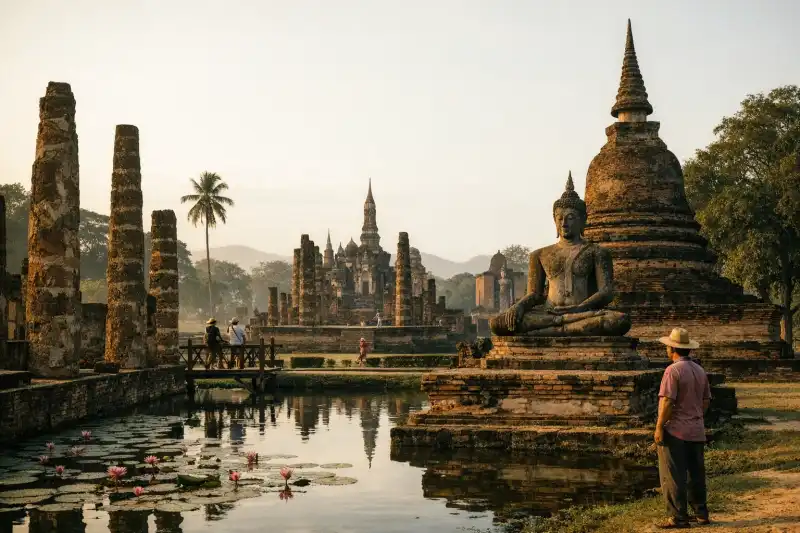
Sukhothai
Sukhothai, in northern Thailand's Sukhothai Province, is famed as the cradle of Thai civilization an...
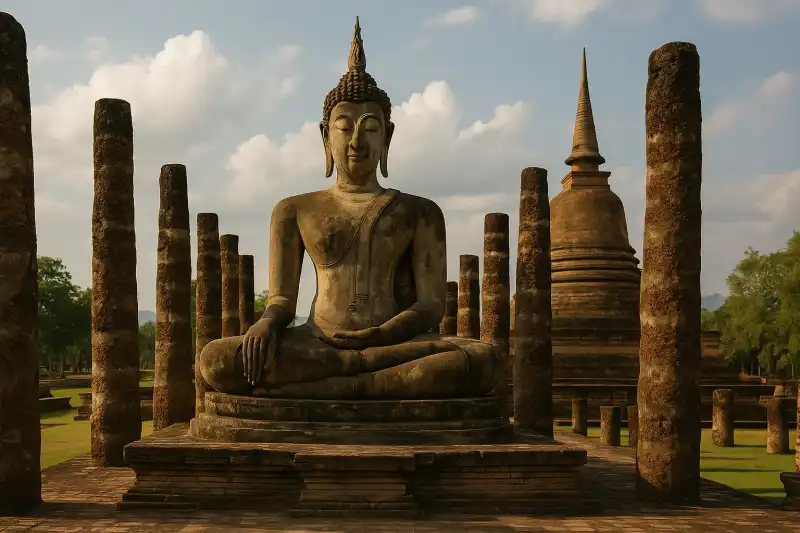
Sukhothai Historical Park Travel Guide 2026: Thailand’s First Capital Without the Crowds
Sukhothai KingdomPlan a smarter Sukhothai Historical Park visit with route tips, key ruins, and practical timing for ...
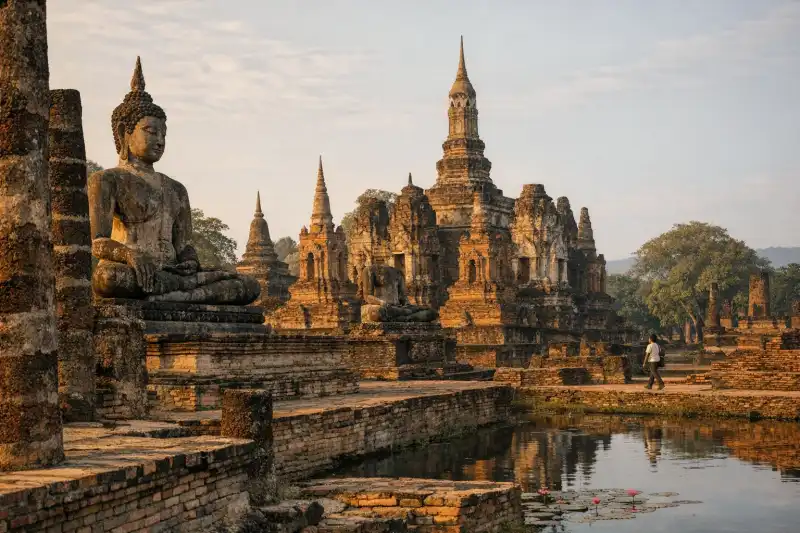
Wat Mahathat (Sukhothai)
Wat Mahathat in Sukhothai, Thailand, is a stunning World Heritage temple complex and the spiritual h...