Quick Info
At a glance
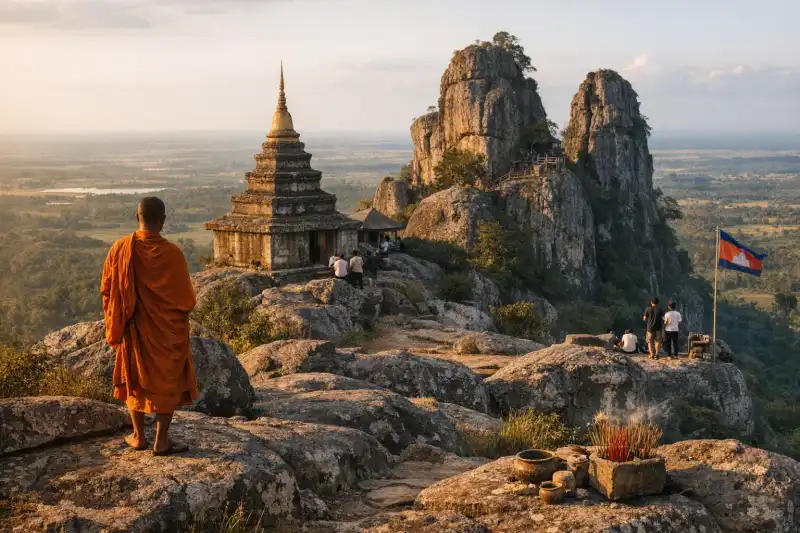
Phnom Bayong in Cambodia is one of those places that rarely appears on standard itineraries yet leaves a deep impression on travelers who make the effort to reach it. Set in Takeo Province, in the broad southern plains where isolated hills rise unexpectedly from rice fields and waterways, the site combines the appeal of an ancient temple ruin with the atmosphere of a rural pilgrimage destination. It is not monumental in the way Angkor Wat is monumental, nor does it arrive with the same polished infrastructure and crowds. Instead, Phnom Bayong rewards curiosity. The journey itself feels like part of the experience: roads pass villages, paddies, and small markets before the landscape narrows toward a hill that has drawn worshippers, settlers, and local visitors for centuries.
What makes Phnom Bayong memorable is this layered sense of time. The stones and surviving architectural fragments speak to Cambodia’s early Khmer past, while the surrounding setting shows how ancient sacred places continue to live within present-day communities. Visitors often come for the temple remains, but they leave remembering the wind at the summit, the views across Takeo’s flat countryside, and the quiet that settles over the hill outside local festival days. For travelers interested in Cambodia beyond the headline destinations, Phnom Bayong offers something increasingly rare: a chance to experience an archaeological site that still feels discovered in the moment, intimate rather than overwhelming, and meaningful in both historical and living cultural terms.
History
Early sacred landscapes in southern Cambodia
Long before the Khmer Empire reached its later architectural zenith in the northwest, the lowlands and hills of southern Cambodia were already important centers of settlement, religion, and political power. Takeo Province, where Phnom Bayong stands, is especially significant in the story of early Cambodia. The region has often been linked with some of the earliest organized polities in mainland Southeast Asia, and its scattered hills became natural places for shrines, sanctuaries, and defensive points. In a largely flat landscape, a hill was not simply a geographic feature. It could be a marker of authority, a sacred axis, and a visible declaration of ritual presence.
Phnom Bayong likely emerged within this wider tradition of hill sanctuaries. Even where inscriptions are sparse or unclear, the broader pattern is familiar across Cambodia: natural elevations were adapted for worship, and religious structures were built in ways that merged landscape with architecture. In these early phases, brick and laterite were common materials, and temples often served as centers of devotion to Hindu deities before many sites gradually incorporated Buddhist use over time. Phnom Bayong fits the pattern of a place where sacred geography mattered as much as masonry.
Development during the early Khmer era
As Khmer political and religious traditions developed between the pre-Angkorian and early Angkorian periods, temple construction became more formalized. At sites such as Phnom Bayong, this likely meant additions, rebuilding, or ritual renewal rather than a single one-time foundation event. Cambodian temple sites often evolved in stages. A modest sanctuary could be expanded, reused, or rededicated by later rulers and communities. Architectural details, surviving plans, and scattered fragments at many provincial sites suggest these spaces were dynamic rather than static.
Phnom Bayong’s remains point to this kind of layered growth. Though it does not preserve the vast enclosure systems or towering sandstone compositions associated with later Angkor, its surviving elements reflect the Khmer habit of adapting difficult topography into sacred architecture. Builders had to negotiate slopes, create terraces or platforms, and position structures in relation to the summit and surrounding views. Such choices were not merely practical. The ascent itself would have had symbolic meaning, turning worship into movement from the ordinary world below toward a spiritually elevated place above.
This period also saw increasing integration between local shrines and wider Khmer state traditions. Even comparatively remote sanctuaries were not isolated from political currents. Royal patronage, regional elites, and religious specialists all played roles in sustaining temple complexes. Phnom Bayong would have belonged to that network of sacred sites that tied local devotion to broader cultural identity across early Cambodia.
Shifts in worship and local continuity
Like many Cambodian temple sites, Phnom Bayong almost certainly experienced changing patterns of religious use over the centuries. Hindu worship may have given way, in whole or in part, to Buddhist practice, or both traditions may have overlapped during transitional phases. Such continuity through adaptation is typical in Cambodia, where sacred places often survive not because they remain unchanged, but because they remain meaningful.
Even when political centers moved and monumental building shifted elsewhere, local communities kept returning to ancient hills and shrines. Offerings, seasonal ceremonies, and folk beliefs preserved these places as active cultural landscapes. This matters for understanding Phnom Bayong today. It is not simply a ruin abandoned by history. Rather, it is part of a long continuum in which formal temple architecture, village spirituality, and regional identity intersect.
In periods of conflict, environmental wear, and neglect, structures would have deteriorated. Brick collapses, vegetation growth, erosion, and stone reuse in nearby settlements affected many lesser-known Cambodian sites. Yet complete disappearance was prevented by memory. Hills with sacred associations tend to endure in popular consciousness even when architecture suffers. Phnom Bayong’s survival as a recognizable destination reflects that persistence.
Phnom Bayong in the modern travel era
In recent decades, Cambodia’s better-known archaeological heritage has drawn global attention, especially around Siem Reap. Sites in southern provinces have remained relatively under-visited, which has both limited tourism development and preserved a quieter atmosphere. Phnom Bayong is part of this second tier of historic destinations: deeply valuable, regionally important, but still outside mass tourism routes.
Today, it appeals to travelers who want to widen their understanding of Khmer history beyond Angkor. Scholars and heritage-minded visitors see in places like Phnom Bayong evidence of how sacred landscapes were distributed across the country, not concentrated in a single imperial zone. For local visitors, the hill remains part of a familiar cultural geography. For international travelers, it offers perspective. Cambodia’s ancient world was broad, interconnected, and diverse, and Phnom Bayong is one of the places where that larger story can still be felt on the ground.
Key Features
The defining feature of Phnom Bayong is its setting. In a province of broad horizontal lines, the hill rises with unusual prominence, instantly giving the site a different character from temples built on flat terrain. That elevation creates both drama and meaning. Approaching from the surrounding countryside, visitors first notice the hill as a landmark long before they reach the archaeological remains. Once on the ascent, the environment changes: village sounds recede, breezes strengthen, and the climb introduces a sense of separation from the fields below. Ancient temple builders understood the power of this shift. Worship here was shaped not only by architecture but by ascent, visibility, and the experience of arriving above the ordinary landscape.
The temple remains themselves are modest compared with Cambodia’s grandest monuments, yet that modesty is part of their appeal. Phnom Bayong is a site where close attention matters. Visitors may notice worn brickwork, surviving stone frames, collapsed sections, and traces of foundations that suggest former structures now mostly lost. These fragments reveal the practical realities of early Khmer building traditions. Before the dominance of large sandstone temples in later imperial centers, many sanctuaries relied on brick, laterite, and carefully carved stone details concentrated at key architectural points such as doorways and lintels. At Phnom Bayong, the surviving material encourages imagination: instead of being overwhelmed by scale, you reconstruct the temple’s former life through texture, alignment, and setting.
Another important feature is the panoramic view. From the upper reaches of Phnom Bayong, the countryside of Takeo Province opens in every direction. Rice fields form changing seasonal patterns of green, gold, and watery silver; palm trees punctuate the plains; village roads and canals draw faint lines through the land. These views help explain why ancient builders valued elevated sites. A hill sanctuary was spiritually potent, but it was also visually commanding. It marked territory, oriented communities, and linked heavenward symbolism with practical oversight of the world below. For modern visitors, the summit view is one of the most memorable aspects of the visit, especially in the soft light of morning or late afternoon.
Phnom Bayong also stands out because of its atmosphere of continuity. Unlike heavily managed archaeological parks, this is a place where heritage often feels integrated into daily local life. Depending on the day, you may encounter families visiting, small offerings left at shrines, or signs of continued devotional use near older remains. This living dimension changes the visitor experience. The site is not simply observed; it is shared. Respectful travelers quickly understand that ancient stones here are not detached museum objects but part of a continuing relationship between community and place.
Vegetation is another part of the site’s identity. Trees, scrub, and seasonal growth soften the ruins and can make the hill feel more secluded than it actually is. In the dry season, the outlines of walls and pathways tend to be easier to discern. In greener months, nature partly reclaims the architecture, creating a more atmospheric if less immediately legible scene. This interaction between masonry and plant life is common at lesser-visited Cambodian sites and contributes to Phnom Bayong’s distinctive mood: part ruin, part lookout, part sacred hill.
Finally, the site’s relative lack of commercialization is itself a feature. There may be basic facilities or local vendors nearby depending on the day, but visitors should not expect the extensive signage, curated pathways, or large visitor centers found at major tourist hubs. For some travelers, that means inconvenience. For others, it is precisely the attraction. Phnom Bayong offers a more direct encounter with place, one that asks for patience, self-guided observation, and a willingness to appreciate archaeology in a quieter, less mediated form.
Getting There
Most travelers reach Phnom Bayong from Phnom Penh, which is the most practical starting point. A private taxi or hired car to Takeo Province is usually the easiest option, especially if you want to combine multiple temple sites in one day. Expect a one-way fare from Phnom Penh to the Takeo area of around $35 to $60 depending on vehicle type, negotiation, and whether you book a round-trip driver. If you arrange a full-day car with waiting time and stops, costs often fall in the $60 to $100 range.
Budget travelers can take a bus or shared minivan from Phnom Penh toward Takeo for roughly $5 to $10 per person, though this option usually requires additional transport at the provincial end. From Takeo town or nearby transport hubs, local moto-taxis or tuk-tuks may be available for the final stretch to Phnom Bayong, typically costing about $8 to $20 depending on distance and waiting time. Prices vary with road conditions, fuel costs, and your ability to arrange a return ride in advance.
If you prefer simplicity, an organized day trip is often the best choice. Guided drivers familiar with southern Cambodia’s temple circuit can include Phnom Bayong alongside other historical sites in the province. This saves time and removes the uncertainty of rural navigation.
Road conditions are generally manageable in the dry season, but some local routes can become muddy or slower after rain. Carry water, cash in small denominations, and a phone with offline maps. Facilities can be limited, so it is wise to plan transport both there and back before you arrive.
When to Visit
The best time to visit Phnom Bayong is during Cambodia’s dry season, especially from November to February. These months usually bring lower humidity, more comfortable daytime temperatures, and clearer skies, all of which make the climb and the hilltop views more enjoyable. Morning light is especially rewarding, with softer temperatures and better conditions for photography. Late afternoon can also be beautiful, though it is smart to leave enough time to descend before dusk.
March to May is the hottest period of the year. Phnom Bayong can still be visited then, but heat builds quickly, and exposed sections of the hill may feel tiring by late morning. If traveling in these months, go as early as possible, wear a hat, and bring more water than you think you need. The reward is often fewer visitors and a stark, dramatic landscape under bright skies.
The rainy season, typically from May or June through October, transforms the countryside around Phnom Bayong into a lush green plain. This can be a very attractive time for scenery, and the fields below the hill often look at their most vivid. However, rain can make roads slower and footpaths slippery. Sudden showers are common, and overgrown vegetation may obscure some details of the ruins. If you visit during this season, flexible timing helps.
If your interest includes local culture, ask whether your visit coincides with regional festivals or Buddhist observances. Sacred hills often become livelier on special dates, offering a more communal atmosphere. On ordinary weekdays, by contrast, Phnom Bayong feels far more tranquil. The choice depends on whether you prefer energy and local activity or quiet reflection among the ruins.
| Quick Facts | Details |
|---|---|
| Location | Takeo Province, Cambodia |
| Site Type | Hilltop temple and ancient religious site |
| Cultural Context | Khmer |
| Best From | Phnom Penh or Takeo |
| Ideal Visit Length | 1–2 hours |
| Best Season | November to February |
| Terrain | Uneven paths, hill ascent, exposed viewpoints |
| Budget Range | Low to moderate, depending on transport |
| Combine With | Other Takeo Province temple sites |
| Visitor Style | Best for independent travelers, heritage enthusiasts, and day-trippers |
Phnom Bayong may not have the fame of Cambodia’s flagship monuments, but that is exactly why it deserves attention. It offers a more intimate entry into Khmer history, one in which landscape, memory, and ruin remain closely linked. For travelers willing to leave the main tourist corridor, the site reveals an older and quieter rhythm of discovery. You come for the temple, but you also come for the hill, the view, and the sense that Cambodia’s ancient world extended far beyond the places most people already know.
Guided tours: worth it?
A guide can be genuinely useful at Phnom Bayong, especially if you want help with transport, timing, tickets, or understanding a large site without losing half the day to logistics.
Best for
- First-time visitors who want context, not just photos
- Travelers who want transport, timing, or entry logistics handled
- Trips where tickets, circuits, or timed entry can shape the day
- Short visits where a planned route saves time
When to go self-guided
Go independently if you already have transport and tickets sorted, enjoy moving at your own pace, and are comfortable checking the latest official rules before you arrive.
What I’d avoid
Skip paid tours that bundle unrelated stops you do not actually want. The best option should either save meaningful planning time or add historical context you would miss on your own.
Takeo Province and Phnom Bayong tours
Useful when: you want to compare guided formats before deciding
Phnom Da and Takeo ancient temples tours
Useful when: you want to compare guided formats before deciding
Day trips from Phnom Penh to Takeo temples
Useful when: transport or pickup logistics matter
Some tour links are affiliate links, which may earn Ancient Travel a small commission at no extra cost to you. I try to surface options that make practical sense for the site—not just anything bookable.
Frequently Asked Questions
Where is Phnom Bayong located?
Phnom Bayong is in Takeo Province in southern Cambodia, within a landscape known for early Khmer temple sites and low hills rising above the plains.
What is Phnom Bayong known for?
It is known for its hilltop setting, early Khmer religious remains, and panoramic countryside views that make it appealing to travelers interested in less-visited ancient sites.
How do you get to Phnom Bayong from Phnom Penh?
Most visitors travel by private car, taxi, or organized day tour from Phnom Penh to Takeo Province, then continue by local road to the hill and temple area.
How much time should I spend at Phnom Bayong?
Plan for 1 to 2 hours at the site itself, or a full day if you combine it with other historic attractions in Takeo Province.
Is Phnom Bayong suitable for casual travelers?
Yes, though the site is best for travelers comfortable with uneven paths, basic facilities, and a more rural, less interpreted archaeological setting.
When is the best time to visit Phnom Bayong?
The dry season from November to February is usually the most comfortable, with clearer skies, cooler temperatures, and easier road access.
Nearby Ancient Sites
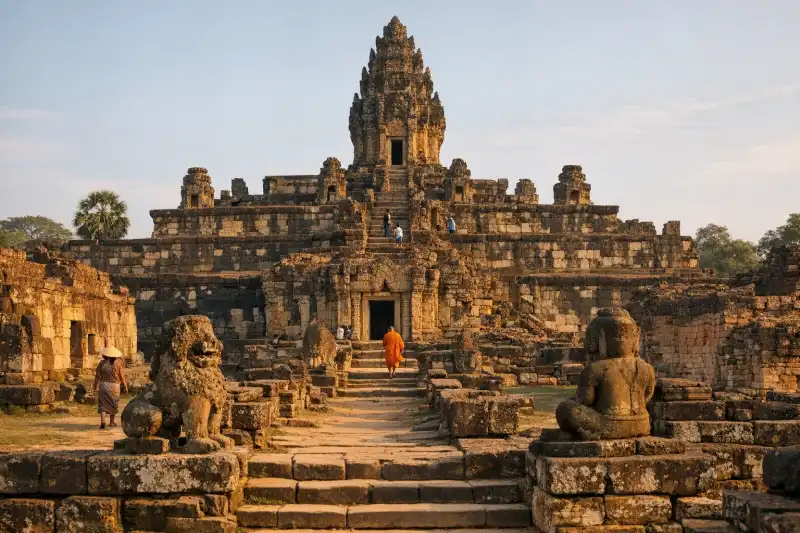
Bakong
Bakong is Cambodia's first major sandstone temple mountain, a stunning Khmer monument at the heart o...
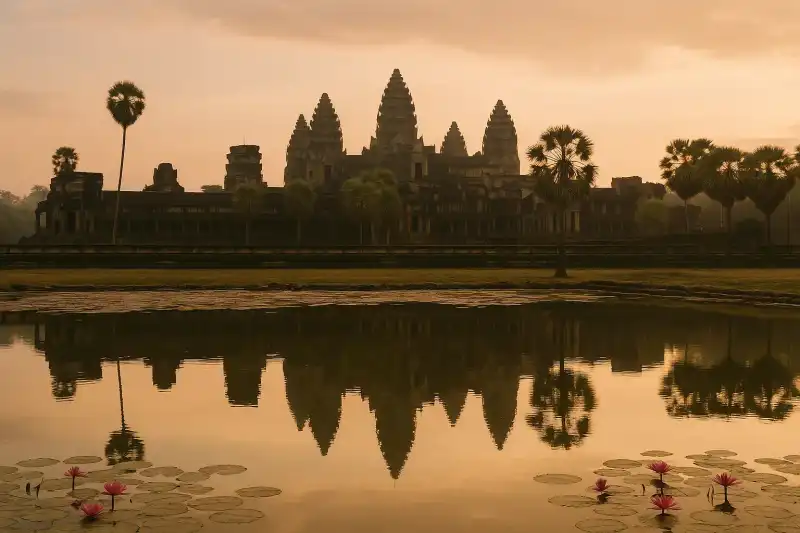
Angkor Wat Travel Guide 2026: Everything You Need to Know
KhmerAngkor Wat, the world's largest religious monument, spans over 400 acres in the heart of Cambodia. T...
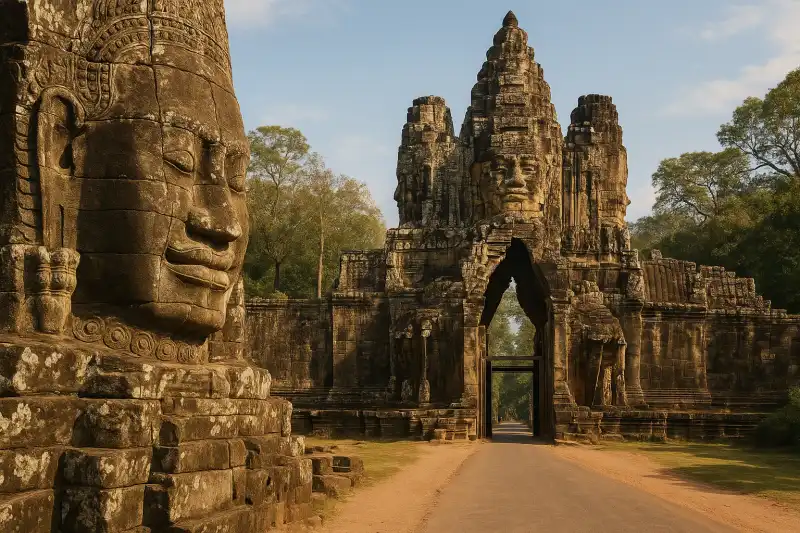
Angkor Thom Travel Guide 2026: Bayon Faces, Gates, and the Khmer Royal City
KhmerAngkor Thom was the last great capital of the Khmer Empire. This guide covers how to visit Bayon, th...