Quick Info
At a glance
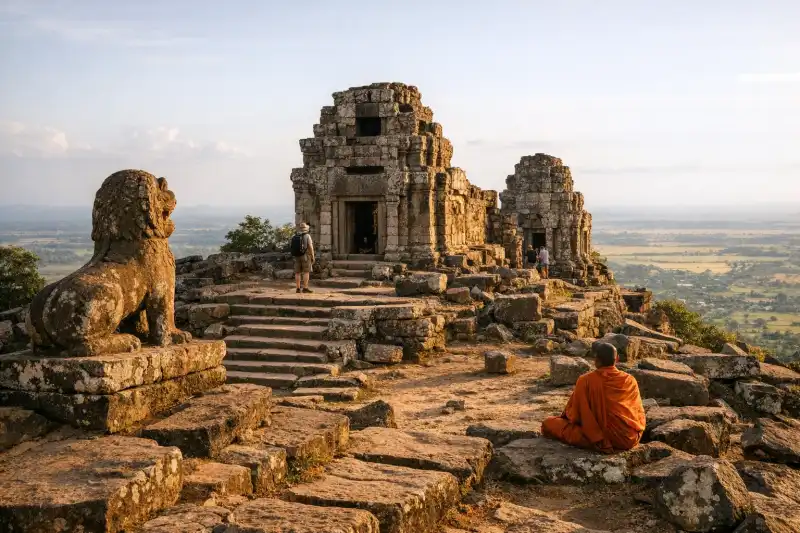
Phnom Bok in Cambodia rises above the plains of Siem Reap as one of the quieter, more atmospheric temples linked to the Angkor world. Unlike the great headline monuments that draw dense crowds from dawn to dusk, this hilltop sanctuary offers a different rhythm: a steep climb, the scent of dry grass and forest, and then a sudden meeting with ancient stone under open sky. For travelers who want to understand Angkor beyond its most photographed towers, Phnom Bok feels like a rewarding detour into the landscape that shaped Khmer sacred architecture.
The site stands on a natural hill northeast of the main Angkor complex, and that elevated position defines the experience as much as the temple itself. Visiting Phnom Bok is not only about inspecting carvings or measuring historical dates; it is also about the approach, the effort of the ascent, and the views that unfold across rice fields, villages, and distant temple country. At the summit, the remains of a 10th-century shrine speak to a time when sacred mountains were central to Khmer kingship and religion. Here, the architecture may be more weathered and the setting more secluded than Angkor Wat, but the sense of place is powerful. Phnom Bok rewards patient visitors with quiet, wind, and a chance to see an important piece of Cambodia’s ancient heritage in a more contemplative way.
History
Early Khmer foundations
Phnom Bok belongs to the formative centuries of the Khmer Empire, when rulers were developing both the religious ideas and the architectural language that would later culminate in the great monuments of Angkor. The temple is generally dated to the reign of King Yasovarman I in the late 9th and early 10th centuries CE, a period of major political and sacred reorganization in the region. Yasovarman is especially associated with the establishment of Yasodharapura, an early Angkorian capital, and with ambitious projects that linked kingship to cosmic geography.
Hilltop temples held particular importance in this setting. The Khmer concept of sacred kingship drew heavily on the symbolism of mountains, above all Mount Meru, the mythical center of the Hindu universe. By placing shrines on prominent hills, rulers could fuse the natural landscape with religious ideology. Phnom Bok was part of that wider pattern, joining other elevated sanctuaries such as Phnom Krom and Phnom Bakheng in expressing political authority through sacred topography. These sites were not simply scenic lookouts; they were statements about order, divine legitimacy, and the king’s relationship to the cosmos.
Construction and religious purpose
The temple on Phnom Bok was built primarily in sandstone and laterite, with a plan that reflects early Angkorian design before the full flowering of the larger temple-mountain complexes. It is commonly understood as a Hindu sanctuary, likely dedicated within the Shaivite tradition, though like many Khmer temples it existed within a religious world that was dynamic rather than rigidly fixed. The Khmer court patronized Brahmanical deities, especially Shiva and Vishnu, while also participating in traditions that would later see Buddhist layers added to many sites across Cambodia.
The summit sanctuary originally consisted of three principal towers aligned on a platform, a form seen in several temples of the period. This triadic arrangement has often been interpreted as both architectural and symbolic, relating to divine order and sacred hierarchy. Doorways, lintels, and decorative elements once carried finely carved details, though many features have been damaged by time, weather, and human activity. Even in ruin, however, the surviving masonry still conveys the confidence of early Khmer craftsmanship.
Because Phnom Bok sits apart from the crowded ceremonial core of Angkor, it helps historians trace how religious space was distributed across the landscape. Temples were not isolated monuments but nodes in a broader sacred network of reservoirs, roads, settlements, and shrines. The hill itself likely intensified ritual meaning, making the journey upward part of the devotional experience.
Transformation through the Angkor era
As Angkor expanded over the 10th, 11th, and 12th centuries, the center of royal building activity shifted and grew more monumental. Temples such as Bakheng, Pre Rup, Baphuon, Angkor Thom, and eventually Angkor Wat came to dominate the cultural and political landscape. In that process, earlier sites like Phnom Bok remained important but no longer represented the cutting edge of royal ambition. Their role changed from newly assertive statements of power to inherited markers within an increasingly dense sacred geography.
This transition is visible in the temple’s relative modesty when compared with later masterpieces. Yet that modesty is exactly what makes Phnom Bok historically valuable. It preserves a glimpse of Angkorian architecture at a stage when builders were experimenting with forms and refining symbolic relationships between hill, temple, and kingship. Rather than competing with the grandeur of later monuments, Phnom Bok complements them by showing where some of those ideas began.
Modern rediscovery and conservation
Like many Cambodian heritage sites, Phnom Bok passed through centuries of changing local use, neglect, and gradual ruin. Trees, climate, and erosion affected the masonry, while conflict in the 20th century made many archaeological areas difficult to access and vulnerable to damage. In recent decades, greater stability and the global recognition of Angkor have renewed attention to outlying temples such as Phnom Bok.
Today the site benefits from its association with the broader Angkor Archaeological Park and the work of Cambodian heritage authorities and international conservation partners. Restoration at Phnom Bok has not transformed it into a polished monument, and that is part of its appeal. Visitors encounter a place that still feels rugged and lightly touched, where preservation efforts coexist with the realities of age and exposure. As interest in less-crowded temple experiences grows, Phnom Bok has become increasingly appreciated not only as a side trip from Siem Reap but as an important historical site in its own right.
Key Features
The defining feature of Phnom Bok is the hill itself. Before the temple comes into full view, visitors experience the ascent through a long staircase that climbs the wooded slope. This approach shapes the emotional tone of the visit. There is a sense of transition from the ordinary world below to a more elevated sacred zone above, a sequence that would have mattered deeply in the temple’s original context. Even today, that climb creates anticipation and gives the summit a special sense of arrival.
At the top, the temple remains stand on a high terrace, their weathered stone softened by time but still legible as an early Angkorian sanctuary. The three principal towers are the most recognizable architectural element. Although damaged, they retain enough of their massing to show the compositional logic of the shrine complex. Their alignment and placement on the platform create an impression of balance and order, while the surviving sandstone blocks reveal the technical skill of Khmer builders working more than a thousand years ago.
The carvings at Phnom Bok are not as extensive or as intact as those at better-known Angkor monuments, yet they reward close looking. Lintels, doorframes, and decorative fragments preserve traces of floral motifs, mythic imagery, and the disciplined ornamental vocabulary of the early Khmer period. Visitors who take time to study these details can appreciate the transition between structural function and symbolic decoration that defines much of Khmer temple art. Rather than overwhelming the eye with abundance, Phnom Bok offers fragments that invite imagination.
Another major feature is the setting. From the summit, the surrounding countryside stretches outward in broad layers of green and brown depending on the season. Rice fields, village roads, palm trees, and distant temple country all become part of the panorama. On clearer days, the elevated view helps visitors understand how ancient Khmer builders related monuments to terrain. This is not heritage detached from landscape; it is heritage anchored in it. The hilltop perspective also makes Phnom Bok especially memorable in early morning or late afternoon, when the light is softer and the plains seem to widen endlessly.
The atmosphere is also one of Phnom Bok’s strongest qualities. Compared with Angkor Wat or Angkor Thom, the site is often quiet, with fewer tour groups and less noise. That changes the way people engage with the ruins. You can hear wind moving through trees, birds calling, and the occasional murmur of local visitors taking in the view. The temple feels less like an attraction moving visitors through a fixed circuit and more like a place that allows for pause. Photographers, history enthusiasts, and travelers seeking a slower experience often find this one of Phnom Bok’s greatest advantages.
The contrast between ruin and resilience stands out here as well. Some structures are broken, stones are displaced, and surfaces show centuries of exposure. Yet the temple remains unmistakably present, and its survival on such a dramatic hill gives it a quiet authority. Phnom Bok may not be the most ornate or famous temple in Cambodia, but it captures something essential about the Angkorian world: the fusion of architecture, kingship, religion, and natural elevation into a sacred statement visible from afar.
Getting There
Phnom Bok is most easily visited from Siem Reap, which serves as the main gateway for the Angkor region. The hill lies northeast of the city, and by road the journey usually takes around 45 minutes to 1 hour depending on traffic, route, and whether you combine the visit with nearby temples such as Banteay Srei or Banteay Samre.
A tuk-tuk from Siem Reap is one of the most popular options for independent travelers. For a half-day trip focused on Phnom Bok and a nearby temple or two, expect to pay roughly $18 to $30, depending on distance, timing, and negotiation. For a fuller day that includes more remote sites, fares often range from $25 to $40. Air-conditioned taxi hire is more comfortable in the hot season and generally costs about $35 to $60 for a half or full day itinerary.
Motorbike or scooter rental can also work for confident riders, with daily rental prices in Siem Reap often around $10 to $15, though rules and insurance conditions should be checked carefully. Cycling is technically possible for strong riders, but the distance and heat make it better suited to experienced cyclists starting very early. Many visitors instead join a private temple tour that includes transport and a driver-guide.
From the base area, reaching the summit requires climbing a substantial staircase. Bring water, wear shoes with grip, and allow extra time if temperatures are high. There may be modest local parking or stopping areas near the foot of the hill, but facilities are limited compared with major Angkor sites. It is wise to carry sun protection, snacks, and cash for transport, since services nearby are minimal.
When to Visit
The best time to visit Phnom Bok is generally during Cambodia’s dry season, from November to February, when temperatures are more manageable and the climb is far more comfortable. Morning visits are especially pleasant during these months, with cooler air, clearer views, and softer light for photography. Because Phnom Bok is known for its elevated setting, visibility matters; the dry season often gives the broadest, sharpest panoramas over the surrounding plains.
March to May is the hottest period of the year. Phnom Bok remains visitable, but the uphill staircase can feel demanding by late morning or midday. If you travel in these months, start as early as possible, carry plenty of water, and avoid strenuous climbing in the strongest sun. The reward is that visitor numbers are often lower, though the trade-off is heat and haze.
The rainy season, usually from May or June through October, transforms the countryside into a richer green and can make the surrounding landscape especially beautiful. Rice fields become more vivid, clouds add drama to photographs, and the hill can feel lush rather than dry. However, rain showers, slippery steps, and more humid conditions can make the ascent harder. Footwear becomes more important, and itineraries need flexibility in case of storms.
For many travelers, the ideal approach is to visit Phnom Bok in the early morning during the cooler dry months, or in the shoulder periods when there is still some greenery in the landscape without the heaviest rain. Sunset can also be attractive for the views, but morning generally offers better comfort and a calmer pace. Whichever season you choose, avoid the middle of the day if possible and plan around the physical effort of the climb rather than treating Phnom Bok as a quick roadside stop.
| Quick Facts | Details |
|---|---|
| Location | Siem Reap Province, Cambodia |
| Nearest city | Siem Reap |
| Historical era | Early Angkor period |
| Likely patron | King Yasovarman I |
| Date | Late 9th to early 10th century CE |
| Civilization | Khmer Empire |
| Religious tradition | Primarily Hindu, especially Shaivite associations |
| Setting | Hilltop temple on a natural rise northeast of Angkor |
| Time needed | About 1-2 hours |
| Access style | Road transfer plus stair climb to summit |
| Best visit time | Early morning in the dry season |
| Why visit | Quiet atmosphere, panoramic views, and insight into early Khmer sacred landscape |
Phnom Bok is one of those places that often surprises travelers precisely because it is not trying to compete with Cambodia’s most famous monuments. Its appeal lies in proportion and mood: a significant early Khmer temple, a demanding but manageable ascent, and a summit that opens both the landscape and the imagination. In the broader story of Angkor, it helps explain how sacred geography worked long before many visitors arrive at the famous galleries and towers. In practical travel terms, it is an excellent addition to a Siem Reap itinerary for anyone who wants fewer crowds and a stronger sense of discovery.
Seen from below, the hill suggests effort. Seen from above, it explains why that effort matters. The temple ruins, the wind across the stones, and the vast Cambodian plains together create an experience that feels older and quieter than the main circuits. Phnom Bok may be less celebrated than Angkor Wat, but for travelers interested in atmosphere, landscape, and the early vision of the Khmer Empire, it is one of the most rewarding sites in the region.
Guided tours: worth it?
A guide can be genuinely useful at Phnom Bok, especially if you want help with transport, timing, tickets, or understanding a large site without losing half the day to logistics.
Best for
- First-time visitors who want context, not just photos
- Travelers who want transport, timing, or entry logistics handled
- Trips where tickets, circuits, or timed entry can shape the day
- Short visits where a planned route saves time
When to go self-guided
Go independently if you already have transport and tickets sorted, enjoy moving at your own pace, and are comfortable checking the latest official rules before you arrive.
What I’d avoid
Skip paid tours that bundle unrelated stops you do not actually want. The best option should either save meaningful planning time or add historical context you would miss on your own.
Phnom Bok and Angkor Temples Tours
Useful when: you want to compare guided formats before deciding
Siem Reap Temple Day Tours
Useful when: you want to compare guided formats before deciding
Banteay Srei and Phnom Bok Tours
Useful when: you want to compare guided formats before deciding
Some tour links are affiliate links, which may earn Ancient Travel a small commission at no extra cost to you. I try to surface options that make practical sense for the site—not just anything bookable.
Frequently Asked Questions
Where is Phnom Bok located?
Phnom Bok is in Siem Reap Province, Cambodia, northeast of the main Angkor temple zone and not far from Banteay Srei.
Is Phnom Bok included in the Angkor Pass?
Phnom Bok is generally managed as part of the wider Angkor archaeological area, so travelers should check current APSARA and Angkor Enterprise rules before visiting.
How difficult is the climb to Phnom Bok?
The climb involves a long staircase up a hill and can feel strenuous in midday heat, but most reasonably fit visitors can complete it with water and rest stops.
How much time should I allow for Phnom Bok?
Most visitors spend 1 to 2 hours at Phnom Bok, including the ascent, time at the summit temple, and the descent.
What is Phnom Bok known for?
Phnom Bok is known for its elevated setting, early 10th-century Khmer temple, sandstone carvings, and broad views across the countryside around Siem Reap.
Can I visit Phnom Bok without a guide?
Yes, independent visits are possible, but a guide adds useful context about the temple's history, iconography, and relationship to other hilltop Angkorian shrines.
Nearby Ancient Sites
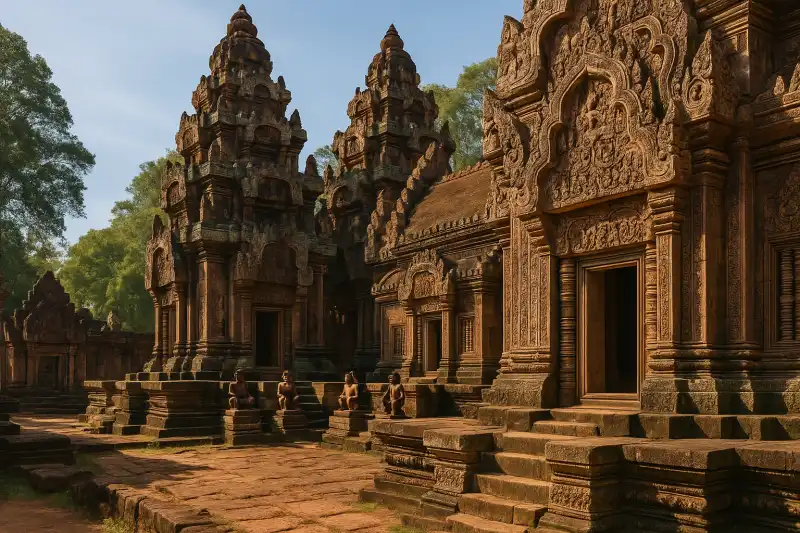
Banteay Srei Travel Guide 2026: Pink Sandstone Temple, Carvings, and Visit Tips
KhmerBanteay Srei is one of Cambodia’s most detailed Khmer temples, known for fine pink sandstone carving...
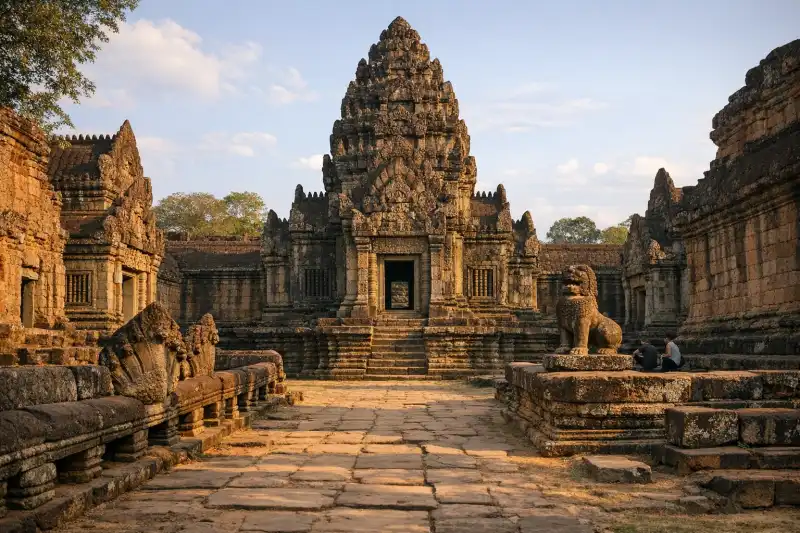
Banteay Samré
Banteay Samré is a beautifully preserved 12th-century Hindu temple in Cambodia’s Siem Reap province,...
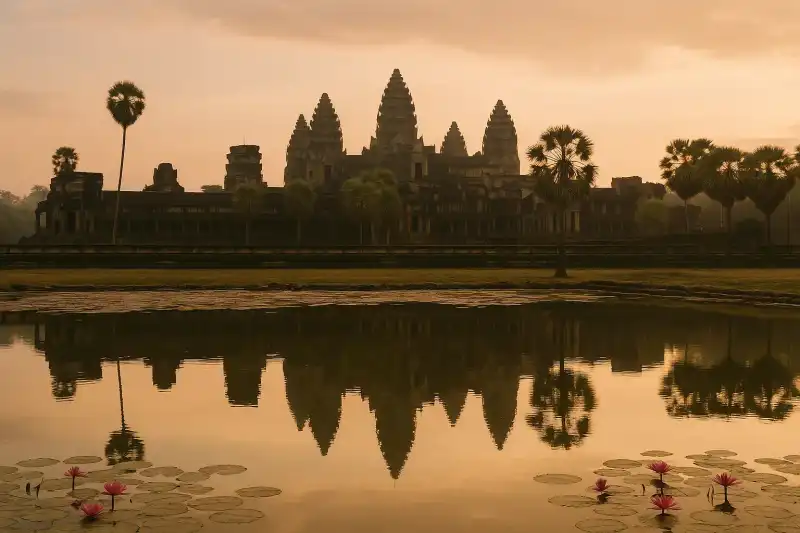
Angkor Wat Travel Guide 2026: Everything You Need to Know
KhmerAngkor Wat, the world's largest religious monument, spans over 400 acres in the heart of Cambodia. T...
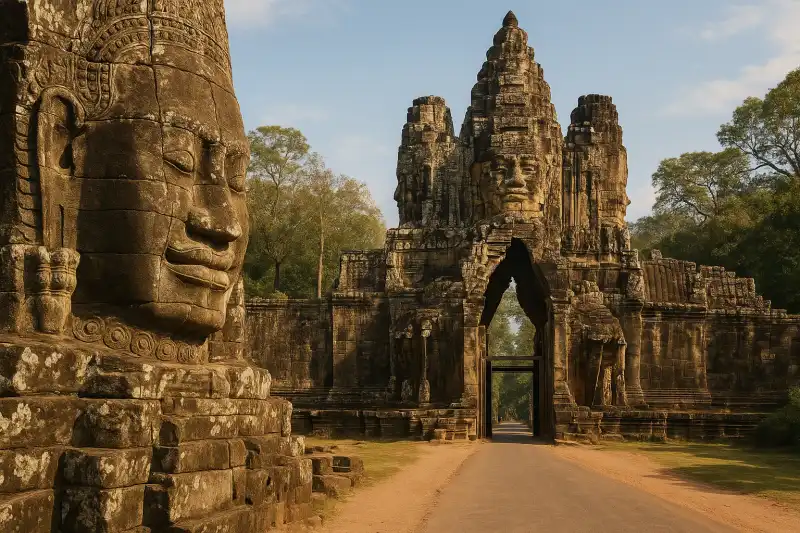
Angkor Thom Travel Guide 2026: Bayon Faces, Gates, and the Khmer Royal City
KhmerAngkor Thom was the last great capital of the Khmer Empire. This guide covers how to visit Bayon, th...
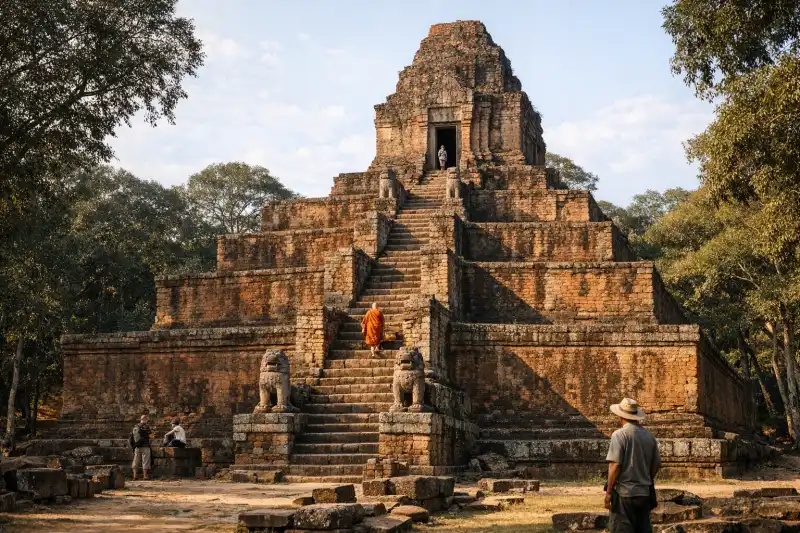
Baksei Chamkrong
Baksei Chamkrong is a 10th-century Hindu temple in Angkor, Cambodia, famed for its pyramid shape and...