Quick Info
At a glance
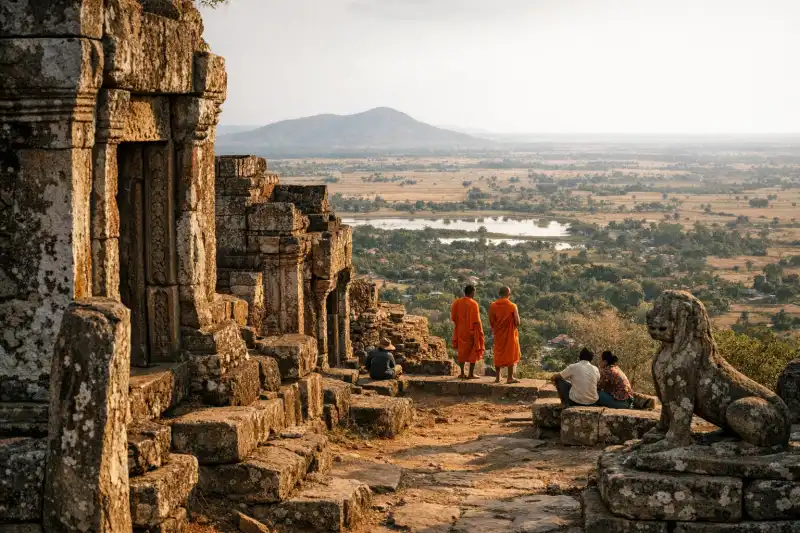
Phnom Chisor in Cambodia rises above the flat rice-growing plains of Takeo Province like a stone memory of the Khmer Empire, drawing visitors upward by stairway toward a temple that seems suspended between earth and sky. Less visited than the great monuments around Siem Reap, this hilltop sanctuary offers something different: not only carved sandstone and laterite remains, but also the physical experience of ascent, the cooling wind at the summit, and a sense of distance from modern noise. The site combines architecture, landscape, and devotion in a way that feels deeply Cambodian. From below, the hill appears solitary and commanding; from above, the countryside spreads in every direction, with fields, villages, ponds, and roads forming a broad living map around the ancient shrine.
For travelers interested in Khmer history beyond the most famous Angkor monuments, Phnom Chisor is one of the most rewarding excursions in southern Cambodia. Its origins reach back to the early 11th century, when kings were consolidating power and expressing authority through temple building. Yet despite its royal pedigree, the mood here is calm and approachable. Climbing the steps, pausing in patches of shade, and arriving at weathered towers and galleries on the crest creates a journey that feels both historical and personal. Phnom Chisor is not simply a ruin on a hill; it is a place where landscape was deliberately chosen to magnify sacred meaning, and where the effort of reaching the summit becomes part of the visit itself.
History
Early Khmer foundations
Phnom Chisor was built during the height of the Khmer Empire, most likely in the early 11th century under King Suryavarman I, who ruled from roughly 1006 to 1050 CE. This was a crucial period in Cambodian history. The empire was expanding, administrative systems were becoming stronger, and rulers increasingly used temple construction to project legitimacy, piety, and control. Like many Khmer sanctuaries, Phnom Chisor was not placed randomly. Its hilltop setting transformed a natural elevation into a sacred mountain, echoing the broader Indic idea of Mount Meru, the cosmic center in Hindu belief.
The temple was dedicated to Hindu deities, especially Shiva and Vishnu, and its original name is often linked to “Sri Suryaparvata,” or “the mountain of the sun,” reflecting both royal associations and religious symbolism. This naming reveals how Khmer kings tied themselves to divine power. A temple was not only a place of worship; it was a statement about order, kingship, and the proper relationship between the earthly realm and the cosmos. By building on a hill visible from the surrounding plain, Suryavarman I created a monument that dominated both physically and ideologically.
Religious and political significance
During the Angkor period, temples like Phnom Chisor functioned within a wider network of royal foundations. Although it lies far from Angkor itself, the monument belongs clearly to the same artistic and political world. The architectural forms, decorative carving, and use of sandstone and laterite align it with other Khmer state temples of the era. Its elevated location probably enhanced ritual prestige, while also making it a regional focal point for worship and royal influence.
As Khmer religion evolved, many temples shifted in use over the centuries. Hindu sanctuaries often incorporated Buddhist practice later, especially as Theravada Buddhism became dominant in Cambodia. Phnom Chisor followed this broader pattern of continuity through adaptation. Even when dynastic priorities changed and political centers moved, sacred places frequently remained important to local communities. Instead of being abandoned completely, they were reinterpreted, reused, and respected in new devotional contexts.
The site’s long life is part of what makes it meaningful today. It was never simply an artifact frozen in the 11th century. Rather, Phnom Chisor lived through successive religious phases and local traditions, absorbing centuries of memory even as stone blocks weathered and structures partially collapsed.
Decline, survival, and modern rediscovery
Like many Khmer monuments, Phnom Chisor experienced gradual decline as the political and economic systems that sustained large temple complexes weakened. Environmental wear, vegetation growth, stone robbing, and the simple passage of time took their toll. The hilltop location, while dramatic, also exposed the structures to wind, rain, and seasonal heat. Architectural elements fell, carvings eroded, and sections of the complex were reduced to fragments.
Yet the temple survived in substantial enough form to preserve its plan, major sanctuaries, and much of its atmosphere. Local reverence likely contributed to that survival. Sacred places in Cambodia often remained embedded in community life even when their original royal context had disappeared. Pilgrimage, offerings, and periodic maintenance helped keep such sites in cultural memory.
In the colonial and post-colonial eras, Phnom Chisor entered archaeological and heritage discussions as scholars and officials documented Cambodia’s ancient monuments beyond the best-known Angkorian core. Restoration and site management have been more modest here than at Cambodia’s most famous temples, but that relative lightness can also be part of its appeal. Visitors encounter a place that still feels rooted in its landscape rather than heavily curated.
Today, Phnom Chisor stands as one of southern Cambodia’s most important ancient sites. It links Takeo Province to the grand narrative of the Khmer Empire and offers evidence that Angkorian civilization was never confined to a single region. The temple remains a destination for domestic visitors, religious observance, and international travelers seeking a quieter but deeply evocative encounter with Khmer architecture. Its history is one of royal ambition, sacred continuity, weathered endurance, and renewed appreciation.
Key Features
Phnom Chisor’s most immediate feature is its setting on a solitary hill, rising above the surrounding plain. This topography shapes the entire visitor experience. Unlike many temples approached horizontally through moats, causeways, or forest clearings, this one is encountered through ascent. The climb is an essential part of understanding the monument. As you move upward, the countryside opens behind you, and the temple gains a sense of separation from ordinary space. By the time you reach the summit, the architecture feels intentionally removed from the everyday world below.
At the top, the remains of the sanctuary spread across the hill’s crest in a way that reflects both formal planning and adaptation to terrain. Built primarily of sandstone and laterite, the temple includes surviving shrines, gateways, and wall sections that evoke the mature Khmer style of the early 11th century. Although not preserved on the colossal scale of Angkor Wat or Angkor Thom, Phnom Chisor has a concentrated dignity. Its architectural fragments are easier to absorb at a human pace, allowing visitors to notice how doorframes, lintels, and wall alignments still organize sacred space.
One of the most striking elements is the temple’s axial arrangement, with entrances and towers set to create processional movement and symbolic orientation. Even in ruin, the logic of the plan remains legible. You can sense where ritual pathways once led worshippers, where thresholds marked transitions between ordinary and sacred realms, and where the principal sanctuaries stood as the spiritual focus of the complex. Khmer architects were masters of using repeated gateways and rising enclosures to shape experience, and Phnom Chisor preserves that effect in a compact hilltop form.
The decorative details are subtler here than at some better-known monuments, but they reward close attention. Carved sandstone elements may include floral motifs, deity-related imagery, and refined moldings typical of the period. Weathering has softened much of the original crispness, yet this erosion creates its own beauty. The stone surfaces appear aged rather than ruined in a purely negative sense, as though the temple has been slowly absorbed into the natural rhythms of sun, rain, and wind.
Another defining feature is the panoramic view. From the summit, Phnom Chisor offers one of the best temple viewpoints in Cambodia outside the northern temple zones. The landscape below is not wilderness but a lived-in agricultural world of paddies, trees, ponds, and scattered settlements. That contrast is powerful. The temple is ancient, but the plain is active and contemporary, reminding visitors that Khmer sacred architecture was always built within productive landscapes rather than isolated from them. In clear weather, the view stretches far, and late afternoon light can turn the fields gold and the ruins honey-colored.
The stairways leading up the hill are also part of the site’s character. Modern access has made the climb manageable for most reasonably fit visitors, though the ascent still requires effort, especially in midday heat. The steps create a rhythm to the visit: climb, pause, look back, continue, arrive. This bodily engagement gives Phnom Chisor a pilgrimage-like quality that many lowland temples do not have to the same degree.
Finally, the atmosphere sets Phnom Chisor apart. It is usually quieter than Cambodia’s marquee sites, and that relative calm allows its features to register more clearly. Instead of crowds moving continuously through galleries, you may hear wind, birds, distant voices, and the scrape of shoes on stone. The site feels both monumental and local, historical and still used. This combination of hilltop placement, early Angkor-period architecture, weathered carving, broad views, and a less commercial pace makes Phnom Chisor one of Cambodia’s most distinctive ancient destinations.
Getting There
Phnom Chisor is most easily reached from Phnom Penh, making it a practical day trip for travelers who want to see an important Khmer temple without going all the way to Siem Reap. The site lies roughly 50 to 60 kilometers south of the capital in Takeo Province. By private car or taxi, the journey usually takes around 1.5 to 2 hours depending on traffic and road conditions. Expect a round-trip private car hire from Phnom Penh to cost about $40 to $70, with prices varying by vehicle type, waiting time, and negotiation.
Tuk-tuks can sometimes be arranged for the journey, but because of the distance and heat, they are better suited to travelers who are comfortable with a slower, more exposed ride. A full-day tuk-tuk charter may cost around $30 to $50. Many visitors prefer hiring a car with driver for comfort, especially if combining Phnom Chisor with other Takeo attractions.
Motorbike rental is another option for experienced riders. Daily rental in Phnom Penh often ranges from $8 to $15, excluding fuel. Roads are generally straightforward, but traffic leaving the capital can be busy, and conditions may vary in rural stretches. If you go by motorbike, start early and carry water, sun protection, and offline maps.
There are also local buses or shared transport heading toward Takeo, though they rarely offer the convenience of direct access to the hill. Budget travelers can reach the general area cheaply, often for just a few dollars, but may still need a moto or tuk-tuk for the final leg. Once at Phnom Chisor, be prepared for the climb to the summit. Entry fees and parking arrangements can change, so it is wise to carry small cash in US dollars or Cambodian riel.
When to Visit
The best time to visit Phnom Chisor is during Cambodia’s dry season, typically from November to early April. During these months, roads are generally easier to manage, the stairway climb is less slippery, and the views from the summit are often clearer. December and January are especially pleasant, with relatively cooler temperatures by Cambodian standards. Early morning and late afternoon are the most comfortable times to make the ascent, as midday heat on the exposed steps can feel intense.
The hot season, especially March and April, can still be rewarding if you plan carefully. The advantage is strong light for photography and often vivid sunsets over the plain, but the drawback is the physical challenge of climbing in high temperatures. If visiting then, bring more water than you think you need, wear a hat, and avoid the middle of the day.
The rainy season, usually from May to October, gives the landscape a lush beauty that many travelers appreciate. Rice fields turn greener, ponds fill, and the countryside around the hill can look especially vibrant. However, rain showers can make the steps slick and humidity can be heavy. Morning visits are often best in this season, before afternoon storms build. If you enjoy dramatic skies and fewer visitors, the wet months have real appeal.
Timing within the day matters as much as timing within the year. Sunrise and early morning bring softer light and cooler air, while late afternoon offers warm colors and expansive views. If your main goal is photography, the golden hour before sunset is particularly attractive. If your goal is comfort and a quieter climb, go as early as possible.
| Quick Facts | Details |
|---|---|
| Location | Takeo Province, Cambodia |
| Main period | Early 11th century CE |
| Civilization | Khmer Empire |
| Likely founder | King Suryavarman I |
| Original religious context | Hinduism, later Buddhist use |
| Setting | Hilltop temple complex above surrounding plains |
| Best base city | Phnom Penh or Takeo |
| Typical visit length | 1.5 to 3 hours on site |
| Access | Stair climb to summit |
| Best time of day | Early morning or late afternoon |
Phnom Chisor rewards travelers who value atmosphere as much as monumentality. It does not overwhelm by scale in the way Cambodia’s most famous temple complexes do. Instead, it works through setting, movement, and the subtle power of survival. The climb creates anticipation, the ruins invite slow observation, and the summit view ties ancient architecture to the present-day landscape below. That combination is rare and memorable.
For anyone building a broader understanding of Khmer civilization, Phnom Chisor is an important reminder that Cambodian sacred architecture extends well beyond Angkor’s central circuit. It shows how royal ideology, Hindu cosmology, local geography, and later religious continuity could be fused into a single hilltop sanctuary. Even in partial ruin, the temple still communicates its purpose: to elevate worship physically and symbolically above the world around it.
Visit with time to linger. Pause in the gateways, look closely at the surviving stonework, and turn often toward the horizon. Phnom Chisor is at its best when approached not as a checklist stop, but as a place to feel the relationship between landscape and belief. In that quiet exchange between stairway, summit, and plain, the site reveals why it has endured for nearly a thousand years.
Guided tours: worth it?
A guide can be genuinely useful at Phnom Chisor, especially if you want help with transport, timing, tickets, or understanding a large site without losing half the day to logistics.
Best for
- First-time visitors who want context, not just photos
- Travelers who want transport, timing, or entry logistics handled
- Trips where tickets, circuits, or timed entry can shape the day
- Short visits where a planned route saves time
When to go self-guided
Go independently if you already have transport and tickets sorted, enjoy moving at your own pace, and are comfortable checking the latest official rules before you arrive.
What I’d avoid
Skip paid tours that bundle unrelated stops you do not actually want. The best option should either save meaningful planning time or add historical context you would miss on your own.
Phnom Chisor tours from Phnom Penh
Useful when: transport or pickup logistics matter
Takeo Province temple day tours
Useful when: you want to compare guided formats before deciding
Cambodia ancient temples private tour
Useful when: you want flexible timing or a private guide
Some tour links are affiliate links, which may earn Ancient Travel a small commission at no extra cost to you. I try to surface options that make practical sense for the site—not just anything bookable.
Frequently Asked Questions
What is Phnom Chisor?
Phnom Chisor is an 11th-century Khmer temple mountain in Takeo Province, Cambodia, built during the reign of King Suryavarman I.
How far is Phnom Chisor from Phnom Penh?
Phnom Chisor is roughly 50 to 60 kilometers south of Phnom Penh, depending on your route, and usually takes around 1.5 to 2 hours by road.
How many steps are there to Phnom Chisor?
Visitors commonly climb several hundred steps to reach the hilltop sanctuary, with modern stairways providing the main access route.
Is Phnom Chisor worth visiting?
Yes, Phnom Chisor is worth visiting for its elevated setting, Angkor-era architecture, quieter atmosphere, and wide views over the countryside.
What should I wear to Phnom Chisor?
Wear lightweight clothing that covers shoulders and knees, comfortable walking shoes for the stairs, and bring sun protection and water.
Can Phnom Chisor be visited as a day trip?
Yes, Phnom Chisor is commonly visited as a half-day or full-day trip from Phnom Penh, often combined with other sites in Takeo Province.
Nearby Ancient Sites
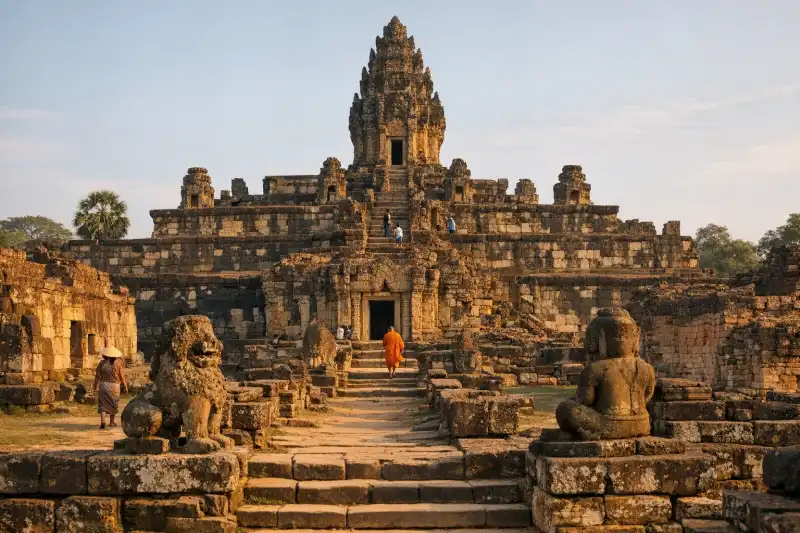
Bakong
Bakong is Cambodia's first major sandstone temple mountain, a stunning Khmer monument at the heart o...
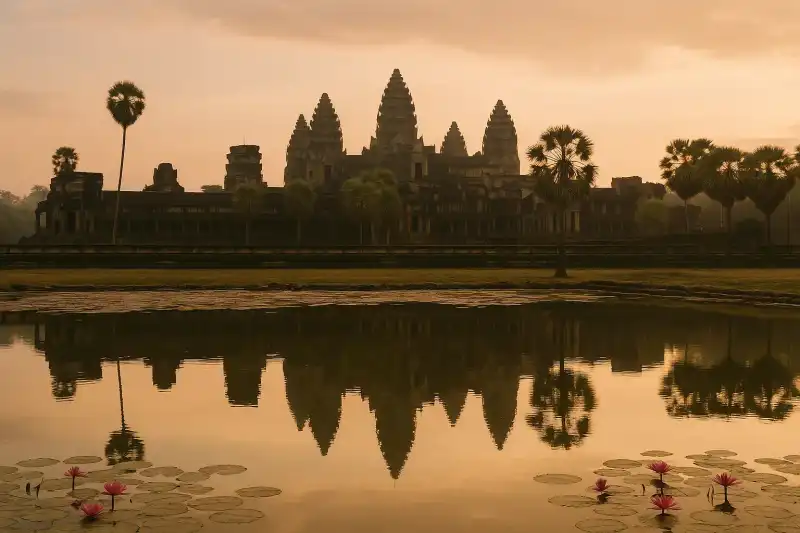
Angkor Wat Travel Guide 2026: Everything You Need to Know
KhmerAngkor Wat, the world's largest religious monument, spans over 400 acres in the heart of Cambodia. T...
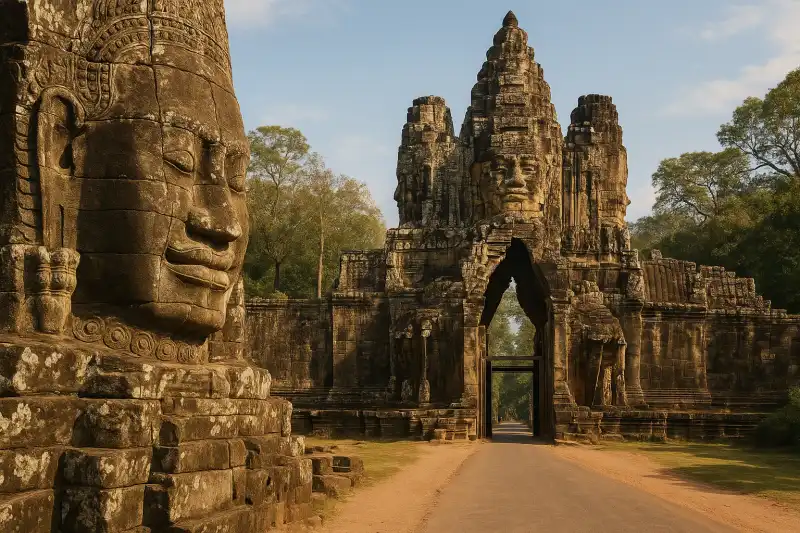
Angkor Thom Travel Guide 2026: Bayon Faces, Gates, and the Khmer Royal City
KhmerAngkor Thom was the last great capital of the Khmer Empire. This guide covers how to visit Bayon, th...
Banteay Srei Travel Guide 2026: Pink Sandstone Temple, Carvings, and Visit Tips
KhmerBanteay Srei is one of Cambodia’s most detailed Khmer temples, known for fine pink sandstone carving...