Quick Info
At a glance
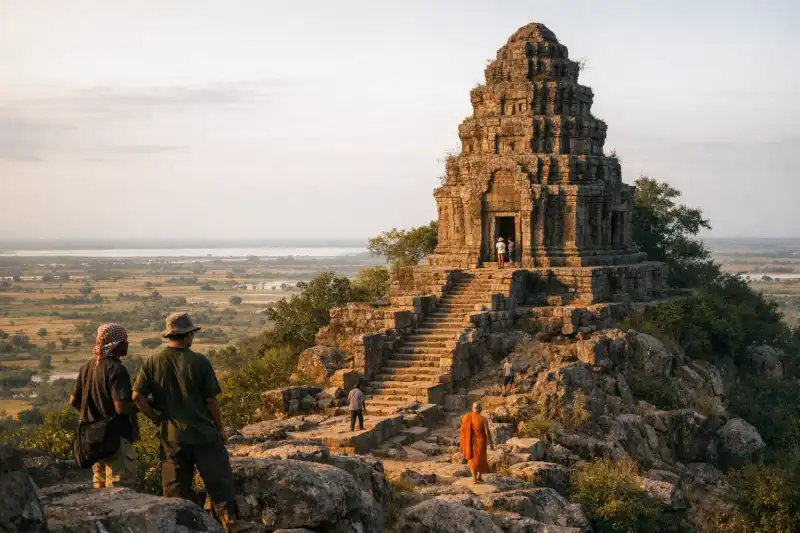
Phnom Da in Cambodia rises from the lowlands of Takeo Province as a rocky hill crowned with some of the country’s earliest surviving temple architecture. Long before the monumental sandstone towers of Angkor came to define Khmer sacred building, this southern landscape was already a place of ritual, political authority, and artistic experiment. Visiting Phnom Da today feels different from visiting Cambodia’s most famous archaeological sites. The scale is smaller, the setting quieter, and the atmosphere more intimate. Instead of grand causeways and vast temple cities, you find a solitary hill, weathered brick shrines, broken sculptures, and wide views over floodplains that once linked settlements, canals, and centers of power.
The journey itself helps explain why Phnom Da matters. The site lies close to Angkor Borei, an ancient settlement associated with the early state often identified with Funan. That relationship gives Phnom Da unusual historical weight: it is not simply an isolated temple on a hill, but part of one of mainland Southeast Asia’s earliest urban and religious landscapes. The surviving sanctuary at the summit, along with cave shrines and remarkable sculpture finds from the area, preserves a moment before the classical Angkorian style fully emerged. For travelers interested in origins rather than only monuments, Phnom Da offers a rare chance to see Cambodia’s deep past in a setting that still feels connected to river routes, seasonal water, and sacred geography.
History
Early settlement and the world of Funan
The history of Phnom Da begins not with the hill alone, but with the wider southern Cambodian plain. By the early centuries of the first millennium CE, this region was part of a network of settlements linked by waterways to the Mekong Delta and the Gulf of Thailand. Chinese historical texts describe a polity known as Funan, and many scholars connect the archaeological remains around Angkor Borei and Phnom Da to that wider world. Whether every detail in those texts corresponds neatly to the excavated evidence is still debated, but there is no doubt that this area was an important center of early state formation, trade, and religious activity.
Its geography helps explain its significance. The lowlands around Angkor Borei were connected by canals and natural channels, making movement of goods and people possible across a watery environment. From India came religious ideas, artistic influences, and forms of royal expression that local elites adapted to their own political and spiritual needs. The communities of this region were not passive recipients of outside culture; they actively shaped new forms of architecture and iconography. Phnom Da likely became important because it combined the practical visibility of a hill in flat terrain with the symbolic power of elevation. Sacred hills across South and Southeast Asia were often imagined as cosmic centers, and Phnom Da seems to have fit naturally into that pattern.
Temple construction in the 6th and 7th centuries
The most visible remains at Phnom Da date primarily to the 6th and 7th centuries CE, a crucial period in the transition from the world associated with Funan to the early Khmer states that followed. The summit sanctuary, built of brick with stone elements, belongs to this formative era. It is among the oldest surviving temple structures in Cambodia and shows a stage of Khmer religious architecture before the later dominance of large-scale sandstone construction.
This was also a period of experimentation in temple form and sacred imagery. Sculptures found at Phnom Da, some now preserved in museums, are among the masterpieces of early Cambodian art. They include representations of Hindu deities rendered with a remarkable confidence and distinct local style. These works reveal not only religious devotion but also the presence of skilled workshops capable of translating imported iconographic models into something regionally specific. Vishnu, Shiva, and other divine figures appeared here in forms that already announced the artistic achievements of later centuries.
The site’s religious life was probably complex. Although the architecture and sculpture strongly reflect Hindu traditions, as with many early Southeast Asian sites, ritual practice may have been layered, evolving, and tied closely to local political authority. Temples were not only houses of worship; they were also statements of legitimacy. To build on a hill and install powerful divine imagery was to claim a place within a sacred and political order.
From regional center to historical memory
Over time, political power in Cambodia shifted northward and inland, and the great temple cities of the Angkorian era came to overshadow earlier southern centers. Phnom Da did not become the nucleus of a monumental imperial landscape on the scale seen around Siem Reap. Instead, it remained as a marker of an earlier age, its sanctuaries enduring while dynasties changed and new capitals rose elsewhere.
That relative marginality may have helped preserve the site’s particular character. It was never swallowed by an urban modern setting, and the hill retained its physical distinctiveness in the countryside. Yet like many ancient places, it also suffered from time, weathering, and the removal or displacement of sculpture. Some of the finest finds from Phnom Da are now detached from their original architectural context, known to visitors through museums rather than in situ experience.
Modern archaeology has steadily clarified the importance of Phnom Da and nearby Angkor Borei. Excavations, surveys, and art historical studies have shown that southern Cambodia was central to understanding the beginnings of Khmer civilization. Today Phnom Da stands not as a rival to Angkor, but as an essential predecessor: a place where architecture, religion, and kingship were already being expressed in durable form centuries before the construction of Cambodia’s most famous monuments.
Key Features
What makes Phnom Da memorable is the way landscape and architecture work together. The hill itself is the site’s first great feature. In a region of flat agricultural land, the rocky rise appears almost symbolic by nature, as if it were destined to become sacred. Climbing toward the summit creates a gradual sense of separation from the modern countryside below. Rice fields, canals, and villages remain visible, but from above they begin to resemble the kind of environment that sustained the site in antiquity: watery, fertile, and interconnected.
At the top stands the main temple, a compact but historically significant brick sanctuary. Its proportions are modest compared with Angkorian giants, yet that very modesty helps you appreciate how early it is. The structure belongs to a phase when Khmer temple builders were still developing the architectural vocabulary that would later become so elaborate. The brickwork, weathered surfaces, and surviving stone framing elements show both technical skill and an older aesthetic sensibility. Instead of overwhelming decoration, there is a directness to the design. The temple feels sturdy, concentrated, and deeply rooted in the hill.
Another important aspect of Phnom Da is its association with sculpture. Although not every masterpiece remains on site, the area is famous for producing some of Cambodia’s greatest pre-Angkorian statues. These works are crucial for understanding the artistic importance of the hill. They demonstrate that Phnom Da was not merely a rural shrine but a center with access to ideas, patronage, and highly trained artisans. Even when viewed indirectly through reproductions, museum labels, or guide explanations, these sculptures enrich a visit because they allow you to imagine the sanctuary as it once was: enlivened by powerful divine images, color, and ritual offering.
The caves around Phnom Da add another layer of interest. Among the best known is Asram Maha Rosei, a cave site with carvings and sacred associations. These cave spaces suggest that worship here was not confined to formal temple buildings. Natural formations were incorporated into the sacred landscape, extending the spiritual identity of the hill beyond the summit shrine. This blending of built sanctuary and natural feature is one of Phnom Da’s most appealing qualities. It reminds visitors that ancient religious practice often embraced the terrain itself, not just the architecture placed upon it.
Views from the hill are also part of the experience. On clear days, the surrounding plain unfolds in broad expanses of green and water, depending on the season. The landscape is not empty; it is historically charged. Somewhere within that horizon are the routes, settlement zones, and agricultural systems that supported early state life in the region. Looking outward from Phnom Da helps you understand why a hilltop sanctuary mattered. It served as a visible landmark, a ritual focus, and perhaps a statement of authority over the land below.
Finally, one of Phnom Da’s strongest features is intangible: its atmosphere. Unlike Cambodia’s busiest heritage destinations, this is often a quieter visit. That gives travelers more room to notice texture, heat, wind, birdsong, and the slow relationship between stone and landscape. Phnom Da rewards patience. It is not a place of endless monuments; it is a place of concentrated significance, where a single hill preserves a surprisingly large chapter of early Cambodian history.
Getting There
Most travelers reach Phnom Da from Phnom Penh, which is roughly 90 to 110 kilometers away depending on the route and current road conditions. The simplest option is to hire a private taxi or car for the day. Expect a round-trip hire from Phnom Penh to cost around $50 to $90, depending on vehicle type, waiting time, and whether you combine Phnom Da with Angkor Borei and the local museum. A private driver is usually the most practical choice because public transport to the immediate site is limited.
A budget option is to take a bus or shared taxi from Phnom Penh to Takeo town, which typically costs about $4 to $8 per person. From Takeo, you can arrange a tuk-tuk, moto, or local car onward toward Angkor Borei and Phnom Da. This final leg may cost roughly $15 to $30 depending on distance, negotiation, and whether the driver waits for your return. Travel times vary, but allow around 2.5 to 3.5 hours from Phnom Penh in total.
Some visitors approach the area partly by boat, especially in wetter months when waterways are more navigable. Boat trips between Angkor Borei and the Phnom Da area can be a scenic way to appreciate the ancient canal landscape, though prices depend heavily on season and whether you charter privately. A small local boat may cost around $10 to $25 per person, while private arrangements can be higher.
If you prefer structure, guided day tours from Phnom Penh occasionally include Phnom Da, often paired with Tonle Bati or Angkor Borei. These can save time and simplify logistics. Whatever route you choose, bring cash, water, sun protection, and comfortable footwear, since the final approach includes outdoor walking and some uphill movement.
When to Visit
The best time to visit Phnom Da is generally during Cambodia’s dry season, from November to February, when temperatures are a bit milder and roads are usually easier to manage. This is the most comfortable period for climbing the hill and exploring in open sun. Mornings are especially pleasant, with softer light for photography and less heat during the ascent. If you want a calm, unrushed experience, arriving early in the day is ideal.
March to May is the hottest period of the year. Phnom Da can still be visited then, but the exposed setting makes midday heat intense. If you travel in these months, plan to start as early as possible, carry plenty of water, and expect a more physically demanding visit. Light clothing, a hat, and sunscreen become essential.
The rainy season, usually from May or June through October, changes the character of the landscape. Fields turn greener, waterways fill, and the broader environment can look especially beautiful and historically evocative. This can be a rewarding time for travelers interested in seeing the wetland setting that once shaped the region’s life. However, rain can make roads muddier and timing less predictable. Sudden downpours are common, and paths may be slippery.
If your itinerary includes a boat connection around Angkor Borei, the wetter months can actually improve the scenic water route, though local conditions vary from year to year. For most visitors, the sweet spot is late November through January: manageable temperatures, greener scenery than the late dry season, and relatively straightforward logistics. Whenever you go, try to avoid the hottest part of the afternoon and allow enough time to explore the hill without rushing.
| Quick Facts | Details |
|---|---|
| Location | Takeo Province, southern Cambodia |
| Nearest town | Angkor Borei |
| Distance from Phnom Penh | About 90-110 km |
| Main period | 6th-7th centuries CE |
| Cultural context | Funan and early Khmer |
| Site type | Hilltop temple complex with cave shrines |
| Best for | Early Khmer history, archaeology, quieter temple visits |
| Typical visit length | 2-4 hours |
| Access | Road, with seasonal boat options nearby |
| What to bring | Water, sun protection, modest clothing, good walking shoes |
Phnom Da is one of those places whose importance grows the longer you think about it. It does not rely on monumental scale or polished visitor infrastructure to make its impression. Instead, it offers something rarer: direct contact with an early chapter of Cambodian civilization in a landscape that still makes historical sense. The hill, the temple, the caves, and the plains around them together form a site that feels foundational. If Angkor shows the Khmer world at its grandest maturity, Phnom Da reveals it at an earlier, more experimental, and in some ways more intimate stage.
For travelers who want to look beyond the most famous circuits, Phnom Da is a deeply rewarding destination. It invites close attention rather than quick consumption. You come away not only with images of an ancient brick sanctuary on a hill, but with a stronger sense of how Cambodia’s sacred architecture began, how waterways shaped early power, and how much of the country’s past lies outside the best-known ruins. In that sense, Phnom Da is both a destination and a key: a place that unlocks the story of what came before Angkor.
Guided tours: worth it?
A guide can be genuinely useful at Phnom Da, especially if you want help with transport, timing, tickets, or understanding a large site without losing half the day to logistics.
Best for
- First-time visitors who want context, not just photos
- Travelers who want transport, timing, or entry logistics handled
- Trips where tickets, circuits, or timed entry can shape the day
- Short visits where a planned route saves time
When to go self-guided
Go independently if you already have transport and tickets sorted, enjoy moving at your own pace, and are comfortable checking the latest official rules before you arrive.
What I’d avoid
Skip paid tours that bundle unrelated stops you do not actually want. The best option should either save meaningful planning time or add historical context you would miss on your own.
Takeo Province and Phnom Da Tours
Useful when: you want to compare guided formats before deciding
Angkor Borei and Phnom Da Day Trips
Useful when: transport or pickup logistics matter
Cambodia Ancient Temples Tours
Useful when: you want to compare guided formats before deciding
Some tour links are affiliate links, which may earn Ancient Travel a small commission at no extra cost to you. I try to surface options that make practical sense for the site—not just anything bookable.
Frequently Asked Questions
What is Phnom Da?
Phnom Da is a hilltop temple complex in Takeo Province, Cambodia, known for its early brick sanctuaries and its importance in the pre-Angkorian period.
How old is Phnom Da?
Most of the surviving temple structures at Phnom Da date to around the 6th to 7th centuries CE, making them among the oldest standing temples in Cambodia.
How do you get to Phnom Da?
Most visitors travel from Phnom Penh to Takeo Province by car or taxi, then continue toward Angkor Borei and the Phnom Da area by road and, in some seasons, by boat through the canals.
Is Phnom Da worth visiting?
Yes. Phnom Da is especially rewarding for travelers interested in early Khmer history, archaeology, quieter temple sites, and landscapes beyond the better-known Angkor monuments.
What should I wear to visit Phnom Da?
Light, modest clothing, comfortable walking shoes, sun protection, and plenty of water are recommended, especially because the site involves outdoor walking and some uphill access.
Can Phnom Da be visited with Angkor Borei?
Yes. Phnom Da is commonly paired with Angkor Borei, where museums and archaeological remains help provide context for the region’s early history.
Nearby Ancient Sites
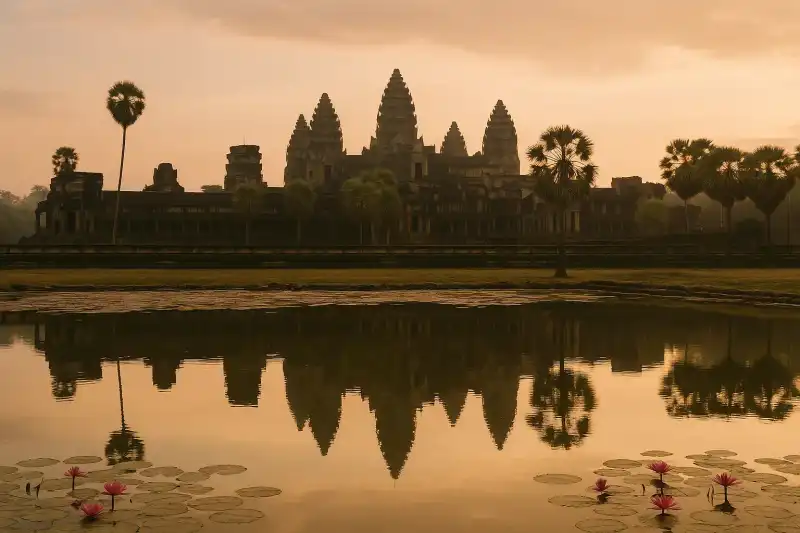
Angkor Wat Travel Guide 2026: Everything You Need to Know
KhmerAngkor Wat, the world's largest religious monument, spans over 400 acres in the heart of Cambodia. T...
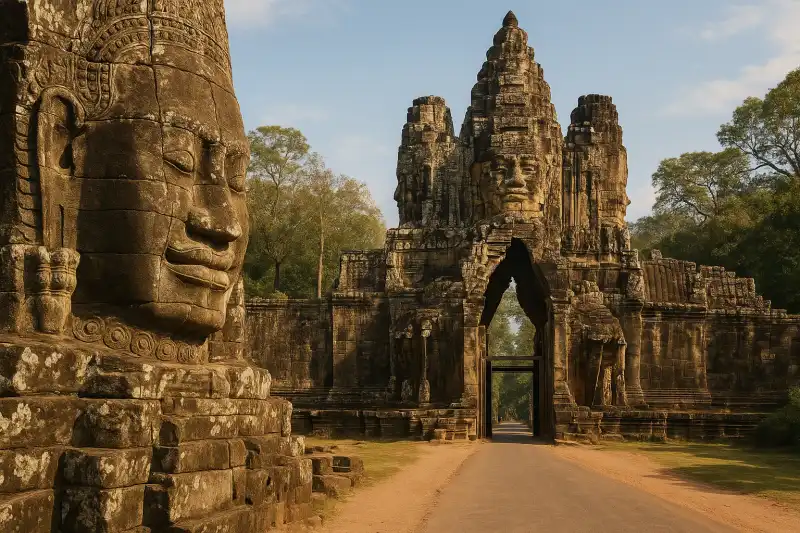
Angkor Thom Travel Guide 2026: Bayon Faces, Gates, and the Khmer Royal City
KhmerAngkor Thom was the last great capital of the Khmer Empire. This guide covers how to visit Bayon, th...
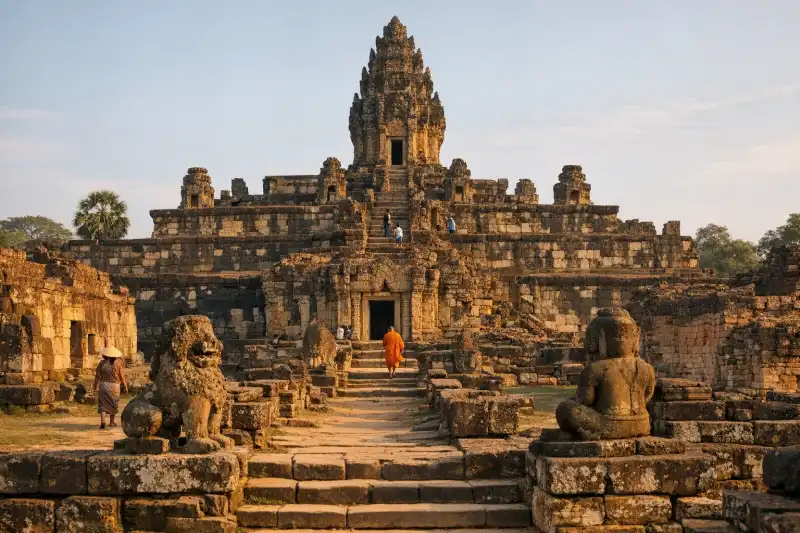
Bakong
Bakong is Cambodia's first major sandstone temple mountain, a stunning Khmer monument at the heart o...