Quick Info
At a glance
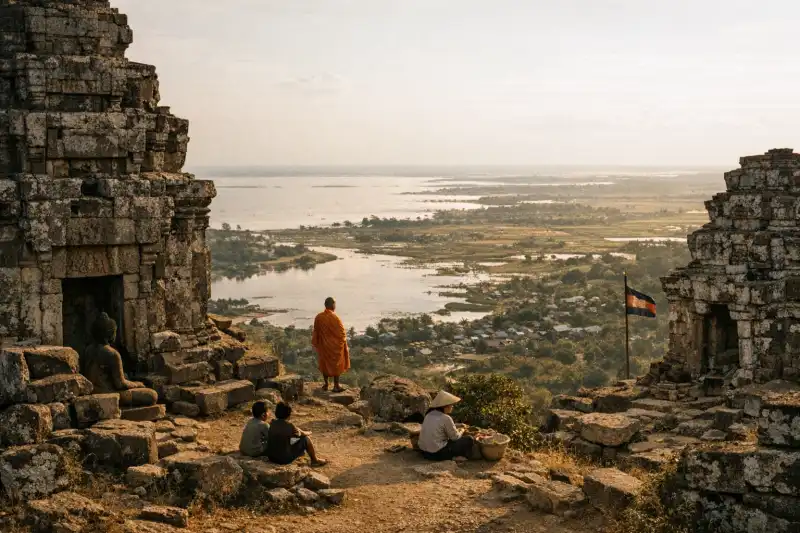
Phnom Krom in Cambodia rises from the flatlands southwest of Siem Reap as a solitary hill crowned by the remains of an Angkorian temple. Compared with the monumental fame of Angkor Wat or the dense ceremonial core of Angkor Thom, Phnom Krom feels more distant, quieter, and more atmospheric. The approach itself hints at why the site remains memorable: roads leading out of town pass villages, open fields, and channels linked to the Tonle Sap ecosystem before the hill suddenly appears, distinct against the sky. At its summit, ancient masonry, wind-worn stones, and wide horizons combine to create one of the most striking elevated viewpoints in the Siem Reap region.
For many travelers, Phnom Krom is as much about setting as architecture. The hill stands near the great Tonle Sap Lake, and from above you can sense the relationship between water, landscape, and settlement that shaped Khmer civilization. This is not a site of endless galleries or bas-reliefs on the scale of the empire’s greatest capitals. Instead, it offers a more focused encounter: a temple placed with deliberate symbolic force on high ground, looking over a world of floodplains, fisheries, and routes of movement. Visiting Phnom Krom rewards those interested in the quieter edges of the Angkor world, where geography and sacred ambition meet in a single dramatic location.
History
Early Khmer foundations
Phnom Krom belongs to the formative centuries of the Angkor period, when Khmer rulers were establishing political power through ambitious building programs and carefully chosen sacred landscapes. The temple on the hill is generally associated with the reign of King Yasovarman I, who ruled in the late 9th and early 10th centuries CE. Yasovarman is remembered as one of the major early Angkorian kings, a ruler who reorganized centers of authority and invested in temples and reservoirs that expressed both royal legitimacy and cosmic order.
Hilltops held special meaning in Khmer religious architecture. A temple mountain could symbolize Mount Meru, the cosmic axis in Hindu belief, and elevating a sanctuary above the plains gave it spiritual and political prominence. Phnom Krom, along with hilltop temples such as Phnom Bok and Phnom Bakheng, reflects this wider program of sacred topography. Rather than placing every major monument in a compact urban core, Khmer builders also claimed elevated points in the surrounding landscape, turning them into visible markers of royal ideology.
Angkorian religious life
The summit temple at Phnom Krom was built in honor of Hindu deities, and like many Khmer sanctuaries of the period, it likely supported ritual activity tied to royal patronage, priestly service, and seasonal observance. The surviving structure includes three principal towers, a common arrangement in Khmer temple design that could be linked to the Hindu trinity: Brahma, Shiva, and Vishnu. Even when the exact ritual sequence is lost to time, the architectural language still points to an environment where worship, kingship, and cosmology were deeply connected.
The materials used at Phnom Krom also place it squarely within the Angkorian architectural tradition. Builders used sandstone for key structural and decorative elements and laterite for terraces and foundations. These were practical and symbolic choices. Laterite provided durable bulk construction, while sandstone allowed more refined shaping for lintels, doorframes, and tower details. Though time and weather have softened many features, the remains still reveal a temple conceived as part of a broader imperial style.
Because Phnom Krom stands somewhat apart from the central Angkor monuments, it helps modern visitors understand that the Khmer world was not only a cluster of famous temples in one archaeological park. It was a network of sacred places, hydraulic works, villages, shrines, and elevated landmarks spread across a managed landscape.
Change, decline, and survival
As Angkorian political priorities shifted over the centuries, some temples retained prominence while others became more peripheral. Phnom Krom’s hilltop location preserved its visual drama but could not guarantee continuous maintenance at imperial levels. Changes in religion, court patronage, and settlement patterns gradually reduced the centrality of many early sanctuaries. Like other monuments of the region, Phnom Krom likely experienced periods of reuse, neglect, adaptation, and local reverence rather than a simple moment of abandonment.
The surrounding environment also mattered. Proximity to Tonle Sap meant Phnom Krom existed in a dynamic ecological zone shaped by annual floods, fisheries, and changing access routes. While this gave the site strategic and symbolic importance, it also placed it near landscapes where habitation and movement patterns shifted with water levels and economic rhythms. Over long periods, the temple remained on its hill while the human world below changed repeatedly.
Rediscovery and modern visitation
During the colonial period and the rise of archaeological study in Cambodia, lesser-known Angkorian sites such as Phnom Krom entered written documentation more fully. Scholars and surveyors identified stylistic features, placed the temple within the chronology of Khmer architecture, and connected it to broader state-building under early Angkorian kings. Conservation at such sites has often been more modest than at headline monuments, but documentation helped preserve Phnom Krom’s place in the historical map of the region.
Today, Phnom Krom occupies a dual role. It is both an ancient religious monument and a popular viewpoint near Siem Reap, especially for travelers seeking a break from the busiest temple circuits. Its history is therefore experienced not only through masonry and chronology, but also through the continuity of place. The hill still commands attention. It still frames the horizon. And it still expresses an old Khmer instinct: that certain heights were ideal locations for connecting earthly rule with sacred order.
Key Features
The most immediately striking feature of Phnom Krom is its setting. Rising from the low plains near Tonle Sap, the hill forms a natural platform from which the broader landscape becomes legible. This elevated perspective is not just scenic; it is interpretive. From the top, visitors can appreciate why the Khmer would have selected this place as a sacred site. The contrast between high ground and the expansive floodplain below gives Phnom Krom a commanding presence that many flatland temples do not possess. On clear days, the light changes constantly across fields, waterways, and distant settlements, making the summit feel both monumental and open.
At the heart of the site stands the temple itself, built on a terrace and composed principally of three towers. Though not as richly preserved as the most famous Angkor monuments, these structures retain enough form to reveal their original coherence. The towers rise from a platform of laterite and sandstone, with traces of doorways, moldings, and architectural framing still visible. Their relative simplicity is part of the appeal. Phnom Krom does not overwhelm the visitor with endless complexity. Instead, it invites close observation of mass, proportion, material, and placement.
The terrace remains are another important feature. They show how Khmer architects shaped the summit into an ordered ceremonial space rather than merely placing a shrine on a hill. Retaining walls and elevated platforms helped define sacred zones and create a sense of ascent culminating in the temple core. Even in ruin, the arrangement communicates hierarchy: the climb, the transition to the terrace, and finally the arrival at the sanctuary. This sequence echoes a broader Angkorian architectural logic in which movement through space mirrored spiritual progression.
Stonework at Phnom Krom rewards attention, especially for visitors interested in early Angkor styles. Though decorative elements are less abundant than at later temples, the surviving details in lintels, frames, and blocks provide insight into Khmer craftsmanship at a formative moment. Weathering has softened many surfaces, but this erosion also gives the site its texture. Lichen, warm stone tones, fractures, and repairs all contribute to an atmosphere of age that feels honest rather than staged.
Equally significant is the relationship between monument and panorama. Phnom Krom is one of the best places near Siem Reap to combine archaeology with broad environmental views. Looking west or south, you sense the immense reach of Tonle Sap’s seasonal system. Depending on the time of year, the waters and wetlands may appear close and expansive or more distant within a patchwork of fields and channels. This changing visual context reminds visitors that Khmer civilization was deeply tied to water management and ecological adaptation. The site is ancient, but the landscape around it remains active and lived in.
Sunset is one reason Phnom Krom is widely visited. The hill’s open vantage makes late afternoon especially atmospheric, and the temple ruins take on a different character in lower light. Sandstone surfaces glow, shadows sharpen architectural lines, and the plains below become streaked with gold and blue. Even so, early morning has its own appeal. Cooler air, fewer visitors, and softer light can make the temple feel more contemplative. In either case, the experience is shaped by exposure to sky and distance as much as by the stones themselves.
The road up the hill is also part of the site’s character. Unlike monuments approached through dense forest or extensive causeways, Phnom Krom unfolds gradually through a climb that emphasizes transition from village plain to sacred elevation. As you ascend, modern life recedes, and the site becomes increasingly defined by wind, open space, and broad visual reach. That progression helps explain why Phnom Krom remains memorable even for travelers who have already seen Cambodia’s larger temple complexes.
Getting There
Phnom Krom is one of the easiest ancient sites to reach from Siem Reap without committing to a full-day temple circuit. The hill lies around 12 to 15 kilometers southwest of the city center, and travel time is usually 25 to 40 minutes depending on traffic, road conditions, and your starting point.
The most common way to get there is by tuk-tuk. From central Siem Reap, a round-trip tuk-tuk with waiting time typically costs about USD 15 to 25, depending on negotiation, season, and whether Phnom Krom is combined with other stops such as Tonle Sap villages or countryside temples. A private car with driver is more comfortable in hot weather and usually ranges from USD 30 to 50 for a half-day outing.
Bicycles are a good option for experienced riders who enjoy independent travel. Rental bikes in Siem Reap often cost USD 3 to 8 per day for standard models, while e-bikes generally range from USD 10 to 20. The route is mostly flat until the final ascent, though heat can be intense by late morning. Carry water and be prepared for sun exposure. Motorbike rentals, where available under current local regulations, can also make the trip straightforward.
Some organized tours include Phnom Krom alongside Tonle Sap excursions, village visits, or sunset itineraries. These can be useful if you want transport arranged in advance. As always, check current ticketing and access conditions before setting out, since road controls and heritage-zone rules can change.
When to Visit
The best time to visit Phnom Krom is during Cambodia’s dry season, roughly from November to early April, when roads are more reliable, skies are often clearer, and the summit views tend to be at their sharpest. December and January are especially pleasant for temperature, making the climb and time spent exploring the terrace more comfortable. This is also peak travel season in Siem Reap, so while Phnom Krom is usually quieter than major Angkor temples, sunset can still attract local and international visitors.
The hot season, especially March through May, brings harsher midday conditions. If you travel at this time, aim for early morning or late afternoon. Phnom Krom offers limited shade at the summit, and the exposed stone surfaces can become extremely hot. Sun protection is essential.
The rainy season, generally from May to October, has advantages as well. The countryside is greener, clouds can make the views more dramatic, and the Tonle Sap landscape often feels more alive and expansive. Sudden downpours, however, can affect comfort and visibility. Roads are usually still passable from Siem Reap, but conditions vary.
For photography and atmosphere, late afternoon is the most popular choice, especially if you want broad views in warm light. For a quieter historical visit, morning is often better. If your main interest is the monument itself rather than sunset, arriving soon after opening hours gives you cooler temperatures, softer light on the masonry, and fewer distractions.
| Quick Facts | Details |
|---|---|
| Location | Southwest of Siem Reap, Cambodia |
| Region | Siem Reap Province |
| Period | Angkor period |
| Associated Ruler | Commonly linked to Yasovarman I |
| Main Features | Hilltop temple, three towers, terraces, panoramic views |
| Primary Materials | Sandstone and laterite |
| Best For | History lovers, photographers, sunset views, quieter temple visits |
| Typical Visit Length | 1 to 2 hours |
| Distance from Siem Reap | About 12 to 15 km |
| Ideal Visit Time | Early morning or late afternoon |
Guided tours: worth it?
A guide can be genuinely useful at Phnom Krom, especially if you want help with transport, timing, tickets, or understanding a large site without losing half the day to logistics.
Best for
- First-time visitors who want context, not just photos
- Travelers who want transport, timing, or entry logistics handled
- Trips where tickets, circuits, or timed entry can shape the day
- Short visits where a planned route saves time
When to go self-guided
Go independently if you already have transport and tickets sorted, enjoy moving at your own pace, and are comfortable checking the latest official rules before you arrive.
What I’d avoid
Skip paid tours that bundle unrelated stops you do not actually want. The best option should either save meaningful planning time or add historical context you would miss on your own.
Phnom Krom Siem Reap Tours
Useful when: you want to compare guided formats before deciding
Siem Reap Temple and Countryside Tours
Useful when: you want to compare guided formats before deciding
Tonle Sap and Phnom Krom Tours
Useful when: you want to compare guided formats before deciding
Some tour links are affiliate links, which may earn Ancient Travel a small commission at no extra cost to you. I try to surface options that make practical sense for the site—not just anything bookable.
Frequently Asked Questions
What is Phnom Krom?
Phnom Krom is a hilltop Angkorian temple site southwest of Siem Reap in Cambodia, best known for its elevated setting, laterite terraces, and wide views over the Tonle Sap region.
How far is Phnom Krom from Siem Reap?
Phnom Krom is roughly 12 to 15 kilometers from central Siem Reap, depending on your starting point, and usually takes around 25 to 40 minutes by road.
Do I need an Angkor Pass to visit Phnom Krom?
Entry rules can change, but Phnom Krom is commonly associated with the wider Angkor archaeological zone. Travelers should confirm current ticket requirements before visiting.
What is the best time of day to visit Phnom Krom?
Late afternoon is especially popular because the hill offers broad sunset views over the plains and Tonle Sap. Early morning is quieter and cooler.
Is Phnom Krom difficult to climb?
The road and access route are manageable for most visitors, especially if arriving by tuk-tuk, bicycle, or car, though some walking on uneven ground is still required near the temple.
Why is Phnom Krom important?
Phnom Krom is important as an Angkor-period hill temple linked to the reign of Yasovarman I, and it illustrates how sacred geography shaped Khmer religious architecture.
Nearby Ancient Sites
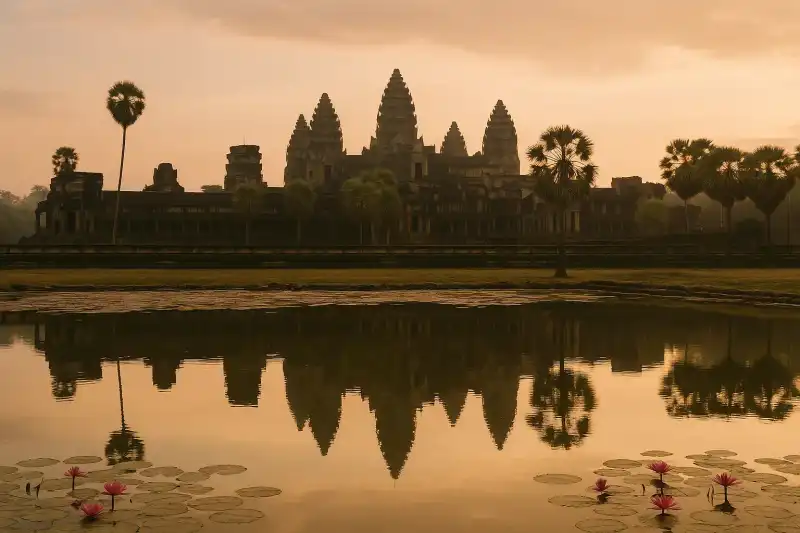
Angkor Wat Travel Guide 2026: Everything You Need to Know
KhmerAngkor Wat, the world's largest religious monument, spans over 400 acres in the heart of Cambodia. T...
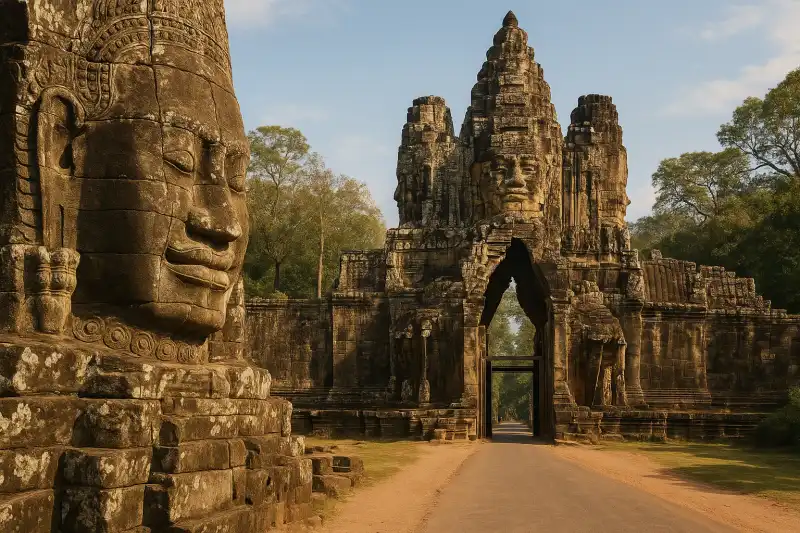
Angkor Thom Travel Guide 2026: Bayon Faces, Gates, and the Khmer Royal City
KhmerAngkor Thom was the last great capital of the Khmer Empire. This guide covers how to visit Bayon, th...
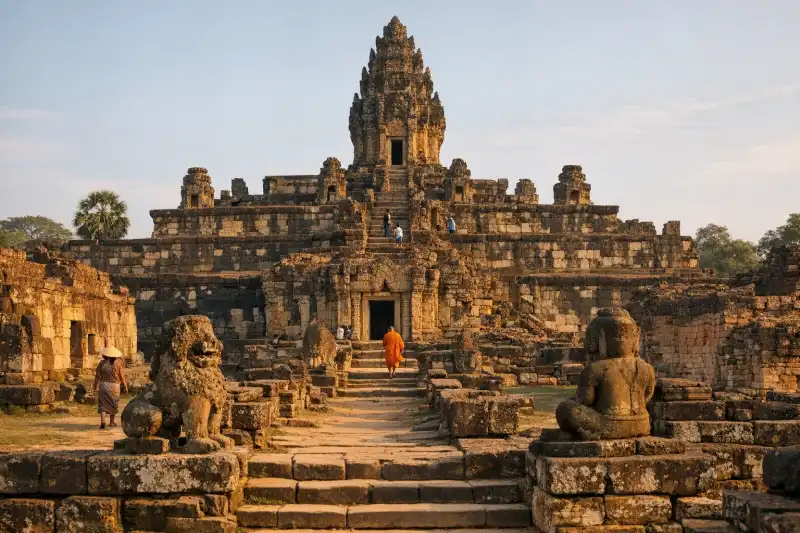
Bakong
Bakong is Cambodia's first major sandstone temple mountain, a stunning Khmer monument at the heart o...
Banteay Kdei
KhmerExplore Cambodia’s Banteay Kdei, a atmospheric Angkor temple-monastery of quiet courtyards, worn car...