Quick Info
At a glance
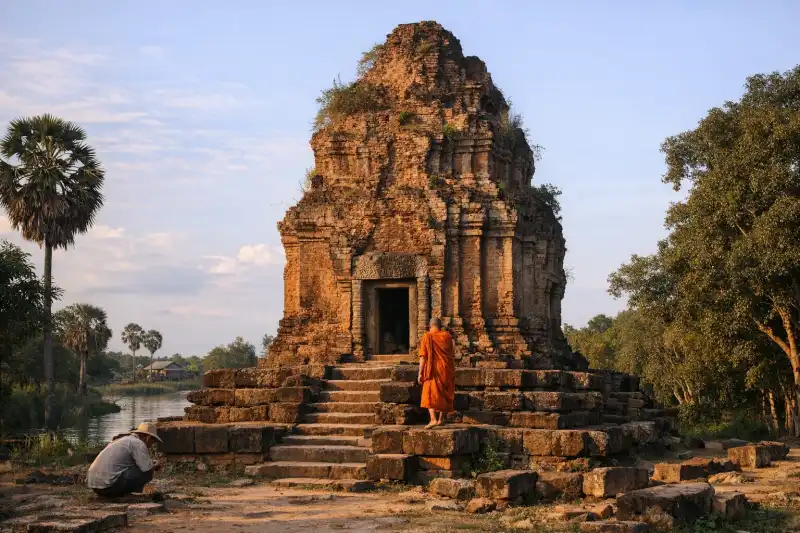
Prasat Andet in Cambodia is one of those places that rewards travelers who are willing to look beyond the country’s most famous temple circuits. Standing in the quiet countryside of Takeo Province, this early Khmer sanctuary does not overwhelm with vast galleries or monumental causeways. Instead, it draws you in with age, atmosphere, and the sense that you are standing near the roots of Cambodian temple architecture. The landscape around it is low, open, and agricultural, with villages and rice fields shaping the rhythm of daily life. Against that setting, the temple feels almost timeless: a compact but dignified reminder of the period before the imperial grandeur of Angkor.
For visitors interested in the deep history of Southeast Asia, Prasat Andet offers something special. It belongs to the pre-Angkorian world, a formative era when Khmer rulers, artisans, and religious communities were developing architectural forms and sacred imagery that would later bloom on a far larger scale. Here, the brickwork, elevated platform, and sculptural details matter as much as sheer size. A visit is not simply about checking off a monument. It is about seeing how Khmer civilization expressed power, belief, and artistic sophistication long before Angkor Wat became the symbol of Cambodia. That quieter significance is what makes Prasat Andet memorable.
History
Early Khmer foundations
Prasat Andet is generally dated to the 7th century CE, placing it in the pre-Angkorian period of Cambodian history. This was an era when the Khmer world was not yet organized around the imperial capital of Angkor, but rather shaped by regional centers, evolving political alliances, and a strong interaction between religion and kingship. Temples of this period often served not only as sacred places but also as statements of authority, legitimacy, and cultural ambition.
Takeo Province is especially important in understanding early Khmer civilization. Southern Cambodia contains several sites linked to the transition from earlier polities into the world that would eventually produce the Angkorian empire. Prasat Andet belongs to this broader historical landscape. Its builders worked in a tradition that emphasized brick sanctuaries, carefully carved stone elements, and elevated temple platforms. These features may seem modest compared with later Angkorian masterpieces, but they represent an essential stage in Khmer architectural development.
The temple is often associated with the period of rulers who promoted Hindu worship, particularly forms of Shaivism centered on Shiva. As with many early Khmer temples, the sanctuary likely housed a sacred image or linga, making it a focal point for ritual activity. In these centuries, religious architecture was closely tied to elite patronage. Constructing a temple was both a devotional act and a political one, demonstrating the ruler’s power to organize labor, control resources, and connect earthly rule with divine order.
Religious and artistic development
The 7th century was a remarkable time for artistic experimentation in the Khmer region. Prasat Andet reflects that creativity in its use of brick construction paired with sandstone carvings. The contrast between the main structural material and the more finely carved architectural details became a hallmark of early Khmer temple design. Lintels, door frames, and decorative elements carried symbolic and religious meaning while also displaying the skill of master artisans.
Art historians have long valued sites like Prasat Andet because they preserve visual evidence of how Khmer iconography evolved. Decorative motifs on pre-Angkorian temples often include vegetal scrolls, divine figures, and mythic imagery linked to Hindu cosmology. These carved surfaces were not mere ornament. They helped transform the building into a sacred environment, where every threshold and façade reinforced the temple’s role as a meeting point between the human and divine worlds.
In historical terms, Prasat Andet stands near the beginning of a trajectory that later produced the more elaborate temple-mountains and complex ceremonial spaces of Angkor. The ideas were already present here: elevation as a sign of sacredness, axial orientation, controlled access to the sanctuary, and an emphasis on symbolic architecture. Visiting the temple today allows you to trace those ideas back to an earlier, more intimate expression.
Survival through later centuries
After the rise of Angkor from the 9th century onward, many pre-Angkorian temples lost their central political importance. New capitals, new royal foundations, and changing religious priorities shifted attention northward. Yet sites like Prasat Andet were not simply abandoned overnight. Rural temples often continued to matter to local communities, whether as places of worship, landmarks, or repositories of memory.
Over the centuries, Cambodia experienced political transitions, regional conflict, environmental change, and periods of neglect that affected countless monuments. Smaller temples were especially vulnerable to weathering, vegetation growth, and the loss of original sculpture. Brick structures can endure for astonishing lengths of time, but they are also susceptible to erosion when exposed to heavy monsoon cycles and lack of conservation.
Prasat Andet’s survival into the present is therefore significant. Even in a fragmentary state, it preserves material evidence from one of the earliest great phases of Khmer architecture. Modern scholarship, heritage interest, and domestic tourism have gradually brought greater attention to such sites, though they remain far less visited than Cambodia’s better-known temple destinations. That relative obscurity is part of the appeal. The temple has not been overwhelmed by mass tourism, and its historical character still feels rooted in the surrounding countryside.
Prasat Andet today
Today, Prasat Andet serves as both an archaeological monument and a place of local importance. Travelers who arrive here often come with a broader interest in ancient Cambodia rather than in headline attractions alone. They find a site that is quieter, more compact, and more contemplative than the great Angkorian complexes.
Its current significance lies in what it reveals about continuity. Prasat Andet helps bridge the story between early Khmer state formation and the later achievements of Angkor. It shows that the sophistication associated with Cambodian temple art did not appear suddenly. It was built over centuries through experimentation, regional traditions, and the work of artisans who perfected sacred forms one sanctuary at a time. In that sense, Prasat Andet is not merely a provincial ruin. It is a key chapter in the long architectural history of Cambodia.
Key Features
What most distinguishes Prasat Andet is its atmosphere of concentrated antiquity. Unlike sprawling temple compounds, this site directs your attention toward a single elevated sanctuary and the surviving components around it. The raised platform immediately creates a sense of reverence. Even before you climb toward the temple, you can see the intention behind its design: to separate sacred space from the ordinary ground below. That gesture of elevation would later become central to Khmer temple planning, but here it appears in a simpler and earlier form.
The main tower, built largely of brick, is the heart of the monument. Early Khmer brickwork can appear plain from a distance, yet close inspection reveals careful proportion and construction. The massing of the sanctuary is compact and vertical, meant to focus attention inward toward the cella, the holiest interior chamber. Though time has stripped away some original details, the remaining form still communicates permanence and sacred gravity. The temple does not rely on scale to impress. It relies on balance, restraint, and the power of survival.
Stone architectural elements add another level of interest. Door frames, lintels, and decorative fragments often preserve the finest carving at early Khmer sites, and Prasat Andet is no exception. The sculpted details are especially important because they carry clues about chronology, religious dedication, and artistic style. Floral patterns, scrolling motifs, and divine imagery connect the temple to a broader visual language found across pre-Angkorian Cambodia. These carvings show how artisans used sandstone not just structurally but symbolically, framing entryways as thresholds into sacred space.
Another key feature is the site’s rural setting. Prasat Andet is not isolated in desert or jungle, but integrated into living agricultural land. That makes the experience very different from visiting a heavily managed heritage park. You approach the temple through a landscape that still supports villages and farms, which helps explain how ancient sanctuaries once existed within active human environments rather than apart from them. The monument feels embedded in local geography, not staged for tourism.
The temple’s scale also encourages a slower kind of observation. At larger sites, visitors often move quickly from one famous viewpoint to another. Here, the pleasure comes from looking closely: the weathering patterns in old brick, the geometry of the base, the interplay of restored and original sections, and the way the light changes the color of the masonry through the day. Morning and late afternoon can be especially rewarding, when shadows sharpen the relief of carvings and give the temple a warmer tone.
For students of architecture, Prasat Andet is valuable because it illuminates the transition from early shrine forms toward the more elaborate religious landscapes of later Khmer civilization. You can see the essential components that would become richer and more expansive in the Angkorian age: axial planning, elevated sanctity, strong doorway emphasis, and decorative framing of sacred access. In a site like this, the DNA of later Khmer monumental design is already visible.
There is also a human feature to the place that should not be overlooked. Smaller temple sites in Cambodia often retain a close relationship with nearby communities. Monuments may be used as local landmarks, occasional ritual spaces, or points of communal pride. That continuity, even when informal, gives Prasat Andet a living dimension. It is not just a museum piece. It remains part of a landscape where memory, religion, and daily life overlap.
Finally, Prasat Andet’s greatest feature may be the perspective it offers. Visitors who know Cambodia mainly through Angkor often come away surprised by how much this earlier temple deepens their understanding of the country’s past. It reminds you that the Khmer architectural tradition had long roots, and that greatness emerged through many stages. The site is modest, but its historical and artistic resonance is not.
Getting There
Prasat Andet is usually visited from Phnom Penh or from towns within Takeo Province. The most practical option for most travelers is a private car or taxi. From central Phnom Penh, the drive generally takes around 2.5 to 3.5 hours depending on traffic, road conditions, and the exact route. A private taxi for the day often costs about $50 to $90 USD, while a car with driver arranged through a hotel or travel agency may range from $60 to $120 depending on waiting time and whether you combine the visit with other sites in Takeo.
Budget travelers can take a bus or shared minivan from Phnom Penh to Takeo town. Fares are commonly in the $4 to $8 USD range one way. From Takeo, you will usually need a tuk-tuk, moto, or local taxi to continue to Prasat Andet. Expect local onward transport to cost roughly $10 to $25 USD depending on distance, negotiation, and whether the driver waits for you at the site.
Self-driving by rental car or motorbike is possible for confident travelers, but it requires attention to rural road conditions, especially in the rainy season. Fuel is inexpensive by international standards, though signage can be limited once you leave main roads. Downloading offline maps is strongly recommended.
Because Prasat Andet is not one of Cambodia’s busiest attractions, it is wise to carry water, sun protection, and small cash for transport or incidental expenses. If you want a smoother experience, ask your driver to include another nearby cultural stop in Takeo Province so the journey feels like a full day out rather than a single out-and-back temple visit.
When to Visit
The best time to visit Prasat Andet is during Cambodia’s dry season, generally from November to April. During these months, roads are easier to navigate, the chance of heavy rain is lower, and the temple grounds are usually more comfortable to explore. December through February tends to offer the most pleasant temperatures, especially in the morning, making it the ideal period for travelers who want to linger and study the architecture without intense heat.
March and April are still good for access, but conditions can become very hot by late morning and afternoon. If you visit then, aim to arrive early. The softer morning light also helps bring out the texture of the brick and stone surfaces, making photography more rewarding.
The rainy season, roughly from May to October, transforms the countryside into a vivid green landscape and can be beautiful in its own way. However, travel becomes less predictable. Rural roads may be muddy or uneven, and short but heavy downpours can interrupt your visit. If you travel during these months, build extra time into your schedule and confirm local road conditions before setting out.
In terms of time of day, early morning and late afternoon are usually best. Midday can be harsh, with limited shade around exposed temple structures. Sunrise itself is less of a formal event here than at major Angkorian sites, but the calm atmosphere in the morning is one of Prasat Andet’s greatest pleasures. Visiting on weekdays may also mean an even quieter experience, with fewer domestic visitors and more space to appreciate the temple’s details in silence.
| Quick Facts | Details |
|---|---|
| Location | Takeo Province, Cambodia |
| Historical period | Pre-Angkorian, 7th century CE |
| Civilization | Khmer |
| Main material | Brick with sandstone decorative elements |
| Religious tradition | Primarily Hindu, likely Shaivite in origin |
| Best base for visitors | Phnom Penh or Takeo |
| Recommended visit length | 45 minutes to 1.5 hours |
| Best season | Dry season, November to April |
| Ideal time of day | Early morning or late afternoon |
| Atmosphere | Quiet, rural, and lightly visited |
Prasat Andet may not have the scale or fame of Cambodia’s most celebrated monuments, but that is exactly why it deserves attention. It preserves a chapter of Khmer history that can be easy to overlook: the formative centuries before Angkor, when architectural ideas, sacred symbolism, and royal patronage were already producing works of sophistication and beauty. In its brick sanctuary, elevated platform, and carved stone details, the temple carries the signatures of an artistic tradition still finding its monumental voice.
For travelers, the reward is not spectacle alone but perspective. A visit to Prasat Andet helps place the later triumphs of Khmer architecture in context. It reveals that the story of Cambodia’s ancient past is broader than a single famous skyline of towers. It includes smaller temples in quieter provinces, where innovation first took shape and where the relationship between monument and landscape still feels direct. If you are interested in ancient Southeast Asia beyond the standard route, Prasat Andet offers one of the most thoughtful and historically rich detours you can make in Cambodia.
Guided tours: worth it?
A guide can be genuinely useful at Prasat Andet, especially if you want help with transport, timing, tickets, or understanding a large site without losing half the day to logistics.
Best for
- First-time visitors who want context, not just photos
- Travelers who want transport, timing, or entry logistics handled
- Trips where tickets, circuits, or timed entry can shape the day
- Short visits where a planned route saves time
When to go self-guided
Go independently if you already have transport and tickets sorted, enjoy moving at your own pace, and are comfortable checking the latest official rules before you arrive.
What I’d avoid
Skip paid tours that bundle unrelated stops you do not actually want. The best option should either save meaningful planning time or add historical context you would miss on your own.
Takeo Province temple tours
Useful when: you want to compare guided formats before deciding
Phnom Penh to Takeo day trips
Useful when: transport or pickup logistics matter
Cambodia ancient temple tours
Useful when: you want to compare guided formats before deciding
Some tour links are affiliate links, which may earn Ancient Travel a small commission at no extra cost to you. I try to surface options that make practical sense for the site—not just anything bookable.
Frequently Asked Questions
Where is Prasat Andet located?
Prasat Andet is in Takeo Province in southern Cambodia, in a rural area south of Phnom Penh.
What is Prasat Andet known for?
It is known as an important pre-Angkorian Khmer temple, especially for its early brick architecture and the refined lintels and carvings associated with the 7th century.
How do you get to Prasat Andet?
Most visitors travel from Phnom Penh by private car, taxi, or hired driver to Takeo Province, then continue on local roads to the temple.
Is there an entrance fee at Prasat Andet?
Fees can change, and some smaller Cambodian temple sites may have no formal ticket office, so it is best to bring small cash and check locally before visiting.
How much time do you need at Prasat Andet?
Around 45 minutes to 1.5 hours is enough for most travelers to walk the grounds, view the architecture, and take photos.
What is the best time of year to visit Prasat Andet?
The dry season from roughly November to April is usually the easiest time to visit because roads are better and the weather is more predictable.
Nearby Ancient Sites
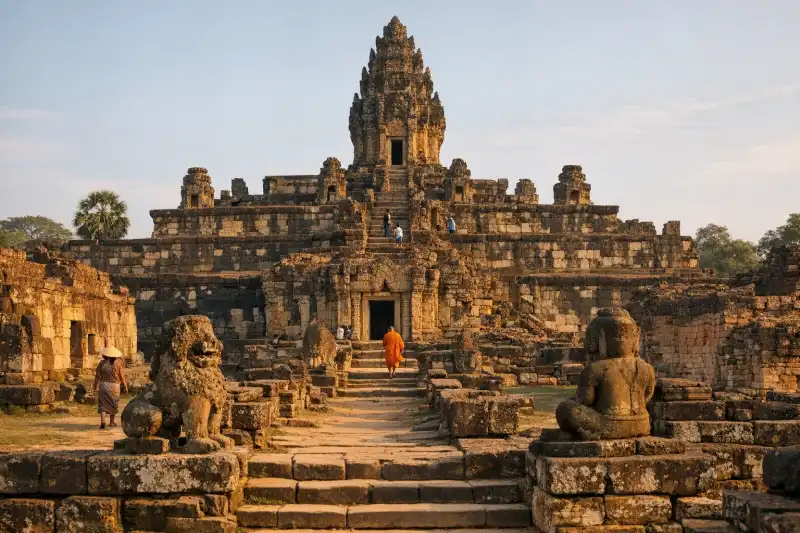
Bakong
Bakong is Cambodia's first major sandstone temple mountain, a stunning Khmer monument at the heart o...
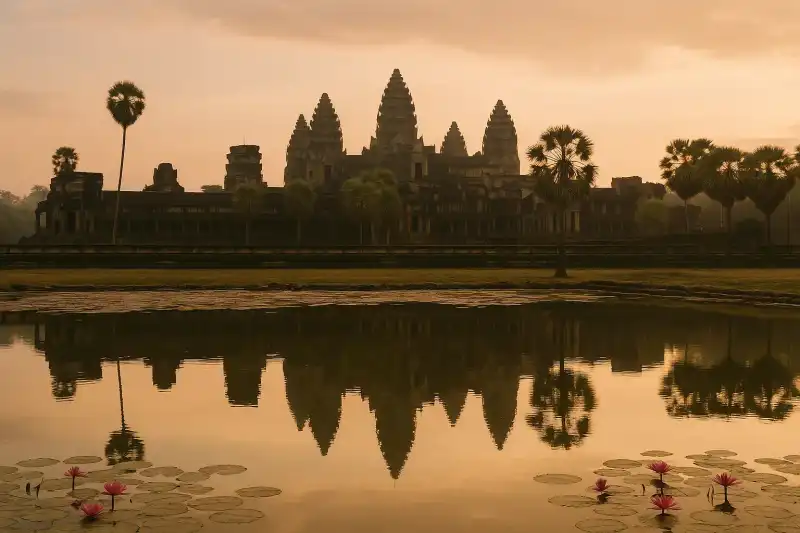
Angkor Wat Travel Guide 2026: Everything You Need to Know
KhmerAngkor Wat, the world's largest religious monument, spans over 400 acres in the heart of Cambodia. T...
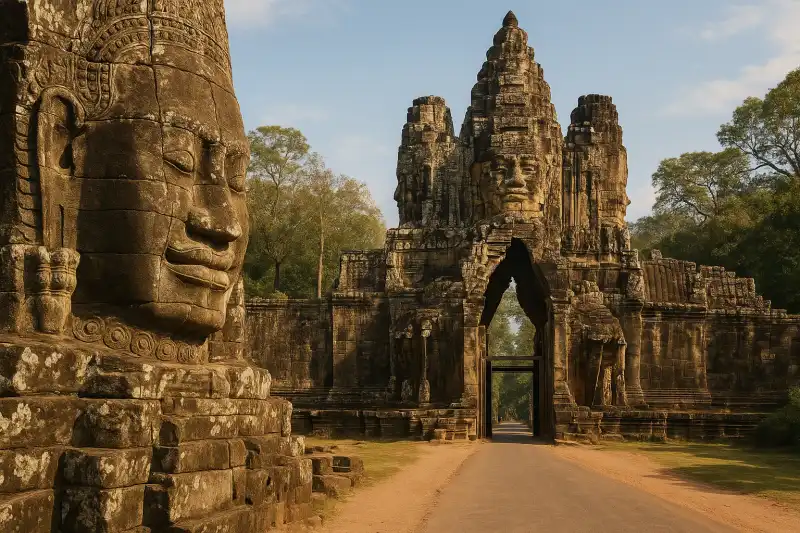
Angkor Thom Travel Guide 2026: Bayon Faces, Gates, and the Khmer Royal City
KhmerAngkor Thom was the last great capital of the Khmer Empire. This guide covers how to visit Bayon, th...
Banteay Kdei
KhmerExplore Cambodia’s Banteay Kdei, a atmospheric Angkor temple-monastery of quiet courtyards, worn car...