Quick Info
At a glance
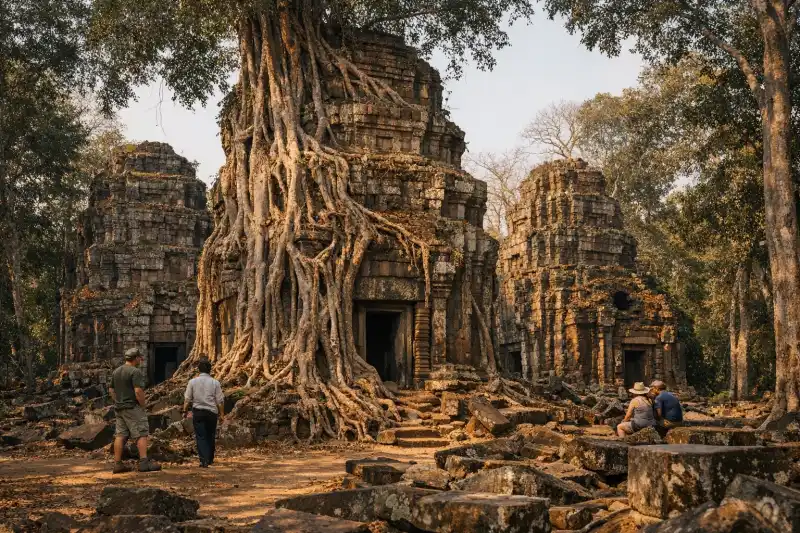
Prasat Bram (Koh Ker) in Cambodia is one of those places that seems to sit halfway between archaeology and myth. Deep in the forested temple zone of Koh Ker, northeast of Siem Reap, its weathered brick towers rise from the earth as if they had been uncovered only yesterday, while giant tree roots grip the masonry with astonishing force. The result is one of the most memorable temple scenes in the country: not the monumental scale of Angkor Wat, but something quieter, more intimate, and in some ways more haunting. Visitors often arrive expecting another stop on a larger Koh Ker circuit and leave talking about Prasat Bram as the most atmospheric ruin of the day.
Part of the short-lived royal capital established at Koh Ker in the 10th century, Prasat Bram reflects a moment when the Khmer Empire briefly shifted its political and ceremonial center away from Angkor. Today, that history survives in fragments of brick, laterite, sandstone, and jungle shade. Birds call from the canopy, filtered light falls on collapsed lintels, and the towers carry the marks of time rather than restoration gloss. For travelers interested in ancient Southeast Asia, Prasat Bram offers something special: a chance to see Khmer architecture in a setting that still feels remote, textured, and alive. It is a temple best approached slowly, with enough time to look beyond the famous roots and notice how it fits into the broader story of Koh Ker’s ambitious and short-lived glory.
History
The Rise of Koh Ker as a Royal Capital
Prasat Bram belongs to the extraordinary archaeological landscape of Koh Ker, which briefly became the capital of the Khmer Empire in the 10th century. This shift is usually associated with King Jayavarman IV, who moved the court from the Angkor region to Koh Ker in the early decades of the century. Although the reasons are still debated, the move was clearly deliberate and ambitious. In a relatively short period, the area was transformed into a major ceremonial and political center, complete with monumental temples, reservoirs, roads, and the great stepped pyramid now known as Prasat Thom or Prang.
Within this context, Prasat Bram was one of many temples built to serve the needs of a rapidly developing royal landscape. Koh Ker was not a random collection of isolated shrines. It was a planned sacred city, and structures like Prasat Bram likely had specific religious roles tied to the worship of Hindu deities, royal legitimacy, and the ritual framework of the Khmer state. Even though Prasat Bram is smaller than Koh Ker’s headline monuments, it formed part of the same architectural and ideological program.
The Temple in the 10th-Century Khmer World
The name “Prasat Bram” is commonly understood to refer to a group of five towers, though not all survive equally well today. Built primarily in brick with sandstone details and laterite structural elements, the temple represents a style typical of the Khmer Empire before the full flowering of the large sandstone complexes better known from Angkor. Brick temples of this era often relied on delicate decorative carving in stucco or on sandstone frames, and they could be both elegant and highly symbolic.
During the 10th century, Khmer temple building was deeply tied to kingship. Temples were not merely places of public worship in the modern sense; they were cosmological statements. Their layout, orientation, and iconography reflected Hindu sacred geography and the idea of the ruler as a divinely sanctioned authority. At Koh Ker, this message was sharpened by the fact that the city itself represented a new seat of power. Temples such as Prasat Bram helped articulate that new order.
Although inscriptions from the wider Koh Ker area are more informative than the remains at Prasat Bram alone, they reveal a world of priests, donations, land grants, divine images, and state-sponsored religious activity. Prasat Bram would have existed within that living network rather than as an isolated monument.
Decline, Abandonment, and Return to the Forest
Koh Ker’s moment as capital did not last long. After Jayavarman IV and his successor Harshavarman II, the royal center shifted back toward Angkor under Rajendravarman II. Once the court moved, Koh Ker lost its political primacy. It did not disappear overnight, but its central role in imperial life faded. Over time, temples that had once stood within an active sacred city became provincial relics.
Like many Khmer monuments, Prasat Bram then entered a long afterlife shaped by climate, vegetation, and changing patterns of local use. Brickwork cracked, decorative elements fell away, and trees took root in and around the towers. In Cambodia’s tropical environment, the forest is never a passive backdrop. It can preserve sites by isolating them, but it can also dismantle them slowly, prying apart masonry with roots and trapping moisture in weakened walls.
For centuries, Koh Ker remained comparatively remote from the better-known temple zones around Angkor. That remoteness helped preserve the site’s mood, even as it contributed to physical deterioration.
Modern Rediscovery and Conservation
In the modern era, Koh Ker gradually re-entered scholarly, national, and tourist awareness. Archaeologists and conservators documented the extent of the city, identifying dozens of monuments spread across the region. Prasat Bram gained special attention because of its visual drama: trees growing over brick towers in a way that instantly captured photographers’ and travelers’ imaginations.
Cambodia’s difficult 20th-century history affected many remote archaeological sites, and Koh Ker was not always easy or safe to access. As stability returned and infrastructure improved, more visitors began to include Koh Ker on day trips from Siem Reap, often pairing it with Preah Vihear. With that increased attention came greater efforts to stabilize structures, improve paths, and manage tourism without stripping the site of its character.
Today, Prasat Bram is appreciated both as a beautiful ruin and as part of the broader Koh Ker archaeological ensemble, recognized internationally for its significance. It remains less visited than the major Angkor temples, which is part of its appeal. The tower group survives not as a perfectly reconstructed monument, but as an evocative fragment of a royal city that briefly challenged Angkor itself.
Key Features
The first thing most visitors notice at Prasat Bram is the interplay between architecture and vegetation. Several of the surviving brick towers are wrapped or crowned by enormous roots, usually from strangler fig or similar tropical trees, which spill over walls and down into the foundations. Unlike a manicured ruin where nature has been carefully held at bay, Prasat Bram presents a more dramatic balance. The roots seem at once destructive and protective, threatening collapse while also holding parts of the structure in a tense embrace. This visual effect gives the temple its distinctive identity within Koh Ker.
Architecturally, Prasat Bram is a good introduction to the brick temple traditions of the Khmer Empire. The towers are comparatively compact, but their proportions are elegant, and traces of decorative detail remain around doorways and frames. Brick was a favored building material for many early and mid-Khmer shrines, especially for tower sanctuaries. Sandstone was used for lintels, colonettes, and certain structural or decorative elements, while laterite often formed hidden or supporting components. At Prasat Bram, these material contrasts can still be read even where sections have collapsed.
The arrangement of the towers is also important. Although the site is not vast, it was conceived as a multi-shrine complex rather than a single freestanding sanctuary. This suggests a ritual program involving more than one divine image or sacred focus. In Khmer temple planning, groups of towers often expressed hierarchy, symmetry, and cosmological order. At Prasat Bram, the surviving remains allow visitors to imagine a more complete ensemble, where brick towers stood clearer and taller, their surfaces finished and probably enhanced with stucco decoration.
What makes the site especially rewarding is its texture. Many Cambodian temples impress through sheer scale, but Prasat Bram works through detail and atmosphere. You notice the roughness of old brick, the dark staining left by rain and lichen, the way roots thread between courses of masonry, and the contrast between sunlit clearings and shaded interiors. In the early morning or late afternoon, these surfaces become even more striking as angled light emphasizes every crack and contour.
The forest setting contributes as much as the ruins themselves. Koh Ker lies in a more sparsely visited landscape than Angkor, and Prasat Bram benefits from that sense of distance. Even when a few tour vehicles are parked nearby, the site often feels quiet. You may hear insects, birds, and the rustle of leaves more clearly than conversation. That quiet allows the temple to be experienced as a place rather than just a monument. For photographers, the composition is compelling; for history-minded travelers, it provides a vivid reminder that many ancient cities did not vanish dramatically, but were slowly reabsorbed into their environments.
There is also an emotional quality to Prasat Bram that sets it apart. The famous tree-covered ruins of Ta Prohm at Angkor are grand and cinematic, but Prasat Bram offers a smaller, less managed version of that encounter between empire and jungle. Because it is less crowded and less architecturally overwhelming, it can feel more personal. Visitors can linger at one tower, trace the line of a doorway, or step back to see how a whole root system has changed the silhouette of the structure.
Prasat Bram is best understood as one stop in the wider Koh Ker complex, yet it has enough individuality to stand alone. It captures several themes central to Cambodian archaeology: the technical skill of Khmer builders, the religious ambitions of the 10th-century court, the temporary nature of political capitals, and the persistent force of the tropical landscape. Those elements combine to make it one of the most photogenic and memorable temples in northern Cambodia.
Getting There
Most travelers reach Prasat Bram from Siem Reap, which is the most practical base for visiting Koh Ker. The journey is roughly 120 kilometers and usually takes about 2.5 to 3.5 hours each way depending on road conditions, traffic leaving the city, and how many stops are included. The easiest option is to hire a private car with driver, which typically costs around $80 to $130 for a full-day Koh Ker trip. If you combine Koh Ker with Preah Vihear, expect more time and often a higher rate, commonly $140 to $200 depending on vehicle type and fuel prices.
Shared tours are sometimes available through local agencies in Siem Reap, though they are less common than Angkor circuits. Prices often range from about $35 to $70 per person depending on group size, inclusions, and whether lunch or guide services are provided. For travelers comfortable with independent road travel, hiring a motorbike is possible but only advisable for experienced riders; daily rental in Siem Reap may cost around $12 to $20, but the distance and heat make this a demanding option.
There is no regular tourist-friendly public transport that drops visitors directly at Prasat Bram, so self-arranged transport remains the norm. Once inside the Koh Ker archaeological zone, sites are spread out, and most visitors continue by the same car, tuk-tuk from a nearby drop-off, or organized tour vehicle. Wear sturdy shoes because the ground around the temple can be uneven, especially after rain. Bring water, sun protection, and cash for tickets, snacks, or tips, as facilities are limited compared with Angkor.
When to Visit
The best time to visit Prasat Bram is during Cambodia’s cooler dry season, generally from November to February. At this time, temperatures are more comfortable for walking, roads are usually in good condition, and the light can be excellent for photography. Mornings are especially pleasant, with softer temperatures and fewer people around the site. If you are planning a day trip from Siem Reap, an early departure helps you arrive before the strongest midday heat.
March to May is the hottest period of the year. The site remains accessible, but the combination of long driving times, exposed walking areas, and rising humidity can make the experience tiring. If you visit in these months, start as early as possible and carry plenty of water. Lightweight clothing, a hat, and sunscreen are essential.
The rainy season, typically from May or June through October, has both drawbacks and advantages. Roads can be muddier, and paths near the temple may become slippery. However, this is also when the surrounding forest is at its greenest, which enhances the visual drama of Prasat Bram’s root-covered towers. Photographers often appreciate the richer colors and moody skies. Short, intense downpours are common, so a light rain jacket or poncho is useful.
For overall balance, December and January are ideal, but Prasat Bram can be rewarding year-round. The key is matching expectations to the season: comfort in the dry months, or lush scenery and atmosphere in the wet ones.
| Quick Facts | Details |
|---|---|
| Location | Koh Ker archaeological complex, Preah Vihear Province, Cambodia |
| Main appeal | Brick Khmer towers dramatically entwined with giant tree roots |
| Historical period | 10th century CE |
| Cultural context | Khmer Empire |
| Best base | Siem Reap |
| Travel time from Siem Reap | About 2.5 to 3.5 hours by road |
| Visit duration | 20 to 45 minutes at the site itself |
| Best season | November to February |
| Good for | History lovers, photographers, temple travelers, offbeat Cambodia itineraries |
| Combine with | Other Koh Ker monuments and, on longer days, Preah Vihear |
Guided tours: worth it?
Self-guided works here, but a guide can add real value if you want the ruins explained as a living place rather than just a sequence of monuments.
Best for
- First-time visitors who want context, not just photos
- Short visits where a planned route saves time
When to go self-guided
Go independently if you prefer setting your own pace, reading as you go, and checking official hours or ticket rules directly before you arrive.
What I’d avoid
Skip paid tours that bundle unrelated stops you do not actually want. The best option should either save meaningful planning time or add historical context you would miss on your own.
Koh Ker temple tours from Siem Reap
Useful when: transport or pickup logistics matter
Preah Vihear and Koh Ker day trips
Useful when: transport or pickup logistics matter
Cambodia ancient temples private tours
Useful when: you want flexible timing or a private guide
Some tour links are affiliate links, which may earn Ancient Travel a small commission at no extra cost to you. I try to surface options that make practical sense for the site—not just anything bookable.
Frequently Asked Questions
What is Prasat Bram?
Prasat Bram is a group of brick temple towers within the Koh Ker archaeological complex in northern Cambodia, known especially for massive tree roots enveloping the ruins.
Where is Prasat Bram located?
Prasat Bram stands inside the Koh Ker temple zone in Preah Vihear Province, Cambodia, about 120 kilometers northeast of Siem Reap by road.
How much time should I allow for a visit?
Most travelers spend 20 to 45 minutes at Prasat Bram itself, though it is usually visited as part of a half-day or full-day exploration of the wider Koh Ker complex.
Is Prasat Bram suitable to visit in the rainy season?
Yes, but paths can be muddy and slippery. The rainy season also makes the surrounding forest greener and more photogenic, so sturdy footwear is recommended.
Do I need a guide at Prasat Bram?
A guide is not strictly necessary, but a knowledgeable driver or licensed guide adds useful historical context and helps connect Prasat Bram to the wider story of Koh Ker.
Why is Prasat Bram famous?
It is famous for its dramatic combination of Khmer brick towers and giant strangler fig roots, creating one of the most atmospheric and frequently photographed scenes in Koh Ker.
Nearby Ancient Sites
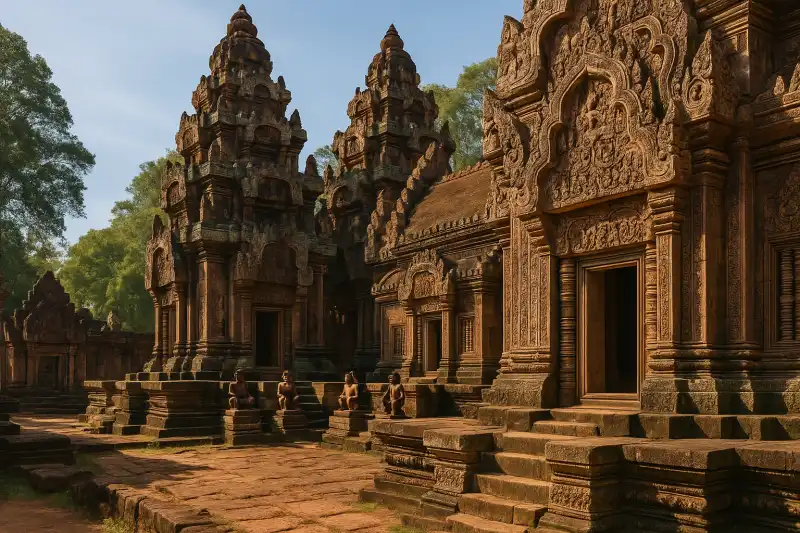
Banteay Srei Travel Guide 2026: Pink Sandstone Temple, Carvings, and Visit Tips
KhmerBanteay Srei is one of Cambodia’s most detailed Khmer temples, known for fine pink sandstone carving...
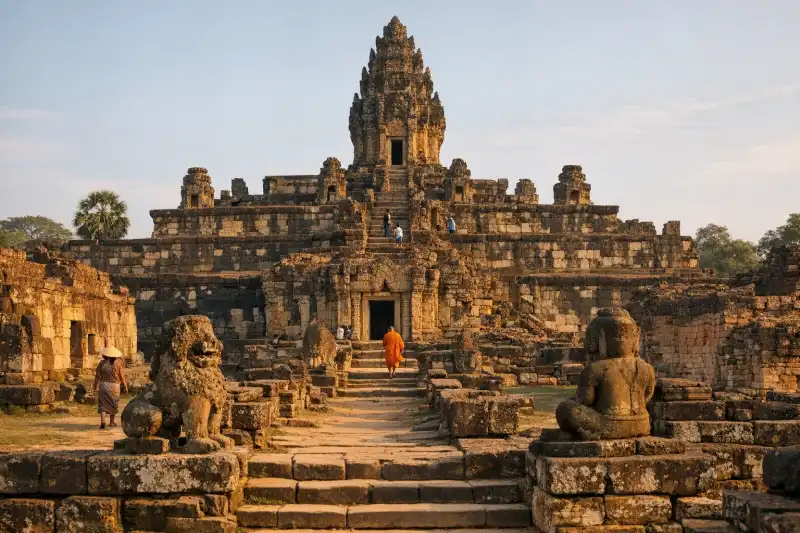
Bakong
Bakong is Cambodia's first major sandstone temple mountain, a stunning Khmer monument at the heart o...
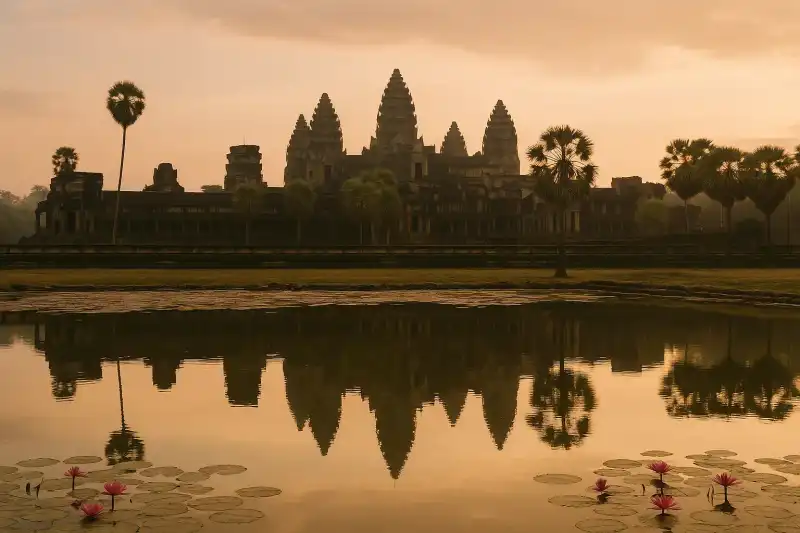
Angkor Wat Travel Guide 2026: Everything You Need to Know
KhmerAngkor Wat, the world's largest religious monument, spans over 400 acres in the heart of Cambodia. T...
Angkor Thom Travel Guide 2026: Bayon Faces, Gates, and the Khmer Royal City
KhmerAngkor Thom was the last great capital of the Khmer Empire. This guide covers how to visit Bayon, th...