Quick Info
At a glance
Prasat Damrei in Cambodia offers a very different experience from the headline monuments of Angkor. Instead of soaring galleries packed with visitors, this lesser-known Khmer site invites a slower kind of attention: weathered stone, quiet vegetation, and the feeling that history is still half hidden in the landscape. For travelers based in Siem Reap, it can serve as a rewarding detour from the classic temple circuit, revealing how broad and varied the sacred geography of the Khmer world once was.
Part of the appeal of Prasat Damrei is precisely that it does not overwhelm at first glance. The site is better appreciated through detail than spectacle. Its surviving elements speak of an era when the Khmer Empire expressed power and belief through temple building on every scale, from imperial capitals to more intimate sanctuaries. At Prasat Damrei, worn carvings, laterite and sandstone masonry, and the site’s relationship to the surrounding plain all help place it within that larger story. Visiting feels a bit like stepping into the margins of Angkorian history, where smaller shrines and outlying monuments still carry the same symbolic vocabulary as the great temple-mountains. For travelers who enjoy archaeology, photography, or simply finding quieter places in famous regions, Prasat Damrei rewards patience and curiosity.
History
Early Khmer foundations
Prasat Damrei belongs to the broad cultural and architectural world of the Khmer Empire, the powerful Southeast Asian civilization that dominated much of mainland Southeast Asia for centuries. While the exact dating of smaller temples can be difficult, scholars generally place monuments of this kind within the flourishing Angkorian period, especially between the 10th and 12th centuries CE. During this era, temple construction expanded well beyond royal capitals, creating a network of shrines, reservoirs, roads, and ceremonial sites across what is now northwestern Cambodia.
The name “Damrei” is associated with the Khmer word for “elephant,” and sites bearing this name often preserve either elephant imagery, local memory, or a landscape connection that later communities used to identify them. As with many lesser-known temples in the Angkor region, Prasat Damrei likely served both religious and social functions. It may have operated as a local sanctuary linked to agricultural settlements, a stop along a ritual or administrative route, or a temple serving a particular elite family or religious foundation under royal patronage. In the Khmer world, even modest shrines were tied into a larger cosmological system in which temples represented sacred mountains and divine order.
Religious life and temple use
The temple was probably first associated with Hindu worship, as many Khmer sanctuaries were dedicated to Shiva, Vishnu, or other deities of the Indic religious world adopted and adapted by Khmer rulers. Architectural forms from the Angkorian period often reflected these sacred associations through tower sanctuaries, symbolic doorways, and carved decorative programs. Over time, however, the religious life of Khmer sites could shift. As Buddhism became increasingly important in Cambodia, especially from the later Angkorian centuries onward, many temples acquired layered religious histories.
This pattern of reuse and reinterpretation is one of the most important facts about ancient Cambodian temples. A structure built under one king and one ritual framework might remain meaningful to nearby communities for generations, even when formal royal patronage declined. Prasat Damrei was likely not frozen in a single historical moment. Instead, like many sites in the region, it probably experienced periods of active worship, adaptation, neglect, and renewed local reverence. Even when a temple ceased to function in its original form, it often remained a landmark embedded in memory, folklore, and the seasonal rhythms of rural life.
Decline, abandonment, and survival
From the 13th century onward, the political center of the Khmer world shifted, and many temples in the Angkor region entered a long phase of reduced maintenance. This did not mean instant abandonment. Rather, some major monuments remained in use while smaller sites became increasingly vulnerable to weather, root growth, stone displacement, and loss of surrounding settlement networks. Prasat Damrei, as a relatively modest monument, would have been especially susceptible to gradual decay.
Cambodia’s tropical environment is both beautiful and destructive when it comes to archaeology. Monsoon rains, heat, vegetation, and shifting soils can all damage masonry over centuries. Sandstone details soften; laterite blocks loosen; collapsed sections become difficult to distinguish from the earth around them. The survival of Prasat Damrei into the present, even in partial form, is therefore notable in itself. What remains today is the product not only of medieval builders but also of endurance against climate, time, and changing human priorities.
Modern rediscovery and heritage context
In the modern period, the fame of Angkor Wat and Angkor Thom understandably drew most international attention, while smaller temples like Prasat Damrei remained far less visible. Yet these quieter sites are essential to understanding the true scale of Khmer architecture. Archaeologists, conservators, and heritage authorities have gradually documented outlying and lesser-visited monuments in order to preserve the broader Angkor landscape, not just its most celebrated icons.
Today, Prasat Damrei is best understood as part of that wider archaeological field. It may not be the centerpiece of most itineraries, but it adds nuance to any exploration of Khmer history. It reminds visitors that Angkor was never a single temple or even a single city. It was a vast sacred and political environment filled with sites of different sizes, purposes, and artistic ambitions. In that sense, Prasat Damrei offers a more intimate entry point into the world of the Khmer Empire: one where the scale is smaller, but the historical resonance remains deep.
Key Features
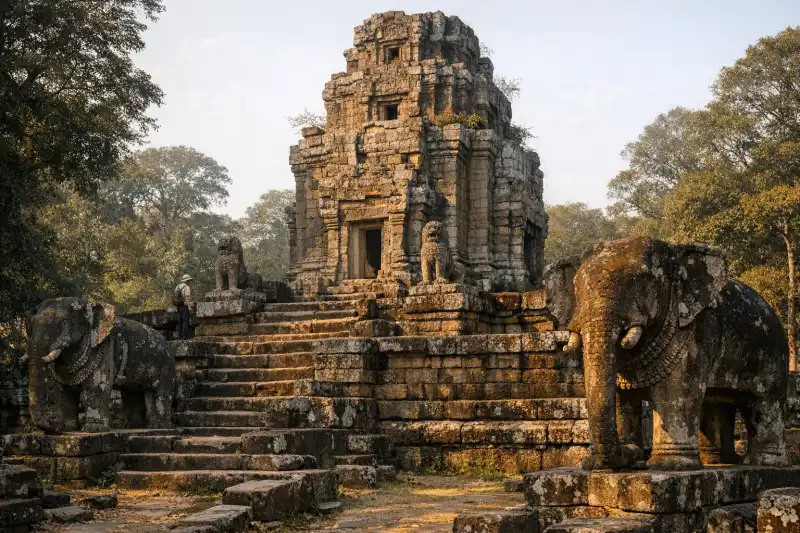
What makes Prasat Damrei memorable is not monumental size but atmosphere. The site has the quiet dignity common to many smaller Khmer temples, where every remaining block seems to hold traces of former geometry and ritual purpose. Approaching it, visitors usually notice first the interplay between stone and vegetation. The monument sits within a landscape that softens the edges of its ruins, making the temple feel discovered rather than staged. This is a very different visual experience from the heavily photographed ceremonial avenues of larger Angkor temples.
Architecturally, Prasat Damrei reflects familiar Khmer building principles in condensed form. Depending on the surviving condition of the structures, visitors may see a central sanctuary or remains of one, built from sandstone and laterite, with alignment and proportions that echo larger temple traditions. Khmer architects were precise in orientation, symbolism, and access. Doorways, false doors, pedestal forms, and tower plans all carried ritual meaning. Even where the upper elements have fallen, the remaining base courses and carved fragments can still suggest the original sacred composition.
One of the pleasures of visiting sites like this is learning to read fragments. A lintel may preserve floral or divine motifs; a doorway frame may show the careful stone dressing used by Khmer masons; a surviving pedestal or platform may indicate where an image once stood. The closer you look, the more the temple reveals. Surfaces that seem plain from a distance can display subtle tooling marks or worn ornament. Corners and thresholds often preserve the strongest clues to the building’s original elegance.
The name Prasat Damrei also encourages attention to the symbolic role of the elephant in Khmer culture. Elephants were associated with royal authority, warfare, ceremonial processions, and practical power. Whether the site’s name derives from carvings, local tradition, or historical usage, it connects the temple to a deeply meaningful image in Cambodian history. Across Angkorian art, elephants appear in military scenes, mythic contexts, and courtly life. A temple linked in memory to that animal immediately gains another interpretive layer.
Another key feature is the sense of scale. At major sites, visitors can sometimes lose perspective in the grandeur of long galleries and enormous towers. At Prasat Damrei, scale works differently. You are close to the architecture. Door frames feel human-sized. The sanctuary concept becomes easier to grasp as a focused sacred space rather than a sprawling urban complex. This can make the site especially rewarding for travelers interested in understanding how Khmer religious architecture functioned at multiple levels, from imperial temple-mountains to local shrines.
Photography is often particularly rewarding here because of changing light and relative calm. Morning and late afternoon tend to bring gentle shadows that help define the texture of stone. During the rainy season, surrounding vegetation can frame the ruins beautifully, while in the drier months the geometry of masonry may stand out more clearly. Without constant crowds, it is easier to compose images that capture the temple’s relationship with its environment.
Finally, Prasat Damrei’s greatest feature may be interpretive rather than physical: it helps complete the story of the Angkor region. Famous monuments show the apex of Khmer architectural ambition, but quieter sites like this reveal how widespread temple culture was. They preserve the ordinary extraordinary—sacred buildings that were not the empire’s grandest statements, yet were still part of its religious, artistic, and political fabric. For many travelers, that quieter insight becomes the most lasting impression.
Getting There
Most visitors reach Prasat Damrei from Siem Reap, the main tourism hub for the Angkor region. Hiring a tuk-tuk remains one of the most convenient options for independent travelers. A half-day circuit that includes one or two lesser-known temples may cost around $18 to $30, while a fuller day with several stops often ranges from $25 to $40 depending on distance, season, and negotiation. For air-conditioned comfort, private car hire typically starts around $45 to $80 for the day.
If you prefer more structure, guided temple tours from Siem Reap can be a good choice, especially if Prasat Damrei is combined with better-known sites such as Banteay Srei, Banteay Samre, or parts of the main Angkor circuit. Group tours often begin around $15 to $35 per person, though private tours are more expensive. Be sure to confirm in advance that Prasat Damrei is specifically included, since many standard itineraries focus only on the major monuments.
Motorbike taxis can sometimes be arranged for shorter routes, but they are less comfortable in hot or wet weather and usually best for experienced travelers. Bicycle access may be possible for strong cyclists if the site is incorporated into a broader countryside ride, though distance and road conditions make this less practical for most visitors. If you self-drive a scooter, expect fuel costs to be low, often under $5 for local exploration, but check current rental rules and safety requirements.
As with other temples in the region, travelers should also budget for the Angkor pass if required for the route they choose. Prices can change, so verify the latest official rates before setting out.
When to Visit
The best time to visit Prasat Damrei is during Cambodia’s dry season, generally from November to February, when temperatures are more comfortable and roads are easiest to manage. Morning visits are especially pleasant, with softer light for photography and a cooler atmosphere for walking around exposed stonework. This is also the busiest season in Siem Reap overall, but smaller sites like Prasat Damrei usually remain far quieter than headline attractions.
March to May brings the hottest weather. Midday visits during these months can be exhausting, with strong sun and high humidity. If you travel during this period, aim to arrive early, carry plenty of water, and combine the site with shaded stops or a slower itinerary. The upside is that tourist numbers may be lower, and temples can feel particularly tranquil outside the main circuits.
The rainy season, roughly from June to October, has both advantages and drawbacks. Downpours can make travel slower and some rural roads muddier, but the landscape becomes lush and vibrant. Greenery around the temple can be striking, and overcast skies may create moody, dramatic photography. Showers often pass quickly, so this season can still be rewarding if you stay flexible and bring suitable footwear.
Whenever you go, the best hours are usually just after opening time in the wider Angkor area or later in the afternoon when temperatures ease. Avoid the harshest midday light if possible. If your priority is solitude, shoulder-season travel in late October, early November, or parts of June can be an excellent compromise between access, scenery, and crowd levels.
| Quick Facts | Details |
|---|---|
| Site name | Prasat Damrei |
| Location | Siem Reap Province, Cambodia |
| Cultural context | Khmer Empire |
| Likely period | c. 10th-12th century CE |
| Main appeal | Quiet Khmer temple in the wider Angkor region |
| Best base | Siem Reap |
| Recommended visit length | 20-45 minutes |
| Best time of day | Early morning or late afternoon |
| Ideal season | November to February |
| Visit style | Best combined with nearby Angkor-area temples |
Prasat Damrei is not the kind of place that tries to impress through scale alone. Its value lies in how it deepens the experience of Cambodia’s temple landscape. By stepping away from the most iconic monuments for a while, visitors gain a better sense of how extensive and varied the Khmer sacred world really was. Here, among quieter ruins and subtler details, Angkor becomes less of a postcard image and more of a lived historical environment.
For travelers willing to slow down, that shift in perspective is meaningful. Prasat Damrei offers a chance to notice the craftsmanship of stone blocks, the resilience of ancient sanctuaries, and the way memory survives in names and landscapes. It is a small but worthwhile chapter in the story of Cambodia, and for many visitors, that understated quality is exactly what makes it special.
Guided tours: worth it?
A guide can be genuinely useful at Prasat Damrei, especially if you want help with transport, timing, tickets, or understanding a large site without losing half the day to logistics.
Best for
- First-time visitors who want context, not just photos
- Travelers who want transport, timing, or entry logistics handled
- Trips where tickets, circuits, or timed entry can shape the day
- Short visits where a planned route saves time
When to go self-guided
Go independently if you already have transport and tickets sorted, enjoy moving at your own pace, and are comfortable checking the latest official rules before you arrive.
What I’d avoid
Skip paid tours that bundle unrelated stops you do not actually want. The best option should either save meaningful planning time or add historical context you would miss on your own.
Angkor Archaeological Park tours
Useful when: you want to compare guided formats before deciding
Siem Reap temple day trips
Useful when: transport or pickup logistics matter
Private Angkor temple tours
Useful when: you want flexible timing or a private guide
Some tour links are affiliate links, which may earn Ancient Travel a small commission at no extra cost to you. I try to surface options that make practical sense for the site—not just anything bookable.
Frequently Asked Questions
Where is Prasat Damrei located?
Prasat Damrei is in Siem Reap Province, Cambodia, within the wider Angkor region that contains many Khmer temples and archaeological remains.
Is Prasat Damrei included in standard Angkor itineraries?
Not usually. Many visitors focus on famous monuments such as Angkor Wat and Angkor Thom, so Prasat Damrei is better suited to travelers who want a quieter stop.
Do I need an Angkor pass to visit Prasat Damrei?
If the site is accessed as part of the Angkor Archaeological Park area, travelers should expect to need the relevant Angkor pass. Confirm current rules before visiting.
How much time should I spend at Prasat Damrei?
Most travelers spend 20 to 45 minutes at the site, though photographers, history enthusiasts, and those combining nearby temples may stay longer.
What is Prasat Damrei known for?
Prasat Damrei is known for its Khmer temple remains, quieter atmosphere, and the chance to appreciate smaller-scale sacred architecture away from the busiest crowds.
Can I visit Prasat Damrei from Siem Reap in one day?
Yes. It is best visited as part of a half-day or full-day temple route from Siem Reap, often combined with better-known monuments in the surrounding area.
Nearby Ancient Sites
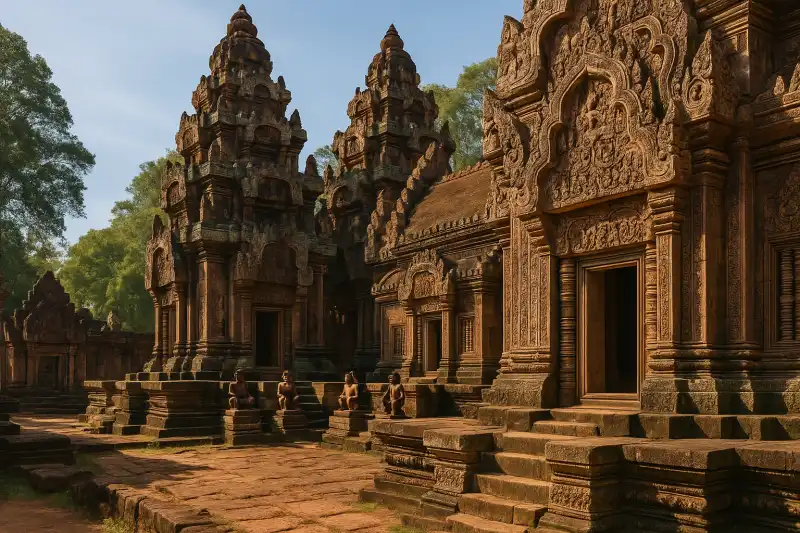
Banteay Srei Travel Guide 2026: Pink Sandstone Temple, Carvings, and Visit Tips
KhmerBanteay Srei is one of Cambodia’s most detailed Khmer temples, known for fine pink sandstone carving...
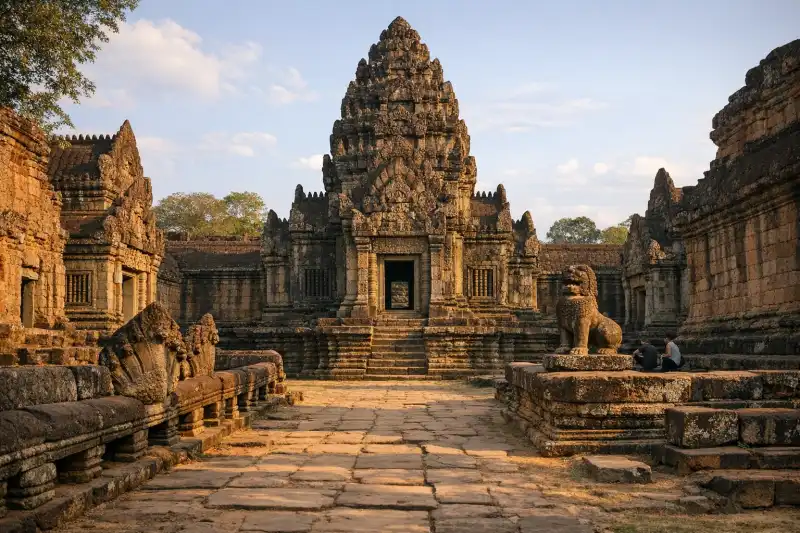
Banteay Samré
Banteay Samré is a beautifully preserved 12th-century Hindu temple in Cambodia’s Siem Reap province,...
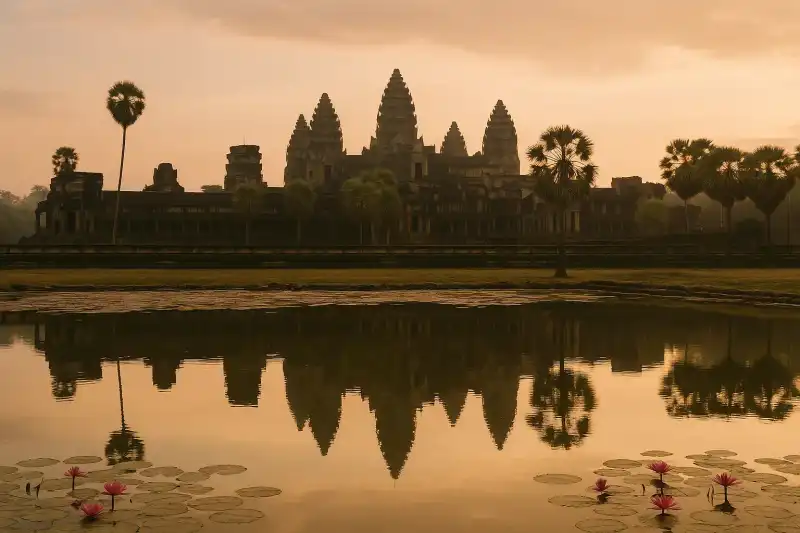
Angkor Wat Travel Guide 2026: Everything You Need to Know
KhmerAngkor Wat, the world's largest religious monument, spans over 400 acres in the heart of Cambodia. T...
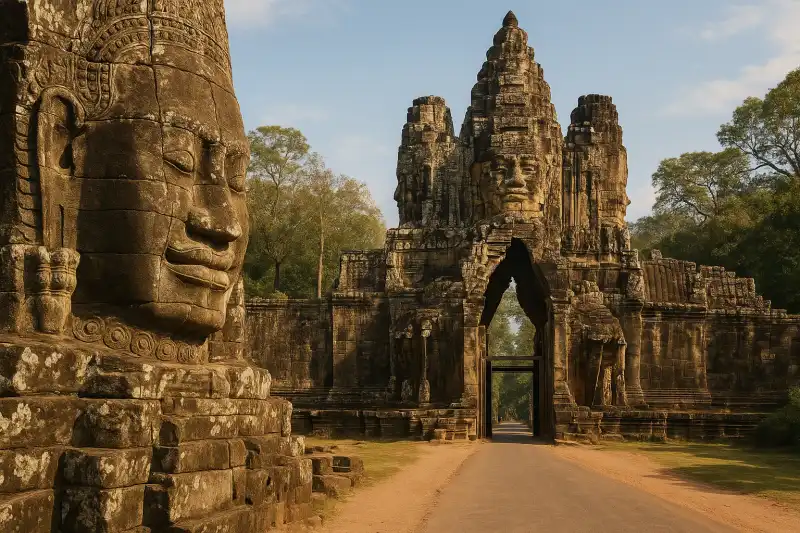
Angkor Thom Travel Guide 2026: Bayon Faces, Gates, and the Khmer Royal City
KhmerAngkor Thom was the last great capital of the Khmer Empire. This guide covers how to visit Bayon, th...