Quick Info
At a glance
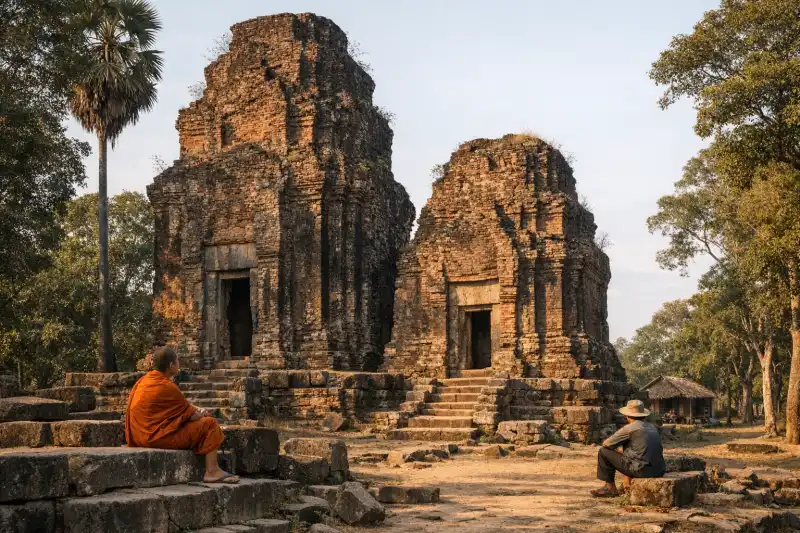
Prasat Neang Khmau in Cambodia is the kind of temple that rewards travelers who step beyond the famous postcard views of Angkor and follow curiosity into quieter corners of the Khmer world. Smaller in scale than the monumental sandstone complexes that dominate most itineraries, it offers something equally valuable: intimacy. Here, weathered brick, scattered laterite, and the soft press of tropical vegetation create an atmosphere that feels more contemplative than theatrical. The site does not overwhelm with size. Instead, it invites a slower style of looking, one in which architectural details, traces of devotion, and the relationship between temple and landscape become easier to appreciate.
For visitors based in Siem Reap, Prasat Neang Khmau makes sense as a complementary stop rather than a standalone destination for a full day. Yet that is precisely its appeal. It reveals the broader texture of the Angkor-era sacred landscape, where not every temple was built as an imperial centerpiece and not every shrine needed monumental scale to express religious meaning. A visit here can feel like stepping into the margins of empire, where local worship, regional patronage, and the practical realities of Khmer construction are still legible in ruin. If Angkor Wat shows the Khmer Empire at its grandest, Prasat Neang Khmau helps you understand it at a more human scale.
History
Early Khmer foundations
Prasat Neang Khmau belongs to the cultural and architectural world of the Khmer Empire, the powerful civilization that shaped much of mainland Southeast Asia between the 9th and 15th centuries. Although the temple is not among the most extensively documented monuments of the Angkor region, it is generally associated with the Angkor period and likely dates to around the 10th or early 11th century CE, when brick temple construction remained an important part of Khmer sacred architecture. During this era, rulers and regional elites sponsored shrines dedicated primarily to Hindu deities, especially Shiva, though religious landscapes were often layered and could shift over time.
The name “Neang Khmau” is usually translated as “Black Lady,” a clue that local memory and later folklore may have become attached to the site long after its original foundation. Such names are common in Cambodia, where ruined temples often accumulated legends linked to queens, princesses, hermits, or guardian spirits. While these stories are not always reliable historical evidence, they matter because they show that sites like this did not disappear from cultural consciousness simply because royal patronage ended. They remained places with identity, memory, and local significance.
Temple building in the Angkor period
To understand Prasat Neang Khmau, it helps to place it in the broader evolution of Khmer temple building. Before the best-known sandstone state temples reached their mature form, many Khmer shrines were built largely in brick with laterite used for foundations and enclosures, while sandstone was reserved for door frames, lintels, colonettes, and key decorative features. This combination appears across many early and middle Angkor monuments. Brick was practical, widely used, and capable of supporting elaborate ornament, often enhanced with stucco that has mostly vanished over the centuries.
Prasat Neang Khmau seems to fit this tradition. Rather than functioning as an immense temple-mountain or major royal center, it was likely a smaller shrine serving a local religious community or commemorating a patron’s piety and status within the expanding Khmer world. During the 10th and 11th centuries, temple construction was not limited to kings alone. Officials, regional elites, and religious foundations all participated in shaping the sacred geography around Angkor. This makes smaller temples historically important, because they reveal how power and belief spread outward from the imperial core.
Religious continuity and change
Like many Khmer temples, Prasat Neang Khmau was probably first linked to Hindu worship. The dominant cults of the early Angkor period centered on Shiva and Vishnu, often expressed through symbolic forms such as the linga. Over time, however, Cambodia’s religious landscape changed. Mahayana Buddhist influences grew during certain reigns, and Theravada Buddhism gradually became the dominant faith in later centuries. In many Cambodian temples, this did not mean clean replacement. Instead, old sacred sites were reused, rededicated, or simply reinterpreted by later generations.
There is no need to imagine Prasat Neang Khmau as a site frozen in one single moment of belief. Like so many monuments in Cambodia, it likely experienced phases of use, neglect, adaptation, and rediscovery. Some architectural elements may have fallen early, while the site itself remained known to nearby communities. This long continuity—ritual, memory, abandonment, return—is one of the defining features of Khmer archaeology.
Decline, survival, and modern appreciation
After the gradual decline of Angkor as a political center, many outlying and secondary temples became increasingly vulnerable to the tropical environment. Trees, roots, termites, moisture, and seasonal flooding all altered the original fabric of brick and laterite structures. Unlike the grandest temples, smaller monuments often received less sustained conservation attention, which means that what visitors see today can be fragmentary. Yet these fragments are historically valuable. They preserve the everyday reality of survival in the monsoon climate and the uneven afterlife of ancient sacred architecture.
In the modern era, growing archaeological interest in Cambodia has helped place lesser-known temples like Prasat Neang Khmau within a wider network of Angkor-period heritage. Even when a monument is modest, it contributes to the bigger historical picture: how Khmer architecture developed, how regional shrines supported imperial ideology, and how sacred spaces remained meaningful across centuries of change. For travelers, that makes Prasat Neang Khmau more than a minor stop. It is part of the living mosaic that helps explain the reach and resilience of the Khmer past.
Key Features
What makes Prasat Neang Khmau compelling is not spectacle in the usual sense, but texture. The temple’s brickwork is among its most distinctive qualities. Khmer brick temples often appear deceptively simple from a distance, yet close inspection reveals careful proportion, refined masonry, and the interplay of structural and decorative materials. At Prasat Neang Khmau, surviving sections of wall and foundation help visitors understand how early Khmer builders balanced durability with elegance. Even where stucco or carved detail has been lost, the remaining surfaces retain a tactile quality that differs markedly from the polished grandeur of large sandstone monuments.
Another key feature is the temple’s relationship with its setting. Unlike heavily managed flagship sites, smaller temples often feel more embedded in the landscape. Trees, grass, scattered stone, and shifting light shape the experience as much as the architecture itself. This gives Prasat Neang Khmau a quiet atmosphere that many travelers find memorable. In the early morning, the site can feel almost meditative, with birdsong replacing the noise of tour groups and the warm Cambodian light bringing out red and brown tones in the brick. In late afternoon, the ruin takes on a softer, more reflective mood.
The layout, though modest, is also important. Khmer temples were rarely random clusters of buildings. Even small shrines reflected cosmological ideas, ritual movement, and the hierarchy of sacred space. Visitors may notice axial planning, an emphasis on orientation, and the use of raised platforms or enclosures to separate the divine precinct from the surrounding world. At Prasat Neang Khmau, these remnants help convey how Khmer religious architecture organized devotion through space. Entering the temple area is not just physical movement; it is passage into a structured sacred environment.
Material contrast is another feature worth noticing. Brick, laterite, and sandstone each served distinct purposes in Khmer construction. Laterite, a porous iron-rich stone common in Cambodia, was often used for less visible structural parts or enclosure walls. Sandstone, when present, usually marked points of ritual and visual emphasis such as doorways, lintels, and carved details. At Prasat Neang Khmau, whatever survives of these transitions helps visitors read the temple the way an archaeologist might: by understanding which parts carried symbolic weight and which parts provided the practical support.
There is also value in the monument’s scale. Because Prasat Neang Khmau is smaller than Angkor’s headline temples, you can absorb it more completely in a short time. The human proportions make it easier to imagine worshippers approaching the shrine, priests performing rituals, or local patrons expressing prestige through temple endowment. Larger monuments can inspire awe; smaller ones often encourage understanding. Here, the Khmer world feels less abstract and more lived-in.
For photographers and architecture enthusiasts, the site offers excellent opportunities to study weathering and age. Brick edges soften, foundations sink unevenly, and vegetation frames the ruin in ways no designer originally intended. These transformations are not flaws in the visitor experience; they are part of the story. Prasat Neang Khmau shows what centuries do to sacred architecture in a humid tropical climate. It is a place where ruin itself becomes a historical document.
Getting There
Most travelers visit Prasat Neang Khmau from Siem Reap, the main gateway to the Angkor region. The easiest option is to hire a tuk-tuk driver for a half-day or full-day itinerary that includes several lesser-known temples. In and around Siem Reap, a tuk-tuk for a short custom route typically costs about $15 to $25 for half a day, while a fuller day with multiple stops may run $20 to $35 depending on distance, waiting time, and the season. Always confirm the route and price in advance.
Private car hire is more comfortable during the hottest months, especially if you want air-conditioning and flexibility. Expect to pay roughly $40 to $70 for a car and driver for a day, again depending on how many sites you include. Some travelers combine Prasat Neang Khmau with larger temples in the Angkor area, while others pair it with countryside stops for a quieter itinerary.
If you prefer a guided experience, organized temple tours from Siem Reap can be a good choice. Prices vary widely, but shared day tours often begin around $18 to $35 per person, while private heritage tours can cost $50 or more. Be sure to check whether your Angkor pass is included; often it is not. Depending on current site regulations, you may need a valid pass for entry to temples in the wider Angkor zone.
Self-driving by rented motorbike is generally not the first recommendation for most visitors due to navigation, road conditions, and local rules, but bicycles are possible for confident riders if the route is not too far from your base. In Cambodia’s heat, however, even short distances can feel demanding by midday, so carry plenty of water.
When to Visit
The best time to visit Prasat Neang Khmau is during Cambodia’s dry season, generally from November to February, when temperatures are more comfortable and skies are often clearer. These months are ideal for combining major Angkor monuments with smaller temples because you can move around more easily without the exhaustion that builds during the hotter part of the year. Morning visits are especially rewarding. The air is cooler, the light is softer, and quieter sites like this one feel particularly atmospheric before the day becomes busy.
March to May is the hottest period. The advantage is that popular landmarks in the region may be slightly less crowded at certain times, but the heat can be intense, often pushing visitors to limit outdoor exploration to early morning. If you travel during these months, plan to arrive shortly after sunrise, wear light clothing, and carry more water than you think you need.
The rainy season, roughly from June to October, transforms the landscape. Rice fields brighten, trees appear fuller, and the countryside around temple sites can be strikingly green. Rain usually comes in bursts rather than all day, but muddy paths, slick stone, and sudden downpours are common. For photographers, this can be an excellent season, with moody skies and saturated colors. For casual visitors, it requires a little more flexibility.
No matter the season, avoid the middle of the day if possible. Prasat Neang Khmau is best appreciated slowly, and Cambodia’s strongest sun makes both walking and close architectural observation less pleasant. Early morning or late afternoon gives you the best balance of comfort, light, and atmosphere.
| Quick Facts | Details |
|---|---|
| Location | Siem Reap Province, Cambodia |
| Cultural Context | Khmer Empire |
| Likely Date | 10th–11th century CE |
| Main Building Material | Brick with laterite and sandstone elements |
| Best Base | Siem Reap |
| Suggested Visit Length | 20–45 minutes |
| Best Time of Day | Early morning or late afternoon |
| Ideal Season | November to February |
| Travel Style | Best visited as part of a broader Angkor-area itinerary |
| Why Visit | Quiet atmosphere, Khmer brick architecture, and insight into lesser-known sacred sites |
Guided tours: worth it?
A guide can be genuinely useful at Prasat Neang Khmau, especially if you want help with transport, timing, tickets, or understanding a large site without losing half the day to logistics.
Best for
- First-time visitors who want context, not just photos
- Travelers who want transport, timing, or entry logistics handled
- Trips where tickets, circuits, or timed entry can shape the day
- Short visits where a planned route saves time
When to go self-guided
Go independently if you already have transport and tickets sorted, enjoy moving at your own pace, and are comfortable checking the latest official rules before you arrive.
What I’d avoid
Skip paid tours that bundle unrelated stops you do not actually want. The best option should either save meaningful planning time or add historical context you would miss on your own.
Siem Reap Ancient Temples Tour
Useful when: you want to compare guided formats before deciding
Angkor Archaeological Park Day Tour
Useful when: you want to compare guided formats before deciding
Siem Reap Countryside Temple Tour
Useful when: you want to compare guided formats before deciding
Some tour links are affiliate links, which may earn Ancient Travel a small commission at no extra cost to you. I try to surface options that make practical sense for the site—not just anything bookable.
Frequently Asked Questions
What is Prasat Neang Khmau?
Prasat Neang Khmau is a small ancient Khmer temple in Siem Reap Province, Cambodia, known for its brick construction and quieter setting away from the most crowded Angkor monuments.
Where is Prasat Neang Khmau located?
It is located in Siem Reap Province near the wider Angkor region, making it possible to visit as part of a temple itinerary from Siem Reap.
Do I need an Angkor pass to visit Prasat Neang Khmau?
Access requirements can change, but many temples in the Angkor area fall under the Angkor pass system. Check current APSARA Authority rules or ask your hotel or driver before visiting.
How much time should I spend at Prasat Neang Khmau?
Most visitors spend 20 to 45 minutes at the site, though history enthusiasts and photographers may want longer to study the brickwork and surrounding landscape.
Is Prasat Neang Khmau worth visiting?
Yes, especially if you enjoy lesser-known Khmer temples, quieter ruins, and seeing how smaller shrines complement the grander monuments around Angkor.
What should I wear when visiting Prasat Neang Khmau?
Wear light, breathable clothing that covers shoulders and knees, along with sturdy shoes, sun protection, and water for the hot Cambodian climate.
Nearby Ancient Sites
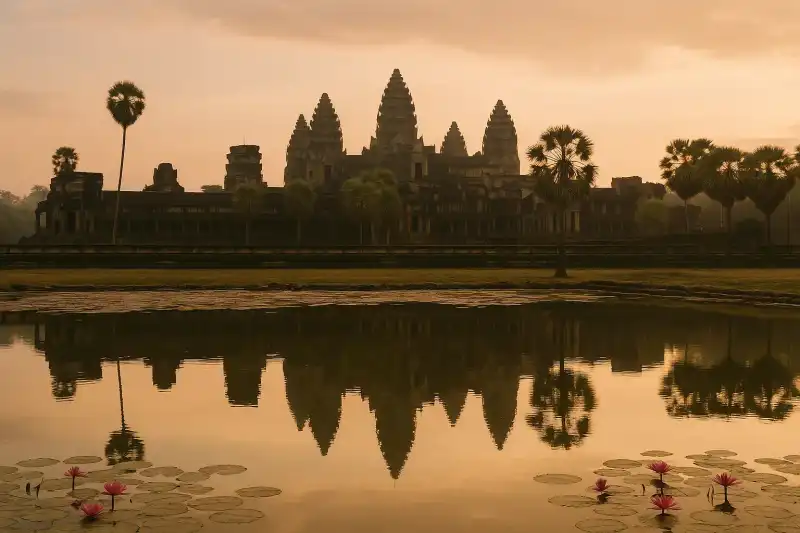
Angkor Wat Travel Guide 2026: Everything You Need to Know
KhmerAngkor Wat, the world's largest religious monument, spans over 400 acres in the heart of Cambodia. T...
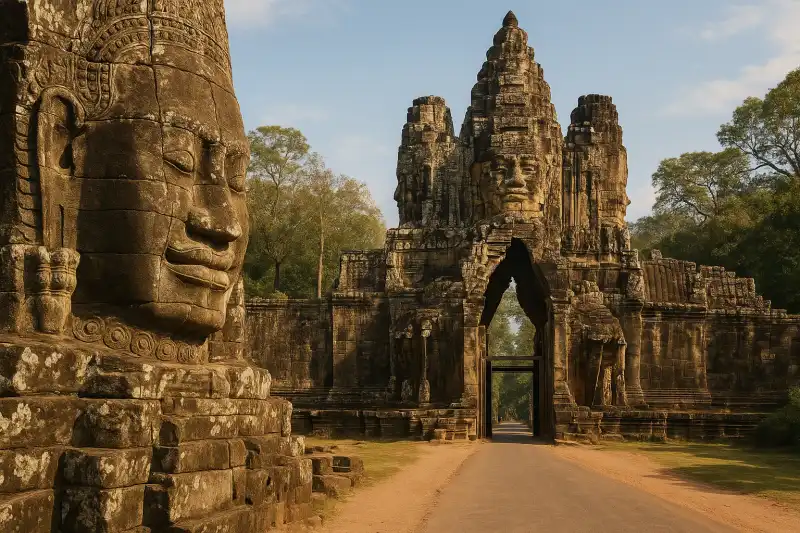
Angkor Thom Travel Guide 2026: Bayon Faces, Gates, and the Khmer Royal City
KhmerAngkor Thom was the last great capital of the Khmer Empire. This guide covers how to visit Bayon, th...
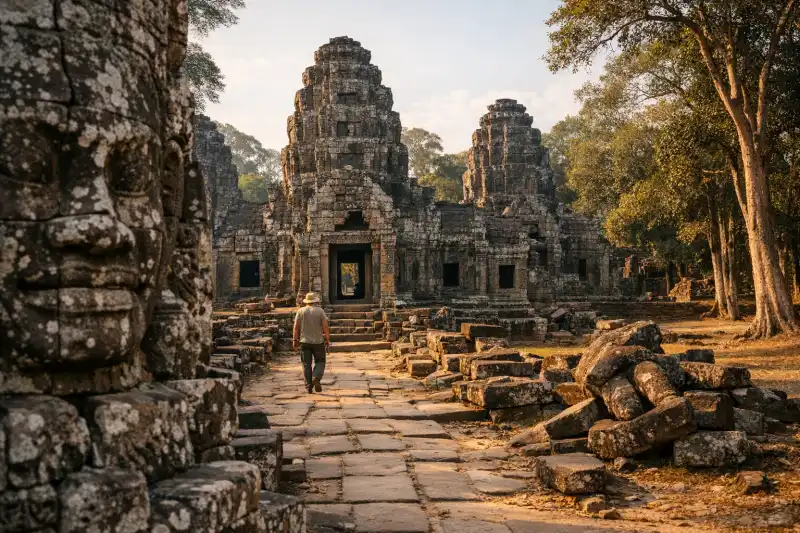
Banteay Kdei
KhmerExplore Cambodia’s Banteay Kdei, a atmospheric Angkor temple-monastery of quiet courtyards, worn car...
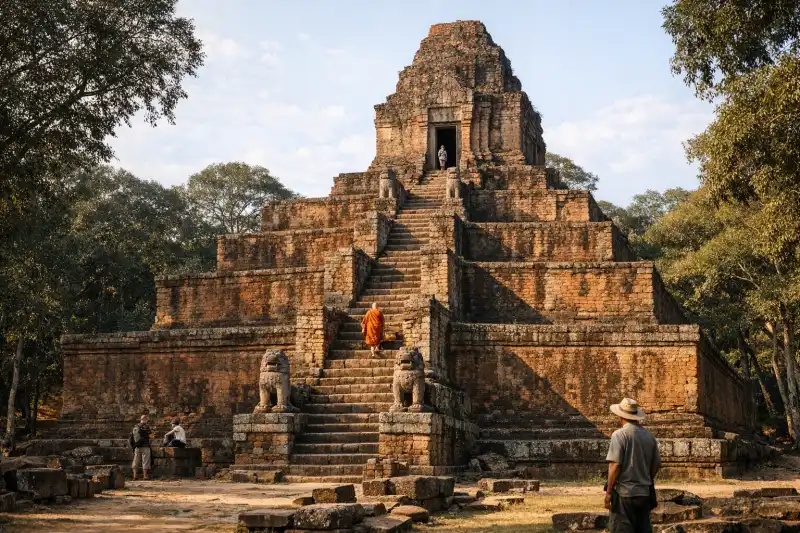
Baksei Chamkrong
Baksei Chamkrong is a 10th-century Hindu temple in Angkor, Cambodia, famed for its pyramid shape and...
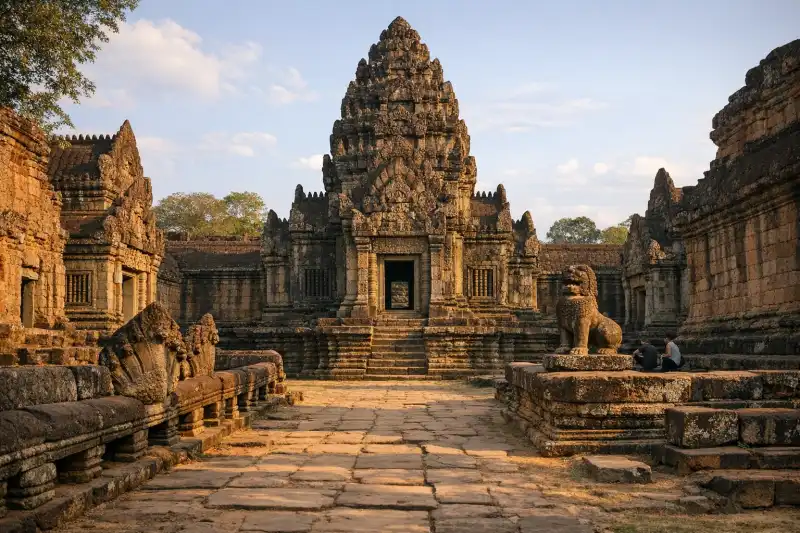
Banteay Samré
Banteay Samré is a beautifully preserved 12th-century Hindu temple in Cambodia’s Siem Reap province,...