Quick Info
At a glance
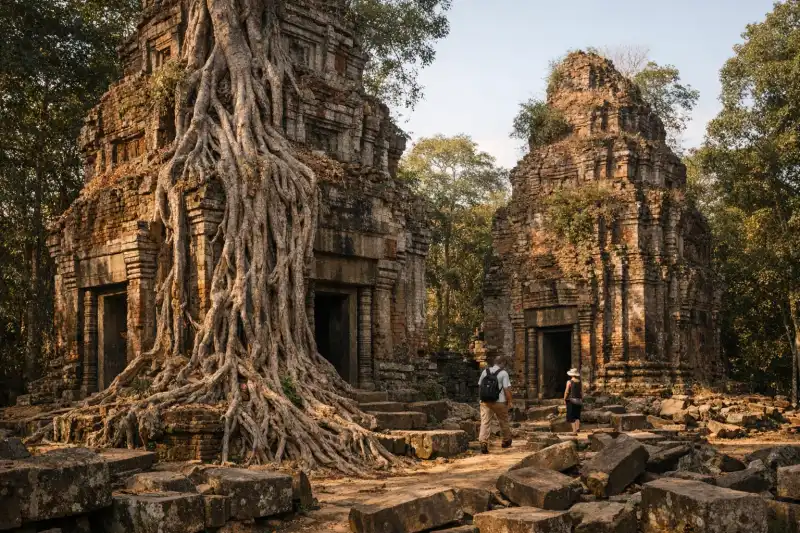
Prasat Pram in Cambodia feels like the kind of place travelers imagine before they ever see Southeast Asia: red-brick towers softened by age, jungle roots gripping ancient walls, and a stillness broken mainly by birdsong and the crunch of gravel underfoot. Set within the Koh Ker archaeological zone in Preah Vihear Province, this temple group is not the biggest monument in the Khmer world, nor the most famous, but it is one of the most memorable. The atmosphere does much of the work. Instead of broad causeways crowded with visitors, you find a more secluded corner of the former Khmer Empire, where architecture and forest seem locked in a patient, centuries-long embrace.
For many visitors, Prasat Pram becomes the emotional highlight of a trip to Koh Ker. The site is compact enough to explore in a short stop, yet rich enough to linger in the mind long afterward. Its five sanctuaries, built of brick and laterite, stand in varying states of preservation, and several are famously wrapped by immense tree roots that spill over doorways and down tower faces like slow-moving stone-colored rivers. The effect is both dramatic and intimate. Unlike the grand ceremonial scale of Angkor Wat or Angkor Thom, Prasat Pram rewards close looking: the texture of old bricks, traces of stucco, fragments of carvings, and the way tropical light changes the color of the ruins through the day. It is a place where history feels tactile, and where the Khmer past survives not as a museum piece but as a living landscape.
History
Koh Ker as a royal capital
To understand Prasat Pram, it helps to place it within the brief but important rise of Koh Ker as a center of power. In the early 10th century, the Khmer Empire experienced a significant political shift when King Jayavarman IV established his capital at Koh Ker, then known as Chok Gargyar. This was an unusual departure from the Angkor region, which had already become the heartland of Khmer kingship. For a relatively short period, however, Koh Ker was the focal point of royal ambition, temple building, and political symbolism.
During this era, monumental construction transformed what had been a regional center into an imperial landscape. Large sanctuaries, reservoirs, roads, and ceremonial structures appeared across the area. Prasat Thom and the great stepped pyramid now called Prang rose as statements of kingship and cosmic order. Prasat Pram belongs to this same flourishing building campaign. Though much smaller than the royal state temples, it reflects the confidence and resources available when Koh Ker stood near the center of the empire.
Construction in the 10th century
Prasat Pram is generally dated to the 10th century, within the Koh Ker period associated with Jayavarman IV and his successor Harshavarman II. The name “Pram” means “five” in Khmer, referring to the five principal towers of the complex. The arrangement of multiple shrines reflects common Khmer sacred planning, in which clustered sanctuaries could honor different deities or express a symbolic sacred geography.
Built primarily of brick with laterite structural elements and sandstone details, the temple demonstrates a transitional moment in Khmer architecture. Brick remained an important material for sanctuaries, especially for towers, but builders also employed sandstone for decorative frames, lintels, and sculptural highlights. Originally, the brick surfaces may have been coated with stucco and ornamented more richly than what survives today. Although time has stripped away much of that finish, enough remains to suggest the skill and sophistication of Khmer builders working in this period.
The temple likely functioned as a religious monument integrated into the broader sacred and administrative network of Koh Ker. While modern visitors know it chiefly for its romantic appearance, Prasat Pram was originally an active sacred site, shaped by ritual use, patronage, and the ideological language of kingship.
Decline after the capital returned to Angkor
Koh Ker’s moment as capital did not last long. After the reign associated with Jayavarman IV and Harshavarman II, the Khmer political center returned to the Angkor area under Rajendravarman II. That move did not erase Koh Ker, but it did reduce its centrality. Temples remained, local communities persisted, and the sacred landscape endured, yet the pulse of imperial construction shifted elsewhere.
Prasat Pram, like many Koh Ker monuments, entered a slower historical phase after this transition. Without the constant maintenance and ceremonial prominence enjoyed by temples near later capitals, the structures became more vulnerable to weather, vegetation, and the gradual accumulation of damage. In Cambodia’s tropical environment, abandoned or lightly used monuments are quickly claimed by plant life. Over centuries, roots entered joints, moisture weakened masonry, and portions of decorative programs disappeared.
Even so, these processes did not simply destroy the temple; they also created the visual identity for which it is now celebrated. The very roots that threaten ancient masonry also produce the site’s haunting beauty, turning Prasat Pram into a vivid example of how ruins evolve after their primary historical moment has passed.
Rediscovery, conservation, and modern tourism
Like many remote Khmer sites, Koh Ker became better known to scholars and international visitors during the colonial and post-colonial eras, when surveyors, archaeologists, and historians worked to document Cambodia’s architectural heritage. Political instability in the 20th century, including years of conflict and insecurity in rural Cambodia, limited sustained conservation and tourism. For a long time, Koh Ker remained far less visited than the Angkor monuments near Siem Reap.
In recent decades, improved road access and expanding interest in Cambodia’s lesser-known heritage sites have brought more travelers to Prasat Pram. Conservation efforts have focused on stabilizing structures, clearing paths, and making the wider Koh Ker zone safer and easier to visit. The temple still retains its sense of remoteness, but it is no longer beyond the ordinary traveler’s reach.
Today, Prasat Pram stands at an interesting intersection of archaeology, tourism, and environmental drama. Visitors come for history, for photography, and for the emotional experience of seeing a temple that appears half-built by human hands and half-remade by the forest. That balance is delicate, and ongoing preservation remains essential if the site is to survive the pressures of time, weather, and increasing visitation.
Key Features
What most distinguishes Prasat Pram is the visual power of its five towers. They do not form a perfectly intact ensemble; instead, they stand as a cluster of survivors, each revealing a different stage of preservation. This unevenness gives the temple much of its character. One tower may retain strong vertical lines and recognizable door frames, while another appears softened by collapse or engulfed by roots. Together, they create a layered impression of time rather than a single monumental statement.
The brickwork itself deserves close attention. Khmer brick temples can look simple from a distance, but at Prasat Pram the surfaces reveal careful engineering and subtle craftsmanship. The narrow bricks were laid with precision, creating walls that still hold their form after roughly a millennium. In places, traces of stucco hint that the temple was once more elaborately finished than the bare brick now suggests. The contrast between smooth surviving masonry and rough root systems is one of the site’s most striking visual effects.
The tree roots are, of course, the feature most travelers remember. Several towers are dramatically entwined with giant roots that clasp the structures from above and across the sides. Unlike a ruin where vegetation merely obscures the architecture, here the roots actively shape the composition. They frame doorways, curve over cornices, and descend in heavy folds to the ground. The result is almost sculptural. For photographers, this interplay of organic and built forms makes Prasat Pram one of the most rewarding temple sites in Cambodia. Morning and late-afternoon light can deepen the red tones of the brick and bring out the pale gray or silver colors in the roots.
Prasat Pram also reflects the broader artistic vocabulary of the Koh Ker period. Though not as ornamentally abundant as some Angkor temples, it includes sandstone elements such as door frames and decorative fragments that point to the rich visual culture of 10th-century Khmer architecture. Some lintels and carved details survive only in part, but even fragments show the complexity once present. As with many ruins, imagination becomes part of the visit: you see not only what remains, but what must once have existed.
Another appeal of the site lies in its scale. Grand temples can overwhelm, especially when crowded. Prasat Pram invites a slower, more personal encounter. You can walk around the towers, study angles and materials, and notice changes in atmosphere from one side of the complex to the other. The temple feels less like a backdrop and more like a place to inhabit for a while. This intimacy makes it especially rewarding for travelers interested in architecture rather than just checklist sightseeing.
The surrounding environment adds another layer. Koh Ker is more rural and forested than the heavily developed areas around Angkor. At Prasat Pram, that means the temple sits within a landscape that still feels relatively quiet. You hear insects, wind in the leaves, and the occasional voices of other visitors, but the setting often preserves a sense of isolation. That atmosphere matters. Temples were never only buildings; they belonged to landscapes, water systems, roads, and sacred geographies. Even in partial ruin, Prasat Pram communicates something of that older environmental context.
Finally, the site’s emotional resonance should not be underestimated. There are many technically important monuments in Southeast Asia, but fewer that produce such an immediate sense of wonder. Prasat Pram manages to feel both fragile and resilient. Its towers have been cracked, overgrown, and weathered, yet they remain standing, and in standing they have acquired a second life as one of Cambodia’s most poetic temple ruins.
Getting There
Most travelers visit Prasat Pram from Siem Reap, which is the easiest base thanks to its hotels, restaurants, and transport options. The journey to Koh Ker takes roughly 2.5 to 3.5 hours each way by road, depending on traffic, road conditions, and how many temple stops you make. Private transport is the most practical choice. A car with driver from Siem Reap usually costs around $70 to $120 for a full-day trip to Koh Ker, often depending on whether you combine it with Beng Mealea or other sites. Hiring an SUV can be worth it in the rainy season, when road conditions may be less predictable.
Shared minivans or public transport are less straightforward, as Koh Ker is not served in the same tourist-friendly way as Angkor. Some budget travelers arrange a tuk-tuk only for shorter local routes, but a tuk-tuk from Siem Reap to Koh Ker is generally a very long and dusty journey and often costs $50 to $80 or more, making it less comfortable and not always much cheaper than a car. Organized day tours are common and usually range from about $45 to $100 per person depending on group size, inclusions, and whether lunch or guide services are included.
You should also budget for the Koh Ker entrance ticket, which is typically separate from the Angkor pass. Ticket prices can change, so check current official rates before traveling. Once inside the archaeological zone, Prasat Pram is usually one of several easy stops along a circuit that may also include Prasat Thom and the stepped pyramid. Bring cash, water, sun protection, and sturdy shoes, as facilities are limited compared with the Angkor parks near Siem Reap.
When to Visit
The best time to visit Prasat Pram is generally during Cambodia’s dry season, from November to February, when temperatures are more comfortable and roads are usually in their best condition. This period offers cooler mornings, clearer skies, and more pleasant walking conditions around Koh Ker. For photography, the slanting light of early morning can be especially beautiful at Prasat Pram, highlighting the textures of brick and roots without the harsh glare of midday sun.
March to May is the hottest time of year. The site remains visitable, but expect intense heat by late morning and afternoon, often above 35°C. If you travel in these months, start very early, carry plenty of water, and pace yourself. The benefit of this season is that visitor numbers can be lower, giving the temple an even quieter atmosphere.
The rainy season, roughly from May to October, transforms the landscape. Forests become greener, the air often feels fresher after rain, and the temple can look especially lush and dramatic. However, heavy downpours can complicate road travel, and paths may become muddy or slippery. If you visit during this time, a car rather than a tuk-tuk is strongly recommended. Rainy season travel can be rewarding for photographers who want rich colors and moody skies, but flexibility is important.
In terms of time of day, arriving early is ideal. You avoid the hottest temperatures, enjoy gentler light, and often have a calmer experience before tour groups move through the circuit. Late afternoon can also be atmospheric, though you will need to manage timing carefully for the return drive to Siem Reap. Overall, the most comfortable combination is a dry-season morning visit, but Prasat Pram remains compelling year-round if you prepare well.
| Quick Facts | Details |
|---|---|
| Location | Koh Ker archaeological zone, Preah Vihear Province, Cambodia |
| Best known for | Five brick towers, especially those wrapped in giant tree roots |
| Historical period | 10th century CE |
| Civilization | Khmer Empire |
| Main building materials | Brick, laterite, and sandstone |
| Meaning of name | “Pram” means “five” in Khmer |
| Typical visit duration | 20–45 minutes |
| Usual base for visitors | Siem Reap |
| Access | Most commonly reached by private car or organized day tour |
| Best season | November to February for cooler, drier weather |
Prasat Pram is not a temple of overwhelming scale, but that is part of its strength. It distills many of the qualities that make Cambodia’s ancient sites unforgettable: refined Khmer craftsmanship, deep historical layers, a powerful natural setting, and a sense that the past has not entirely retreated. In a country famous for monumental landmarks, Prasat Pram offers something quieter and, for many travelers, more intimate. It is a place where ruins are not simply viewed but felt—through silence, texture, shade, and the slow, visible work of time. If you are willing to travel beyond the standard Angkor circuit, this small cluster of towers may become one of the most evocative stops in your journey through Cambodia’s ancient world.
Guided tours: worth it?
Self-guided works here, but a guide can add real value if you want the ruins explained as a living place rather than just a sequence of monuments.
Best for
- First-time visitors who want context, not just photos
- Short visits where a planned route saves time
When to go self-guided
Go independently if you prefer setting your own pace, reading as you go, and checking official hours or ticket rules directly before you arrive.
What I’d avoid
Skip paid tours that bundle unrelated stops you do not actually want. The best option should either save meaningful planning time or add historical context you would miss on your own.
Koh Ker and Beng Mealea from Siem Reap
Useful when: transport or pickup logistics matter
Private Koh Ker Temple Tour
Useful when: you want flexible timing or a private guide
Siem Reap to Koh Ker Ancient Temples
Useful when: you want to compare guided formats before deciding
Some tour links are affiliate links, which may earn Ancient Travel a small commission at no extra cost to you. I try to surface options that make practical sense for the site—not just anything bookable.
Frequently Asked Questions
What is Prasat Pram?
Prasat Pram is a group of five Khmer temple towers in the Koh Ker archaeological zone of northern Cambodia, best known for brick shrines embraced by huge tree roots.
Where is Prasat Pram located?
Prasat Pram is located at Koh Ker in Preah Vihear Province, Cambodia, roughly 120 kilometers northeast of Siem Reap.
Do I need a separate ticket for Prasat Pram?
Prasat Pram is usually visited as part of the Koh Ker archaeological complex, so visitors normally buy the site pass covering the wider zone rather than a separate ticket for this single temple.
How much time should I spend at Prasat Pram?
Most travelers spend 20 to 45 minutes at Prasat Pram, though photographers and architecture enthusiasts may want longer to explore the towers, carvings, and dramatic root-covered facades.
Can I visit Prasat Pram on a day trip from Siem Reap?
Yes. Prasat Pram is commonly visited on a long day trip from Siem Reap, often combined with Prasat Thom and other Koh Ker monuments.
What makes Prasat Pram special?
Its combination of Khmer brick architecture, remote forest atmosphere, and giant strangler fig roots growing over the towers makes Prasat Pram one of Cambodia's most photogenic temple ruins.
Nearby Ancient Sites
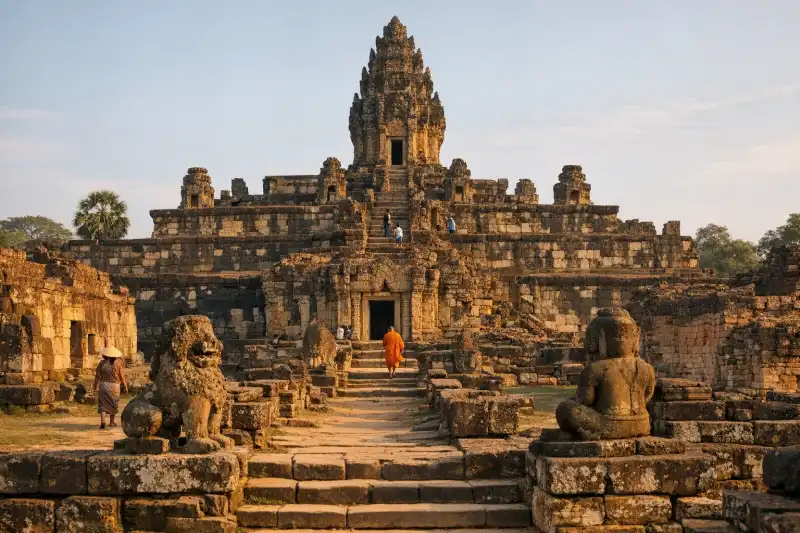
Bakong
Bakong is Cambodia's first major sandstone temple mountain, a stunning Khmer monument at the heart o...
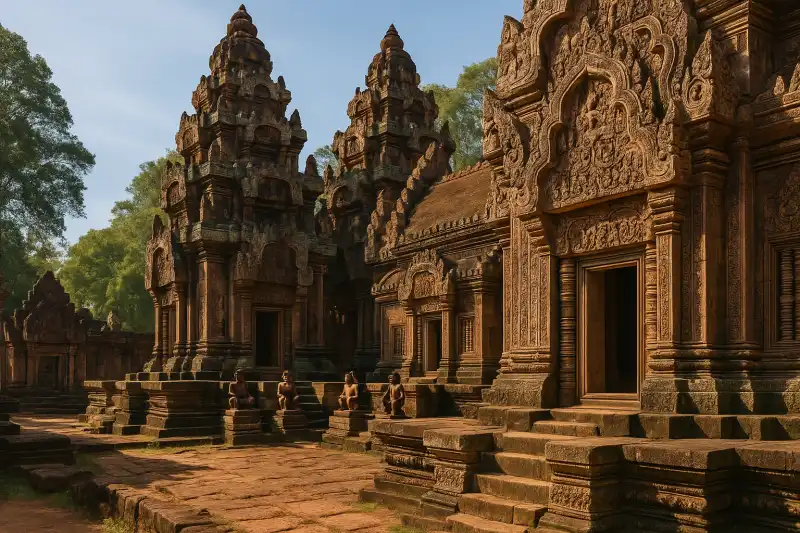
Banteay Srei Travel Guide 2026: Pink Sandstone Temple, Carvings, and Visit Tips
KhmerBanteay Srei is one of Cambodia’s most detailed Khmer temples, known for fine pink sandstone carving...
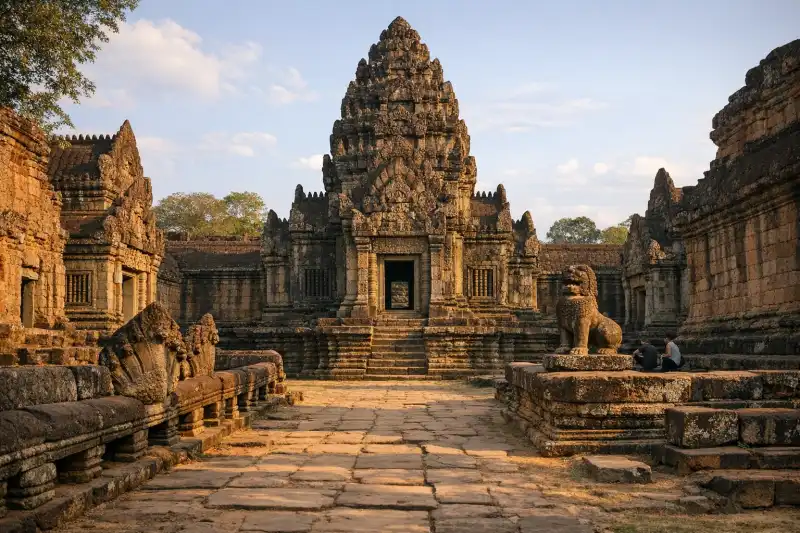
Banteay Samré
Banteay Samré is a beautifully preserved 12th-century Hindu temple in Cambodia’s Siem Reap province,...
Angkor Wat Travel Guide 2026: Everything You Need to Know
KhmerAngkor Wat, the world's largest religious monument, spans over 400 acres in the heart of Cambodia. T...