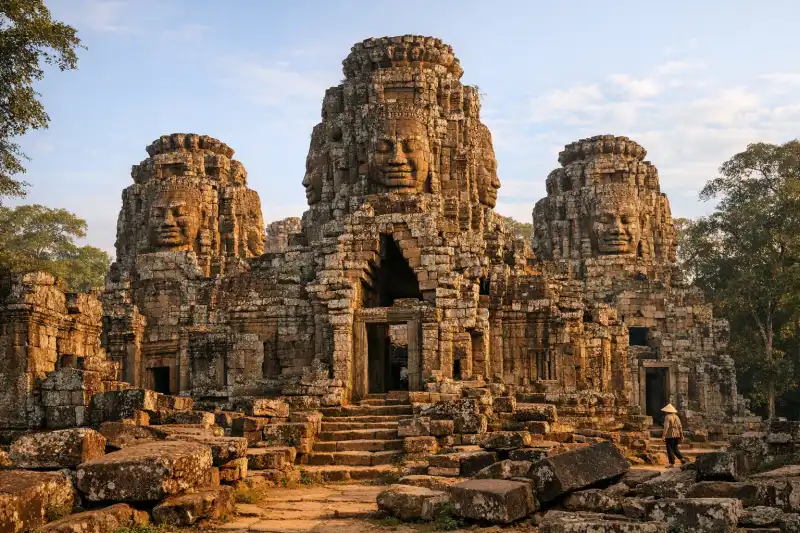
Quick Info
At a glance
Prasat Preah Stung in Cambodia is the kind of temple site that rewards travelers who enjoy leaving the best-known paths behind. While the great monuments of Angkor draw global attention with their towers, causeways, and monumental bas-reliefs, smaller and quieter Khmer sanctuaries like this one reveal a different side of the ancient landscape: intimate, local, and deeply tied to the countryside that has grown around them. Here, the experience is less about crowds and grand spectacle and more about atmosphere. Trees soften the outline of old stone. Village roads replace busy tourist routes. The temple appears not as an isolated museum piece, but as part of a living region where rice fields, shrines, and scattered ruins still share the same terrain.
For visitors based in Siem Reap, Prasat Preah Stung offers a chance to understand how broad and layered Cambodia’s Angkorian heritage really is. Sites like this help fill in the story between the famous capitals and royal foundations, showing how temple building extended into provincial spaces and local sacred networks. Even if the surviving architecture is modest compared with Angkor Wat or Angkor Thom, the appeal lies in the details: weathered masonry, traces of Khmer design, a sense of long continuity, and the rural calm that surrounds the monument. For travelers interested in archaeology, architecture, photography, or simply a more reflective temple visit, Prasat Preah Stung can feel like a quiet conversation with Cambodia’s past.
History
Early Khmer Religious Landscape
Prasat Preah Stung belongs to the broad cultural world shaped by the Khmer Empire, whose influence spread across much of mainland Southeast Asia between the 9th and 15th centuries. During the Angkorian period, temple construction was not limited to the imperial center alone. Across the countryside, rulers, local elites, and religious communities sponsored sanctuaries that anchored both devotion and administration. Smaller temples often served as regional nodes, linking agricultural territories to the sacred authority of the state. In this sense, Prasat Preah Stung should be understood not as an isolated ruin but as part of the greater Angkorian network that extended across today’s Siem Reap Province.
The name “prasat” itself refers to a temple or sanctuary tower, usually built in brick, laterite, or sandstone. “Preah” commonly signals something sacred or holy in Khmer usage. Sites carrying such names often preserve layers of local memory, even when inscriptions are absent or fragmentary. As with many lesser-known Cambodian temples, the exact founding date of Prasat Preah Stung is difficult to fix with certainty without extensive epigraphic or excavation evidence. However, on stylistic grounds and through comparison with related monuments in the region, it is generally associated with the Angkorian era, likely between the 11th and 12th centuries, when temple construction flourished under strong royal patronage.
Angkorian Development and Temple Use
During the 11th and 12th centuries, the Khmer Empire reached impressive levels of political organization, hydraulic management, and religious patronage. Temples built in this period often reflected both Hindu and, later, Buddhist traditions. Many began as shrines dedicated to Shiva or Vishnu, then experienced adaptation or reinterpretation over time as royal preferences and local practices changed. This fluidity is characteristic of Cambodian sacred architecture, where religious continuity often mattered more than rigid doctrinal boundaries.
Prasat Preah Stung was likely part of this evolving sacred world. A provincial temple could have served several functions at once: as a ritual center, as a marker of territorial organization, and as a visible symbol of Khmer authority in the countryside. The architecture would have expressed cosmological ideas familiar throughout the empire, even on a reduced scale. A central sanctuary represented the divine realm, while orientation, enclosure, and access embodied sacred order. At the same time, the temple may have supported the life of nearby communities through festivals, offerings, and seasonal observances tied to the agricultural calendar.
Unlike the better-preserved state temples, however, smaller shrines were often more vulnerable to alteration. Building materials could be reused, wooden superstructures might vanish entirely, and decorative elements might erode beyond easy identification. This means that the site’s present appearance reflects not just its original design but centuries of environmental wear, local reuse, and changing patterns of worship.
Decline, Survival, and Local Memory
From the 13th century onward, the political focus of the Khmer world gradually shifted. Environmental pressures, internal transformations, and changing regional dynamics all affected Angkor’s monumental landscape. Yet decline did not mean sudden abandonment everywhere. Many temples survived through adaptation. Some remained places of local veneration even after elite patronage faded. Others lingered as respected ruins, known by nearby villages and folded into the spiritual geography of the land.
Prasat Preah Stung appears to have survived in this quieter way. Like many Cambodian ruins outside the most intensively restored complexes, it likely endured because local communities continued to recognize it as meaningful, whether as a sacred place, a historical landmark, or a feature of village identity. In Cambodia, ancient temples often remain embedded in everyday cultural memory rather than existing solely as archaeological objects. This continuity is one reason even modest ruins can carry a strong sense of presence.
Modern Recognition and Tourism
In the modern era, archaeological mapping, heritage awareness, and the expansion of tourism in Siem Reap have brought renewed interest to smaller temples in the Angkor region. While Prasat Preah Stung does not enjoy the fame of Cambodia’s iconic monuments, it benefits from being part of a landscape that travelers increasingly explore beyond the standard circuits. As interest grows in lesser-known Khmer sites, temples like this one are gaining recognition for their historical value and their role in illustrating the full breadth of Angkorian civilization.
Today, visiting Prasat Preah Stung offers a glimpse not only of medieval Khmer architecture but also of the way Cambodia’s ancient heritage survives in fragments, in atmosphere, and in local continuity. It reminds travelers that the story of the Khmer Empire was never written only in its grand capitals. It was also built into smaller sanctuaries scattered across the countryside, where stone, belief, and landscape still meet.
Key Features
Prasat Preah Stung’s appeal lies in subtlety. This is not a temple where visitors come expecting massive galleries or long carved narrative walls. Instead, its character emerges through scale, material, setting, and the quiet dignity of age. The surviving structure or ruins convey the familiar vocabulary of Khmer temple architecture in a more intimate form. Even where ornament has weathered away, the proportions of the sanctuary, the alignment of the plan, and the relationship between the temple and its surroundings still communicate a strong sense of sacred design.
One of the most notable features is the rural atmosphere that frames the monument. Unlike heavily trafficked sites, Prasat Preah Stung can feel closely woven into the everyday landscape of Siem Reap Province. The approach may pass through villages, fields, and local roads, creating a gradual transition from modern travel into historical space. This setting matters. Khmer temples were never meant to be encountered only as isolated ruins; they were part of managed landscapes of water, agriculture, and settlement. At Prasat Preah Stung, that connection remains easier to imagine than at more urbanized or highly controlled heritage locations.
Architecturally, the temple reflects the durable building traditions of the Khmer world. Depending on the surviving remains, visitors may notice laterite blocks, sandstone details, or traces of a sanctuary tower form typical of Angkorian provincial shrines. Even fragmentary doorframes, lintels, or stepped bases can be revealing. Khmer temple builders paid great attention to orientation and symbolic progression, so the way one approaches the sanctuary often still carries the logic of ritual movement. What may seem modest at first glance becomes more rewarding when viewed carefully: how the stones fit together, how openings frame light, and how surviving decorative elements mark thresholds between outer and inner space.
Another key feature is the sense of weathering itself. At Prasat Preah Stung, erosion is part of the experience rather than a flaw in it. Time has rounded edges, softened carvings, and blended masonry with roots, grass, and shade. For photographers, this creates a gentler visual mood than the stark grandeur of larger temple complexes. Morning and late-afternoon light can emphasize texture beautifully, especially when the stone catches warm color against surrounding greenery.
The site also offers interpretive value for travelers interested in the broader Angkor network. Seeing only the largest monuments can give the impression that Khmer architecture was solely imperial and monumental. Smaller temples like Prasat Preah Stung complicate that picture in a useful way. They show how sacred architecture functioned at different scales, and how artistic and religious ideas radiated beyond royal capitals. A visit here can deepen one’s understanding of the Khmer Empire by revealing the provincial expression of a civilization often represented only by its most famous masterpieces.
Finally, there is the emotional feature that many travelers remember most: quiet. At a site with limited crowds, you can spend more time noticing birdsong, the movement of leaves, the pattern of shadows, and the way old stone sits in the land. That calm often becomes the most memorable element of all. Prasat Preah Stung may not overwhelm with spectacle, but it offers something rarer in busy destinations: space to slow down and absorb Cambodia’s ancient past at a human pace.
Getting There
Most travelers reach Prasat Preah Stung from Siem Reap, the main tourism hub for the Angkor region. The simplest option is to hire a tuk-tuk, car, or taxi with a driver who is familiar with smaller temple sites beyond the standard routes. From central Siem Reap, a half-day vehicle hire is often the most practical choice if you plan to combine Prasat Preah Stung with other nearby ruins. Expect tuk-tuk fares to start around $18 to $30 for a short customized excursion, while a private car may range from $35 to $60 depending on distance, road conditions, and waiting time.
Motorbike taxis can be cheaper, usually around $10 to $20 for a nearby outing, but they are less comfortable in hot weather and not ideal if roads are rough or you want flexibility for photography. Renting a bicycle from Siem Reap is possible for experienced cyclists, with rates often between $3 and $8 per day, though this only makes sense if the site is included on a route within your riding range and the weather is manageable. Bring plenty of water, as the heat can be intense even in the morning.
If you are booking through a local guide or tour operator, ask specifically whether Prasat Preah Stung is included, as many standard temple tours focus only on major Angkor highlights. It is wise to confirm road access in advance, especially during or just after the rainy season, when some rural tracks may become muddy. Mobile data coverage is generally useful around Siem Reap, but having the destination name written in Khmer or pinned on a map app can help avoid confusion.
When to Visit
The best time to visit Prasat Preah Stung is during Cambodia’s dry season, especially from November through February. These months usually bring the most comfortable conditions for exploring temple sites: lower humidity, clearer skies, and cooler mornings. Temperatures still rise by midday, but the overall experience is far more pleasant than in the hotter parts of the year. If you want the best combination of easy road access, soft light, and manageable heat, aim for an early-morning visit in this season.
March to May is the hottest period. The countryside can look dry and dusty, and temple visits become tiring quickly after about 10 a.m. If you travel at this time, start very early, wear a hat, and carry more water than you think you will need. The advantage of these months is that tourist numbers are often lower outside peak holiday periods, so quieter sites like Prasat Preah Stung can feel especially peaceful.
The rainy season, usually from May to October, transforms the landscape. Fields become vividly green, moats and ponds often refill, and the temple’s rural setting can look beautiful under dramatic skies. The trade-off is transportation: unpaved roads may be slippery, and sudden downpours can disrupt plans. If you visit in the wet season, leave extra time and consider hiring a driver rather than relying on independent transport.
Whatever the month, sunrise and late afternoon are the most rewarding times on site. The light is softer, photography is better, and the temple’s atmosphere feels calmer and more evocative before the strongest heat arrives.
| Quick Facts | Details |
|---|---|
| Location | Siem Reap Province, Cambodia |
| Nearest city | Siem Reap |
| Historical era | Angkorian period |
| Likely date | 11th-12th century CE |
| Civilization | Khmer Empire |
| Site type | Provincial Khmer temple ruin |
| Best visit length | 30-60 minutes |
| Best season | November to February |
| Typical transport | Tuk-tuk, private car, motorbike taxi |
| What to bring | Water, sun protection, sturdy shoes, camera |
Prasat Preah Stung is best approached with patient expectations. It is not a monument that competes with Angkor Wat in scale or fame, and that is precisely why many travelers appreciate it. Its value lies in context, texture, and atmosphere. Here, Cambodia’s ancient past does not present itself as a single overwhelming masterpiece. Instead, it appears in a quieter form: a surviving fragment of Khmer sacred architecture resting in a living rural landscape. For visitors willing to look beyond the headline sights of Siem Reap, that quieter form can be deeply rewarding.
A stop at Prasat Preah Stung works especially well for travelers who want to understand the Angkor region as more than a checklist of famous names. The Khmer Empire was sustained by networks of temples, settlements, and agricultural lands, and smaller sanctuaries like this one are essential to that bigger picture. Visiting them adds nuance to the grand story. You begin to see how sacred architecture functioned not only in imperial capitals but also across the countryside, where local worship, political identity, and daily life intersected.
If you have already seen the major temples and want a more reflective outing, or if you simply enjoy lesser-known heritage sites, Prasat Preah Stung offers a memorable detour. It rewards close attention, good light, and a slower pace. In that stillness, among old stones and village landscapes, the site reveals something enduring about Cambodia: the extraordinary depth of its past, and the many ways that past continues to inhabit the present.
Guided tours: worth it?
A guide can be genuinely useful at Prasat Preah Stung, especially if you want help with transport, timing, tickets, or understanding a large site without losing half the day to logistics.
Best for
- First-time visitors who want context, not just photos
- Travelers who want transport, timing, or entry logistics handled
- Trips where tickets, circuits, or timed entry can shape the day
- Short visits where a planned route saves time
When to go self-guided
Go independently if you already have transport and tickets sorted, enjoy moving at your own pace, and are comfortable checking the latest official rules before you arrive.
What I’d avoid
Skip paid tours that bundle unrelated stops you do not actually want. The best option should either save meaningful planning time or add historical context you would miss on your own.
Siem Reap Ancient Temples Tours
Useful when: you want to compare guided formats before deciding
Angkor Archaeological Park Day Tours
Useful when: you want to compare guided formats before deciding
Siem Reap Countryside and Temple Excursions
Useful when: you want to compare guided formats before deciding
Some tour links are affiliate links, which may earn Ancient Travel a small commission at no extra cost to you. I try to surface options that make practical sense for the site—not just anything bookable.
Frequently Asked Questions
Where is Prasat Preah Stung located?
Prasat Preah Stung is in Siem Reap Province, Cambodia, within the wider cultural landscape of the Angkor region and reachable from Siem Reap city.
Is Prasat Preah Stung inside the main Angkor temple circuit?
It is associated with the broader Angkor area but is less visited than the main circuit temples, so access may involve a more rural route and local guidance.
How much time should I allow for a visit?
Most travelers need around 30 to 60 minutes on site, though photographers and history enthusiasts may want longer to explore the surroundings.
Do I need a guide to visit Prasat Preah Stung?
A guide is not strictly required, but hiring one or arranging transport with a knowledgeable driver can make it much easier to find and understand the site.
What should I wear when visiting?
Wear lightweight clothing that covers shoulders and knees, sturdy shoes for uneven ground, and bring sun protection and water.
What is the best season to visit Prasat Preah Stung?
The dry season from roughly November to February is usually the most comfortable, with cooler temperatures, easier roads, and clearer skies.
Nearby Ancient Sites
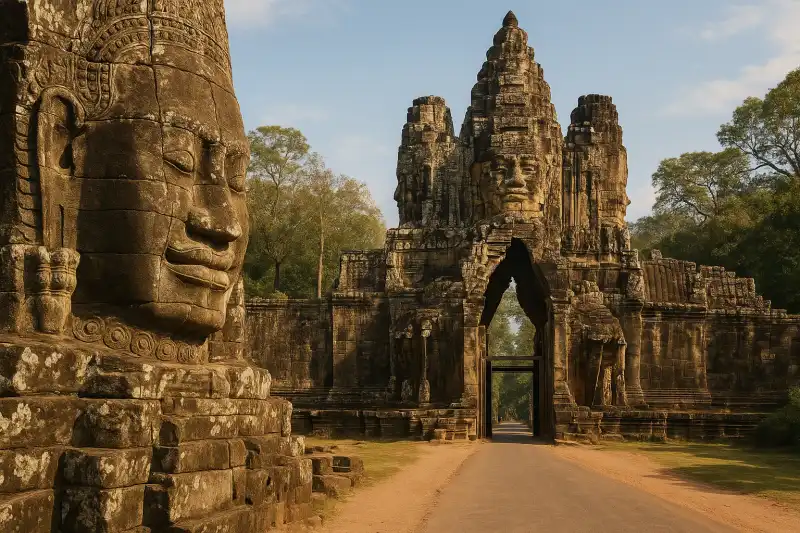
Angkor Thom Travel Guide 2026: Bayon Faces, Gates, and the Khmer Royal City
KhmerAngkor Thom was the last great capital of the Khmer Empire. This guide covers how to visit Bayon, th...
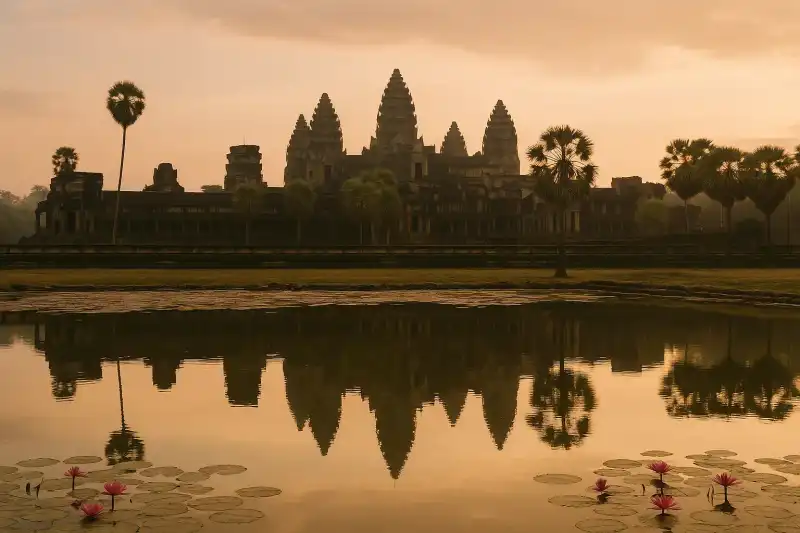
Angkor Wat Travel Guide 2026: Everything You Need to Know
KhmerAngkor Wat, the world's largest religious monument, spans over 400 acres in the heart of Cambodia. T...
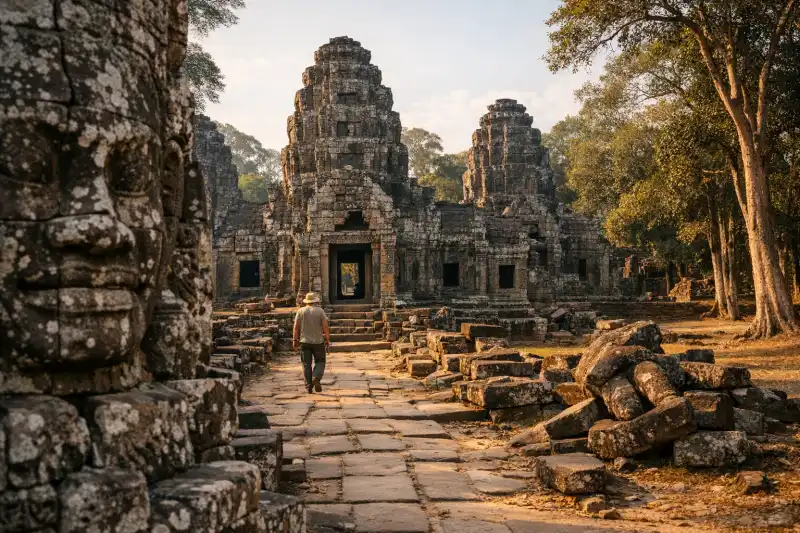
Banteay Kdei
KhmerExplore Cambodia’s Banteay Kdei, a atmospheric Angkor temple-monastery of quiet courtyards, worn car...
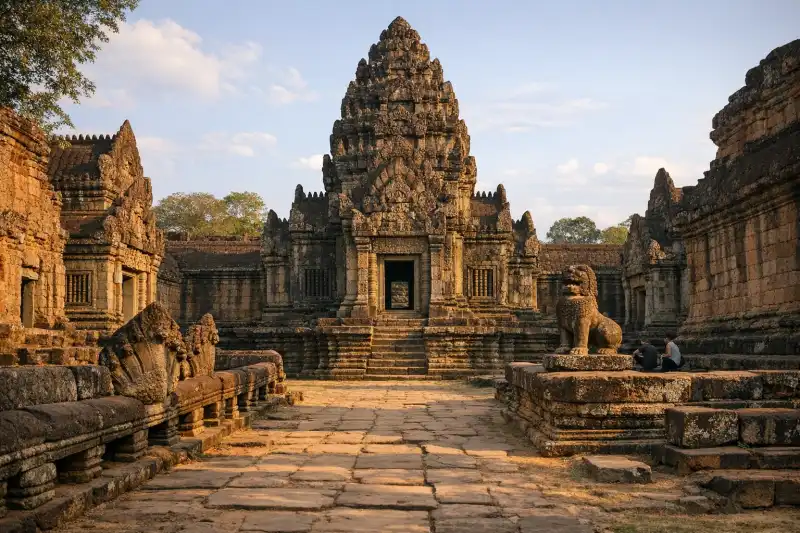
Banteay Samré
Banteay Samré is a beautifully preserved 12th-century Hindu temple in Cambodia’s Siem Reap province,...
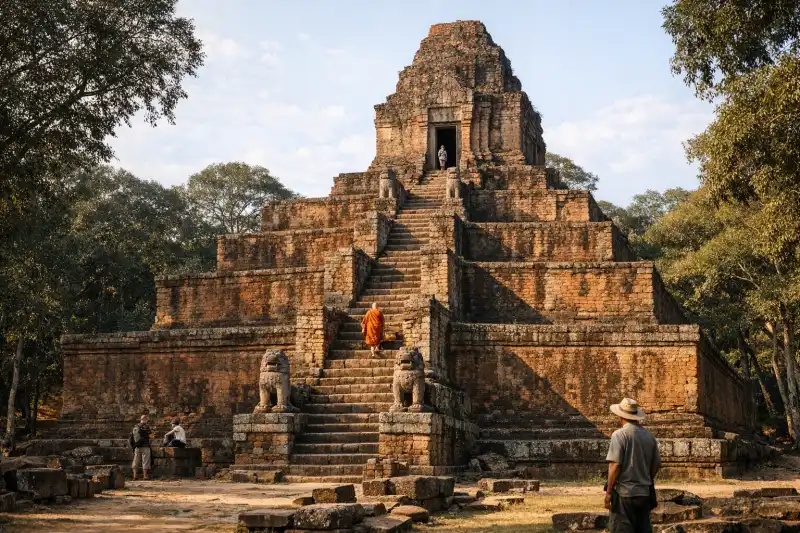
Baksei Chamkrong
Baksei Chamkrong is a 10th-century Hindu temple in Angkor, Cambodia, famed for its pyramid shape and...