Quick Info
At a glance
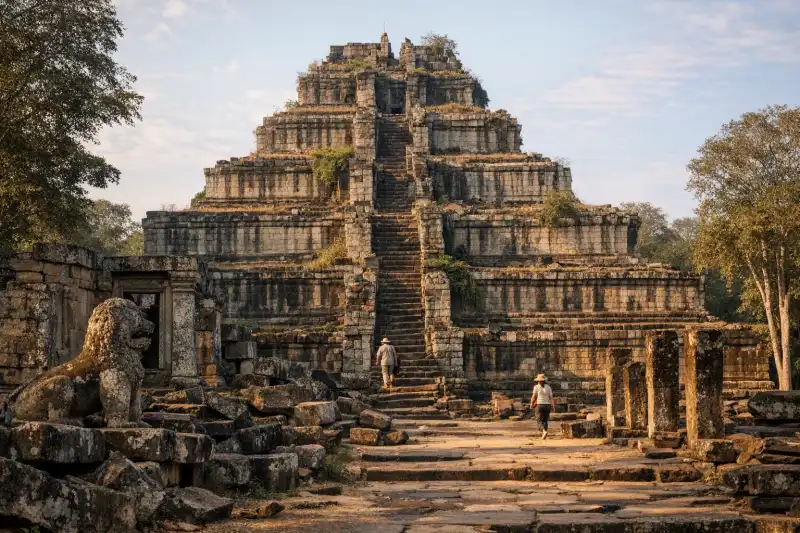
Prasat Thom (Koh Ker) in Cambodia rises from the forest with an intensity that feels different from the more familiar silhouettes of Angkor. Remote, angular, and unexpectedly monumental, it belongs to a place that was once the center of royal ambition rather than a provincial outpost. The approach is part of the experience: red-earth roads, scattered villages, stretches of woodland, and then, almost suddenly, the remains of a city that briefly carried the weight of an empire. At its heart stands Prasat Thom, the principal sanctuary of Koh Ker, crowned by the great stepped pyramid often called Prang, one of the most arresting temple forms in Southeast Asia.
Unlike the broad ceremonial vistas of Angkor, Koh Ker feels concentrated and self-contained, as if designed to proclaim power quickly and decisively. The site was built during a short but consequential period in the 10th century, when the Khmer court shifted its capital here. That unusual political moment left behind a sacred landscape of shrines, reservoirs, causeways, and towers spread through the forest, with Prasat Thom as its symbolic and architectural center. For modern visitors, the reward is not just a single monument but an entire royal statement preserved in stone and laterite. There is grandeur here, but also quiet. Birdsong replaces traffic, and the mood is less museum-like than exploratory. Visiting Prasat Thom means encountering a Khmer capital that flourished briefly, dramatically, and on its own terms.
History
The rise of Koh Ker as a royal capital
Prasat Thom belongs to one of the most unusual chapters in Khmer history. In the early 10th century, the Khmer Empire was already an established regional power, with political and religious traditions deeply rooted in the area of Angkor. Yet during the reign of Jayavarman IV, the center of royal authority shifted away from Angkor to Koh Ker, known in inscriptions as Chok Gargyar. This relocation was not a minor administrative adjustment. It marked the creation of a full royal capital, complete with temples, reservoirs, roads, and ceremonial architecture designed to support both governance and sacred kingship.
Jayavarman IV likely established his power base at Koh Ker before formally becoming king, and once enthroned he invested heavily in monumental construction. Prasat Thom emerged as the central state temple of this new capital. The site’s scale and planning make clear that Koh Ker was conceived as a legitimate seat of empire, not a temporary encampment. The architecture reflects urgency and ambition: large building programs, bold massing, and a willingness to depart from some established Angkorian forms.
Jayavarman IV and the great temple program
The most important construction phase at Prasat Thom took place during the reign of Jayavarman IV, around 921 to 941 CE. This was a period when temple building served political theology as much as devotion. Khmer kings expressed authority through the construction of state temples linked to the cult of Shiva and to the concept of the devaraja, or god-king. At Koh Ker, this ideology seems to have been articulated with unusual force.
Prasat Thom was not just a shrine but the ritual focus of an entire capital. Inscriptions and archaeological evidence suggest that the complex once held significant religious images, including an enormous linga associated with Shiva. Koh Ker is also known for colossal sculptures of exceptional dynamism, many of which were removed in earlier decades through looting and are now the subject of repatriation efforts. These works reveal the artistic vitality of the period: robust forms, energetic movement, and a monumental confidence that matches the architecture.
The stepped pyramid behind the main sanctuary, often referred to as Prang, became the visual emblem of the site. Its layered terraces created an elevated sacred summit, echoing the symbolic mountain at the center of Hindu cosmology. This mountain-temple concept was not new in Khmer architecture, but at Koh Ker it took on a particularly stark and commanding form.
Return of the court to Angkor
After Jayavarman IV and his successor Harshavarman II, the Khmer court returned to the Angkor region under Rajendravarman II in the mid-10th century. Koh Ker’s time as capital was therefore brief, lasting only a few decades. Yet brief does not mean insignificant. The city remained ritually and regionally important, and the buildings left behind continued to shape Khmer architectural development.
The return to Angkor likely reflected both political realities and the advantages of the older heartland, where hydraulic systems, established elites, and dynastic legitimacy were more firmly anchored. Koh Ker’s relative remoteness may have made long-term administration more difficult. Still, the fact that an imperial capital could be built here so rapidly demonstrates the Khmer state’s organizational capacity and the authority of the king who initiated it.
Over time, as the political center shifted away, the forests gradually reclaimed the site. Unlike Angkor, which remained famous to travelers and scholars, Koh Ker stayed more isolated, visited mainly by local communities and occasional explorers.
Rediscovery, conservation, and modern recognition
In the modern era, Koh Ker was documented by French scholars during the colonial period, but its remoteness limited early conservation work. The late 20th century brought additional challenges. Civil conflict, landmine contamination in some areas, and organized looting endangered the site and contributed to the dispersal of sculptures into international collections.
In recent decades, access has improved significantly, and conservation efforts have expanded. Archaeological mapping has helped researchers understand Koh Ker as a full urban complex rather than a single isolated temple. International attention has also focused on the return of looted masterpieces, restoring part of the site’s historical integrity and raising awareness of Cambodia’s cultural heritage protection.
Today Prasat Thom stands as the best-known monument within Koh Ker and as a powerful reminder that Khmer history was never confined to Angkor alone. Its recognition as part of Cambodia’s wider heritage landscape has brought more visitors, but it still retains a sense of distance and discovery that feels increasingly rare.
Key Features
The defining feature of Prasat Thom is its layered composition. This is not a temple experienced in a single glance. Instead, the complex unfolds through causeways, enclosures, galleries, courtyards, and vertical shifts in level, culminating in the imposing pyramid at the rear. The approach itself matters. As you move inward, the architecture stages a progression from the horizontal world of pathways and surrounding forest to the sharply ascending geometry of the sacred center.
The front sections of the complex include sandstone and laterite structures that once framed ritual movement and marked transitions between different precincts. Though many elements survive only in fragmentary form, enough remains to reveal the scale of the original layout. Doorways, lintels, and wall sections display the disciplined craftsmanship of Khmer builders, while scattered carved blocks hint at decorative programs that would once have enriched the austere mass of the architecture. At ground level, there is a sense of breadth: long alignments, broad spaces, and remnants of axial planning that tie the temple to the wider city around it.
Then there is the pyramid, usually called Prang, which gives Koh Ker its unforgettable profile. Rising in seven tiers, it resembles a gigantic stepped mountain more than the curving towers commonly associated with Cambodian temples. Its form is severe, almost minimalist from a distance, but deeply expressive. The stacked terraces create a rhythm of retreating planes that catch light differently across the day, turning the monument from warm ochre in morning sun to darker, heavier tones under cloud or late afternoon shadow. The structure was designed to dominate both physically and symbolically, asserting the temple’s role as the cosmic and political summit of the capital.
The material palette contributes strongly to the site’s character. Laterite, with its porous texture and earthy color, gives much of Koh Ker a rugged, muscular appearance. Sandstone appears in key architectural and sculptural details, allowing for finer carving where needed. The contrast between these materials reflects practical building choices but also shapes the visual impact: solid, heavy structural masses relieved by more refined surfaces at thresholds and sacred points.
Another notable feature is the relationship between Prasat Thom and the broader Koh Ker landscape. This was not an isolated temple built in a vacuum. Nearby are other shrines, towers, and water structures that formed part of a planned royal city. The large baray, or reservoir, speaks to the Khmer integration of sacred architecture with hydraulic management and urban planning. Even when visitors focus mainly on Prasat Thom, they are standing within a network of monuments that once supported courtly ritual, political display, and daily life.
The sculptural legacy of Koh Ker also deserves attention, even when many original works are now in museums or under conservation. The site became famous for large, energetic statues of deities, guardians, and mythical figures, often carved with a forceful style that distinguishes them from some Angkorian works. This artistic boldness aligns perfectly with the architecture of Prasat Thom: both favor impact, monumentality, and a certain uncompromising authority. When repatriated statues are discussed in relation to Koh Ker, they help visitors imagine the complex not as weathered ruins alone, but as a once vividly inhabited ceremonial environment.
Perhaps the most memorable quality, however, is the atmosphere. Prasat Thom feels less polished than heavily visited sites and more elemental. Trees edge the clearings, cicadas pulse in the heat, and the temple’s steep lines rise unexpectedly from the greenery. That combination of monumental design and relative quiet gives the site unusual emotional force. It is one of those rare places where scale does not erase solitude; instead, it amplifies it.
Getting There
Most travelers reach Prasat Thom (Koh Ker) from Siem Reap, which is the easiest base thanks to its hotels, transport options, and tour infrastructure. The drive is about 120 kilometers and usually takes between 2.5 and 3.5 hours each way, depending on road conditions and stops along the route. A private car with driver is the most practical option for independent travelers. Expect to pay roughly $70 to $120 for a full-day round trip from Siem Reap, depending on vehicle type, fuel prices, and whether the itinerary includes additional sites such as Beng Mealea.
Shared or small-group tours are another common choice. These usually cost around $35 to $80 per person, depending on inclusions such as hotel pickup, guide services, lunch, and combined site visits. If you prefer context while traveling, a guided day trip can be especially useful because Koh Ker is spread across a broader archaeological zone rather than a single compact monument.
Tuk-tuks are generally not recommended for the full journey from Siem Reap due to distance, weather exposure, and the length of the day, though local drivers may occasionally quote higher custom fares. Renting a motorbike is possible for experienced riders, but only if you are comfortable with long rural drives, heat, and variable road quality; fuel and rental together can total $15 to $30, excluding the physical effort involved.
Entrance fees and regulations can change, so check current official information before departure. Bring cash, water, and basic snacks, as services near the site are more limited than at Angkor. Starting early is wise, both for cooler temperatures and for maximizing time on site before the return drive.
When to Visit
The best time to visit Prasat Thom is during Cambodia’s dry season, generally from November to February. These months offer the most comfortable temperatures for walking the temple grounds, with lower humidity and clearer skies that are especially favorable for photography. Morning light tends to be gentle and flattering on the laterite and sandstone surfaces, while the surrounding forest looks fresh after the rains without being difficult to navigate.
March to May is the hottest period. The site remains visitable, but midday heat can be intense, especially because parts of the complex are exposed and the journey from Siem Reap is long. If you travel during these months, aim to arrive early, carry plenty of water, and pace yourself. Lightweight clothing, sun protection, and regular shade breaks become essential rather than optional.
The rainy season, from roughly June to October, transforms the landscape. Vegetation becomes lush, moats and reservoirs feel more alive, and the remote setting gains a dramatic atmosphere. On the other hand, heavy rain can make the trip slower, roads muddier in some sections, and temple paths slippery. Photography can be excellent when clouds break, but you will need good footwear and a more flexible schedule.
For many travelers, the ideal strategy is a dry-season weekday visit. You avoid the strongest heat, minimize the chance of weather disruption, and enjoy the quieter mood that makes Koh Ker special. Even in peak tourism months, Prasat Thom is usually far less crowded than Angkor’s headline monuments. That relative calm is part of its appeal, so arriving early in the day helps preserve the sense that you are discovering, not merely touring, a former royal capital.
| Quick Facts | Details |
|---|---|
| Site name | Prasat Thom (Koh Ker) |
| Location | Koh Ker archaeological zone, Preah Vihear Province, Cambodia |
| Civilization | Khmer Empire |
| Main period | 10th century CE |
| Principal patron | Jayavarman IV |
| Type | State temple and temple-pyramid complex |
| Famous for | Seven-tier pyramid known as Prang |
| Distance from Siem Reap | About 120 km |
| Typical visit length | 2 to 4 hours on site |
| Best season | November to February |
| Travel style | Best visited by private car or organized day tour |
| Combined visits | Often paired with Beng Mealea from Siem Reap |
Prasat Thom rewards travelers who want to see a different face of Cambodia’s ancient past. It is less ornate than some Khmer masterpieces and less famous than Angkor Wat, but that is exactly why it lingers in the memory. Here, architecture becomes a direct expression of royal ambition: bold, compressed, and monumental. In the silence between laterite walls and beneath the steep lines of the pyramid, you sense how briefly and forcefully Koh Ker served as the center of power. For anyone interested in Khmer history beyond the standard circuit, this is one of the most compelling destinations in the country.
Guided tours: worth it?
A guide can be genuinely useful at Prasat Thom (Koh Ker), especially if you want help with transport, timing, tickets, or understanding a large site without losing half the day to logistics.
Best for
- First-time visitors who want context, not just photos
- Travelers who want transport, timing, or entry logistics handled
- Short visits where a planned route saves time
When to go self-guided
Go independently if you already have transport and tickets sorted, enjoy moving at your own pace, and are comfortable checking the latest official rules before you arrive.
What I’d avoid
Skip paid tours that bundle unrelated stops you do not actually want. The best option should either save meaningful planning time or add historical context you would miss on your own.
Koh Ker temple tours
Useful when: you want to compare guided formats before deciding
Siem Reap to Koh Ker day trips
Useful when: transport or pickup logistics matter
Koh Ker and Beng Mealea tours
Useful when: you want to compare guided formats before deciding
Some tour links are affiliate links, which may earn Ancient Travel a small commission at no extra cost to you. I try to surface options that make practical sense for the site—not just anything bookable.
Frequently Asked Questions
What is Prasat Thom at Koh Ker?
Prasat Thom is the principal temple complex of Koh Ker, a 10th-century Khmer royal capital in northern Cambodia, best known for its dramatic stepped pyramid, Prang.
How far is Prasat Thom from Siem Reap?
Prasat Thom is roughly 120 kilometers northeast of Siem Reap. Most travelers take about 2.5 to 3.5 hours each way by car, depending on road and weather conditions.
Do I need a separate ticket for Koh Ker?
Ticketing policies can change, but Koh Ker has often required a separate entrance pass from the main Angkor ticket. Check current official pricing before you travel.
Can you climb the pyramid at Prasat Thom?
Access rules vary over time for safety and conservation reasons. Visitors should follow current on-site guidance and any restrictions in place when they arrive.
Is Prasat Thom worth visiting as a day trip?
Yes. It is one of Cambodia’s most distinctive Khmer sites and offers a very different atmosphere from Angkor, with fewer crowds and a more remote setting.
What should I bring for a visit?
Bring water, sun protection, insect repellent, sturdy shoes, cash for tickets or snacks, and modest clothing suitable for temple visits.
Nearby Ancient Sites
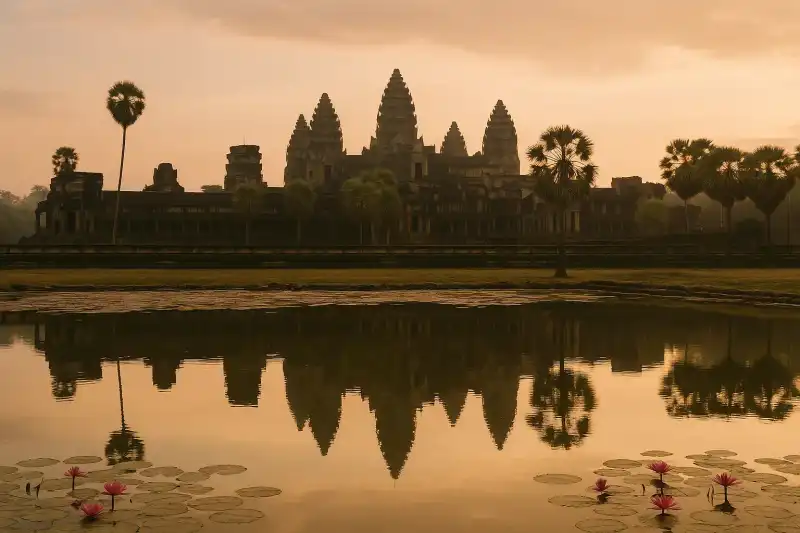
Angkor Wat Travel Guide 2026: Everything You Need to Know
KhmerAngkor Wat, the world's largest religious monument, spans over 400 acres in the heart of Cambodia. T...
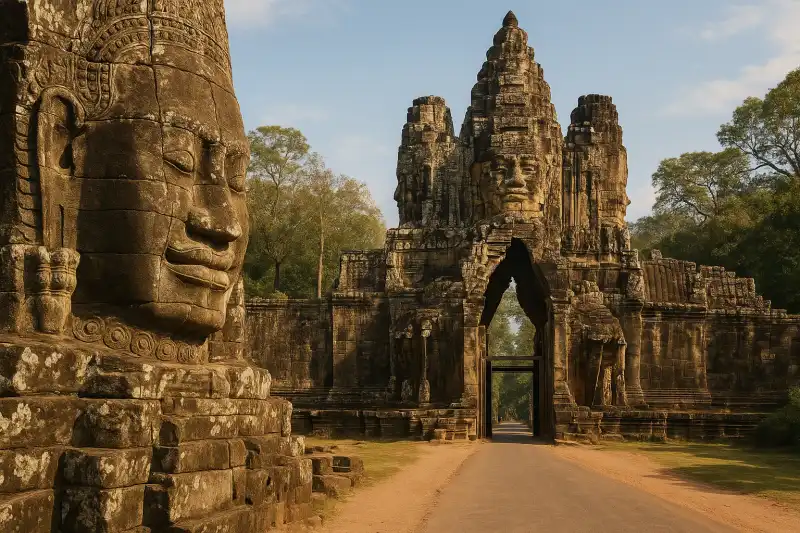
Angkor Thom Travel Guide 2026: Bayon Faces, Gates, and the Khmer Royal City
KhmerAngkor Thom was the last great capital of the Khmer Empire. This guide covers how to visit Bayon, th...
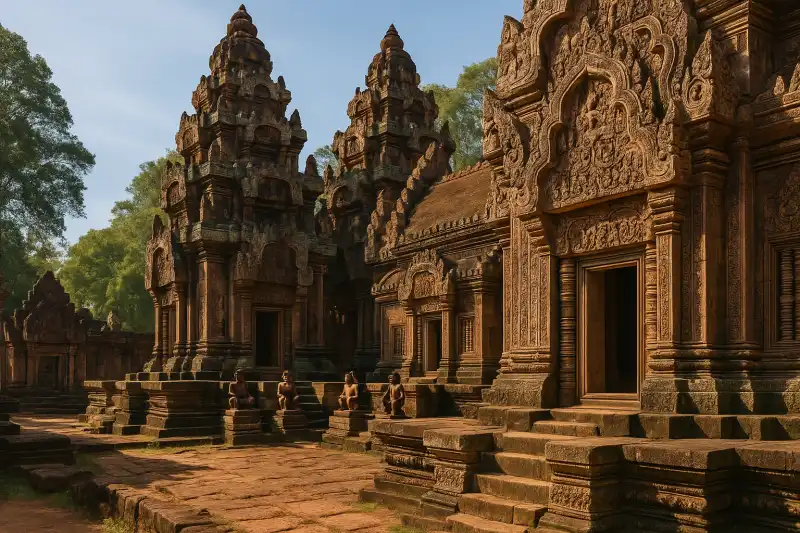
Banteay Srei Travel Guide 2026: Pink Sandstone Temple, Carvings, and Visit Tips
KhmerBanteay Srei is one of Cambodia’s most detailed Khmer temples, known for fine pink sandstone carving...
Bakong
Bakong is Cambodia's first major sandstone temple mountain, a stunning Khmer monument at the heart o...
Baphuon
Khmer EmpireAn 11th-century sandstone temple mountain in Angkor Thom, Cambodia, renowned for its monumental recl...