Quick Info
At a glance
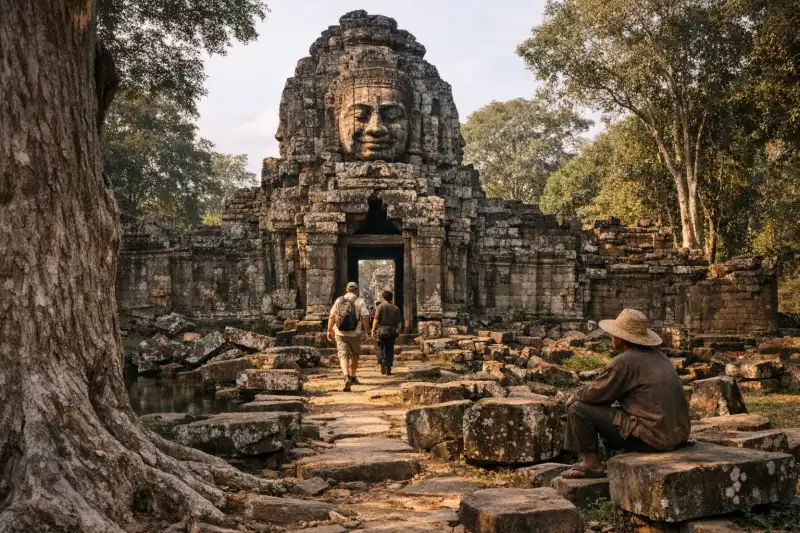
Preah Khan Kompong Svay in Cambodia feels less like a single temple than a forgotten sacred landscape reclaimed by distance, silence, and forest. Far from the heavy visitor traffic of Angkor, this immense Khmer complex lies in a remote part of the country where earthworks, causeways, moats, shrines, and laterite walls spread across a surprisingly large area. Even before you reach the central sanctuary, the scale of the site becomes clear: broad enclosures and reservoirs hint at a ceremonial and political center that once mattered deeply to the Khmer world. Today, the journey itself is part of the experience, carrying travelers through rural Cambodia to a place where the monuments appear gradually through trees and open ground.
What makes Preah Khan Kompong Svay especially memorable is the combination of grandeur and isolation. It lacks the polished presentation of Cambodia’s most famous temples, yet that is precisely its appeal. The ruins often feel exploratory rather than staged, allowing visitors to imagine the site in layers: a strategic outpost, a religious foundation, and a statement of royal ambition. Carved sandstone doorways stand amid laterite construction, traces of moats and avenues reveal deliberate planning, and the central structures preserve the unmistakable language of Khmer sacred architecture. For travelers interested in ancient infrastructure, temple urbanism, and the wider geography of the Khmer Empire, Preah Khan Kompong Svay offers one of Cambodia’s most intriguing and underrated archaeological experiences.
History
Early foundations and regional importance
The history of Preah Khan Kompong Svay is still studied and debated, but most scholars place its major development within the middle and later centuries of the Khmer Empire. The area was likely important before the site reached its monumental form. Its location in the eastern mainland zone of the empire gave it strategic value, linking the Angkor heartland with outlying territories and resource regions. Rather than serving only as a temple, Preah Khan Kompong Svay appears to have functioned as a large royal and religious center embedded in a broader network of roads, waterworks, and settlements.
Some elements may date to the 11th century, when Khmer rulers were consolidating power across wide territories through temple construction and regional administration. Like many Khmer foundations, the site probably evolved over time rather than appearing all at once. Early shrines and enclosures may have been expanded by later kings, with new ceremonial buildings layered onto an already significant sacred landscape.
Expansion under the high Khmer Empire
The site is most often associated with the great building era of the 12th century, when Khmer architecture flourished across the empire. During this period, state temples, reservoirs, and causeways projected royal legitimacy while binding distant provinces to the political and spiritual order centered on the king. Preah Khan Kompong Svay grew into one of the largest enclosed temple complexes in Cambodia, a fact that immediately suggests an importance beyond purely local devotion.
Its architecture reflects a mixture of materials and styles seen across the Khmer world. Laterite, sandstone, galleries, gopuras, and cruciform plans all point to the mature temple-building tradition of the era. Scholars have linked parts of the complex to royal building campaigns associated with Suryavarman II and Jayavarman VII, though the chronology is not simple. This overlap may indicate continued use and redevelopment under successive reigns rather than a single founding event.
The name itself can cause confusion. This site is not the famous Preah Khan inside the Angkor region, but another large Khmer complex, sometimes called Preah Khan of Kompong Svay. The shared name suggests prestige and sacred significance, but each site has its own historical identity.
Religious life and imperial networks
As with many Khmer monuments, religion and kingship were deeply intertwined at Preah Khan Kompong Svay. The complex likely served Hindu worship in earlier phases, with later Buddhist associations becoming more prominent as religious priorities shifted within the empire. This pattern was common in Khmer state architecture, where temples could be rededicated, modified, or symbolically reinterpreted over generations.
The site’s vast surrounding enclosure and hydraulic elements also indicate that it was part of a larger lived environment. Khmer temples were rarely isolated buildings. They existed within carefully planned landscapes that included reservoirs, roads, embankments, and habitation zones. Preah Khan Kompong Svay’s baray and moats were not only practical features but also part of the symbolic cosmic order expressed in Khmer design. Water, enclosure, and axial layout carried religious meaning while serving political and environmental functions.
Its scale suggests that the complex may have had a military or logistical role as well. Some researchers have proposed that it functioned as a provincial power center or an eastern counterpart to the Angkor region’s better-known ceremonial cores. Whether administrative, defensive, or dynastic in emphasis, it was clearly not a minor rural shrine.
Decline, obscurity, and rediscovery
Like many Khmer centers beyond Angkor, Preah Khan Kompong Svay declined as imperial structures weakened in the late medieval period. Shifts in political power, religious focus, trade routes, and settlement patterns likely contributed to its reduced significance. Without continuous royal sponsorship, large temple complexes became difficult to maintain. Forest growth, climate, looting, and the collapse of timber superstructures gradually altered the site.
For centuries, the ruins remained known locally but remote from the mainstream routes of international travel and scholarship. Modern archaeological attention brought renewed awareness, yet Preah Khan Kompong Svay still remains far less visited than Angkor. That relative obscurity has helped preserve a sense of discovery, even as conservation and documentation continue.
Today, the site is recognized as one of Cambodia’s most impressive lesser-visited Khmer monuments. Its history is not defined by a single king or inscription alone, but by the accumulated evidence of adaptation, expansion, and long-term regional importance. In that sense, Preah Khan Kompong Svay is valuable not only for its architecture but for what it reveals about how the Khmer Empire operated across distance.
Key Features
The first striking feature of Preah Khan Kompong Svay is its sheer size. This is not a compact temple that can be understood from one viewpoint. It unfolds gradually through successive spaces, broad enclosures, and traces of ancient planning that reward slow exploration. Even visitors familiar with Khmer architecture are often surprised by how expansive the grounds feel. The site’s outer limits suggest a monumental complex intended to impress anyone approaching it, whether pilgrim, official, or messenger from another part of the empire.
A defining element is the vast enclosure system. Khmer sacred architecture often used concentric layouts to create a progression from the outer world to a sacred center, and here that principle is extended on an extraordinary scale. Moving inward, visitors encounter gateways, laterite walls, and open stretches that make the central sanctuary feel both protected and symbolically elevated. This sequence creates a sense of ritual transition that would have been central to the original experience of the site.
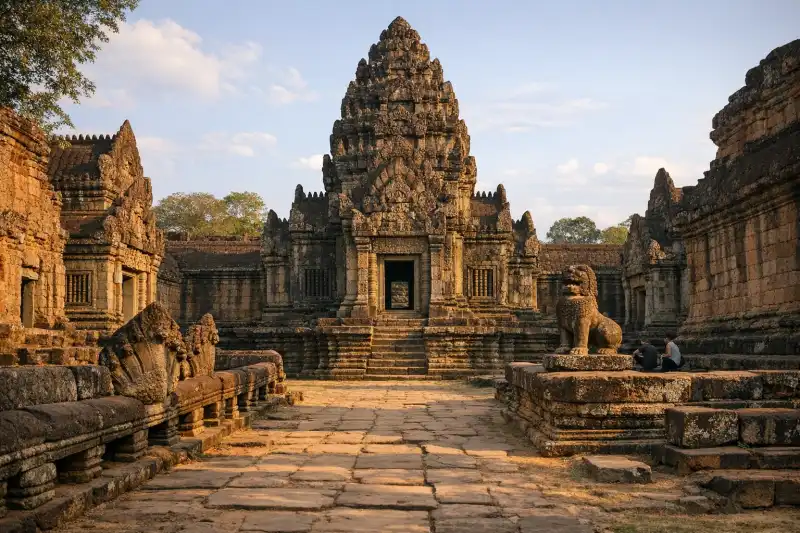
The central sanctuary preserves some of the most visually compelling architecture. Though damaged and incomplete, it still shows the elegance of Khmer sacred design through sandstone lintels, doorframes, and towers. The balance between laterite mass and carved stone detail is particularly appealing. Like many Khmer temples, the surviving structures express both engineering confidence and cosmological purpose. Towers rise from a carefully ordered plan, while galleries and courts organize movement and vision. Standing in the core area, visitors can sense how the architecture once directed ceremonial attention toward sacred images and royal symbolism.
Another important feature is the baray, the large man-made reservoir associated with the complex. Water was essential in Khmer planning, and such reservoirs had practical, political, and religious significance. At Preah Khan Kompong Svay, the presence of substantial hydraulic works reinforces the idea that this was a major center, not a peripheral temple of modest ambition. The surrounding landscape would once have integrated water storage, symbolic geography, and agricultural support. Even when partly overgrown or subdued by time, these features reveal the site’s connection to the environmental mastery associated with Khmer statecraft.
The causeways and approaches are also memorable. Khmer builders understood the drama of arrival. Long linear approaches across moats or embanked ground framed the temple as a destination of power. At Preah Khan Kompong Svay, these routes still help visitors imagine how formal movement through the complex once worked. Processions, offerings, and royal or ritual entries would have been shaped by these carefully organized paths. The remains may be fragmented, but the planning logic remains readable.
One of the most rewarding qualities of the site is the way architecture and vegetation interact. Unlike highly restored monuments, Preah Khan Kompong Svay often retains a rougher edge. Trees, shade, open patches of earth, and scattered masonry give it an exploratory atmosphere. This is not ruin romanticism for its own sake; rather, it allows the scale and setting of the monument to come through. The forest does not simply hide the temple. It frames the monument as part of a larger historical landscape that has never been fully separated from nature.
Visitors interested in architectural comparison will notice both familiar and unusual details. There are echoes of Angkorian forms in the towers, plans, and building materials, yet the site’s remoteness and historical layering give it a distinct personality. It feels less like a polished showpiece and more like a major regional node in the Khmer world, one that can still be studied spatially. For photographers, archaeologists, and travelers who enjoy reading ancient places in the ground itself, this quality is one of the site’s greatest strengths.
Perhaps the most important feature of all is intangible: atmosphere. Preah Khan Kompong Svay offers a rare chance to experience a large Khmer complex with relative quiet. The absence of heavy crowds changes how the site is understood. Instead of moving from photo stop to photo stop, visitors can notice alignments, distances, textures, and the rhythm of enclosure and release. The result is a more immersive sense of what an imperial temple landscape might have felt like beyond the capital.
Getting There
Reaching Preah Khan Kompong Svay requires more planning than visiting Cambodia’s better-known temple sites, and that remoteness is part of why many travelers choose to go. The most practical starting points are Kampong Thom, Siem Reap, or occasionally Preah Vihear Province towns, depending on your route and transport arrangements. Independent travel is possible, but for most visitors a private car or SUV with driver is the most reliable option.
From Kampong Thom, a full-day vehicle hire typically costs around $70-120 depending on road conditions, fuel, season, and whether a local guide is included. Travel times vary, but expect roughly 2.5 to 4 hours each way because road surfaces can change significantly between dry and wet periods. From Siem Reap, private day trips or overnight arrangements generally range from $120-220, with longer driving times that can exceed 4 hours each way. Shared public transport usually does not go directly to the ruins, so buses only solve part of the journey.
Motorbike trips are possible for experienced riders, especially in the dry season, but this is not ideal for casual visitors. Road signage and conditions can be inconsistent, and fuel stops and services may be sparse. If you hire a local guide or driver familiar with the site, expect to pay extra but gain time, context, and fewer logistical headaches.
Bring cash, water, snacks, and a fully charged phone. Facilities near the temple are limited, so this is a destination where practical preparation matters more than usual.
When to Visit
The best time to visit Preah Khan Kompong Svay is during Cambodia’s dry season, especially from November to February. During these months, temperatures are generally more manageable, humidity is lower, and road access is usually easier. Because the site is large and exposed in parts, cooler mornings make walking much more comfortable. Light in the early part of the day is also better for photography, especially where carved stone and laterite surfaces catch low-angle sun.
March to May can still be visited, but the heat becomes intense by late morning and afternoon. If you travel in this period, start as early as possible, carry plenty of water, and plan shade breaks. The site’s scale makes heat management more important here than at some smaller temple complexes.
The rainy season, usually from June to October, transforms the landscape into a greener and more dramatic setting. Moats, vegetation, and earthworks can look beautiful after rain, and the atmosphere becomes especially lush. The trade-off is access. Roads may become muddy or slower, and travel times can increase noticeably. If you come during this season, confirm conditions locally and use a driver with experience on rural routes.
For the best overall balance of comfort, accessibility, and visual appeal, December and January are especially strong choices. Regardless of month, aim to arrive early in the day. Preah Khan Kompong Svay is best appreciated unhurriedly, when the site is quiet and the heat has not yet taken over the landscape.
| Quick Facts | Details |
|---|---|
| Location | Preah Vihear Province, Cambodia |
| Alternate name | Preah Khan of Kompong Svay |
| Civilization | Khmer Empire |
| Main period | 11th-13th centuries CE |
| Site type | Temple complex and regional ceremonial center |
| Best base | Kampong Thom or Siem Reap |
| Visit duration | Half day minimum, full day ideal |
| Best season | November to February |
| Access | Private car, SUV, or experienced motorbike travel |
| Why visit | Huge scale, remote setting, and major Khmer architecture beyond Angkor |
Preah Khan Kompong Svay is the kind of place that changes the way travelers think about ancient Cambodia. It shows that the Khmer world was not only concentrated around Angkor’s famous monuments, but extended across an enormous landscape of roads, reservoirs, and provincial centers that sustained imperial power. Here, that larger story becomes visible in physical form. The size of the enclosure, the command of water, and the authority expressed by the sanctuary all point to a place that once mattered profoundly within the kingdom’s network.
For visitors, the reward lies not in polished interpretation or convenience, but in perspective. The site invites you to look beyond the usual circuit and encounter Khmer architecture in a more spacious and reflective way. Its ruins are compelling not only because they are old or impressive, but because they preserve evidence of a sophisticated state working across distance, environment, and belief. To stand within Preah Khan Kompong Svay is to see the Khmer Empire at one of its edges, where sacred ambition met geography and where history now lingers in stone, earth, and forest silence.
Guided tours: worth it?
A guide can be genuinely useful at Preah Khan Kompong Svay, especially if you want help with transport, timing, tickets, or understanding a large site without losing half the day to logistics.
Best for
- First-time visitors who want context, not just photos
- Travelers who want transport, timing, or entry logistics handled
- Short visits where a planned route saves time
When to go self-guided
Go independently if you already have transport and tickets sorted, enjoy moving at your own pace, and are comfortable checking the latest official rules before you arrive.
What I’d avoid
Skip paid tours that bundle unrelated stops you do not actually want. The best option should either save meaningful planning time or add historical context you would miss on your own.
Cambodia temple tours
Useful when: you want to compare guided formats before deciding
Preah Vihear and ancient temples tours
Useful when: you want to compare guided formats before deciding
Siem Reap archaeological site tours
Useful when: you want to compare guided formats before deciding
Some tour links are affiliate links, which may earn Ancient Travel a small commission at no extra cost to you. I try to surface options that make practical sense for the site—not just anything bookable.
Frequently Asked Questions
Where is Preah Khan Kompong Svay located?
Preah Khan Kompong Svay is in present-day Preah Vihear Province, Cambodia, in a remote forested area east of Siem Reap and north of Kampong Thom.
Is Preah Khan Kompong Svay the same as Preah Khan in Angkor?
No. Although both are Khmer temple complexes and share the name Preah Khan, Preah Khan Kompong Svay is a separate, much more remote site outside the Angkor core.
How long should I plan for a visit?
Most visitors should allow at least half a day on site, with a full day recommended if you want time to explore the enclosure, central sanctuary, baray, and outer structures.
Do I need a guide to visit Preah Khan Kompong Svay?
A guide is not strictly required, but it is highly recommended because the complex is large, remote, and less clearly interpreted than major temple sites near Siem Reap.
What should I bring for a trip to Preah Khan Kompong Svay?
Bring water, sun protection, insect repellent, sturdy shoes, cash for transport or local services, and snacks, since facilities near the site are limited.
What is the best season to visit Preah Khan Kompong Svay?
The dry season from roughly November to February is usually the most comfortable, with easier road access and cooler temperatures for exploring the ruins.
Nearby Ancient Sites
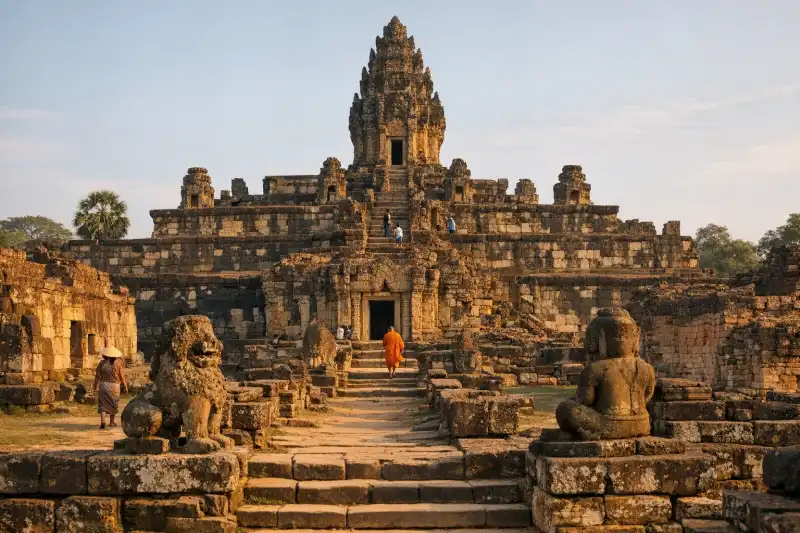
Bakong
Bakong is Cambodia's first major sandstone temple mountain, a stunning Khmer monument at the heart o...
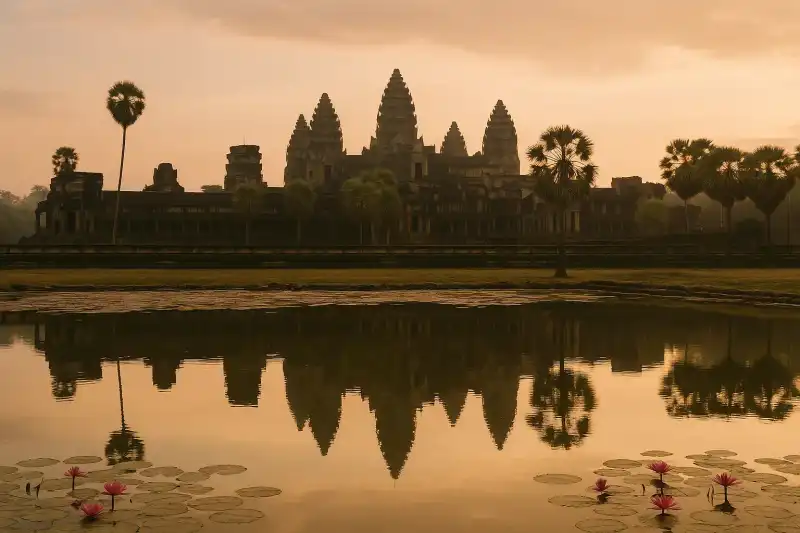
Angkor Wat Travel Guide 2026: Everything You Need to Know
KhmerAngkor Wat, the world's largest religious monument, spans over 400 acres in the heart of Cambodia. T...
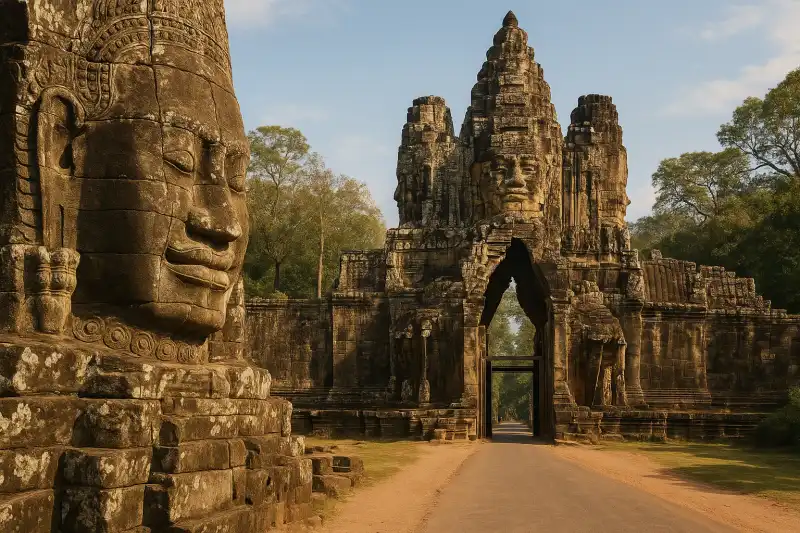
Angkor Thom Travel Guide 2026: Bayon Faces, Gates, and the Khmer Royal City
KhmerAngkor Thom was the last great capital of the Khmer Empire. This guide covers how to visit Bayon, th...
Banteay Samré
Banteay Samré is a beautifully preserved 12th-century Hindu temple in Cambodia’s Siem Reap province,...