Quick Info
At a glance
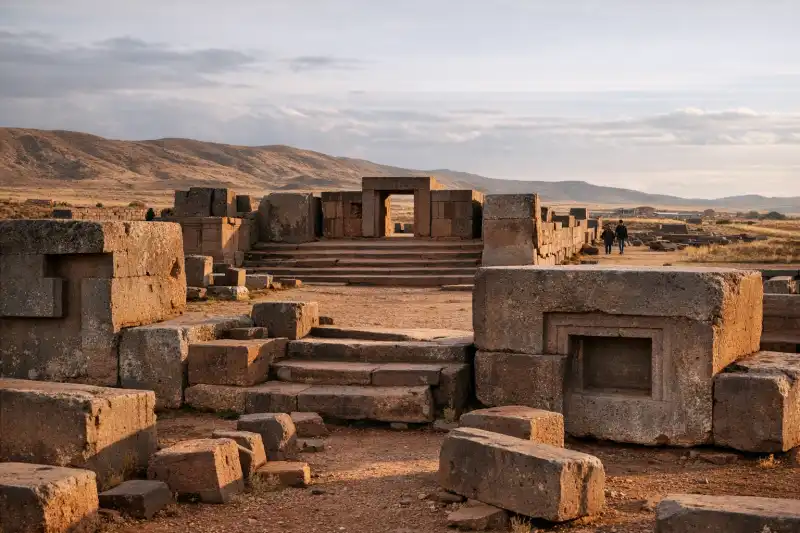
Pumapunku, in Bolivia, is one of the most intriguing archaeological places in the Andes: a windswept ceremonial complex of massive stone platforms, finely cut blocks, and broken architectural pieces lying on the high plain near Lake Titicaca. Even before you understand its history, the setting does much of the work. The Altiplano feels immense, open, and starkly luminous, with broad skies, cold air, and distant mountain horizons that make every ruin seem both isolated and monumental. Pumapunku is often visited together with nearby Tiwanaku, yet it has a distinct character of its own. Where some ancient sites impress through towering walls or standing temples, Pumapunku fascinates through fragments—carefully shaped stones, terraces, and alignments that hint at a structure of remarkable ambition.
For travelers, that first encounter can be surprising. You may arrive expecting a single intact monument and instead find a large ceremonial precinct whose surviving elements are spread across the ground, their craftsmanship visible in cut angles, smooth faces, and fitting joints. This is part of its appeal. Pumapunku invites close looking. It asks visitors to imagine process as much as result: quarrying, transport, design, assembly, and ritual use at nearly 3,850 meters above sea level. Far from being just an appendix to Tiwanaku, it is one of the most important places for understanding the engineering, ceremonial life, and political power of the Tiwanaku civilization.
History
Early development within the Tiwanaku world
Pumapunku was built as part of the broader Tiwanaku urban and ceremonial complex, one of the great pre-Columbian centers of the Andean world. Tiwanaku developed near the southern basin of Lake Titicaca and grew from an early settlement into a powerful religious and political center whose influence extended far beyond the Bolivian Altiplano. Scholars generally place the florescence of Tiwanaku between roughly 500 and 1000 CE, although the roots of the culture go earlier and some building phases likely unfolded over generations.
Within this larger sacred landscape, Pumapunku appears to have been a major ceremonial sector rather than a separate city. Archaeological evidence suggests it was planned with great care, integrated into the wider cosmological and architectural order of Tiwanaku. Its name is commonly translated as “Gate of the Puma,” though the surviving remains do not preserve a single obvious gate in the way modern visitors might imagine. Instead, the complex included elevated platforms, terraces, courts, and carefully worked stone elements that likely supported walls, portals, and ritual spaces.
The importance of Pumapunku is closely tied to the rise of Tiwanaku as a regional power. This was not simply a local village that happened to produce fine masonry. It was the ceremonial heart of a civilization capable of mobilizing labor, organizing long-distance exchange, and projecting influence across diverse ecological zones. The precision and scale of Pumapunku’s construction point to a sophisticated social structure and highly developed architectural knowledge.
Construction, ceremony, and stoneworking
The main construction phases of Pumapunku likely took place during the mature Tiwanaku period. Builders used both red sandstone and harder andesite, sourcing materials from different locations and transporting them to the site with methods that still provoke practical questions, though not the fantasies often attached to the ruins. Archaeologists emphasize that these feats were achieved through organized human labor, careful planning, and deep local knowledge of stone and landscape.
What makes Pumapunku so striking is the quality of its masonry. Some blocks were cut with exceptional accuracy, including straight edges, right angles, sockets, grooves, and clamps for joining pieces. These details reveal a highly controlled architectural system. The stones were not random megaliths but components of a carefully designed whole. The site may have included raised platforms reached by formal access ways, with select areas reserved for ritual performances, elite activity, or processions.
Pumapunku was almost certainly more than an engineering display. In the Andean world, architecture often encoded sacred order. Orientation, elevation, and the movement of people through built space mattered. Water may also have played a role, as it did at other Tiwanaku monuments, transforming architecture into a dynamic ceremonial environment. The complex likely functioned as a place where political authority, religious symbolism, and monumental design came together.
Decline, collapse, and later memory
By around the 11th century CE, Tiwanaku entered a period of decline. The reasons remain debated, but climate stress, shifting agricultural systems, political fragmentation, and social change are all considered possible factors. As the power of the Tiwanaku state waned, its ceremonial core lost the concentrated labor and institutional support needed for upkeep and renewal. Pumapunku, like other sectors of the city, fell out of active use.
Over time, architectural elements collapsed, were buried, shifted, or were reused. Earth movement, weathering, and later disturbance altered the layout further. By the time outsiders recorded the site in the colonial and modern eras, much of Pumapunku survived in a disassembled state. This partly explains why it became fertile ground for speculation. Fragments can invite imagination, and in Pumapunku’s case that imagination has often strayed into pseudoarchaeology. Claims about extraterrestrials or lost super-civilizations persist in popular media, despite abundant evidence that the complex belongs squarely within the achievements of Andean peoples.
Modern archaeological work has done much to restore Pumapunku to its real historical context. Excavation, mapping, reconstruction studies, and material analysis have shown the site to be a product of Tiwanaku planning, ritual life, and technical expertise. Today it is valued not only for its visual drama but as a key source for understanding state formation, religion, and monumental building in the pre-Columbian Andes.
Key Features
What most visitors notice first at Pumapunku is the platform itself: a broad earthen and stone mass that once supported a highly formal ceremonial structure. The surviving form does not present a complete building in the conventional sense. Instead, it reads as a monumental architectural landscape. Terraces define the complex, and the elevated platform gives the entire site a sense of intention and command over the surrounding plain. Even in partial ruin, its scale conveys planning on a grand level.
The sandstone elements are among the largest and most visually powerful features. Some blocks are enormous, with clean planes and deliberately shaped faces that suggest they were integral to retaining walls, terraces, or major architectural boundaries. Their reddish tone contrasts with the pale Altiplano light, making them especially photogenic in morning and late afternoon. These sandstone masses create the impression of weight and permanence, grounding the site in the earth.
Equally important are the andesite blocks, which reveal the technical finesse for which Pumapunku is famous. These smaller but often more intricately worked stones include the so-called H-shaped blocks that have become iconic in photographs and documentaries. Their precision is real and impressive: straight cuts, repeated proportions, fitted recesses, and carved details indicate modular design. But their significance lies not in mystery; it lies in craftsmanship. They show that Tiwanaku masons understood standardized production, joinery, and the visual language of elite ceremonial architecture.
You can also see evidence of metal clamp technology in some stone connections. Builders used specially shaped joints, and in some cases metal fasteners, to stabilize architectural elements. This detail is easy to overlook, but it is one of the clearest signs that Pumapunku was a carefully engineered complex, not simply a platform built from rough megaliths. Looking closely at these features rewards the patient visitor far more than scanning the site quickly for dramatic ruins.
Another important aspect of Pumapunku is its relationship to the broader Tiwanaku center. It does not stand in isolation as a curiosity in a field; it belongs to a planned sacred and urban landscape that included major temples, monoliths, sunken courts, and processional spaces. Visiting Pumapunku alongside the main Tiwanaku ruins helps clarify scale and function. The combined experience shows how different sectors may have served distinct ceremonial purposes while participating in a unified ideological program.
The site’s open setting is itself a key feature. On the high plateau, architecture interacts strongly with sky, weather, and horizon. Winds move constantly across the ground. Clouds can transform the mood from brilliant to austere in minutes. The distant Andes frame the ruins in a way that reinforces their ceremonial gravity. This is not incidental. Andean sacred architecture often engaged with surrounding topography, celestial events, and ritual movement through open space. Pumapunku’s physical exposure likely enhanced its power.
Finally, one of the most memorable qualities of the site is interpretive rather than purely visual: the sense of incompletion the ruins now carry. Because so much survives as fallen or displaced stone, visitors are invited into an act of reconstruction. You begin to read tool marks, edges, alignments, and material contrasts. Instead of being overwhelmed by a single intact façade, you engage with the underlying logic of ancient building. For travelers interested in archaeology rather than spectacle alone, that makes Pumapunku especially rewarding.
Getting There
Most travelers reach Pumapunku from La Paz, the nearest major city and the practical base for a visit. The ruins lie about 70 kilometers west of La Paz near the town of Tiwanaku, and the journey by road usually takes 1.5 to 2 hours depending on traffic and weather. The easiest option is to book a guided day tour, which typically includes round-trip transport, a stop at the Tiwanaku museum, and time at both Tiwanaku and Pumapunku. Shared tours often start around $25 to $50 USD per person, while private tours can range from about $80 to $180 USD depending on group size and inclusions.
Independent travelers can also go by public transport. Minibuses and shared vans for Tiwanaku generally depart from La Paz’s General Cemetery area or other transport hubs, with fares often around 15 to 25 bolivianos each way. From the town, Pumapunku is close enough to reach by a short walk or local taxi. A taxi from central La Paz directly to the site is faster and more flexible but much more expensive, commonly around 250 to 400 bolivianos one way unless negotiated as a round trip with waiting time.
Entrance fees can change, so check current prices before traveling. If you are visiting independently, bring cash, water, sunscreen, and warm layers. Altitude can make short walks feel more strenuous than expected, and the open site offers little shelter from sun, wind, or sudden weather changes.
When to Visit
Pumapunku can be visited year-round, but the best months are usually during the dry season from about May to October. During this period, skies are often clearer, roads are more reliable, and the strong sunlight helps bring out the textures and colors of the stonework. Dry-season mornings can be very cold, especially from June through August, so layered clothing is essential. The benefit of these cooler months is visibility: the Altiplano often looks exceptionally crisp, with broad views and dramatic light for photography.
The rainy season, roughly November to March, has its own appeal. The surrounding landscape can appear greener, and cloud formations over the plateau can be beautiful and atmospheric. However, afternoon showers are more common, and muddy ground may make walking less comfortable. If you visit at this time, aim for an early start when weather is often calmer. A waterproof layer and sturdy shoes are worthwhile.
April and November can be excellent shoulder-season months, offering a balance between manageable weather and fewer travel complications. Weekdays generally feel quieter than weekends, especially if local school groups or domestic tour groups are active. Morning visits are often best, not only for softer light but because altitude, wind, and sun exposure can feel harsher as the day goes on.
Whenever you choose to go, allow time to acclimatize in La Paz or elsewhere in the highlands before your visit. Pumapunku is not a physically difficult site, but the elevation affects many travelers, and even a gentle walk can feel unexpectedly tiring.
| Quick Facts | |
|---|---|
| Location | Near Tiwanaku, La Paz Department, Bolivia |
| Civilization | Tiwanaku |
| Main period | c. 6th-10th century CE |
| Elevation | About 3,850 meters above sea level |
| Nearest major city | La Paz |
| Best combined visit | Tiwanaku archaeological complex and museum |
| Famous for | Precision-cut stone blocks, terraces, and ceremonial architecture |
| Typical visit length | 1-2 hours at Pumapunku, longer with Tiwanaku |
| Best season | Dry season, May to October |
| Access | Day tour, public minibus, private taxi, or self-arranged transport |
Pumapunku rewards a different kind of traveler than sites defined by dramatic standing architecture. It is a place for careful observation, patience, and respect for context. The broken stones are not evidence of incomprehensible mystery but of a brilliant Andean civilization that conceived architecture on a monumental scale and executed it with exceptional skill. Seen alongside the wider Tiwanaku complex, Pumapunku helps illuminate one of South America’s most important ancient traditions. Seen on its own, under the sharp Bolivian sky, it remains unforgettable: austere, intelligent, and quietly astonishing.
Guided tours: worth it?
Self-guided works here, but a guide can add real value if you want the ruins explained as a living place rather than just a sequence of monuments.
Best for
- First-time visitors who want context, not just photos
- Short visits where a planned route saves time
When to go self-guided
Go independently if you prefer setting your own pace, reading as you go, and checking official hours or ticket rules directly before you arrive.
What I’d avoid
Skip paid tours that bundle unrelated stops you do not actually want. The best option should either save meaningful planning time or add historical context you would miss on your own.
Tiwanaku and Pumapunku day tours from La Paz
Useful when: transport or pickup logistics matter
Tiwanaku archaeological site tours Bolivia
Useful when: you want to compare guided formats before deciding
La Paz to Tiwanaku private tour
Useful when: you want flexible timing or a private guide
Some tour links are affiliate links, which may earn Ancient Travel a small commission at no extra cost to you. I try to surface options that make practical sense for the site—not just anything bookable.
Frequently Asked Questions
What is Pumapunku?
Pumapunku is a monumental temple and platform complex that forms part of the greater Tiwanaku archaeological site in western Bolivia.
Where is Pumapunku located?
Pumapunku lies near the town of Tiwanaku in Bolivia’s La Paz Department, roughly 70 kilometers west of La Paz on the Altiplano.
Can you visit Pumapunku on a day trip from La Paz?
Yes. Most visitors reach Pumapunku as part of a half-day or full-day excursion from La Paz, often combined with the main Tiwanaku ruins and museum.
How high is Pumapunku above sea level?
The site stands at about 3,850 meters above sea level, so travelers should be prepared for high altitude conditions.
Why is Pumapunku famous?
It is best known for its precisely cut sandstone and andesite blocks, sophisticated stone joinery, and its role in the ceremonial core of the Tiwanaku civilization.
Do you need a guide at Pumapunku?
A guide is not always required, but it is highly recommended because much of the site survives as scattered architectural elements that are easier to understand with expert interpretation.
Nearby Ancient Sites
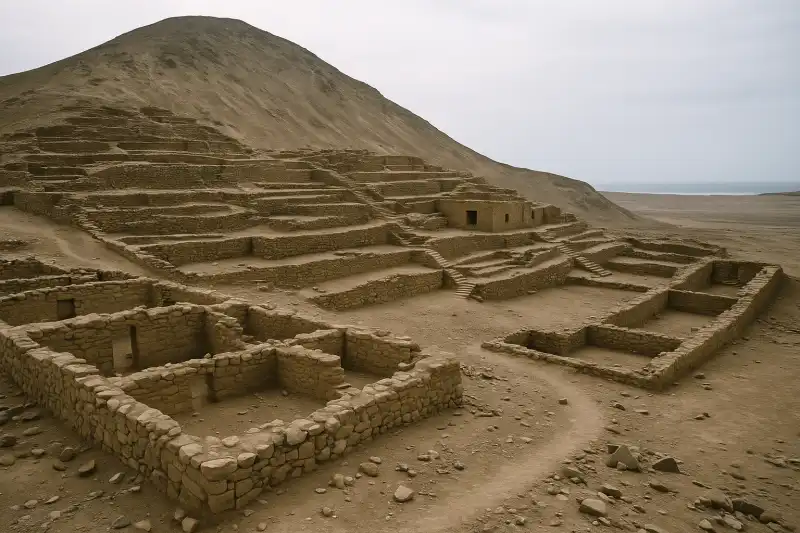
Aspero Peru Guide 2026: Norte Chico Pyramids & Caral Coast
Norte-Chico-CaralVisit Aspero in Peru to see Norte Chico pyramids, plazas, and elite temples, with practical tips for...
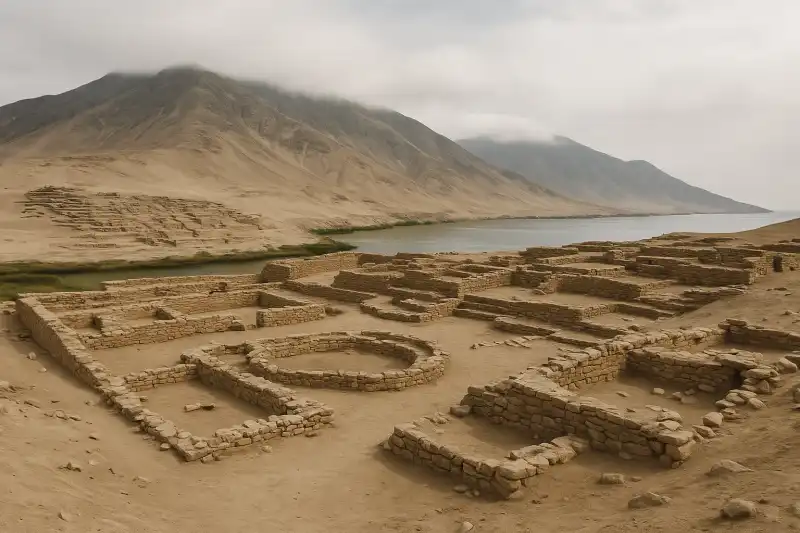
Bandurria Peru Guide 2026: Ancient Mounds & Pacific Wetlands
Norte-Chico-Preceramic-AndeanPlan your Bandurria visit in Peru with history, key mounds, transport from Lima or Huacho, entry tip...