Quick Info
At a glance
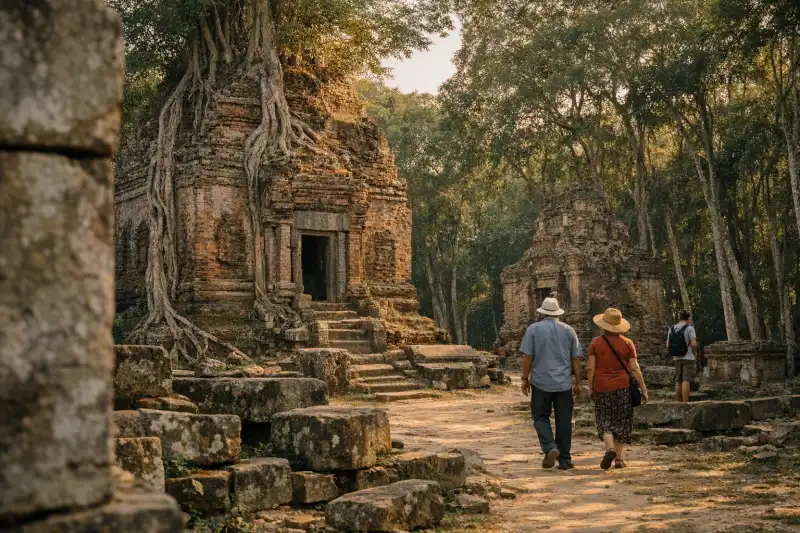
Sambor Prei Kuk in Cambodia feels different from the country’s better-known temple destinations. Instead of soaring sandstone galleries crowded with tour buses, you find a quieter landscape of red-brick towers, sandy forest paths, cicada song, and shafts of light filtering through tall trees. The site lies in Kampong Thom Province, roughly midway between Phnom Penh and Siem Reap, yet it often feels far removed from the main circuit. That sense of stillness is part of its appeal. Here, visitors encounter the deep roots of Khmer architecture in a setting where archaeology and woodland seem to exist together.
The name Sambor Prei Kuk is often translated as “the temple in the richness of the forest,” and the phrase suits the experience perfectly. This was once the monumental heart of ancient Isanapura, a capital of the Chenla kingdom in the 7th century. Long before Angkor rose to imperial grandeur, rulers here were already experimenting with temple layouts, religious imagery, and building techniques that would shape the future of Cambodia’s sacred architecture. Today, many of the sanctuaries remain partly embraced by vegetation, their carved brickwork weathered but still expressive. Visiting is not only a chance to see an important UNESCO World Heritage Site, but also to step into an earlier chapter of Southeast Asian history, where the foundations of the Khmer world were taking form among the forests of central Cambodia.
History
Early settlement and the rise of Chenla
The history of Sambor Prei Kuk begins before the famous age of Angkor. In the centuries after the decline of Funan, political power in mainland Southeast Asia shifted inland, and the kingdom known to Chinese sources as Chenla emerged as a major force. By the 6th and 7th centuries, rulers in the central Cambodian region were consolidating authority, controlling agricultural land, trade routes, and river networks that linked the interior with wider regional exchange.
Sambor Prei Kuk became associated with Isanapura, a capital founded by King Isanavarman I in the early 7th century. The location was strategic. It sat in fertile territory and enjoyed access to communication routes connecting different parts of the kingdom. More importantly, it became a ceremonial and political center where kings expressed legitimacy through religion and monumental building. The temples of the site reveal a world in which royal power and sacred symbolism were inseparable. Sanctuaries dedicated to Hindu deities stood at the core of the landscape, asserting both piety and authority.
Isanapura and the flowering of temple construction
Under Isanavarman I and his successors, Sambor Prei Kuk entered its most significant building phase. The complex was not a single temple but an urban-sacred zone made up of multiple groups of shrines, enclosure walls, causeways, and associated structures spread across the forested plain. Most of the surviving monuments date from the 7th century, though some may preserve earlier foundations and others show later use.
Architecturally, the site is crucial because it demonstrates an early and highly creative phase of Khmer design. Builders favored brick for sanctuary towers, often placed on raised platforms and framed by decorative false doors, colonettes, lintels, and sculptural motifs worked in brick, sandstone, and stucco. Some towers are octagonal, a rare form in Southeast Asian temple architecture and one of the site’s most distinctive features. The sculptural language already includes themes that would echo through later Khmer art: lions guarding entrances, makara motifs, vegetal ornament, and carefully conceived sacred geometries.
Religiously, Sambor Prei Kuk appears to have supported Shaivite worship in particular, though the broader ritual landscape likely included multiple Hindu traditions and changing practices over time. Inscriptions from the region help identify patrons, dedications, and aspects of the social world around the temples, including links between rulers, elites, and religious institutions.
From pre-Angkor to the Angkorian world
By the late 8th and early 9th centuries, Cambodia’s political center shifted. New royal foundations and evolving state structures paved the way for the Angkorian era, whose monumental heartland lay farther northwest. Sambor Prei Kuk did not vanish overnight, but it lost its central political role as newer capitals emerged. Even so, its artistic and architectural influence endured. Scholars regularly point to the site as a precursor to later Khmer temple planning and decorative programs.
In this sense, Sambor Prei Kuk is not merely older than Angkor; it is part of the story of how Angkor became possible. Here, one can trace experiments in shrine design, enclosure arrangements, symbolic orientation, and sacred kingship that later matured into the vast temple mountains and urban complexes of the Khmer Empire. The transition from the pre-Angkor period to the Angkorian age is one of gradual development rather than abrupt rupture, and Sambor Prei Kuk stands as one of the clearest surviving bridges between those eras.
Rediscovery, conservation, and UNESCO recognition
As political centers moved and forests expanded, the temple groups became increasingly secluded. Local communities never entirely forgot them, but for outsiders the site entered the category of ruins reclaimed by nature. During the colonial era, French scholars and archaeologists documented many of the monuments, recording inscriptions and architectural details that remain essential for modern research.
In the 20th and 21st centuries, conservation gained urgency. Brick temples are especially vulnerable to weathering, vegetation growth, structural collapse, and looting. Preservation work at Sambor Prei Kuk has therefore required careful stabilization, documentation, and site management. International and Cambodian teams have contributed to surveying, excavation, restoration, and interpretation.
A major milestone came in 2017, when the archaeological site of ancient Ishanapura—Sambor Prei Kuk—was inscribed on the UNESCO World Heritage List. That recognition affirmed both its outstanding historical significance and its role in understanding the origins of Khmer civilization. Today, the site is increasingly appreciated not only as a precursor to Angkor but as a major destination in its own right: quieter, older, and deeply revealing of Cambodia’s early state formation and sacred art.
Key Features
What makes Sambor Prei Kuk memorable is the combination of architectural importance and atmosphere. The complex is usually divided into several main temple groups, commonly identified by lettered zones such as Prasat Sambor, Prasat Tao, and Prasat Yeai Poeun. Each has its own character, but all are linked by the same sense of scattered sacred architecture embedded in woodland. Unlike sites where monuments are tightly clustered behind a single enclosure, here the experience unfolds as a sequence of walks through the forest, arriving at shrines one after another.
The brick towers are the most striking elements. Their surfaces often preserve subtle decoration that rewards slow looking: molded pilasters, false doors, floral patterns, and remnants of stucco that once gave the temples a richer and more finished appearance. Time has softened edges and opened cracks, yet many towers still convey impressive verticality. The octagonal shrines are especially notable. They are unusual enough to stop even visitors familiar with Khmer architecture, and they hint at a period of experimentation before later architectural conventions became dominant.
Sambor Prei Kuk also stands out for its sculptural details. Sandstone lintels above doorways can feature refined carvings despite centuries of exposure. Lions placed at entrances remain among the signature images of the site, projecting ritual guardianship in a more intimate scale than the colossal figures seen at later monuments. Some shrines preserve traces of interior sanctity too, though many original statues and sacred objects are gone. Even in fragmentary form, the temples communicate a strong sense of ceremonial purpose.
Another defining feature is the relationship between the ruins and the forest. Large trees rise behind sanctuary walls, roots skirt old masonry, and the sandy ground muffles footsteps. In some places this natural setting creates a near-mythic mood; in others it helps explain why the site feels less monumental but more immediate than Angkor. You are not simply looking at architecture in isolation. You are seeing how ancient construction has aged within a living landscape.
The scale of the wider archaeological zone is also important. Sambor Prei Kuk was not just a collection of shrines but part of an urban center. Archaeological research has identified traces of roads, embankments, moats, habitation areas, and broader spatial organization extending beyond the most visited monuments. This larger setting helps visitors understand the temples not as remote hermitages but as components of a functioning capital city, where court life, ritual, and administration once intersected.
One of the pleasures of visiting is the comparative lack of crowds. While Angkor’s major temples can feel theatrical and intensely photographed, Sambor Prei Kuk allows for more contemplative viewing. You can often hear birds and insects more clearly than other travelers. That quieter atmosphere makes architectural details easier to appreciate and gives the site an almost archaeological intimacy. It is particularly rewarding for travelers interested in chronology, because the monuments reveal the roots of later Khmer forms in a way that more polished and better-known sites sometimes obscure.
For photographers, the site offers rich contrasts: reddish brick against green foliage, bright clearings opening suddenly from shaded paths, and temple towers that emerge gradually rather than dramatically. For history-focused visitors, the key feature is interpretive significance. Sambor Prei Kuk explains an early stage of state religion, urban planning, and monumentality in Cambodia. For general travelers, the appeal is simpler but no less powerful: it is beautiful, atmospheric, and far less hurried than many famous temple destinations.
Getting There
Sambor Prei Kuk is most commonly reached from Kampong Thom, Siem Reap, or Phnom Penh. The nearest practical base is Kampong Thom town, about 30 to 35 kilometers away. From there, a tuk-tuk or taxi to the site typically costs around $15 to $30 return, depending on negotiation, waiting time, and whether the driver includes several temple groups. A motorbike taxi can be cheaper, often around $8 to $15 return, but is less comfortable in hot or wet weather.
From Siem Reap, private car transfer is the easiest option for independent travelers. Expect fares of roughly $70 to $120 each way for a sedan or SUV, depending on season and hotel arrangements. Shared minivans and buses usually run between Siem Reap and Kampong Thom for around $8 to $15, after which you need local transport onward to the temples. This is the most economical route, though it takes longer and requires coordination.
From Phnom Penh, buses to Kampong Thom generally cost about $6 to $12 and take around 3.5 to 4.5 hours. Private car hire from the capital can range from $60 to $110 each way. Some travelers visit Sambor Prei Kuk as a stop on the overland journey between Phnom Penh and Siem Reap, which can be an efficient way to break up the trip.
At the site itself, tickets and local guiding services may be available near the entrance area. Hiring a local guide is often worthwhile for context, especially because the forested layout can make the complex feel more dispersed than first-time visitors expect. Bring water, sun protection, and cash, as facilities are more limited than at Cambodia’s biggest tourist sites.
When to Visit
The best time to visit Sambor Prei Kuk is generally during Cambodia’s dry season, especially from November to February. These months offer the most comfortable temperatures for walking between temple groups, with cooler mornings and lower humidity than later in the year. The forest setting also looks attractive in the angled light of the dry season, and paths are usually easier to navigate. If you want the most pleasant conditions for photography and longer exploration, this is the safest choice.
March to May is the hottest period. The site remains open and can still be rewarding, but midday heat can be intense, especially because visits involve walking through exposed clearings as well as shaded areas. If traveling at this time, start as early as possible and aim to finish the main exploration before early afternoon. Carry more water than you think you need.
The rainy season, roughly from May to October, brings a different kind of beauty. The forest becomes greener, the air feels fresher after rain, and the site can be especially atmospheric with damp brick and lush vegetation. Visitor numbers are often lower too. The trade-off is that heavy showers, muddy sections, and more humid conditions can slow your visit. Roads are generally passable, but transport may take longer during periods of strong rain.
For most travelers, early morning is the best time of day year-round. Light is softer, wildlife sounds are more noticeable, and temperatures are easier to handle. Late afternoon can also be appealing, but if you are coming from Kampong Thom or farther away, be sure to leave enough time for the return journey before dark. If you can choose only one season, the cool dry months offer the best balance of comfort, accessibility, and atmosphere.
| Quick Facts | Details |
|---|---|
| Location | Kampong Thom Province, Cambodia |
| Ancient name | Isanapura or Ishanapura |
| Main period | 6th-9th centuries CE, with major 7th-century construction |
| Civilization | Chenla and early Khmer |
| UNESCO status | World Heritage Site since 2017 |
| Known for | Pre-Angkor brick temples, octagonal towers, forest setting |
| Nearest town | Kampong Thom |
| Time needed | 2-4 hours for the main groups |
| Best season | November to February |
| Typical access | Private car, tuk-tuk from Kampong Thom, or overland stop between Phnom Penh and Siem Reap |
Sambor Prei Kuk rewards travelers who are willing to slow down. It may not deliver the overwhelming scale of Angkor, but it offers something rarer: a chance to see the origins of Khmer sacred architecture in a setting that still feels quietly mysterious. The site’s brick shrines, scattered through forest and linked to the forgotten capital of Isanapura, reveal a formative chapter in Cambodian history that is easy to overlook if you only follow the standard route. For visitors interested in early Southeast Asian states, temple architecture, or simply beautiful archaeological landscapes, Sambor Prei Kuk is one of Cambodia’s most compelling and underrated ancient destinations.
Guided tours: worth it?
A guide can be genuinely useful at Sambor Prei Kuk, especially if you want help with transport, timing, tickets, or understanding a large site without losing half the day to logistics.
Best for
- First-time visitors who want context, not just photos
- Travelers who want transport, timing, or entry logistics handled
- Trips where tickets, circuits, or timed entry can shape the day
- Short visits where a planned route saves time
When to go self-guided
Go independently if you already have transport and tickets sorted, enjoy moving at your own pace, and are comfortable checking the latest official rules before you arrive.
What I’d avoid
Skip paid tours that bundle unrelated stops you do not actually want. The best option should either save meaningful planning time or add historical context you would miss on your own.
Sambor Prei Kuk tours
Useful when: you want to compare guided formats before deciding
Kampong Thom and Sambor Prei Kuk day trips
Useful when: transport or pickup logistics matter
Cambodia ancient temples tours
Useful when: you want to compare guided formats before deciding
Some tour links are affiliate links, which may earn Ancient Travel a small commission at no extra cost to you. I try to surface options that make practical sense for the site—not just anything bookable.
Frequently Asked Questions
What is Sambor Prei Kuk?
Sambor Prei Kuk is a large pre-Angkorian temple complex in Kampong Thom Province, Cambodia, once part of the Chenla capital of Isanapura in the 7th century.
Why is Sambor Prei Kuk important?
It is one of Cambodia’s most important early temple cities, preserving rare brick sanctuaries, octagonal towers, and architectural forms that influenced later Khmer monuments such as those at Angkor.
How far is Sambor Prei Kuk from Siem Reap?
The site is roughly 170 to 180 kilometers from Siem Reap by road, and the journey usually takes about 3.5 to 4.5 hours depending on traffic and stops.
How much time do you need to visit Sambor Prei Kuk?
Most visitors need between 2 and 4 hours to explore the main temple groups at a comfortable pace, though history enthusiasts may want longer.
Is Sambor Prei Kuk a UNESCO World Heritage Site?
Yes. Sambor Prei Kuk was inscribed on the UNESCO World Heritage List in 2017 for its importance as an archaeological site of ancient Ishanapura.
When is the best time to visit Sambor Prei Kuk?
The coolest and driest months from November to February are generally the best for visiting, though the green season can also be beautiful with fewer visitors.
Nearby Ancient Sites
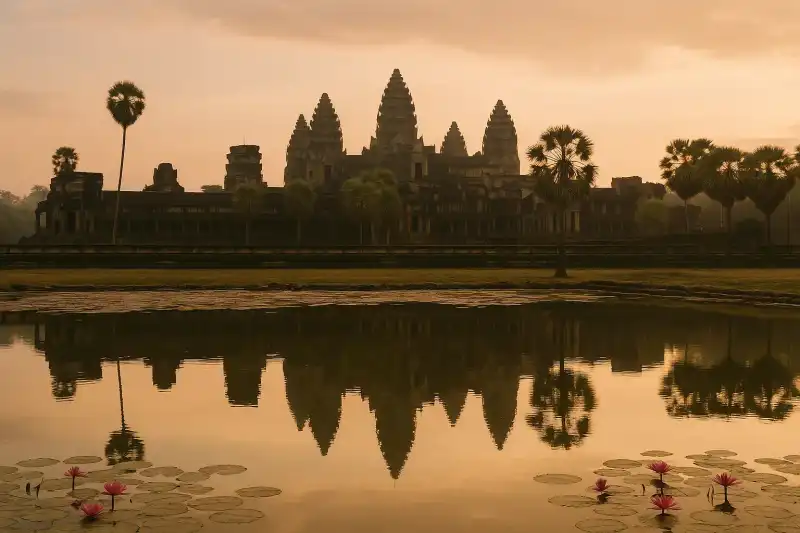
Angkor Wat Travel Guide 2026: Everything You Need to Know
KhmerAngkor Wat, the world's largest religious monument, spans over 400 acres in the heart of Cambodia. T...
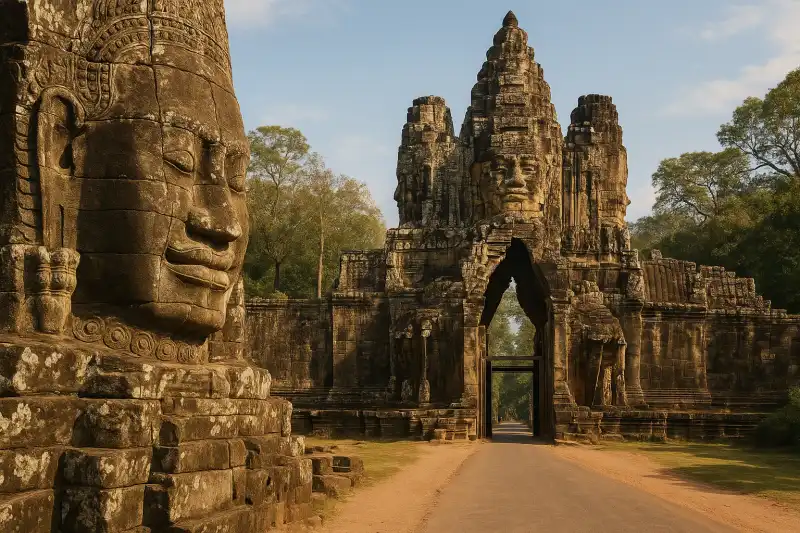
Angkor Thom Travel Guide 2026: Bayon Faces, Gates, and the Khmer Royal City
KhmerAngkor Thom was the last great capital of the Khmer Empire. This guide covers how to visit Bayon, th...
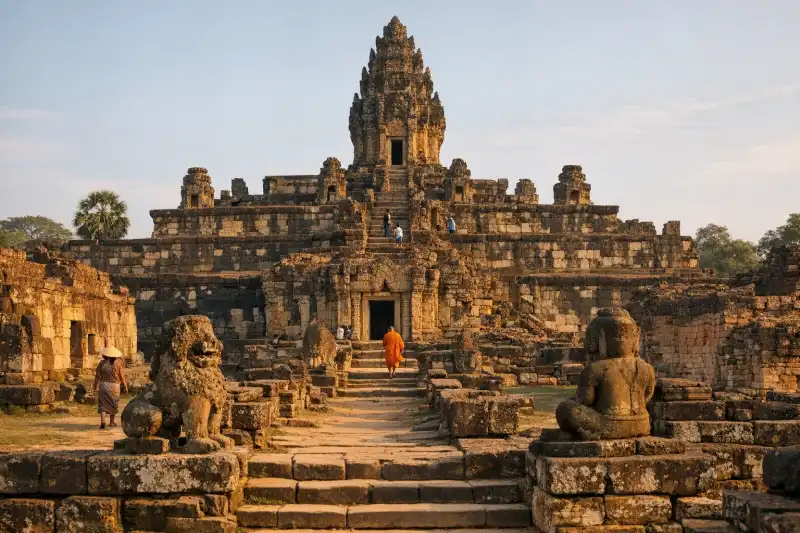
Bakong
Bakong is Cambodia's first major sandstone temple mountain, a stunning Khmer monument at the heart o...
Banteay Srei Travel Guide 2026: Pink Sandstone Temple, Carvings, and Visit Tips
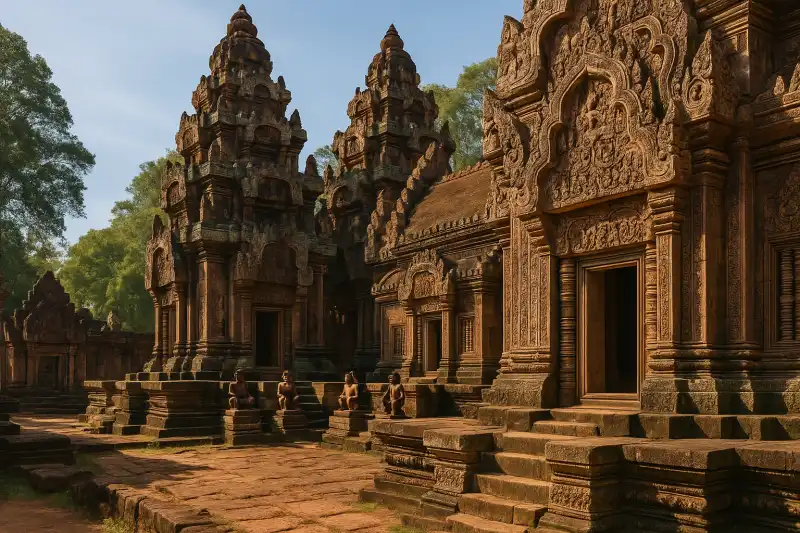
KhmerBanteay Srei is one of Cambodia’s most detailed Khmer temples, known for fine pink sandstone carving...