Quick Info
At a glance
Sanchi Stupa in India rises above the plains of Madhya Pradesh with a calm authority that feels very different from the bustle of most major heritage destinations. Set on a low hill not far from modern Bhopal, this Buddhist complex rewards visitors not with sheer scale, but with balance, symbolism, and remarkable continuity. The monuments at Sanchi are among the oldest surviving Buddhist structures in the world, and they preserve a visual record of religious devotion stretching from the Mauryan age into later centuries of Indian history.
What makes the site especially memorable is its atmosphere. Even before you begin studying the gateways, railings, shrines, and smaller stupas, the setting itself does part of the work. The hilltop location creates a sense of removal, and the scattered stone remains encourage a slower pace of exploration. Sanchi is not a ruined city in the conventional sense, nor is it a single isolated monument. It is a sacred landscape shaped over generations, where emperors, monks, patrons, artists, and pilgrims all left their mark.
For travelers interested in ancient India, Sanchi offers one of the clearest introductions to early Buddhist art and architecture. For general visitors, it offers something simpler but just as valuable: a place where stone, ritual movement, and sacred storytelling come together with unusual elegance. The result is a site that feels both historically profound and deeply contemplative.
History
Ashoka and the earliest stupa
The origins of Sanchi are usually traced to the 3rd century BCE, during the reign of Emperor Ashoka of the Mauryan dynasty. Ashoka is remembered as one of the most important royal patrons of Buddhism after his conversion following the Kalinga war, and tradition connects him with the construction of stupas across the Indian subcontinent. At Sanchi, the earliest core of what is now known as the Great Stupa likely began as a relatively modest brick structure commissioned during this Mauryan phase.
Sanchi’s importance may have been strengthened by its geographic setting and by courtly ties. Some traditions associate the region with Ashoka’s wife Devi, who is said to have come from nearby Vidisha. Whether or not every later account is historically exact, the area was clearly well positioned within networks of trade, administration, and religious patronage. The original monument probably served as a reliquary stupa, built to honor Buddhist memory and to provide a focus for devotion rather than congregational worship in the later temple sense.
Expansion under the Shungas
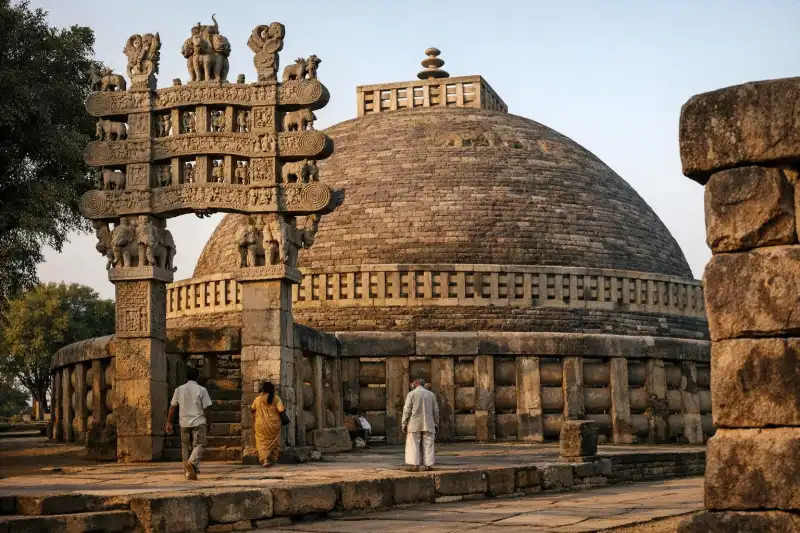
After the Mauryan empire declined, the site did not disappear. Instead, Sanchi entered a major phase of enlargement under the Shunga period, beginning in the 2nd century BCE. The Great Stupa was expanded from its earlier brick form into the larger stone monument seen today. Its hemispherical dome was enlarged, a high circular drum was added, and a stone railing enclosed the sacred circuit for circumambulation.
This period was crucial because it transformed the monument architecturally and ritually. The stupa was not simply a mass of masonry; it was designed to be approached, encircled, and read symbolically. The balustrades and processional paths guided worshippers in meditative movement around the monument. The harmika at the summit and the central umbrella mast expressed sacred hierarchy and cosmological meaning.
At the same time, other stupas and structures began to appear on the hill, showing that Sanchi had become more than a single commemorative monument. It was evolving into a major Buddhist establishment with a community, patronage base, and a durable ritual life.
Satavahana patronage and the carved gateways
Perhaps the most famous artistic additions came around the 1st century BCE to 1st century CE, when the four monumental toranas, or gateways, were erected at the cardinal points of the Great Stupa. These gateways are the visual heart of Sanchi today. Their densely carved surfaces depict scenes from the Buddha’s previous lives, episodes associated with his career, celestial beings, worshippers, animals, and symbolic motifs such as the Bodhi tree, empty throne, wheel, and footprints.
One of the striking features of Sanchi’s art is that the Buddha is often represented aniconically in these early carvings. Instead of showing him in human form, artists used symbols to evoke his presence. This was not a limitation of skill but a meaningful artistic and religious convention within early Buddhist visual culture.
Inscriptions indicate that the gateways and related features were funded by a wide range of donors, including monks, nuns, merchants, artisans, and lay devotees. This broad donor base reveals that Sanchi was not only a royal project. It was sustained by communities whose gifts helped shape one of the greatest early Buddhist art sites in South Asia.
Later monasteries, decline, and rediscovery
Sanchi remained active for many centuries. Additional temples, monasteries, pillars, and smaller stupas were constructed between the Gupta period and the early medieval era. Some later temples at the site are especially important for the history of Indian architecture because they show the development of early structural temple forms in stone.
Over time, however, Buddhism declined in much of central India, and Sanchi gradually lost its active religious role. The hill was not destroyed in a single dramatic event; rather, it faded from prominence, and the monuments weathered centuries of relative neglect. By the time European officers and antiquarians took notice in the 19th century, many structures were damaged, overgrown, or disturbed by earlier treasure seekers.
Scientific study and conservation began in the colonial period, especially under Sir John Marshall in the early 20th century. Restoration efforts, though shaped by the methods and assumptions of their time, helped stabilize the monuments and bring international attention to their significance. Today Sanchi is recognized as a UNESCO World Heritage Site and remains one of the most important places for understanding early Buddhist architecture, patronage, and art in India.
Key Features
The center of attention at Sanchi is Stupa 1, the Great Stupa, and it is easy to see why. Its great rounded dome appears simple from a distance, but the closer you get, the more carefully composed it becomes. The monument is defined by geometry and movement: the hemispherical mass, the circular pathways, the railings, and the gateways together create a complete ritual design. Unlike later religious buildings that draw people inside, the stupa’s meaning unfolds as you move around it. Its sanctity lies in presence, relic association, and symbolic form rather than interior space.
The four torana gateways are the site’s most celebrated artistic achievement. Carved in warm stone and crowded with narrative detail, they function almost like visual scriptures. There are processions, elephants, riders, trees laden with meaning, stupas depicted within stupas, and scenes of reverence before symbols standing in for the Buddha. Their composition rewards both casual viewing and close study. Even if you know little about Buddhist iconography, the carvings are lively and accessible, full of rhythm, ceremony, and human attention. For specialists, they are invaluable documents of early Indian narrative art.
Stupa 2 and Stupa 3 add depth to the experience because they show that the hill was not built around only one monument. Stupa 3 is associated with relics of important Buddhist disciples and has its own dignified presence, while Stupa 2 is known for decorative medallions and railings that preserve another layer of artistic development. Together, these monuments make the complex feel like a living sacred landscape rather than a single masterpiece isolated from context.
Sanchi also includes monastic remains and temples from later periods. These ruins are quieter than the Great Stupa, but they are essential for understanding the site’s long life. Temple 17, often cited as an important early Gupta temple, is especially significant for the history of Indian architecture because of its restrained, almost classical clarity. Its simple columned porch and compact sanctuary show an architectural language quite different from the earlier stupa tradition, yet it sits within the same sacred environment. This layering is one of Sanchi’s greatest strengths. Visitors can see, in one place, the evolution of Indian religious building across centuries.
The Ashokan pillar is another notable feature, even though it survives only in part at the site. Like other pillars associated with Ashoka, it speaks to imperial patronage, polished stone craftsmanship, and the spread of Buddhist values through monumental inscriptions and symbols. Fragments and related finds help connect Sanchi to the wider Mauryan world.
The hilltop setting should also be counted as a key feature in its own right. Sanchi’s monuments are not pressed into a dense urban fabric. Instead, they are arranged across open ground, with views outward over the surrounding countryside. This gives the complex an unusual spaciousness. You notice silence, wind, and shifting light on stone. Morning and late afternoon can be especially beautiful, when the carvings gain depth and the railings cast long shadows. For photographers, historians, and reflective travelers alike, the environment contributes to the meaning of the site.
A visit is usually completed with the nearby archaeological museum, which houses sculptures, inscriptions, capitals, and fragments that help make sense of what survives on the hill. Some pieces that are too fragile or too important to leave exposed are best appreciated there. Seen together, the open-air remains and the museum collection provide a fuller picture of how sophisticated Sanchi once was.
Getting There
Sanchi is most commonly visited from Bhopal, the capital of Madhya Pradesh, which lies roughly 45 to 50 kilometers away. By road, the journey usually takes around 1 to 1.5 hours depending on traffic and your exact starting point. A private taxi from Bhopal is the most convenient option for most travelers and typically costs about INR 2,500 to 4,500 for a round trip with waiting time, depending on vehicle type and negotiation. App-based cabs may be available in Bhopal, but for a day visit many travelers prefer a pre-arranged car.
Train travel is also possible. Sanchi has a small railway station with connections on some regional routes, while Vidisha, around 10 kilometers away, is a larger and often more practical rail stop. From Vidisha station, an auto-rickshaw or taxi to the monuments may cost roughly INR 300 to 800 depending on the vehicle and time of day. From Sanchi station, local transfers are shorter and cheaper, often around INR 100 to 300.
If you are arriving by air, Raja Bhoj Airport in Bhopal is the nearest major airport. From there, you can continue directly by road or spend a night in Bhopal and visit Sanchi as a day trip. Some travelers combine Sanchi with nearby Vidisha and Udayagiri Caves for a fuller heritage circuit.
Entrance fees and museum charges can change, so it is wise to check current rates before visiting. Carry water, sun protection, and some cash for local transport, especially if relying on smaller stations or auto-rickshaws.
When to Visit
The best time to visit Sanchi Stupa is generally from October to March, when Madhya Pradesh is cooler and more comfortable for walking around the exposed hilltop complex. During these months, daytime temperatures are usually pleasant enough for a slow visit, and the softer winter light is ideal for viewing the carved gateways and taking photographs. Early mornings in December and January can be chilly, but conditions are still much easier than in the hotter months.
April to June is the least comfortable season for most travelers. Central India can become extremely hot, and because Sanchi offers limited shade in several parts of the archaeological zone, midday exploration can be draining. If you must visit in summer, arrive as close to opening time as possible, wear a hat, and plan a shorter circuit with plenty of water.
The monsoon season, roughly July to September, transforms the surrounding landscape into greener scenery and can make the hill look particularly attractive. However, rain showers, humidity, and slippery paths may affect the experience. For some visitors, this season has a quieter charm, especially if they do not mind occasional interruptions from weather.
Whenever you go, aim for either morning or late afternoon. The site is more atmospheric then, and the relief carvings on the toranas are easier to appreciate in angled light. Midday can flatten details visually and feel much hotter. If your schedule allows, pairing the hill complex with the museum after a morning visit makes for a balanced day.
| Quick Facts | Details |
|---|---|
| Location | Sanchi, Raisen district, Madhya Pradesh, India |
| Nearest major city | Bhopal |
| UNESCO status | Buddhist Monuments at Sanchi |
| Main period | 3rd century BCE onward |
| Best known for | The Great Stupa and carved torana gateways |
| Religious tradition | Buddhism |
| Ideal visit length | 2 to 4 hours |
| Best season | October to March |
| Nearest rail access | Sanchi station or Vidisha station |
| Typical trip style | Half-day or full-day excursion from Bhopal |
Sanchi Stupa is one of those rare places that can satisfy very different kinds of travelers at once. It is academically significant without feeling forbidding, visually rich without being overwhelming, and spiritually resonant even for visitors who arrive with no background in Buddhism. Its power lies in clarity. The site shows how ancient builders shaped stone into a path of memory, devotion, and movement, and how later communities continued that sacred conversation across centuries.
In practical terms, Sanchi is an easy heritage excursion from Bhopal. In cultural terms, it is far more than that. It is one of the essential monuments of ancient India, a place where imperial ambition, local patronage, artistic imagination, and religious symbolism still meet on a quiet hill. For anyone tracing the deep history of the subcontinent, Sanchi is not just worth visiting. It is foundational.
Guided tours: worth it?
Most travelers can visit Sanchi Stupa independently. Compare a tour only if you want a tighter history-focused visit, easier logistics, or a guide who can answer questions on the spot.
Best for
- Short visits where a planned route saves time
When to go self-guided
Go independently if you prefer setting your own pace, reading as you go, and checking official hours or ticket rules directly before you arrive.
What I’d avoid
Skip paid tours that bundle unrelated stops you do not actually want. The best option should either save meaningful planning time or add historical context you would miss on your own.
Sanchi Stupa tours from Bhopal
Useful when: transport or pickup logistics matter
Sanchi and Udayagiri Caves day trips
Useful when: transport or pickup logistics matter
Bhopal heritage and Sanchi excursions
Useful when: you want to compare guided formats before deciding
Some tour links are affiliate links, which may earn Ancient Travel a small commission at no extra cost to you. I try to surface options that make practical sense for the site—not just anything bookable.
Frequently Asked Questions
What is Sanchi Stupa best known for?
Sanchi Stupa is best known for the Great Stupa, one of the oldest surviving stone structures in India, and for its beautifully carved torana gateways depicting Buddhist stories and symbols.
Where is Sanchi Stupa located?
Sanchi Stupa is located in the Raisen district of Madhya Pradesh, India, about 45 to 50 kilometers northeast of Bhopal.
How much time should I plan for a visit?
Most travelers should allow 2 to 4 hours to explore the main hill complex, the museum, and the surrounding monuments at a comfortable pace.
Is Sanchi Stupa a UNESCO World Heritage Site?
Yes, the Buddhist Monuments at Sanchi are inscribed as a UNESCO World Heritage Site for their outstanding historical, artistic, and religious significance.
What is the best way to reach Sanchi?
The easiest approach is usually from Bhopal by taxi, private car, or train to Sanchi station, followed by a short local transfer to the monument complex.
Can you go inside the Great Stupa?
Visitors do not enter the solid dome itself, but they can walk around the monument and along the circumambulatory paths to appreciate its architecture and symbolic layout.
Nearby Ancient Sites
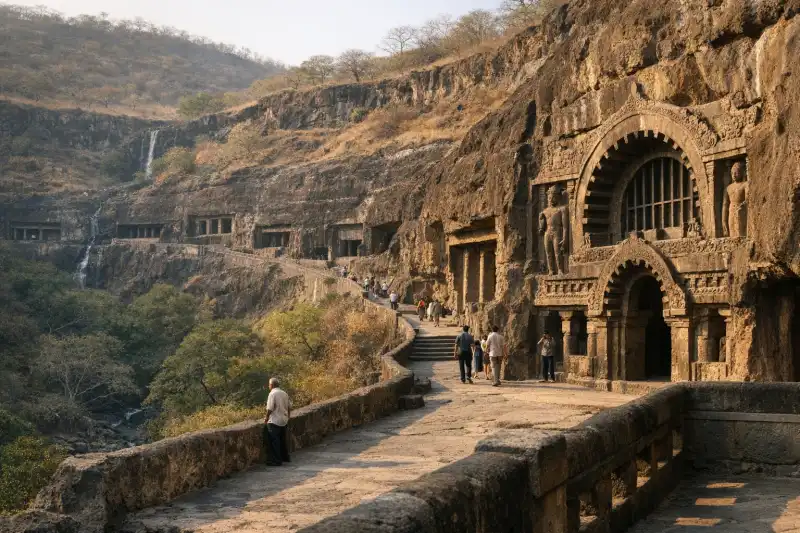
Ajanta Caves
Ancient Indian BuddhistExplore India’s Ajanta Caves, a masterpiece of Buddhist rock-cut art famed for murals, sculptures, a...
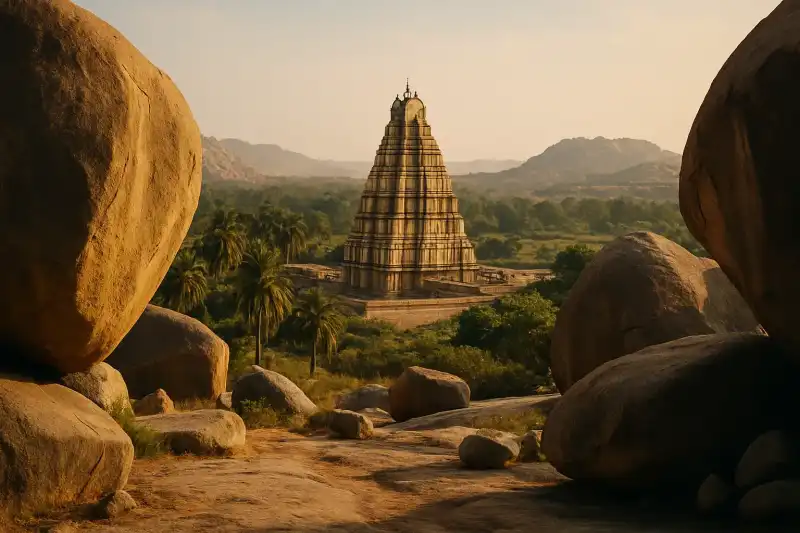
Hampi: The Bouldering Paradise Hiding Ancient India's
Vijayanagara EmpireDiscover Hampi, where Vijayanagara Empire ruins meet world-class bouldering among surreal granite la...

Angkor Wat Travel Guide 2026: Everything You Need to Know
KhmerAngkor Wat, the world's largest religious monument, spans over 400 acres in the heart of Cambodia. T...