Quick Info
At a glance
Si Satchanalai in Thailand feels different from many famous heritage sites the moment you arrive. Instead of a crush of tour groups and hurried photo stops, you find broad green spaces, laterite ruins softened by age, and temple silhouettes rising quietly above trees. The ancient city stands in northern central Thailand, in today’s Sukhothai Province, and was once one of the most important urban centers of the Sukhothai Kingdom. Now preserved as Si Satchanalai Historical Park, it offers a vivid sense of how a medieval Thai city could be both monumental and deeply connected to river, forest, craft production, and religious life.
What makes the site memorable is not only its UNESCO status, but its atmosphere. Paths wind past lotus ponds, old defensive walls, and elegant chedis that reveal changing artistic influences from Sri Lanka, the Khmer world, and local Sukhothai traditions. Compared with nearby Sukhothai, Si Satchanalai often feels calmer and more spacious, making it especially rewarding for travelers who like to explore at their own pace. Here, the remains of monasteries, ordination halls, and kiln complexes tell a layered story of kingship, Buddhism, trade, and craftsmanship. For visitors interested in ancient Thailand, this is not a secondary stop but a major destination in its own right: a place where political history, religious devotion, and artistic refinement still linger in brick, stucco, and stone.
History
Origins before the Sukhothai Kingdom
The area around Si Satchanalai was occupied before it became one of the principal cities of the Sukhothai realm. Its position near the Yom River helped shape its early importance. River systems in mainland Southeast Asia were not only sources of water and fertile land, but also arteries of communication and trade. Settlements in this region benefited from agricultural production and access to wider networks linking inland communities with neighboring cultural spheres.
Before the rise of an independent Thai kingdom in the 13th century, central and northern Thailand saw the influence of earlier Mon, Khmer, and local Tai political traditions. Architectural and artistic forms that later appeared at Si Satchanalai did not emerge in isolation. The city’s eventual monuments show traces of these broader currents, especially in the use of prang-like towers, laterite construction, and certain religious layouts. By the time the city became prominent, it had inherited a landscape already shaped by regional exchange and state formation.
Si Satchanalai under Sukhothai rule
Si Satchanalai rose to prominence during the Sukhothai period, roughly from the 13th century onward, when it served as a key sister city to Sukhothai itself. It was not a peripheral outpost. Historical evidence suggests it played an important political and dynastic role, sometimes associated with crown princes and royal administration. In practical terms, that meant the city stood close to the center of power, not merely under it.
This status is reflected in the scale and quality of the surviving monuments. Numerous wats, city fortifications, and administrative zones point to a prosperous urban center with both ceremonial and strategic importance. The city was enclosed by walls and moats in some areas, while nearby hills provided a defensible landscape. Religion was central to city life, and Theravada Buddhism shaped much of the monumental building program. At the same time, the architecture shows experimentation and synthesis, hallmarks of a kingdom defining its own identity.
One of Si Satchanalai’s major distinctions was its role in ceramic production. The region became famous for high-quality wares often referred to as Sawankhalok ceramics. Kiln sites in and around the ancient city indicate a thriving craft industry that likely supplied domestic and overseas markets. This made Si Satchanalai not only a religious and political center but also an economic one.
Later transformations and decline
Like many premodern cities in Southeast Asia, Si Satchanalai did not remain politically dominant forever. As power shifted southward and regional kingdoms evolved, the city’s central role diminished. The rise of Ayutthaya gradually altered the political map of Thailand. Although Si Satchanalai continued to matter locally, it no longer occupied the same position it had held during the height of Sukhothai influence.
Over time, some monuments were abandoned, damaged, adapted, or repaired. Forest growth, changing trade routes, warfare, and shifts in settlement patterns all contributed to the city’s transformation. Yet unlike some ancient urban centers that disappeared almost completely beneath later development, Si Satchanalai retained enough of its historical footprint to preserve the outlines of its old sacred and civic landscape.
The city’s kilns also declined as production patterns changed. Even so, ceramic finds from the region remained important for understanding Southeast Asian trade and technology. Archaeology later revealed just how significant the manufacturing sector had once been.
Rediscovery, conservation, and UNESCO recognition
Modern archaeological work and conservation efforts brought Si Satchanalai back into broader public awareness. Scholars, Thai heritage authorities, and conservators documented the temples, walls, sculptures, and kilns, gradually clarifying the city’s importance within the Sukhothai era. Restoration has generally aimed to stabilize the ruins while preserving the atmosphere of the site rather than reconstructing it too heavily.
Si Satchanalai is now protected as part of the UNESCO World Heritage listing known as the Historic Town of Sukhothai and Associated Historic Towns. This recognition places it among the most important cultural sites in Thailand. Today, the park allows visitors to experience a former royal and religious center in a relatively open, uncrowded setting, where the broad patterns of an ancient city are still legible in the terrain.
Key Features
The appeal of Si Satchanalai lies in its combination of major monuments and quiet archaeological texture. This is not a site defined by a single iconic ruin. Instead, its power comes from the relationship between many structures spread across a large historic landscape. As you move through the park, you begin to understand the city as a network of sacred compounds, roads, water features, and defensive lines rather than as an isolated collection of temple remains.
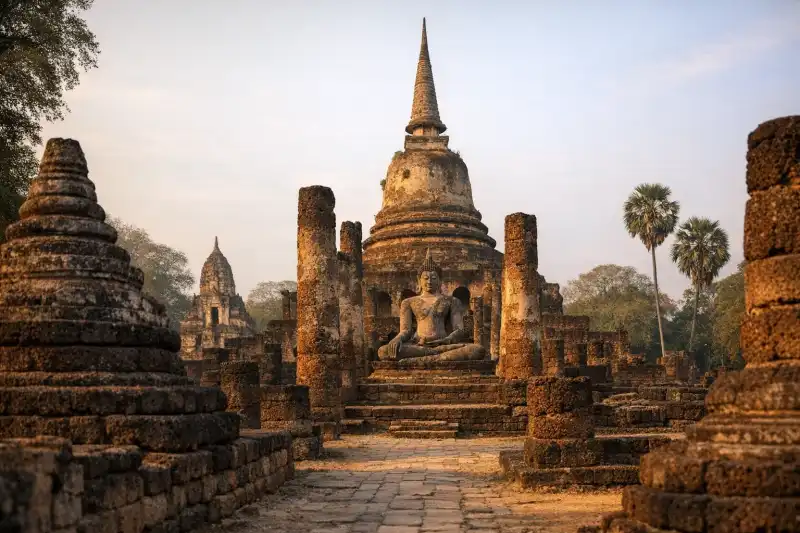
Wat Chang Lom is often the first monument to leave a lasting impression. Its bell-shaped chedi is encircled by rows of sculpted elephants emerging from the base, a design with roots in Sri Lankan Buddhist architecture but interpreted in a distinctly local way. The elephants give the structure both symbolic weight and visual rhythm, and the surviving stucco work hints at how rich the original decorative scheme once was. Surrounded by trees and open space, the monument captures the graceful seriousness of Sukhothai religious architecture.
Another highlight is Wat Chedi Chet Thaeo, one of the park’s most architecturally varied temple complexes. Rather than presenting a single dominant form, it contains multiple chedis of different shapes and styles, suggesting continuous patronage and evolving artistic preferences over time. For visitors, this makes the site especially revealing. You can see how builders and patrons experimented with form, combining lotus-bud towers, square bases, and other structural types. It feels almost like an open-air study in the visual language of the Sukhothai world.
Wat Nang Phaya is famous for its refined stucco decoration, particularly floral and geometric motifs that show a high level of craftsmanship. Though time has taken much of the original surface, enough remains to demonstrate the elegance of the artisans who worked here. This temple helps explain why Si Satchanalai matters not only politically and religiously, but artistically. The surviving ornament is delicate in concept even where it is weathered in fact.
The site’s topography also adds character. Some monuments sit on flatter ground among trees and ponds, while others relate to low hills that define the edge of the city. This creates changing views and a stronger sense of spatial planning than visitors sometimes expect. The old city walls and gates, though fragmentary, still suggest a once-organized urban system. You are not simply visiting temples in a park; you are moving through the remains of a functioning city with sacred, defensive, and productive zones.
One of the most distinctive aspects of Si Satchanalai is the connection to ceramic production. The nearby kiln areas, associated with the famous Sawankhalok wares, expand the meaning of the site beyond ritual architecture. These kilns speak to industry, trade, and technical skill. They remind visitors that medieval cities were sustained not only by kings and monks but by potters, laborers, merchants, and transport networks. In this sense, Si Satchanalai offers a more complete portrait of premodern urban life than temple ruins alone might suggest.
The natural setting contributes greatly to the visitor experience. During the early morning, light filters through trees and falls softly across brick platforms and laterite columns. In the late afternoon, shadows sharpen the profiles of stupas and assembly halls. Because the park is relatively expansive and less crowded than some Thai heritage attractions, it is easy to pause, listen, and notice details: the curve of a chedi, the texture of old brick, the way roots edge around ancient foundations. This calm is one of the site’s greatest features.
For travelers interested in photography, architecture, religion, archaeology, or landscape history, Si Satchanalai works on several levels at once. It rewards quick visits with obvious beauty, but it rewards slow visits even more by revealing the underlying logic of a once-important city.
Getting There
Si Satchanalai Historical Park is most commonly reached from Sukhothai, Sawankhalok, Phitsanulok, or even Chiang Mai and Bangkok as part of a longer overland itinerary. The simplest option is a private car or taxi. From modern Sukhothai, the drive usually takes around 1 to 1.5 hours depending on your exact starting point and road conditions. A private taxi or arranged transfer from Sukhothai often costs roughly 1,200 to 2,000 THB round trip, depending on waiting time and negotiation.
Budget travelers can combine local transport. From Sukhothai or New Sukhothai, you may be able to take a bus or minivan toward Sawankhalok, then continue by local songthaew or tuk-tuk to the historical park. Total one-way costs can be quite modest, often around 80 to 200 THB depending on connections, but schedules may be limited and travel times less predictable. If you want flexibility, staying in Sawankhalok or arranging transport through a guesthouse can make the journey much easier.
From Bangkok, some travelers take a domestic flight to Sukhothai or Phitsanulok, then continue by road. Flights are the fastest option, but train-and-road combinations are also possible via nearby rail-connected towns. Once at the park, cycling is a popular way to explore if bicycles are available locally, while motorbikes and hired drivers are useful for covering outlying areas more efficiently. Bring water, sun protection, and cash for tickets, transport, and small local services.
When to Visit
The best time to visit Si Satchanalai is generally the cool season from November to February. During these months, temperatures are more comfortable, humidity is lower, and exploring the large archaeological park on foot or by bicycle is far easier. Morning and late afternoon are especially pleasant, with softer light that also makes the ruins more photogenic.
The hot season, usually from March to May, can still be rewarding if you start early, but midday heat can be intense. Because the site is spread out, you may spend longer in the sun than expected. If visiting at this time, plan a sunrise or early morning start, carry plenty of water, and take breaks in shaded areas.
The rainy season, roughly from June to October, transforms the landscape. Vegetation becomes lush, ponds and surrounding greenery look vibrant, and the park can feel especially atmospheric. Rain showers, however, may interrupt sightseeing and make cycling less convenient. Paths can be slick in places, and photography may require patience between downpours. On the positive side, visitor numbers are often lower.
If you can choose your timing precisely, aim for a weekday morning in the cool season. This combination offers the best balance of comfort, light, and quiet. Festival periods can add cultural interest, but they may also bring more domestic visitors. No matter the month, arriving early is one of the smartest choices, because Si Satchanalai is at its most evocative when the air is still cool and the ancient city feels almost private.
| Quick Facts | Details |
|---|---|
| Location | Si Satchanalai District, Sukhothai Province, Thailand |
| UNESCO Status | Part of the Historic Town of Sukhothai and Associated Historic Towns |
| Historical Era | Sukhothai Kingdom |
| Main Significance | Royal, religious, and ceramic-production center |
| Best For | Archaeology, architecture, cycling, photography, Thai history |
| Ideal Visit Length | Half day to full day |
| Nearest Base | Sawankhalok or Sukhothai |
| Best Season | November to February |
| Typical Transport | Private car, taxi, local bus plus songthaew |
| Notable Monuments | Wat Chang Lom, Wat Chedi Chet Thaeo, Wat Nang Phaya |
Si Satchanalai rewards the traveler who values atmosphere as much as monumentality. It is historically important, visually rich, and still comparatively peaceful, allowing you to imagine the rhythms of an old Thai city without constant interruption. Where some archaeological parks impress through scale alone, this one draws you in through balance: sacred architecture, evidence of craftsmanship, traces of urban planning, and a natural setting that has not overwhelmed the ruins but gently frames them. For anyone exploring the heritage of Thailand beyond the most famous stops, Si Satchanalai is one of the country’s essential ancient places.
Guided tours: worth it?
Self-guided works here, but a guide can add real value if you want the ruins explained as a living place rather than just a sequence of monuments.
Best for
- First-time visitors who want context, not just photos
- Short visits where a planned route saves time
When to go self-guided
Go independently if you prefer setting your own pace, reading as you go, and checking official hours or ticket rules directly before you arrive.
What I’d avoid
Skip paid tours that bundle unrelated stops you do not actually want. The best option should either save meaningful planning time or add historical context you would miss on your own.
Si Satchanalai Historical Park tours
Useful when: you want to compare guided formats before deciding
Sukhothai and Si Satchanalai day trips
Useful when: transport or pickup logistics matter
Sukhothai historical tours from Bangkok
Useful when: transport or pickup logistics matter
Some tour links are affiliate links, which may earn Ancient Travel a small commission at no extra cost to you. I try to surface options that make practical sense for the site—not just anything bookable.
Frequently Asked Questions
What is Si Satchanalai known for?
Si Satchanalai is known for its well-preserved Sukhothai-era temples, ancient city walls, ceramic kiln sites, and its status as part of the UNESCO-listed Historic Town of Sukhothai and Associated Historic Towns.
Is Si Satchanalai worth visiting?
Yes. It is one of Thailand’s most rewarding archaeological parks, offering major monuments, quieter paths, and a more peaceful atmosphere than many better-known heritage sites.
How much time do you need at Si Satchanalai?
Most visitors need at least half a day to see the main ruins, while a full day is ideal if you want to cycle, visit outlying temples, and explore the kiln areas.
How do you get to Si Satchanalai from Sukhothai?
The site is usually reached by car, private transfer, or local bus and songthaew combinations from Sukhothai. Travel time is typically around 1 to 1.5 hours depending on route and connections.
When is the best time to visit Si Satchanalai?
The coolest and most comfortable months are generally from November to February, when temperatures are lower and sightseeing is easier.
Can you cycle around Si Satchanalai Historical Park?
Yes. Cycling is one of the best ways to explore the park because the grounds are spacious, roads are relatively calm, and many ruins are spread out across a large area.
Nearby Ancient Sites
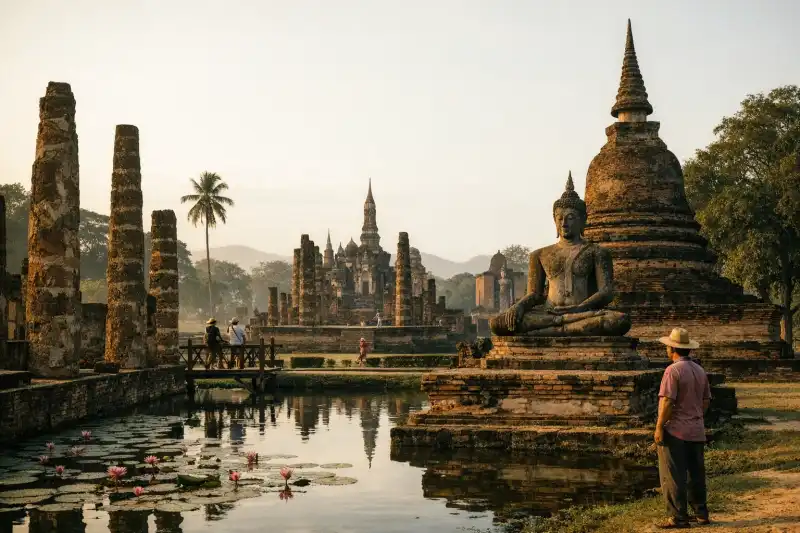
Sukhothai
Sukhothai, in northern Thailand's Sukhothai Province, is famed as the cradle of Thai civilization an...
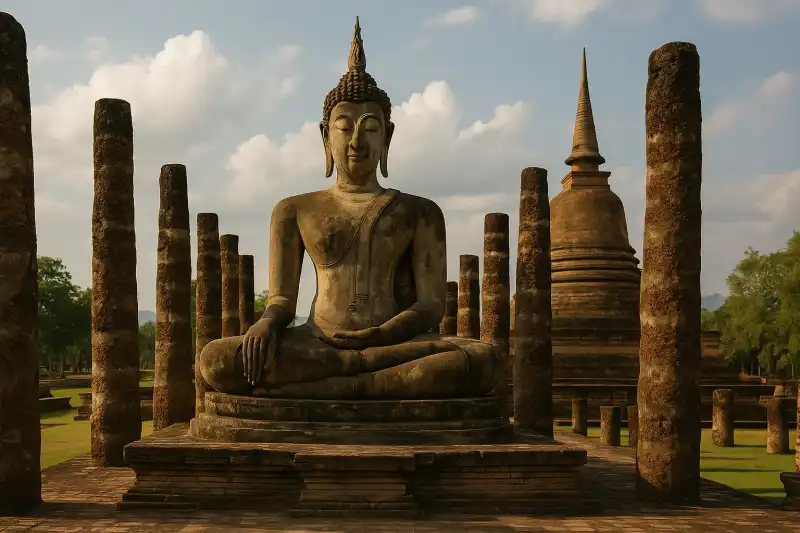
Sukhothai Historical Park Travel Guide 2026: Thailand’s First Capital Without the Crowds
Sukhothai KingdomPlan a smarter Sukhothai Historical Park visit with route tips, key ruins, and practical timing for ...
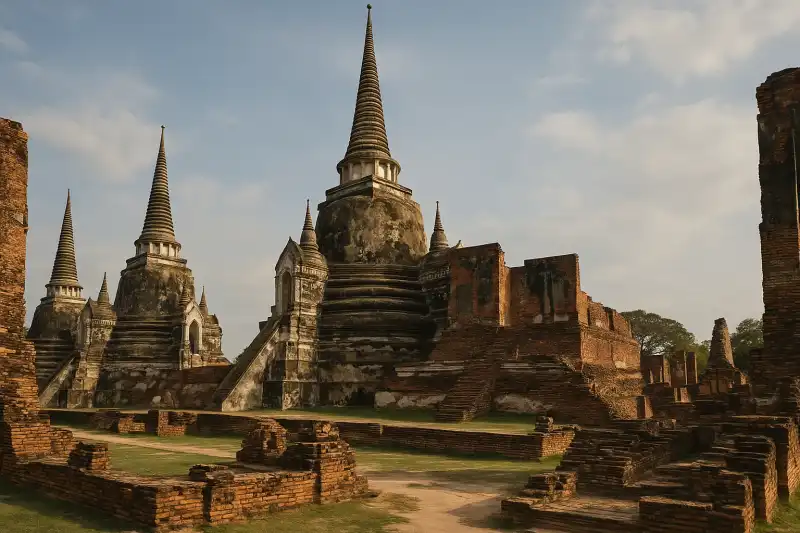
Ayutthaya Travel Guide 2026: Temple Ruins, Day Trip Planning, and What to Prioritize
Ayutthaya KingdomPlan a focused Ayutthaya visit with practical temple routing, timing, and transport guidance from Ba...
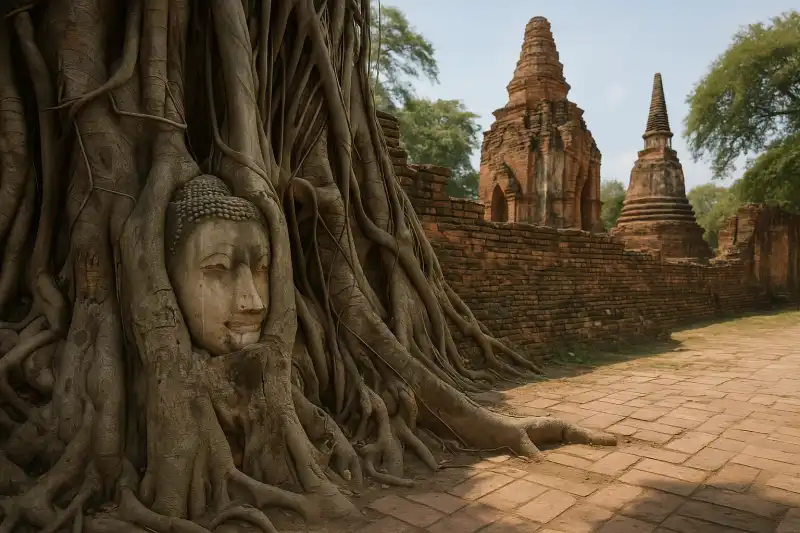
Wat Mahathat Ayutthaya Travel Guide 2026: The Tree-Root Buddha Head, Timing, and What to Know
Ayutthaya KingdomPlan a focused Wat Mahathat visit with practical timing, photography etiquette, and routing tips ins...