Quick Info
At a glance
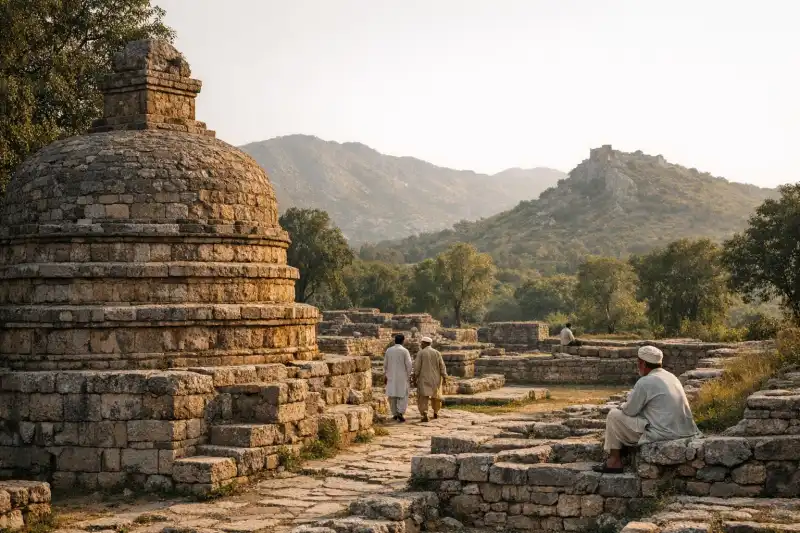
Taxila in Pakistan is not a single ruin standing alone in a field, but a layered archaeological landscape where entire centuries seem to lie side by side. Just northwest of Islamabad, this UNESCO World Heritage Site preserves the remains of ancient cities, monasteries, shrines, fortifications, and streets that once connected South Asia with Central Asia, Persia, and the wider Hellenistic world. A visit here feels less like entering one monument and more like stepping into a map of civilizations that met, traded, argued, worshipped, and learned in the same valley.
The setting adds to that impression. Low hills rise beyond the plains, and the modern town gives way to broken stone walls, stupas, and monastic courtyards that appear with little warning. Taxila is often described as one of the great centers of Gandhara, but that phrase only hints at its historical depth. The site spans multiple urban foundations, including Bhir Mound, Sirkap, and Sirsukh, each associated with different rulers and cultural influences. Nearby religious complexes such as Dharmarajika and Jaulian reveal how important Taxila became for Buddhism, especially under the Kushans. At the museum, elegant schist sculptures and devotional objects help tie the scattered ruins into a coherent story. For travelers interested in ancient history, religion, archaeology, or the meeting of East and West, Taxila is one of Pakistan’s most compelling and intellectually rewarding destinations.
History
Early settlement and Achaemenid influence
The history of Taxila reaches back well before the classical world took notice of it. The valley was inhabited from very early times, and by the first millennium BCE it had become an important settlement zone due to its strategic position near the routes linking the Indus region with the northwest. Taxila sat in a natural corridor between the Indian subcontinent and lands farther west, a location that made it valuable long before monumental ruins were built.
By around the 6th century BCE, the region came under Achaemenid Persian influence, likely as part of the empire’s eastern frontier. This connection introduced Taxila to wider imperial networks of taxation, administration, and long-distance exchange. While the surviving ruins visible today are mostly later, the importance of Taxila as a regional center was already established in this period. Ancient literary traditions also associate it with learning, and although some later claims about a formal “university” can be overstated, there is little doubt that Taxila became known as a place where teachers, scholars, and religious thinkers gathered.
Alexander, the Indo-Greeks, and the city of Sirkap
In the late 4th century BCE, Alexander the Great passed through the region during his campaign into the Indian subcontinent. Classical sources mention a ruler of Taxila who allied with him, demonstrating the city’s political significance. After Alexander’s death, the area fell into shifting patterns of control among Hellenistic successors, local dynasties, and eventually the Mauryan Empire.
One of the most fascinating phases came later, when Indo-Greek rulers shaped the urban landscape in visible ways. The city of Sirkap, one of the principal archaeological areas at Taxila, is especially associated with this era and the centuries that followed. Its street plan reflects a more regular, gridded layout than earlier settlement forms, and scholars have long noted the blend of Hellenistic, South Asian, and Iranian elements in its architecture and material culture. In Taxila, these influences were not abstract concepts but practical realities. Coins, shrines, decorative motifs, and building techniques all suggest that people from different traditions shared the same urban environment.
Mauryan and Buddhist development
The Mauryan period, especially under Ashoka in the 3rd century BCE, was pivotal for the spread of Buddhism in the region. Taxila became one of the important centers where Buddhist patronage left an enduring mark. Monuments such as stupas and monastic institutions began to transform the valley into a sacred as well as political landscape.
This was not a simple replacement of one culture by another. Taxila remained a crossroads, and Buddhism developed here within a cosmopolitan environment shaped by merchants, rulers, pilgrims, and artisans. The city’s position on major routes helped Buddhist institutions flourish, since monasteries often benefited from trade traffic and royal donations alike. Over time, the region accumulated a constellation of religious complexes rather than a single dominant sanctuary.
Kushan prosperity and Gandharan brilliance
Taxila reached one of its great peaks under the Kushans, particularly from the 1st to 3rd centuries CE. During this period, Gandhara emerged as one of the most remarkable artistic and religious zones in Asia, and Taxila was one of its major centers. The Kushan Empire linked northern India, Afghanistan, and Central Asia, creating conditions for prosperity and exchange on an extraordinary scale.
Many of the Buddhist remains most admired by visitors today belong to this broad era. Monasteries such as Jaulian show a mature architectural and devotional world: courtyards lined with chapels, votive stupas, monastic cells, and richly adorned sacred spaces. Gandharan sculpture flourished, with images of the Buddha and bodhisattvas carved in a style that often reveals classical Mediterranean influence while remaining deeply rooted in Buddhist religious life. Taxila’s artistic output and intellectual climate made it a major node in the transmission of Buddhist ideas across Asia.
Decline, invasions, and rediscovery
Taxila’s decline was gradual rather than sudden. Changing trade routes, political instability, and repeated invasions weakened the city over time. By the 5th century CE, the invasions of the Huns severely disrupted urban and monastic life across the region. Many religious establishments were damaged or abandoned, and Taxila eventually lost the prominence it had held for centuries.
For long periods, the ancient cities survived mainly as mounds, local memory, and scattered ruins. Serious archaeological attention in the 19th and early 20th centuries, especially through the work of Sir John Marshall, brought Taxila back into wider historical consciousness. Excavations revealed just how extensive the site was and confirmed its importance for understanding the cultural interplay of South Asia, the Hellenistic world, and Buddhist history. Today, Taxila stands not only as an ancient city complex but as one of the key places for studying how civilizations overlapped rather than remained separate.
Key Features
Taxila’s greatest strength as a destination is its variety. Instead of one iconic monument dominating the experience, the site unfolds as a network of places that together reveal how the valley evolved over many centuries. This makes it especially rewarding for travelers who enjoy comparing urban forms, religious architecture, and changing artistic styles.
Bhir Mound is usually understood as the earliest major urban settlement among the principal ruins. What visitors see now may appear less visually dramatic than some of the later remains, but that understated quality is part of its interest. The irregular layout suggests an older city form, one less geometrically ordered than Sirkap. Walking through the area, you are not looking for a single grand facade but for the texture of an early city: foundations, lanes, and the sense of life arranged organically over time.
Sirkap is often the most immediately striking urban ruin in Taxila. Its planned street grid and surviving walls make it easier to imagine a functioning ancient city. Here, the sense of cultural blending becomes especially vivid. Archaeologists have identified sanctuaries and structures reflecting multiple traditions, and visitors often notice how the city feels both South Asian and connected to a broader Hellenistic urban vocabulary. Among its best-known remains is the so-called Double-Headed Eagle Stupa, frequently cited as an example of Taxila’s mixed artistic language. Even when the decorative details are weathered, the site conveys unusual complexity: this was a city where ideas crossed boundaries as readily as merchants crossed roads.
Sirsukh, the latest of the three main cities, is less commonly the emotional centerpiece for first-time visitors, but it completes the historical sequence. Founded under Kushan rule, it reflects another phase of urban planning and defense. While not always as immediately evocative as Sirkap or as spiritually resonant as the monasteries, it matters because it shows that Taxila was not frozen in one era. It kept being rebuilt, reimagined, and adapted as political powers changed.
Among the religious monuments, Dharmarajika is one of the essential stops. This large stupa complex is associated with early Buddhist patronage and later additions, and its broad open setting helps visitors understand the scale of Buddhist activity around Taxila. The central mound, subsidiary chapels, and scattered remains create a sacred landscape rather than a single enclosed monument. It is the kind of place where movement matters: as you walk around the structure, the plan of devotion becomes easier to grasp.
Jaulian, by contrast, is often the site that leaves the strongest visual impression. Set on a hill, this monastery complex preserves a more intimate and legible monastic environment. Cells open onto courtyards, and the assembly of stupas and shrines feels close enough to imagine daily routine. The remains of stucco and carved elements help bring the place to life. Even travelers with only a general interest in Buddhist archaeology often find Jaulian memorable because it combines atmosphere, setting, and architectural clarity.
The Taxila Museum is indispensable. Because the archaeological zones are spread out and represent different periods, the museum provides the narrative thread that binds the visit together. Its collection of Gandharan sculpture is particularly important, with serene Buddhas, bodhisattvas, friezes, reliquaries, and ornamental fragments that reveal the sophistication of local workshops. The museum also displays coins and smaller finds that help explain trade, political change, and the multicultural character of the region. Without the museum, the valley can feel like a sequence of impressive ruins; with it, the whole site becomes historically legible.
Another key feature of Taxila is the broader landscape itself. The ruins are not isolated museum pieces but parts of a valley shaped by roads, hills, fields, and changing settlement patterns. That context reminds visitors why Taxila mattered so much. It controlled movement. It connected regions. It became wealthy because people and ideas could pass through it. The best way to appreciate Taxila is to think of it as an ancient system rather than a single monument.
Getting There
Taxila is one of the easiest major archaeological destinations to reach in Pakistan. It lies roughly 35 to 40 kilometers northwest of Islamabad and can be visited comfortably as a half-day or full-day trip from either Islamabad or Rawalpindi. By car or hired taxi, the journey usually takes around 45 minutes to 1 hour depending on traffic. Ride-hailing and private taxi fares from central Islamabad often range from PKR 2,500 to 5,000 one way, while a full round trip with waiting time may cost more depending on negotiation and vehicle type.
Budget travelers can use public transport. Buses and local wagons run between Rawalpindi, Islamabad, and Taxila, though they are less direct and less comfortable than a private car. Fares are generally inexpensive, often in the range of PKR 100 to 300 depending on route and vehicle. From the Taxila town area, you may need a rickshaw or local taxi to reach the museum and scattered archaeological sites, since the ruins are not all clustered in one walkable zone.
Hiring a driver for the day is often the most practical option, especially if you want to combine the Taxila Museum, Sirkap, Dharmarajika, and Jaulian. Day hire from Islamabad commonly starts around PKR 8,000 to 15,000 depending on vehicle size and waiting time. Organized tours are another convenient choice if you want transport plus historical context. Visitors should carry some cash for local transport, tickets, and refreshments, and start early if planning to cover several areas in one trip.
When to Visit
The best time to visit Taxila is from October to March, when temperatures are milder and outdoor exploration is more comfortable. During these months, skies are often clearer, the light is softer for photography, and walking among exposed stone ruins is far more pleasant than in peak summer heat. Winter days are usually manageable, though mornings and evenings can feel cool, so layered clothing is a good idea.
Spring, particularly February and March, is also attractive because the surrounding landscape can look greener and the weather remains favorable before the hotter season begins. This is an especially good time for travelers who want to spend longer at multiple sites without feeling rushed by the sun.
Summer, from roughly May to August, can be intensely hot. Since most of Taxila’s archaeological remains are open and offer limited shade, midday visits in summer can be tiring. If you must go during this period, arrive early in the morning, carry plenty of water, wear sun protection, and keep expectations realistic about how many separate ruins you can comfortably cover in one day.
The monsoon period can bring humidity and occasional rain, though the region is not visited primarily for lush weather. Rain may soften the atmosphere and reduce dust, but it can also complicate movement between sites. Overall, the cooler season remains the strongest choice. If possible, visit on a clear weekday morning, when the museum and ruins feel calmer and you have more space to absorb Taxila’s unusual mix of silence, scholarship, and deep historical resonance.
| Quick Facts | Details |
|---|---|
| Location | Taxila, Punjab, Pakistan |
| UNESCO Status | Part of the Taxila World Heritage Site |
| Main Periods | Achaemenid, Mauryan, Indo-Greek, Scythian, Parthian, Kushan |
| Best Known For | Gandharan art, Buddhist monasteries, ancient urban ruins |
| Key Areas | Bhir Mound, Sirkap, Sirsukh, Dharmarajika, Jaulian, Taxila Museum |
| Nearest Major City | Islamabad |
| Ideal Visit Length | Half day to full day |
| Best Season | October to March |
| Site Type | Archaeological complex and museum |
| Historical Importance | Major crossroads of trade, religion, and learning in ancient South Asia |
Taxila rewards visitors who arrive with curiosity and patience. It is not a site of instant spectacle in the way of a single colossal temple or towering fortress. Its power lies in accumulation: one city after another, one monastery after another, one layer of exchange after another. The ruins ask you to notice transition as much as monumentality. Here, urban planning shifts with political rule, artistic styles absorb foreign influences without losing local meaning, and Buddhist devotion grows within a landscape shaped by trade and imperial ambition.
That is what makes Taxila so significant. It offers a rare chance to see how ancient cultures met in practice, not just in theory. Persian influence, Hellenistic forms, Indian religious traditions, and Kushan patronage all left marks in the same valley. For modern travelers, the result is one of the richest archaeological experiences in Pakistan: intellectually dense, visually varied, and deeply evocative. A day at Taxila can begin with broken walls and end with a clearer understanding of how connected the ancient world really was.
Guided tours: worth it?
Self-guided works here, but a guide can add real value if you want the ruins explained as a living place rather than just a sequence of monuments.
Best for
- First-time visitors who want context, not just photos
- Short visits where a planned route saves time
When to go self-guided
Go independently if you prefer setting your own pace, reading as you go, and checking official hours or ticket rules directly before you arrive.
What I’d avoid
Skip paid tours that bundle unrelated stops you do not actually want. The best option should either save meaningful planning time or add historical context you would miss on your own.
Taxila day tours from Islamabad
Useful when: transport or pickup logistics matter
Taxila Museum and ancient ruins tours
Useful when: you want to connect a site and museum visit
Islamabad to Taxila cultural tours
Useful when: you want to compare guided formats before deciding
Some tour links are affiliate links, which may earn Ancient Travel a small commission at no extra cost to you. I try to surface options that make practical sense for the site—not just anything bookable.
Frequently Asked Questions
What is Taxila famous for?
Taxila is famous for its extensive archaeological ruins, Buddhist monasteries, Gandharan art, and its role as a major learning and trade center in antiquity.
Where is Taxila located?
Taxila is located in Punjab Province, Pakistan, northwest of Islamabad and Rawalpindi, near the Margalla Hills.
How much time do you need to visit Taxila?
Most visitors should allow at least half a day to a full day to explore the museum and the main archaeological zones such as Bhir Mound, Sirkap, and Jaulian.
Is Taxila worth visiting from Islamabad?
Yes, Taxila is one of the most rewarding day trips from Islamabad because it is close to the capital and offers major historical, archaeological, and Buddhist heritage sites.
Do you need a guide at Taxila?
A guide is not strictly necessary, but hiring one or visiting with background reading greatly improves the experience because the site includes several separate ruins from different historical periods.
What can you see at Taxila Museum?
Taxila Museum displays sculptures, reliquaries, coins, architectural fragments, and other finds from the ancient city and surrounding monasteries, especially from the Gandharan period.
Nearby Ancient Sites
Anuradhapura
SinhaleseSacred ancient capital of Sri Lanka, Anuradhapura preserves towering Buddhist stupas, the world's ol...
Angkor Wat Travel Guide 2026: Everything You Need to Know
KhmerAngkor Wat, the world's largest religious monument, spans over 400 acres in the heart of Cambodia. T...
Angkor Thom Travel Guide 2026: Bayon Faces, Gates, and the Khmer Royal City
KhmerAngkor Thom was the last great capital of the Khmer Empire. This guide covers how to visit Bayon, th...