Quick Info
At a glance
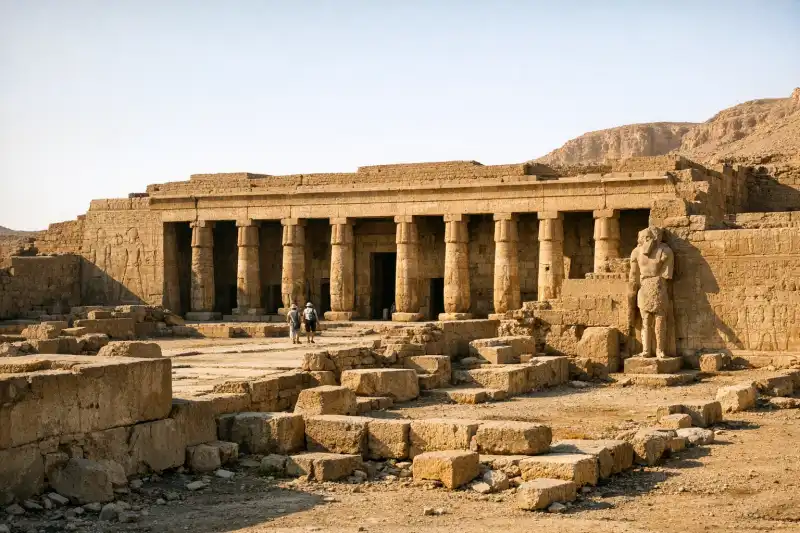
In Upper Egypt, the Temple of Seti I (Abydos) in Egypt rises from the desert edge with an air of quiet authority. Far from the more crowded monuments of Luxor and Giza, this remarkable sanctuary offers something different: a sense of intimacy with ancient Egyptian religion, kingship, and memory. Its pale limestone walls still preserve some of the finest relief carving in the country, and the temple’s setting at Abydos, one of Egypt’s holiest ancient landscapes, gives every chamber a deeper resonance.
Abydos was not just another provincial town. For millennia it was associated with Osiris, lord of the underworld, and with royal cult traditions that linked living kings to their divine and ancestral predecessors. When Seti I, father of Ramesses II, chose to build here in the 13th century BCE, he was placing himself within one of Egypt’s most sacred ceremonial centers. The result was a temple unlike many others: formal and royal, yet intensely spiritual, designed for processions, offerings, and acts of remembrance.
Today, visiting the Temple of Seti I feels like entering a masterpiece that rewards patience. Hypostyle halls, sanctuaries, and side chapels unfold in a sequence of beautifully proportioned spaces, each decorated with scenes of ritual precision and artistic confidence. Even travelers who have seen Egypt’s grander monuments often leave Abydos impressed by the quality of the surviving carvings and by the atmosphere of stillness that lingers around the site.
History
Early Sacred Abydos
Long before Seti I began building his temple, Abydos was already one of ancient Egypt’s most revered religious centers. The area had deep roots in Egypt’s earliest dynastic history and was linked to royal burials in the Early Dynastic Period. Over time, however, its greatest significance became religious rather than funerary. Abydos developed into the principal cult center of Osiris, the god of death, resurrection, and the afterlife. Pilgrims from across Egypt came here to participate in festivals, leave votive monuments, and symbolically associate themselves with the god’s cycle of death and rebirth.
This sacred background explains why Abydos mattered so much to later kings. Building at Abydos was never simply architectural patronage; it was an act of piety and legitimacy. A pharaoh who honored Osiris and the ancestral traditions of Abydos strengthened his own place within the divine order. By the New Kingdom, the site had accumulated centuries of religious prestige.
Seti I’s Vision in the New Kingdom
Seti I ruled during the 19th Dynasty, in the 13th century BCE, after a period when Egypt had restored stability and imperial reach. He is often remembered as one of the most capable rulers of his line: a military campaigner, a restorer of monuments, and a king deeply committed to traditional religion. His temple at Abydos reflects these priorities.
Rather than creating a simple local shrine, Seti I commissioned an ambitious complex dedicated to several major deities as well as to his own royal cult. The temple’s plan is unusual, with seven sanctuaries aligned at the rear, dedicated to Ptah, Re-Horakhty, Amun-Re, Osiris, Isis, Horus, and Seti himself. This arrangement reveals how the building joined universal state religion with the local sanctity of Abydos and with the divine status of the king.
The temple was also carefully decorated with scenes of offering, purification, and sacred encounter. These were not merely decorative images. In ancient Egyptian belief, such carvings activated ritual power, making the temple an eternal place of communication between gods and humanity. Seti’s reign seems to have emphasized continuity, restoration, and reverence for the past, and no feature captures this better than the famous king list inscribed here.
Completion Under Ramesses II
Seti I died before the entire temple was finished, and parts of the monument were completed by his son, Ramesses II. This continuation was common in Egyptian royal architecture, where major sacred projects often spanned reigns. At Abydos, however, close observation reveals differences in artistic quality between reliefs executed during Seti’s lifetime and some of those completed later. The carvings associated with Seti are especially admired for their delicacy, balance, and elegance; they are among the high points of New Kingdom temple art.
Ramesses II not only completed portions of the temple but also reinforced the dynastic message embedded in it. For the son of a great king, finishing his father’s monument was both a devotional duty and a political statement. It linked father and son in a visible continuum of sacred kingship.
Behind the main temple, another intriguing structure known as the Osireion was also associated with the complex. Though often discussed separately, it contributed to the site’s powerful connection with Osiris and the mysteries of death and rebirth.
Decline, Survival, and Rediscovery
Like many Egyptian temples, Abydos changed over centuries. Cult practices evolved, political centers shifted, and the site gradually lost its original ritual function. Stone was reused, structures deteriorated, and drifting sand covered parts of the ancient landscape. Yet the Temple of Seti I survived in unusually evocative condition, especially in its inner carved spaces.
Modern archaeological interest in Abydos grew in the 19th and 20th centuries, when explorers, Egyptologists, and epigraphers documented its reliefs and inscriptions. The Abydos King List became especially important for reconstructing Egyptian chronology, as it preserves the names of many rulers in a deliberate sequence. Though not a complete historical record by modern standards, it has been invaluable to scholarship.
Today the temple stands as both a major archaeological monument and one of the most spiritually charged sites in Egypt. Its history is not only the story of one king’s monument, but of a place where religion, ancestry, and royal memory were woven together over thousands of years.
Key Features
The greatest strength of the Temple of Seti I lies in its refinement. Unlike some Egyptian temples that overwhelm through sheer scale, Abydos captivates through detail, proportion, and atmosphere. As visitors move through the approach and into the interior halls, the quality of the limestone carving is immediately striking. Figures of the king and the gods retain crisp outlines, subtle modeling, and a grace that often appears almost fresh despite the monument’s age. The reliefs seem less rigid than those at many later temples; they have a calm confidence that reflects the artistic standards of Seti’s reign.
One of the temple’s most important features is its unusual arrangement of seven sanctuaries at the rear. This sequence creates a sense of ritual hierarchy and sacred depth. Each chapel was dedicated to a deity or divine figure central to Egyptian religious life, and together they form a theological map of kingship and cosmic order. The inclusion of a sanctuary for Seti himself demonstrates how Egyptian kingship operated within temple space: the pharaoh was both servant of the gods and participant in divine status. Walking through these chapels, even in their ruined condition, reveals how carefully the temple was planned to stage ceremonial movement and sacred encounter.
The first and second hypostyle halls are among the most memorable spaces. Their columns and carved walls generate a shifting play of shadow and light, especially in the morning. Here the king appears in repeated ritual acts—offering incense, pouring libations, receiving life and authority from the gods. These scenes are not repetitive in a dull sense; rather, they form a visual liturgy. Every image contributes to the maintenance of maat, the Egyptian principle of divine order, truth, and balance.
The temple’s most famous inscription is the Abydos King List. Carved on a corridor wall, it shows Seti I and the crown prince, the future Ramesses II, honoring a line of earlier kings. For modern historians, this list has been essential in understanding pharaonic succession. For ancient viewers, however, it was also an act of reverence. It expressed a selective memory of legitimate royal ancestry, linking Seti to a venerable line of predecessors. The omissions in the list are as meaningful as the inclusions, reminding us that royal history in ancient Egypt was never simply neutral record-keeping; it was curated memory in the service of legitimacy.
Another compelling aspect of the site is its setting within the broader sacred topography of Abydos. The temple was not isolated. It belonged to a landscape that included processional routes, older shrines, cemeteries, and the enigmatic Osireion. This wider context helps explain the monument’s deep association with pilgrimage and afterlife belief. Ancient Egyptians who came here did not merely visit a building—they entered a ritual environment charged with the presence of Osiris and the memory of early kings.
Architecturally, the temple also rewards close observation. Its terraces, halls, side rooms, and chapels reveal a complex but coherent design. In contrast to temples rebuilt many times over later centuries, Abydos preserves a strong sense of its original conceptual unity. The relief program, the sanctuary arrangement, and the devotional emphasis all work together. Even fragments and damaged surfaces contribute to the experience, because they make visible the long life of the monument—its use, abandonment, burial, and rediscovery.
Perhaps most memorable of all is the mood of the place. The Temple of Seti I often feels quieter than Egypt’s most famous sites. That relative calm allows visitors to notice finer details: a hand gesture in a relief, traces of pigment, the curve of a hieroglyph, or the silence of a rear chamber. For many travelers, this is where Abydos surpasses expectation. It is not only an important temple; it is one of the best places in Egypt to appreciate how sacred art, political ideology, and architectural space were fused into a single religious statement.
Getting There
The Temple of Seti I is located at Abydos in Sohag Governorate, in Upper Egypt. Most travelers visit as a road trip rather than by train alone, since the last stretch is easier by car. The most common base is Luxor, from which Abydos is typically reached on a long day trip of around 3 to 4 hours each way, often combined with Dendera. A private car and driver from Luxor usually costs about $80 to $160 USD for the day depending on vehicle type, route, and whether a guide is included. Organized private tours cost more but simplify logistics.
Another practical option is traveling from Sohag, the nearest major city. From Sohag, the drive to Abydos generally takes around 1.5 to 2 hours. A private taxi for a round trip may cost roughly 1,200 to 2,000 EGP, though prices vary by season and negotiation. Visitors arriving by train can use Sohag station as their gateway and then continue by taxi or prearranged transport.
Travelers coming from Qena or combining Abydos with Dendera often hire a driver for a full-day circuit. This is one of the best-value ways to visit if you want to see two major temple sites in one outing. Public transport exists in the region but is limited and less convenient for international visitors, especially if you want flexibility with timing.
Entrance fees are separate from transport and are typically paid on site or through current Egyptian antiquities ticketing systems. Bring water, sun protection, and small cash for transport contingencies. Because signage can be limited, many visitors find that hiring a local guide or joining a guided excursion greatly improves the experience.
When to Visit
The best time to visit the Temple of Seti I is from October to April, when temperatures in Upper Egypt are much more comfortable for walking through exposed archaeological areas. During these months, daytime weather is usually mild to warm rather than intensely hot, making it easier to explore the halls, inspect carvings, and spend time at the wider Abydos complex without rushing. Winter, especially December through February, tends to offer the most pleasant conditions, though mornings can be cool.
Spring and autumn are also excellent choices. In October and November, the heat of summer has usually eased, and the light can be especially attractive for photography. March and early April are similarly rewarding, though occasional dust or wind may affect visibility. If you are combining Abydos with Dendera or other Upper Egyptian sites, these shoulder months often provide a good balance of manageable weather and fewer crowds.
Summer visits from May to September are possible but demanding. Temperatures can become severe by midday, and the exposed approach to the temple can feel exhausting. If you must travel in summer, aim to arrive early in the morning, carry plenty of water, and avoid the hottest hours. The temple’s interior spaces offer some shelter, but the journey itself can be tiring in extreme heat.
For the best overall experience, start early and allow time to enjoy the quiet atmosphere. Abydos is less crowded than many famous Egyptian sites, and an early visit often makes the temple feel even more contemplative. If you value photography, relief study, and a calmer pace, cooler months and morning hours are ideal.
| Quick Facts | Details |
|---|---|
| Location | Abydos, Sohag Governorate, Egypt |
| Historical Period | New Kingdom, 19th Dynasty |
| Builder | Pharaoh Seti I, completed in part by Ramesses II |
| Date | 13th century BCE |
| Main Significance | Major cult temple at sacred Abydos, linked to Osiris and royal ancestry |
| Most Famous Feature | The Abydos King List |
| Best For | Ancient Egyptian history, temple reliefs, religious archaeology |
| Typical Visit Length | 1.5 to 3 hours |
| Nearest Major City | Sohag |
| Common Excursion Route | Day trip from Luxor, often combined with Dendera |
Guided tours: worth it?
Self-guided works here, but a guide can add real value if you want the ruins explained as a living place rather than just a sequence of monuments.
Best for
- First-time visitors who want context, not just photos
- Short visits where a planned route saves time
When to go self-guided
Go independently if you prefer setting your own pace, reading as you go, and checking official hours or ticket rules directly before you arrive.
What I’d avoid
Skip paid tours that bundle unrelated stops you do not actually want. The best option should either save meaningful planning time or add historical context you would miss on your own.
Abydos and Dendera day tours
Useful when: you want to compare guided formats before deciding
Luxor to Abydos private tour
Useful when: you want flexible timing or a private guide
Sohag to Abydos temple tours
Useful when: you want to compare guided formats before deciding
Some tour links are affiliate links, which may earn Ancient Travel a small commission at no extra cost to you. I try to surface options that make practical sense for the site—not just anything bookable.
Frequently Asked Questions
What is the Temple of Seti I at Abydos known for?
It is best known for its exceptionally fine relief carving, its importance within the sacred landscape of Abydos, and the famous Abydos King List, a chronological list of pharaohs carved on one wall.
How do I get to the Temple of Seti I (Abydos)?
Most visitors arrive by private car or organized day trip from Luxor, Sohag, or Qena. The temple is in Abydos in Sohag Governorate, and independent travelers usually combine it with Dendera.
How much time should I spend at the temple?
Allow around 1.5 to 3 hours on site. History-focused travelers may want longer to study the reliefs, chapels, and the wider Abydos archaeological area.
Is the Abydos King List still visible?
Yes, the wall containing the Abydos King List is one of the temple's highlights, though visibility and access can vary depending on conservation work and site management.
When is the best time to visit the Temple of Seti I (Abydos)?
The best months are from October to April, when temperatures are cooler and more comfortable for walking through exposed archaeological areas.
Can I visit Abydos without a guide?
Yes, but a guide is highly recommended because the temple's historical significance, inscriptions, and symbolic layout are much easier to appreciate with expert explanation.
Nearby Ancient Sites
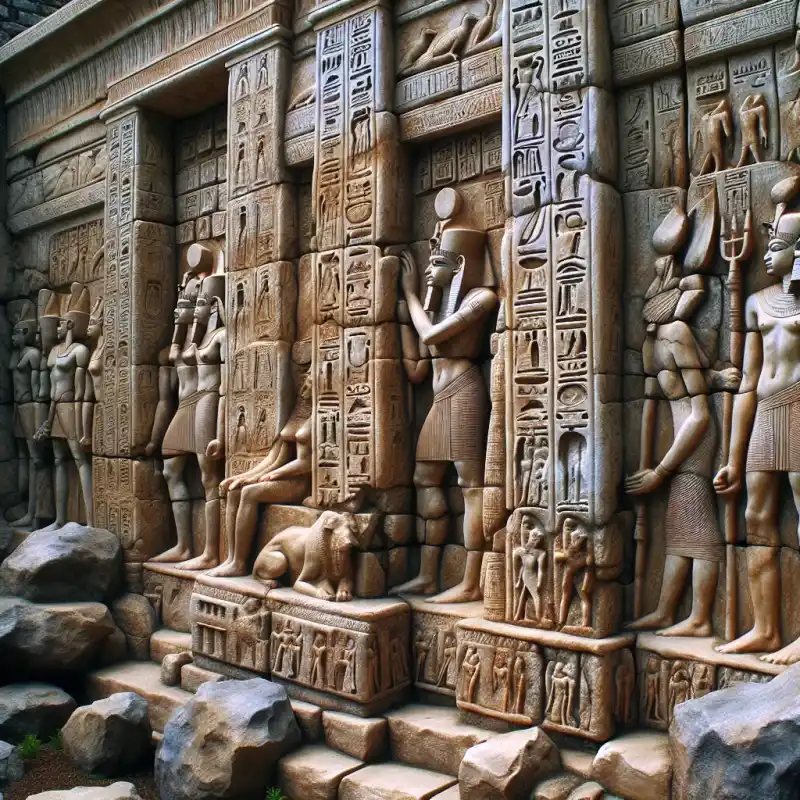
Abydos Temple Egypt Guide 2026: Temple of Seti I & King List
New Kingdom-PtolemaicAbydos Temple near Luxor: magnificent Temple of Seti I with war reliefs, ancient king list, and vibr...
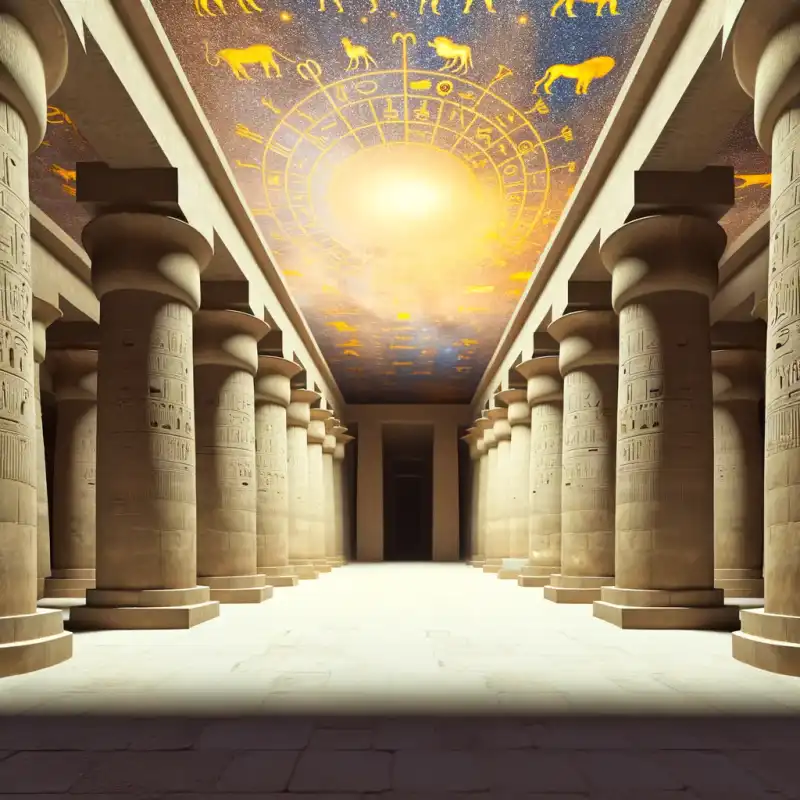
Dendera Temple Complex Egypt Guide 2026: Temple of Hathor & Zodiac Ceiling
Ptolemaic-RomanExplore Dendera's magnificent Temple of Hathor near Luxor. Star-mapped zodiac ceiling, Ptolemaic arc...
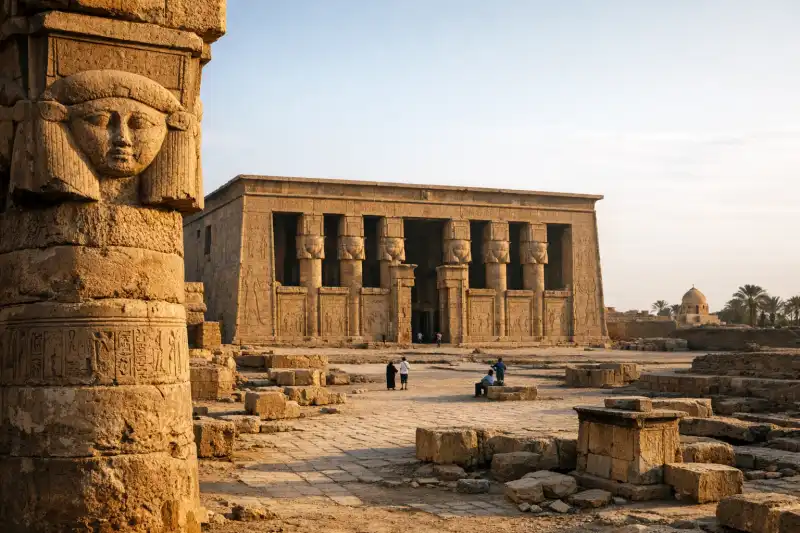
Dendera Temple Complex
The Dendera Temple Complex in Egypt is a remarkably preserved ancient site renowned for its grand Te...
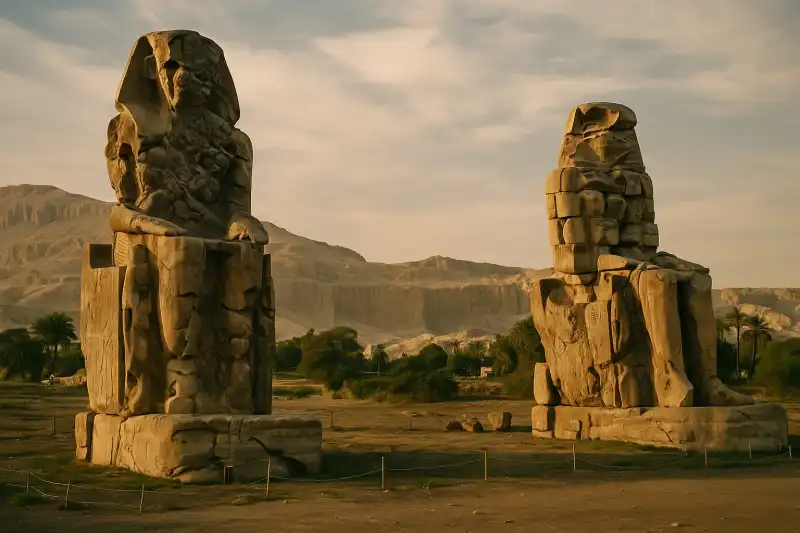
Colossi of Memnon
Ancient Egypt (New Kingdom)Twin colossal statues of Pharaoh Amenhotep III guarding the Theban necropolis on Luxor's West Bank, ...