Quick Info
At a glance
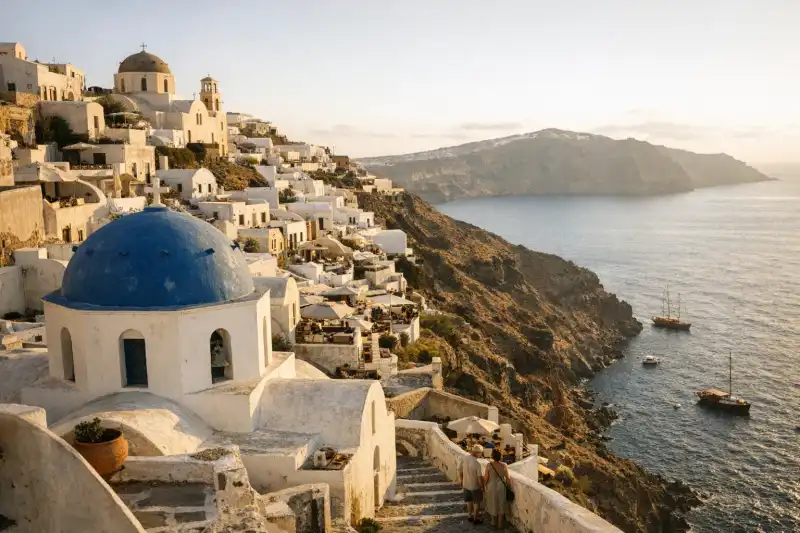
Thera in Greece rises above the bright Aegean on a long ridge of dark rock, where the remains of an ancient city still command one of the most striking views in the Cyclades. Known today as Ancient Thera, the site sits atop Mesa Vouno on Santorini, between the resort beaches of Kamari and Perissa, far from the postcard crowds that concentrate on the island’s caldera edge. Here, instead of whitewashed lanes and sunset terraces, visitors find streets, sanctuaries, houses, and public buildings laid out on a mountain crest, shaped by centuries of Greek, Roman, and Byzantine occupation.
What makes Thera so memorable is not only its archaeology but its setting. The climb itself feels theatrical: sea below, wind across the ridge, and the volcanic landscape opening in every direction. Once at the top, the ruins seem less like isolated stones and more like a city paused mid-conversation with the sky. It is a place where military strategy, trade, religion, and daily life all intersected, and where geography clearly influenced history. For travelers interested in ancient Greece beyond Athens, Thera offers a rewarding contrast—less monumental than a great mainland sanctuary, perhaps, but more intimate and dramatically placed. Visiting it adds depth to any Santorini itinerary, revealing that the island’s story did not begin with modern tourism or even with the famous Bronze Age settlement at Akrotiri, but continued high in the hills for well over a millennium.
History
Hellenistic foundations and the Dorian past
Ancient Thera traces its origins to the early first millennium BC, when Dorian settlers are traditionally said to have established a community on the mountain. The city’s name is connected with Theras, the legendary leader associated with the colonization of the island. Its elevated position was no accident. Mesa Vouno offered defensibility, commanding views of sea routes and the surrounding land, while also creating a naturally fortified settlement. In an age when security mattered as much as access to resources, this was a strategic place to build.
By the Archaic and Classical periods, Thera had become part of the wider Greek world, participating in regional networks of trade and culture. Inscriptions, sanctuaries, and civic remains indicate a functioning polis with religious and political life typical of Greek communities. The city was not among the largest in the Aegean, but it occupied an important island position and developed institutions that linked it to mainland traditions while retaining a local identity. Its hilltop placement shaped the urban plan, forcing streets and buildings to adapt to the narrow ridge.
Growth under Hellenistic influence
The Hellenistic era, following the campaigns of Alexander the Great, brought significant development to Thera. This was the period when much of the urban character visible today took form. Public architecture expanded, and the city acquired features such as an agora, gymnasium, temples, and residential quarters. The presence of military installations points to the continuing strategic value of the site, especially in the power politics of the eastern Mediterranean.
Thera’s location made it useful as a station within maritime networks connecting the Greek mainland, the islands, and the eastern Mediterranean. The city likely benefited from trade and movement through these routes, even if its mountain setting meant that its port activities took place below rather than within the city itself. Religious life also flourished, with cult sites reflecting both local devotion and broader Hellenistic patterns. The sanctuary of Apollo Karneios, a deity linked with Dorian identity, underlines how older traditions persisted within the changing world of Hellenistic kingdoms.
Roman adaptation and urban continuity
When Roman power spread across the Greek world, Thera did not vanish; instead, it adapted. The Roman period saw continuity in occupation and civic life, though with changes in administration, architecture, and social habits. Some buildings were reused, altered, or expanded. Baths, houses, and public areas reveal a city that remained inhabited and integrated into imperial systems. Roman rule often reinforced existing urban centers rather than replacing them outright, and Thera appears to have followed this pattern.
The city may not have matched the wealth of major Romanized centers elsewhere in Greece, but its survival shows resilience. Inscriptions from the site help illuminate public offices, military presence, and local organization. These details are especially valuable because they demonstrate that Thera was not merely a scenic outpost. It functioned as a living community, one in which imperial influence met strong local continuity. Visitors walking through the ruins today can still sense this layering in the architecture, where Greek planning and Roman use overlap rather than cancel each other out.
Byzantine decline and abandonment
In late antiquity and the Byzantine period, settlement continued but gradually shifted. Changing economic patterns, new defensive concerns, earthquakes, and evolving religious structures all affected life on the island. As elsewhere in the Aegean, older urban forms often contracted or transformed. Christianity replaced pagan worship, and some ancient buildings fell out of use or were repurposed. The exposed mountaintop that once offered security may have become less practical as settlement patterns changed.
Over time, habitation moved away from the high ridge, and Ancient Thera declined into ruin. The reasons were likely cumulative rather than singular: environmental stress, seismic activity, administrative changes, and the emergence of more convenient settlement areas all played a role. By the medieval period, the city no longer functioned as a major inhabited center.
Rediscovery and archaeology
Modern archaeological attention brought Thera back into view. Systematic excavations in the late 19th and early 20th centuries revealed the city’s street plan, sanctuaries, inscriptions, and public spaces. Scholars were especially interested in the site’s long occupational sequence and its ability to illuminate island life from the early Greek period through late antiquity. Because Santorini is often associated first with prehistoric Akrotiri, Ancient Thera offers an important reminder that the island’s history continued long after the Bronze Age volcanic catastrophe.
Today, Thera is valued not only as an archaeological site but as a place where topography and history are inseparable. Its exposed ridge preserves a city shaped by military logic, civic ambition, and adaptation across centuries. That combination gives it a distinctive place among Greek ruins: less a monumental showpiece than a dramatic, legible urban landscape suspended between mountain and sea.
Key Features
Ancient Thera rewards slow exploration because its most impressive qualities emerge through movement across the ridge rather than from a single viewpoint. The urban layout is one of the site’s great strengths. Streets still trace the shape of the settlement, allowing visitors to understand how the city functioned spatially. You move from civic areas to sacred spaces, from domestic remains to lookouts over the coast, and the transitions make the city feel coherent rather than fragmentary. Even where walls survive only to low height, the arrangement of the place remains surprisingly clear.
One of the most notable areas is the agora, the civic heart of the city. Here, the public dimension of Thera becomes visible. The open space, surrounded by ruins of adjacent structures, would once have hosted trade, social exchange, and political activity. On a mountaintop site where space was limited, every public area mattered, and the agora reflects that careful urban organization. Nearby remains help define a city that was active and structured, not simply ceremonial.
Religious architecture is another major draw. The sanctuary of Apollo Karneios is among the most important monuments, linking the city to its Dorian heritage. The cult of Apollo here reflects the persistence of local identity through centuries of broader political change. Other sanctuaries and shrines also appear across the site, showing how worship was woven into the city’s daily and civic fabric. Rather than one overwhelming temple dominating the landscape, Thera presents a network of sacred points integrated into the urban plan.
The theater is especially evocative. Set into the slope with the sea and island horizon beyond, it combines performance space with extraordinary natural backdrop. Even in ruin, the theater suggests a communal life that valued gathering, spectacle, and public culture. It is not the largest ancient theater in Greece, but it may be one of the most atmospheric. Standing there, it is easy to imagine voices carrying into the wind while spectators looked beyond the stage toward the Aegean.
Residential quarters offer a more intimate perspective. Foundations and room plans reveal houses adapted to the difficult terrain, often compact and practical. These remains humanize the site. Ancient Thera was not only a place of officials, soldiers, or priests; it was also a lived-in city of kitchens, courtyards, workshops, and neighborhood routines. The mountain dictated constraints, but residents clearly knew how to build efficiently in a demanding environment.
Military aspects are also visible, if less immediately dramatic. The ridge location itself is a form of fortification, and the city’s strategic position helps explain its long life. Looking down toward Kamari and Perissa, visitors can appreciate how control of this height translated into surveillance and defense. Geography was a constant presence in urban decision-making here. This is one reason Thera feels so different from many lowland archaeological sites: the landscape is not background scenery but a primary architectural element.
What ultimately distinguishes Thera, however, is the panorama. The site offers sweeping views of southeastern Santorini, the coastline, nearby beaches, and the brilliant blue expanse of the Aegean. These views are not incidental. They help explain why the city stood here and why visiting it leaves such a strong impression. The contrast between volcanic rock, pale stone ruins, and sea light gives the place a stark beauty. For photographers, history enthusiasts, and travelers simply looking for a quieter, more contemplative side of Santorini, this visual drama is a major part of the experience.
Getting There
Ancient Thera is located on Santorini above Kamari and Perissa, and the easiest way to reach it is by rental car, scooter, ATV, or taxi. From Fira, the island’s main town, the drive usually takes around 20 to 30 minutes depending on traffic and your starting point. Taxi fares from Fira commonly range from about €25 to €40 one way, while shorter rides from Kamari or Perissa are often around €15 to €25. If you are renting a small car or scooter, expect daily hire prices to vary widely by season, but budget travelers might find scooters from roughly €25 to €40 per day and compact cars from about €40 upward in shoulder season, often more in summer.
A public bus can reduce costs, though it usually requires a connection. Buses on Santorini commonly run through Fira, so travelers coming from other parts of the island may need to transfer there before continuing to Kamari or Perissa. Fares are generally modest, often in the €2 to €3 range per ride, but schedules can be seasonal and less convenient for reaching the site entrance directly. From the beach resorts below, some visitors choose to hike up. The trail is scenic but steep, rocky, and exposed to the sun, so it is best attempted in cooler hours with water and sturdy shoes.
Organized tours are another practical option, especially if you want to combine Thera with Akrotiri, local villages, or wine stops. These tours often include hotel pickup, transport, and a guide, making them good value for travelers who prefer not to navigate the island roads themselves. However you arrive, try to come early in the day, when temperatures are lower and parking is easier.
When to Visit
The best times to visit Thera are spring and autumn, when Santorini is warm but not at its most intense. From April to early June, the island is usually bright and green by Cycladic standards, with milder temperatures that make walking around the exposed mountain site much more comfortable. September and October are similarly appealing: the sea remains warm, the light is beautiful, and the heat is typically less oppressive than in midsummer. These months are ideal if you want to combine archaeology with beach time and village exploring.
Summer, especially July and August, is the most popular season on Santorini, but it can be challenging at Ancient Thera. Shade is minimal, the stone paths radiate heat, and midday temperatures can make the climb and exploration tiring. If you visit in high summer, aim for the earliest opening hours and bring more water than you think you need. A hat, sunscreen, and solid footwear are essential. The trade-off is that skies are often crystal clear, giving the site its most vivid sea views.
Winter is quieter and can offer a more contemplative experience, but conditions are less predictable. Some days are crisp and pleasant, while others are windy or wet, and transport options may be more limited. You should always check opening hours in advance, as seasonal adjustments can affect access. For most travelers, late spring and early autumn strike the best balance between comfort, scenery, and manageable crowds. Visiting then allows you to appreciate the archaeological remains without feeling rushed off the ridge by heat or heavy tour traffic.
| Quick Facts | Details |
|---|---|
| Location | Mesa Vouno, Santorini, Greece |
| Region | South Aegean |
| Nearest resort areas | Kamari and Perissa |
| Best known as | The hilltop archaeological site of Ancient Thera |
| Main periods | Archaic, Hellenistic, Roman, Byzantine |
| Founded | Traditionally 9th century BC |
| Terrain | Steep, rocky, exposed mountaintop paths |
| Typical visit length | 1.5 to 3 hours |
| Best season | April-June and September-October |
| What to bring | Water, hat, sunscreen, sturdy shoes |
A visit to Thera adds an important dimension to Santorini. Many travelers arrive on the island expecting caldera views, cave hotels, and sunsets, and they find all of that. But Ancient Thera reveals a deeper continuity: a long-lived city perched above the sea, shaped by wariness, worship, trade, and endurance. Its remains may be quieter than the island’s modern hotspots, yet that quiet is part of the appeal. You walk among foundations and sanctuaries with the wind in your ears and the coastline spread beneath you, and the centuries feel unusually close.
For anyone interested in the layers of Greek history, Thera is worth the effort of the climb. It connects mythic origins, Hellenistic ambition, Roman adaptation, and Byzantine decline in one compact but compelling landscape. Just as importantly, it shows how ancient communities responded to place. Here on this volcanic ridge, geography was destiny, and the city that grew from it still speaks clearly through stone, path, and view.
Guided tours: worth it?
A guide can be genuinely useful at Thera, especially if you want help with transport, timing, tickets, or understanding a large site without losing half the day to logistics.
Best for
- First-time visitors who want context, not just photos
- Travelers who want transport, timing, or entry logistics handled
- Short visits where a planned route saves time
When to go self-guided
Go independently if you already have transport and tickets sorted, enjoy moving at your own pace, and are comfortable checking the latest official rules before you arrive.
What I’d avoid
Skip paid tours that bundle unrelated stops you do not actually want. The best option should either save meaningful planning time or add historical context you would miss on your own.
Santorini archaeology and ancient sites tours
Useful when: you want to compare guided formats before deciding
Ancient Thera and Santorini highlights tours
Useful when: you want to compare guided formats before deciding
Santorini history and Akrotiri excursions
Useful when: you want to compare guided formats before deciding
Some tour links are affiliate links, which may earn Ancient Travel a small commission at no extra cost to you. I try to surface options that make practical sense for the site—not just anything bookable.
Frequently Asked Questions
What is Thera?
Thera, often called Ancient Thera, is an archaeological site on Santorini in Greece, set high on Mesa Vouno mountain above the island's southeastern coast.
How do I get to Ancient Thera?
Most visitors reach the site by car, taxi, or organized tour from Fira, Kamari, or Perissa. A steep access road reaches the entrance, and a hiking trail also connects the ruins with the beaches below.
How much time do I need at Thera?
Plan for about 1.5 to 3 hours, depending on your interest in archaeology, your pace on the uphill terrain, and how long you spend enjoying the panoramic views.
Is Thera difficult to visit?
The site involves uneven ground, rocky paths, steps, and strong sun exposure, so it can be challenging for visitors with limited mobility or those not prepared for a hilltop walk.
Can I visit Thera and Akrotiri on the same day?
Yes. Many travelers combine Ancient Thera with Akrotiri in one day, especially if they have a rental car or join a guided Santorini history tour.
What should I bring to Ancient Thera?
Bring water, sun protection, sturdy shoes, and ideally a hat. Shade is limited and the exposed mountaintop can feel very hot in summer.
Nearby Ancient Sites
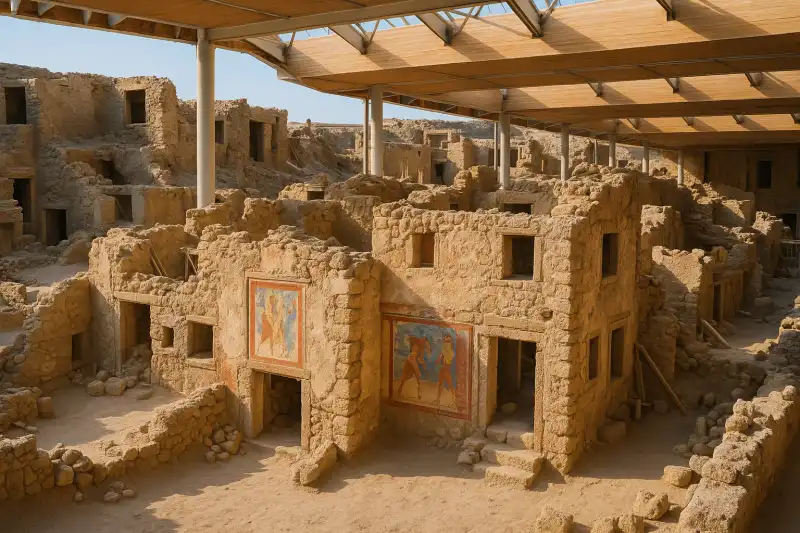
Akrotiri
Minoan / CycladicExplore Akrotiri, the Bronze Age Minoan city buried under volcanic ash on Santorini around 1613 BCE ...
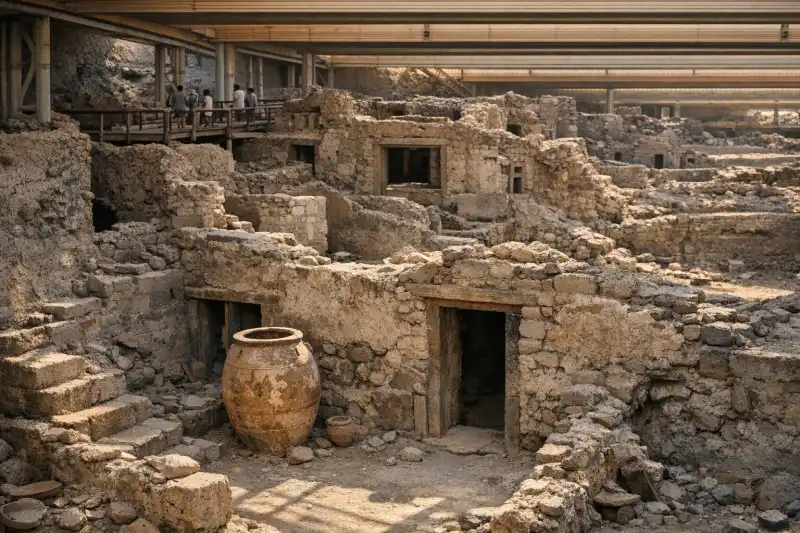
Ancient Akrotiri (Santorini)
Explore Ancient Akrotiri, the breathtaking Bronze Age settlement preserved in volcanic ash on Santor...
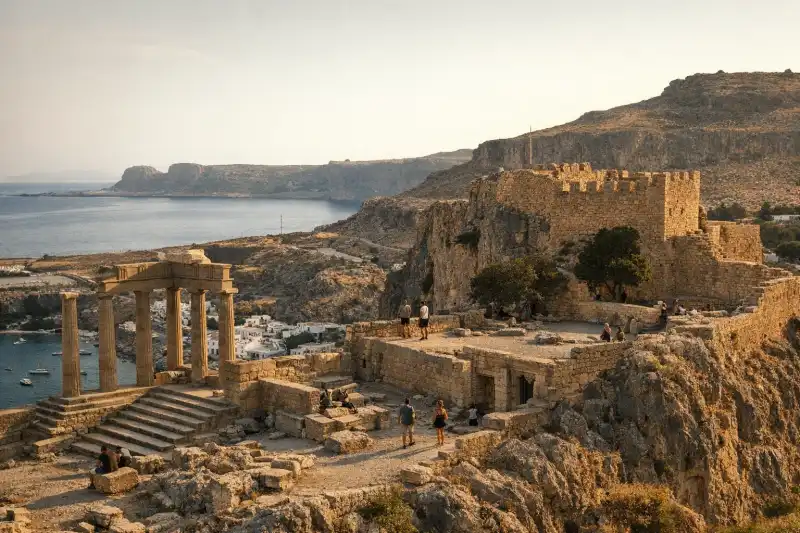
Acropolis of Lindos
Ancient Greek, Hellenistic, Roman, Byzantine, Knights HospitallerThe Acropolis of Lindos on Rhodes, Greece, is a spectacular ancient citadel blending Classical and m...