Quick Info
At a glance
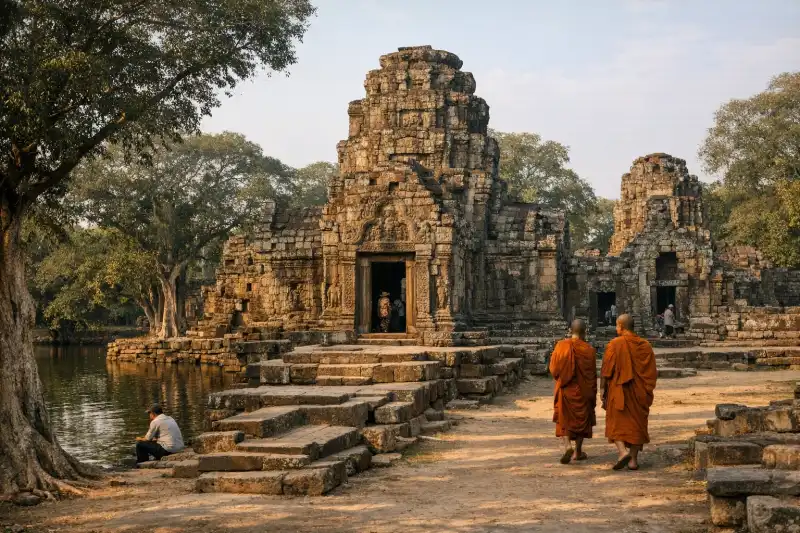
Tonle Bati (Ta Prohm Tonle Bati) in Cambodia offers a very different experience from the grand temple cities that dominate most conversations about Khmer heritage. South of Phnom Penh, beyond the capital’s traffic and riverfront boulevards, the landscape opens into rice fields, village roads, palms, and a broad lake where Cambodians come to relax on weekends. In this calm setting stands one of the country’s most approachable Angkorian monuments: a compact but elegant temple whose proportions, carvings, and surviving structure reveal the sophistication of Khmer sacred architecture without the overwhelming scale of Angkor.
For many travelers, Tonle Bati feels like an introduction to Cambodia’s ancient past that is both intimate and rewarding. The temple rises from a living rural environment rather than from an archaeological park shaped mainly for tourism. Children play nearby, families gather in pavilions by the water, incense drifts from active shrines, and the old stones remain woven into everyday life. That mixture is part of the site’s appeal. You are not only seeing a relic of the Khmer Empire, but also a place still visited by local worshippers and day-trippers.
Although smaller than the monuments of Siem Reap, Ta Prohm Tonle Bati rewards slow attention. Its weathered sandstone, laterite walls, devata carvings, and surviving tower arrangement speak to a period when Khmer builders created sanctuaries of great balance and refinement. For visitors based in Phnom Penh, it is one of the easiest and most satisfying ancient sites to explore in a single day.
History
Early Khmer settlement in the Tonle Bati area
The region around Tonle Bati has long been inhabited thanks to its fertile land, seasonal water, and strategic location between the lower Mekong basin and the cultural centers that shaped early Cambodian history. Takeo Province itself is often associated with some of the oldest political and religious landscapes in the country, including pre-Angkorian sites that show the deep antiquity of settlement in southern Cambodia. While Tonle Bati is best known today for its later Angkorian temple, the broader area had likely already been part of a connected network of villages, shrines, and agricultural communities for centuries before the monument was built.
This background matters because Khmer temples were rarely placed in isolation. They were inserted into existing landscapes that carried practical and spiritual meaning. Reservoirs, ponds, fields, and elevated ground all played a role in determining where sanctuaries rose. Tonle Bati’s lakeside setting reflects that relationship between sacred architecture and controlled water, a recurring theme across Khmer civilization.
Construction under the Khmer Empire
Ta Prohm Tonle Bati is generally dated to the late 12th or early 13th century, during the reign of Jayavarman VII or shortly thereafter. This was one of the most active building periods in Khmer history. Jayavarman VII is remembered as a powerful ruler who restored and expanded the Khmer Empire after conflict, and who also initiated a major wave of religious construction. Many temples linked to his reign reflect Mahayana Buddhist patronage, though over time some later shifted in use or incorporated Hindu and Theravada elements.
The temple at Tonle Bati shares stylistic features with monuments from this era, including compact planning, a strong use of sandstone, and decorative carving that emphasizes both sacred imagery and architectural rhythm. Though smaller than major imperial foundations, it was not a minor undertaking. Its surviving enclosure walls, central sanctuary, and decorative program demonstrate that it was built by skilled artisans familiar with the mature Angkorian tradition.
Its common name, Ta Prohm Tonle Bati, sometimes leads to confusion with the far more famous Ta Prohm at Angkor. The two are separate sites. The Tonle Bati temple likely took on the Ta Prohm designation through later local usage, but architecturally it belongs to the same broad cultural world of Khmer state temple building, adapted to a provincial setting.
Religious change and continued local use
Like many Khmer monuments, Tonle Bati did not remain fixed within a single religious identity forever. Cambodia’s sacred sites often moved through phases of patronage, reinterpretation, and continued devotion. A sanctuary that began with Buddhist affiliations might absorb Hindu imagery or vice versa; later still, Theravada Buddhist practice could become dominant in and around the ruins. Rather than treating these changes as abrupt replacements, it is more accurate to see them as layers.
This helps explain why the site has remained meaningful long after the political center of the Khmer Empire shifted. Even when imperial power faded, temples such as Tonle Bati continued to anchor local memory and religious life. Their stones were not simply abandoned; they were incorporated into a changing sacred landscape.
Colonial-era attention and modern preservation
During the French colonial period, scholars and administrators took growing interest in Cambodia’s ancient monuments, especially those tied to the Angkorian tradition. While Tonle Bati never received the same international attention as Angkor, it was recognized as an important example of Khmer architecture in the south. Its relative accessibility from Phnom Penh also helped maintain awareness of its historical value.
In modern Cambodia, the temple has continued to serve both as a heritage site and as part of a popular leisure destination centered on the lake. This dual identity presents both strengths and challenges. On one hand, steady local visitation keeps the place alive and relevant. On the other, increased foot traffic, informal development, weathering, and time all place pressure on the monument. Preservation here is less about isolating the temple from life and more about balancing access, reverence, and conservation.
Today, Tonle Bati stands as one of the most visible reminders that the Khmer architectural world extended far beyond the famous monuments of Siem Reap. It preserves, in manageable scale, the craftsmanship and religious complexity of a major historical era.
Key Features
What makes Tonle Bati especially compelling is the clarity with which its architecture can still be read. Even visitors with no specialist knowledge quickly notice the harmonious proportions of the sanctuary. The temple is compact, but not crude; modest in scale, but refined in execution. Its stone surfaces hold just enough surviving detail to reward close looking without demanding an archaeologist’s eye.
The main structure is built largely of sandstone, with laterite used in supporting and enclosure elements, a combination common in Khmer temple construction. The central sanctuary rises with a sense of vertical concentration, drawing the eye upward from doorways and carved lintels toward the tower above. Though time has softened some lines and worn away finer details, the building still conveys the disciplined geometry that defines mature Khmer architecture.
One of the pleasures of visiting is studying the carved decoration at close range. Door frames, pediments, and wall surfaces preserve figures and motifs that connect the temple to the broader artistic language of the Khmer Empire. Devatas and ornamental flourishes appear in niches and around openings, while the surviving lintels hint at narrative and symbolic programs that once would have been even more striking. The carvings do not overwhelm the architecture; instead, they seem integrated into it, emphasizing transition points such as entrances and sacred thresholds.
The temple’s setting is equally important. Unlike monuments encountered deep in forest or in vast archaeological compounds, Ta Prohm Tonle Bati sits within an inhabited, socially active landscape. The nearby lake changes the mood of the visit. Light reflected from the water, movement of people in the picnic areas, and the rural openness around the site all create a gentler atmosphere than the more theatrical temple encounters found elsewhere in Cambodia. This does not diminish the monument’s historical weight. Instead, it highlights how ancient sites can remain part of everyday life.
A short distance away, visitors may also encounter Yeay Peau, a smaller but culturally significant temple in the same area. Many people pair the two, creating a broader sense of the historic sacred complex around Tonle Bati. Together they show that the site was not just a single isolated building but part of a more layered religious environment.
Another notable feature is accessibility. At some Khmer monuments, collapse, scale, or restricted movement can make the experience abstract or physically demanding. Tonle Bati is easier to navigate. You can move around the temple, observe masonry details, and understand its spatial plan in a relatively short time. For first-time visitors to Khmer architecture, this makes it an excellent learning site. For more experienced travelers, it offers a chance to appreciate craftsmanship without the crowds and logistical complexity of larger temple zones.
The interplay between ancient stone and living worship also deserves attention. Offerings, incense, and local acts of devotion remind visitors that the temple is not only a historical specimen. This living dimension changes the tone of a visit. It encourages respect, patience, and a willingness to see the monument as both past and present. In Cambodia, many sacred places are best understood this way: not frozen in time, but continuously reinterpreted.
Finally, there is the emotional quality of scale. Because Tonle Bati is not monumental in the way Angkor Wat is monumental, visitors often notice smaller things: the texture of stone blocks, the framing of a doorway, the silence inside a shaded chamber, the contrast between a worn carving and bright modern offerings. These intimate details can make the site feel unexpectedly memorable. It is less about spectacle and more about presence.
Getting There
Tonle Bati is one of the simplest ancient sites to reach from Phnom Penh. The temple lies roughly 30 to 35 kilometers south of the capital in Takeo Province, and travel time is usually about 1 to 1.5 hours depending on traffic, road conditions, and your exact starting point.
A private tuk-tuk from Phnom Penh is one of the most popular options for independent travelers. Expect to pay around $18 to $30 for a round trip with waiting time, depending on negotiation, fuel costs, and whether you include additional nearby stops. This is a good choice if you want a flexible half-day excursion and do not mind a slower ride.
A private taxi is faster and more comfortable, especially in the hotter months or rainy season. Round-trip fares commonly range from $35 to $60. If you are traveling with two to four people, this can be excellent value. Some drivers will also combine Tonle Bati with other sites in Takeo Province for an added fee.
Motorbike rental in Phnom Penh can cost roughly $8 to $15 per day, excluding fuel. Confident riders may enjoy the freedom of going independently, but urban traffic when leaving the capital can be intense, and road awareness is essential. If you are unfamiliar with Cambodian driving conditions, a tuk-tuk or taxi is usually the better option.
Budget travelers may also find local buses or shared transport heading south, but these are less convenient because you will still need onward transport to the temple area. Organized day tours from Phnom Penh vary widely in price, often from $35 to $90 or more depending on inclusions.
Bring small cash for entrance-related local costs, parking, snacks, and lakeside food stops, as digital payment options may be inconsistent.
When to Visit
The best time to visit Tonle Bati is during Cambodia’s dry season, generally from November to February, when temperatures are more comfortable and skies are often clearer. Morning visits during these months are especially pleasant. The light is softer, the stonework photographs well, and you can explore before midday heat builds.
From March to May, temperatures rise sharply and afternoons can become exhausting, especially if you plan to walk slowly around the temple or continue to other nearby sites. If you travel during the hot season, aim to arrive early, carry plenty of water, and wear a hat and light but respectful clothing. The temple itself offers some shade, but not enough to fully escape the heat.
The rainy season, usually from May to October, brings greener scenery and fewer visitors on weekdays. Tonle Bati can be beautiful at this time, with lush vegetation and a more dramatic sky over the lake. However, heavy downpours can interrupt plans, roads may be muddy in places, and humidity is high. If you do not mind unpredictable weather, this season can still be rewarding, especially for photography and a quieter atmosphere.
Weekends and public holidays are busier because Tonle Bati is also a local leisure destination. Families from Phnom Penh and surrounding areas come for lakeside meals and relaxation, which creates a lively, social mood. If you want a calm temple experience, choose a weekday morning. If you are interested in seeing the site as locals use it today, a weekend visit adds color and energy.
Sunrise is less of a major event here than at Angkor, but early morning remains the ideal time for comfort, softer light, and a more contemplative visit.
| Quick Facts | Details |
|---|---|
| Site name | Tonle Bati (Ta Prohm Tonle Bati) |
| Location | Takeo Province, Cambodia |
| Nearest major city | Phnom Penh |
| Distance from Phnom Penh | About 30-35 km south |
| Historical period | Late 12th to early 13th century |
| Civilization | Khmer Empire |
| Religious context | Primarily associated with Buddhist-era Khmer temple building, later layered with ongoing local worship |
| Main materials | Sandstone and laterite |
| Visit duration | 1-2 hours for the temple; half a day with the lake and nearby stops |
| Best time to go | Dry season mornings, especially November to February |
| Good for | Day trips, Khmer history, architecture, photography, quiet temple visits |
| Commonly combined with | Yeay Peau temple and lakeside Tonle Bati leisure areas |
Tonle Bati may not have the fame of Cambodia’s largest temple complexes, but that is precisely why it lingers in memory. It offers a clear, elegant glimpse into Angkorian craftsmanship without the scale, crowds, or logistical demands that often shape first encounters with Khmer architecture. For travelers based in Phnom Penh, it is one of the easiest ways to connect with Cambodia’s deeper historical landscape in just a few hours.
What stays with many visitors is not only the temple’s age, but its setting within living Cambodia. Here, ancient stone stands beside water, worship, family outings, and village rhythms. The result is a site that feels less like a distant ruin and more like a place that has continued to matter across centuries. If you are looking for an accessible but meaningful temple experience beyond the capital, Ta Prohm Tonle Bati is an excellent choice.
Guided tours: worth it?
A guide can be genuinely useful at Tonle Bati (Ta Prohm Tonle Bati), especially if you want help with transport, timing, tickets, or understanding a large site without losing half the day to logistics.
Best for
- First-time visitors who want context, not just photos
- Travelers who want transport, timing, or entry logistics handled
- Trips where tickets, circuits, or timed entry can shape the day
- Short visits where a planned route saves time
When to go self-guided
Go independently if you already have transport and tickets sorted, enjoy moving at your own pace, and are comfortable checking the latest official rules before you arrive.
What I’d avoid
Skip paid tours that bundle unrelated stops you do not actually want. The best option should either save meaningful planning time or add historical context you would miss on your own.
Tonle Bati day trips from Phnom Penh
Useful when: transport or pickup logistics matter
Phnom Penh to Ta Prohm Tonle Bati tours
Useful when: you want to compare guided formats before deciding
Takeo Province cultural tours
Useful when: you want to compare guided formats before deciding
Some tour links are affiliate links, which may earn Ancient Travel a small commission at no extra cost to you. I try to surface options that make practical sense for the site—not just anything bookable.
Frequently Asked Questions
Where is Tonle Bati (Ta Prohm Tonle Bati)?
Tonle Bati is in Takeo Province, about 30 to 35 kilometers south of Phnom Penh, Cambodia, beside a popular lakeside recreation area.
Is Tonle Bati the same as Ta Prohm in Angkor?
No. Ta Prohm Tonle Bati is a smaller 12th-century temple near Phnom Penh, while the more famous Ta Prohm is part of the Angkor complex near Siem Reap.
How much time do you need to visit Tonle Bati?
Most visitors spend 1 to 2 hours at the temple itself, or half a day if combining it with the lake, nearby temples, and a trip from Phnom Penh.
Do you need a guide at Tonle Bati?
A guide is not essential, but one can add helpful context about Khmer history, symbolism, and the differences between this temple and the Angkor sites.
Can you visit Tonle Bati as a day trip from Phnom Penh?
Yes. It is one of the easiest ancient temple excursions from Phnom Penh and can be reached by tuk-tuk, taxi, motorbike, or organized tour.
What should you wear to Tonle Bati?
Wear light clothing suitable for heat, but choose respectful attire that covers shoulders and knees because it is an active cultural and religious site.
Nearby Ancient Sites
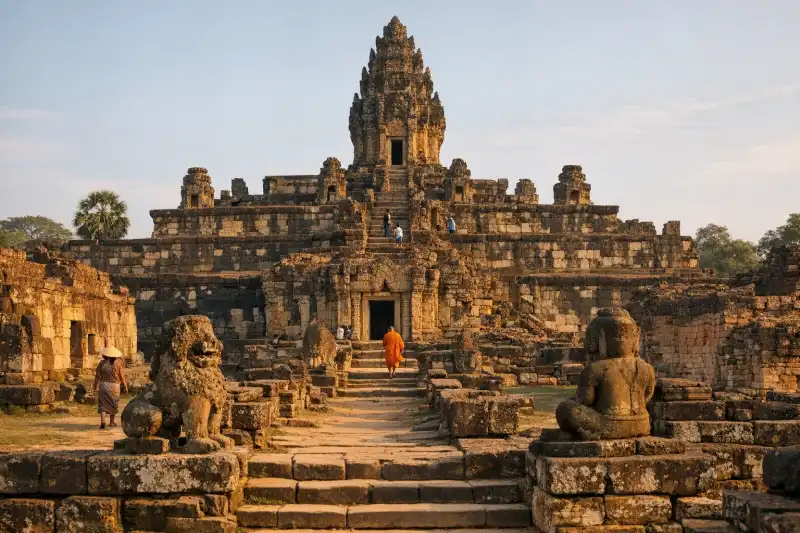
Bakong
Bakong is Cambodia's first major sandstone temple mountain, a stunning Khmer monument at the heart o...
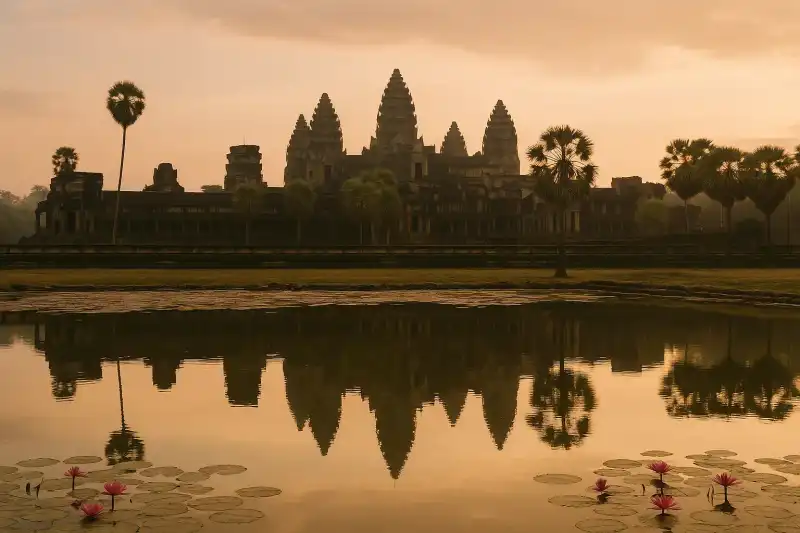
Angkor Wat Travel Guide 2026: Everything You Need to Know
KhmerAngkor Wat, the world's largest religious monument, spans over 400 acres in the heart of Cambodia. T...
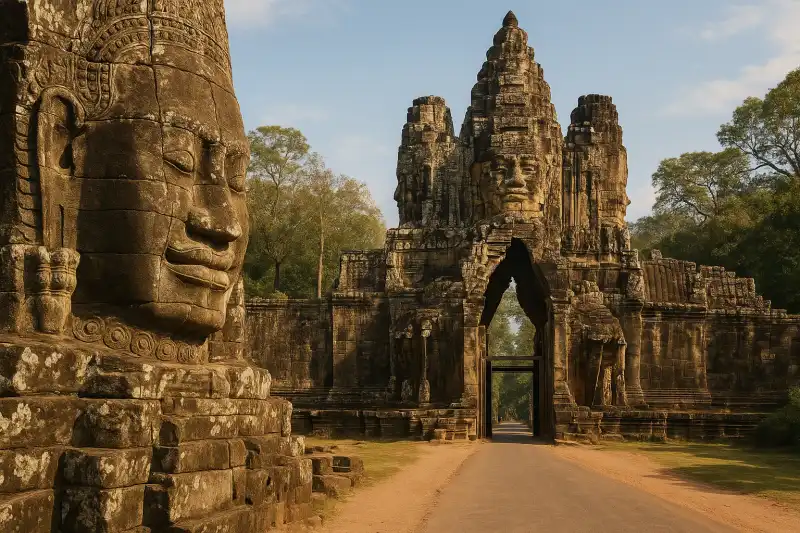
Angkor Thom Travel Guide 2026: Bayon Faces, Gates, and the Khmer Royal City
KhmerAngkor Thom was the last great capital of the Khmer Empire. This guide covers how to visit Bayon, th...