Quick Info
At a glance
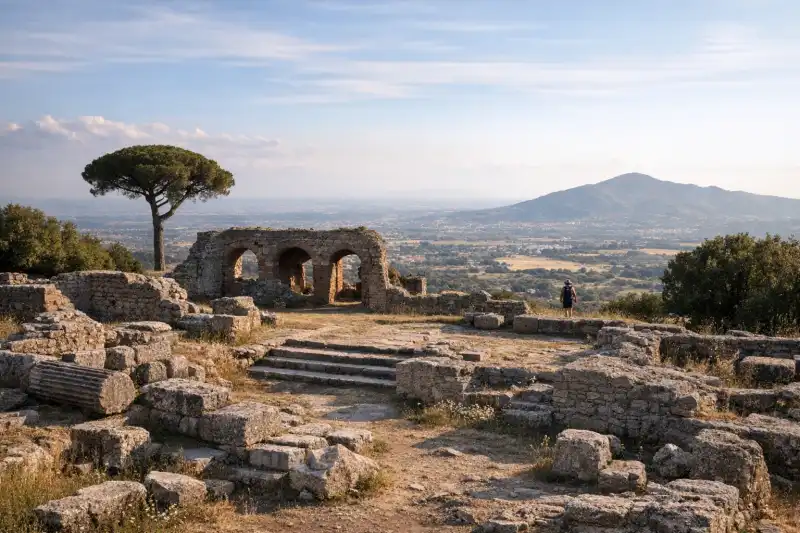
Tusculum, Italy rises quietly above the surrounding countryside of Lazio, where the Alban Hills catch changing light and the air feels a little cooler than in Rome below. Today the site is an archaeological park of scattered ruins, grassy terraces, and broad views, but it was once one of the most important hill towns in central Italy. Standing here, it is easy to understand why generations of nobles, politicians, and writers were drawn to this ridge. The location combines defensibility, fertile land, and a natural sense of retreat, all within reach of the capital.
For modern visitors, Tusculum has a different appeal from the monumental center of Rome. It is not overwhelming, and that is part of its charm. Instead of dense crowds and towering landmarks at every corner, you find a landscape where architecture and topography still speak to one another. Fragments of walls emerge from the hillside. The theater curves elegantly with the terrain. The forum area suggests the rhythms of civic life, while the panorama stretches over vineyards, woods, and distant urban sprawl. Tusculum rewards travelers who like places that must be read slowly. Its significance lies not only in what survives in stone, but in what the setting reveals about Roman leisure, local power, and the long continuity of life in the hills southeast of Rome.
History
Early origins and Latin identity
Tusculum’s story begins long before the high Roman Empire. It was one of the ancient Latin cities of central Italy, and in early tradition it occupies a meaningful place in the network of communities that shaped the region around Rome. Although archaeology is often more cautious than legend, there is little doubt that the site was inhabited in the early first millennium BCE. Its elevated position made it valuable for defense and communication, while the slopes nearby offered productive agricultural land.
In the archaic period, Tusculum was part of the Latin cultural world, sharing political and religious ties with neighboring communities. It existed in a landscape where alliances shifted frequently and where Rome was only one power among several. As Rome expanded, relations between the city and Tusculum evolved from rivalry and negotiation toward integration. This transition was a critical moment in Tusculum’s identity. Rather than disappearing into Roman expansion, the settlement became closely connected with it.
Incorporation into the Roman world
Tusculum is often remembered as one of the earliest communities to receive a privileged relationship with Rome. By the Republican period, it had become deeply embedded in the Roman state. This brought political stability and opened the way for a new kind of prosperity. Its location, close enough to the capital for easy access but removed enough to provide relief from city life, made it especially attractive to members of the Roman elite.
The surrounding district became famous for villas. Wealthy Romans built country residences in the Tusculan landscape, using the area as a place for rest, intellectual retreat, and social display. The phrase “Tusculan villa” became almost shorthand for cultivated leisure. The most celebrated association is with Cicero, who owned a villa in the area and referred to Tusculum in his writings. Although the exact remains of his estate are debated, the literary connection is powerful. Tusculum came to symbolize a life balanced between politics and philosophy, public duty and private reflection.
Imperial prosperity and civic monumentality
Under the Roman Empire, Tusculum retained importance as both a local center and a prestigious residential district. The monumental remains visible today largely reflect this mature phase of urban life. Public buildings were laid out in forms familiar across the Roman world, including a forum, a theater, and infrastructure that tied the settlement to the broader systems of trade and administration.
The theater is one of the clearest witnesses to this period. It illustrates how Roman urbanism adapted itself to terrain, using the hillside to support seating while creating a civic monument that served both entertainment and communal identity. The forum area, though less immediately dramatic to casual visitors, is equally revealing. It points to a functioning town with institutions, commerce, and civic ritual, rather than a purely aristocratic resort.
Tusculum’s prosperity also reflected its position in a favored zone of the Roman countryside. The nearby Alban Hills were known for healthy air, productive estates, and easy travel connections to Rome. This was a landscape where urban and rural life merged in particularly Roman ways.
Late antiquity, medieval continuity, and decline
Like many ancient towns, Tusculum changed significantly in late antiquity. Political instability, shifting patterns of settlement, and transformations in the imperial system affected the site. Yet it did not vanish overnight. Instead, Tusculum persisted and adapted. During the early medieval period, it remained inhabited and even gained renewed strategic value because of its hilltop location.
In the Middle Ages, Tusculum became associated with powerful local families, and for a time it played a notable role in the politics of the region around Rome. The continuity of occupation distinguishes it from sites abandoned more completely after antiquity. Layers of Roman and medieval life overlapped on the same ridge, complicating the archaeological record but enriching the site’s historical depth.
Its eventual destruction came amid the turbulent struggles of medieval central Italy. In 1191, Tusculum was sacked and largely ruined by Roman forces and their allies. This was a decisive turning point. Although some activity continued in the surrounding landscape, the hilltop city never recovered its earlier status. Over time, its buildings collapsed, stones were reused elsewhere, and vegetation softened the outlines of streets and monuments.
Rediscovery and archaeology
Interest in Tusculum revived in the modern era as antiquarians, historians, and archaeologists sought to identify and study the places mentioned in classical texts. Excavation and survey gradually clarified the layout of the town and brought major structures back into view. Archaeological work has revealed a site that is not simply a picturesque ruin, but a key witness to Latin origins, Roman municipal life, elite villa culture, and medieval transformation.
Today, Tusculum is appreciated for exactly this layered story. It is not frozen in a single moment. Instead, it shows how a place can be continuously reinterpreted across centuries, shaped by politics, memory, and landscape as much as by architecture.
Key Features
The most striking feature of Tusculum is its setting. The site occupies a commanding ridge in the Alban Hills, and that topographical drama shapes every part of the visit. From the archaeological area, the eye travels across the Roman Campagna toward Rome, while the immediate surroundings feel greener and quieter than the capital’s urban core. This combination of distance and proximity explains much of the site’s long appeal. Tusculum feels secluded, but never isolated.
Among the ruins, the Roman theater is usually the first structure to leave a strong impression. Its semicircular form is still legible, and the surviving cavea makes it easy to imagine spectators gathering here beneath open sky. Unlike some heavily restored theaters elsewhere in Italy, Tusculum’s retains an understated quality. The stone seating emerges naturally from the hillside, emphasizing the relationship between architecture and terrain. It is a place where scale is human rather than overwhelming, and where the landscape remains part of the performance.
Nearby are the remains of the forum, the civic heart of the ancient town. To an untrained eye, this area may appear fragmentary, but with a little patience its importance becomes clear. This was the space of administration, social interaction, and public identity. Foundations, paved sections, and structural traces suggest a town organized around familiar Roman principles, even though its hilltop setting gave those principles a distinctive local expression. The forum reminds visitors that Tusculum was not just a scenic retreat for aristocrats, but also a functioning community with institutions and daily life.
The wider archaeological zone preserves additional remains that deepen the picture. Sections of road, walls, terraces, and building platforms indicate how the urban fabric spread across irregular ground. Some features point to domestic or service areas, while others likely belonged to later phases of occupation. This layered quality is one of Tusculum’s strengths. You are rarely looking at a single clean phase. Instead, the site invites you to notice accumulation, adaptation, and reuse.
Equally important is what cannot always be fully seen: the world of villas that once surrounded Tusculum. The district was famous in Roman literature as a landscape of country houses, gardens, and intellectual retreat. Even where specific villas remain difficult to identify with certainty, the atmosphere of cultivated escape still lingers. The slopes, views, and relative tranquility make the literary associations feel plausible rather than abstract. For visitors interested in Cicero and the social history of the Roman Republic, this is one of the site’s richest dimensions.
Nature also plays a central role in the experience. Grass, shrubs, and seasonal flowers soften the archaeological remains, while the changing weather can alter the mood dramatically. On a clear day, the vistas are expansive and bright. In cooler months, mist can settle in the valleys and make the ridge feel suspended above the landscape. Because Tusculum is not embedded in a dense modern cityscape, the continuity between ancient ruins and natural setting is unusually strong.
Finally, Tusculum’s key feature may be its atmosphere of discovery. It does not announce itself with the theatrical grandeur of the Colosseum or the forum complexes of central Rome. Instead, it rewards curiosity. The site feels spacious, reflective, and slightly off the main tourist route. For many travelers, that quietness becomes the defining memory. Tusculum is a place where history is encountered in open air, with room to pause, look outward, and consider how a once-important city now survives as both monument and landscape.
Getting There
Tusculum is easiest to reach from Rome, making it a practical day trip for travelers who want an ancient site beyond the usual circuit. The most common route is to take a regional train from Roma Termini to Frascati. Tickets usually cost around €2 to €3 each way, and the journey takes roughly 30 minutes. From Frascati, you will need to continue by taxi, local shuttle if available seasonally, or on foot if you are prepared for a longer uphill walk. A taxi from Frascati to the archaeological area generally costs about €15 to €25 depending on time of day and availability.
If you are driving, Tusculum is straightforward from Rome via the roads leading into the Castelli Romani area. Under normal traffic conditions, the trip can take 45 minutes to just over an hour. Driving offers the most flexibility, especially if you want to combine Tusculum with Frascati, local vineyards, or other hill towns. Parking options may vary by season, so it is wise to check current visitor information before departure.
Guided tours from Rome are another convenient option, particularly for travelers who prefer transport and context included in one package. Prices for small-group day tours to the Roman countryside often start around €60 to €120 per person, depending on inclusions. Even if Tusculum is not the sole focus, some Castelli Romani itineraries include nearby stops that complement the visit well.
Because the final approach can involve uneven ground and some uphill walking, sturdy footwear is recommended regardless of how you arrive.
When to Visit
Spring and autumn are generally the best times to visit Tusculum. From April to June, the hills are usually green, wildflowers appear across the slopes, and daytime temperatures are comfortable for walking. The air can be fresh, the views are often clear, and the site feels especially alive in this season. September through early November is similarly appealing, with warm light, milder temperatures, and fewer weather extremes than midsummer.
Summer has advantages if you want long daylight hours and dependable access, but the heat can be intense, especially around midday. Because Tusculum is an open hilltop site with limited shade, high temperatures can make exploration tiring. If you visit in July or August, go early in the morning or later in the afternoon, bring plenty of water, and wear sun protection. The views remain beautiful, but comfort becomes a real factor.
Winter offers a quieter and more contemplative experience. Cooler temperatures make walking easier, and visitor numbers are usually low. On clear days, the light can be superb for photography. However, rain, wind, or fog can change conditions quickly in the hills, and some services nearby may be reduced. Checking the forecast is especially important in colder months.
If your goal is atmosphere rather than maximum convenience, late spring may be the ideal compromise. The landscape is at its most attractive, the archaeological remains are comfortable to explore, and the countryside around Frascati provides a rewarding wider setting for a full day out.
| Quick Facts | Details |
|---|---|
| Location | Near Frascati, Lazio, Italy |
| Ancient identity | Latin city later integrated into the Roman world |
| Best known for | Roman theater, forum remains, hilltop views |
| Distance from Rome | Roughly 25 km southeast of central Rome |
| Best day-trip base | Rome or Frascati |
| Typical visit length | 2 to 4 hours |
| Terrain | Uneven archaeological paths on a hillside |
| Best seasons | Spring and autumn |
| Famous association | Cicero and the culture of Roman country villas |
| Travel style | Independent visit, self-drive, or guided countryside tour |
Tusculum is one of those places that gains power the longer you stay with it. At first, it may seem modest beside the headline monuments of Italy. Yet that modesty is deceptive. Here, the essentials of an ancient landscape are still legible: strategic position, civic organization, elite retreat, long continuity, and eventual ruin. The site offers a quieter kind of grandeur, one rooted in geography and memory rather than spectacle alone.
For travelers interested in the Roman world beyond the center of Rome, Tusculum provides something rare. It connects literary history, archaeology, and landscape in a way that feels immediate. You can stand near the theater, look over the countryside, and understand why this place mattered for centuries. You can also sense how much has been lost, transformed, and reimagined. That mixture of presence and absence gives Tusculum its distinctive character.
A visit here works especially well for those who enjoy walking, reflective ruins, and places that still require imagination. It is not simply a stop to tick off; it is a site to absorb. In the Alban Hills, with Rome not far away but no longer dominating the horizon of experience, Tusculum reveals a different side of ancient Italy—more spacious, more intimate, and deeply rewarding.
Guided tours: worth it?
Self-guided works here, but a guide can add real value if you want the ruins explained as a living place rather than just a sequence of monuments.
Best for
- First-time visitors who want context, not just photos
- Short visits where a planned route saves time
When to go self-guided
Go independently if you prefer setting your own pace, reading as you go, and checking official hours or ticket rules directly before you arrive.
What I’d avoid
Skip paid tours that bundle unrelated stops you do not actually want. The best option should either save meaningful planning time or add historical context you would miss on your own.
Rome Ancient Sites Tours
Useful when: you want to compare guided formats before deciding
Rome Castelli Romani Day Trips
Useful when: transport or pickup logistics matter
Frascati and Roman Countryside Tours
Useful when: you want to compare guided formats before deciding
Some tour links are affiliate links, which may earn Ancient Travel a small commission at no extra cost to you. I try to surface options that make practical sense for the site—not just anything bookable.
Frequently Asked Questions
Where is Tusculum located?
Tusculum is located in the Lazio region of Italy, in the Alban Hills near Frascati, southeast of Rome.
What is Tusculum famous for?
Tusculum is famous for its ancient Roman theater, forum remains, commanding hilltop setting, and its association with Cicero and the Roman elite.
Can you visit Tusculum on a day trip from Rome?
Yes, Tusculum is well suited to a day trip from Rome and can be reached via train to Frascati followed by local transport or a taxi.
Is there an entrance fee for Tusculum?
Entrance policies can vary, so it is best to check current information from local archaeological authorities or visitor services before traveling.
How much time should I spend at Tusculum?
Most visitors spend 2 to 4 hours exploring the archaeological area, enjoying the views, and walking the surrounding landscape.
What should I bring when visiting Tusculum?
Bring sturdy shoes, water, sun protection, and a camera, as the site includes uneven ground and open hilltop paths with little shade.
Nearby Ancient Sites
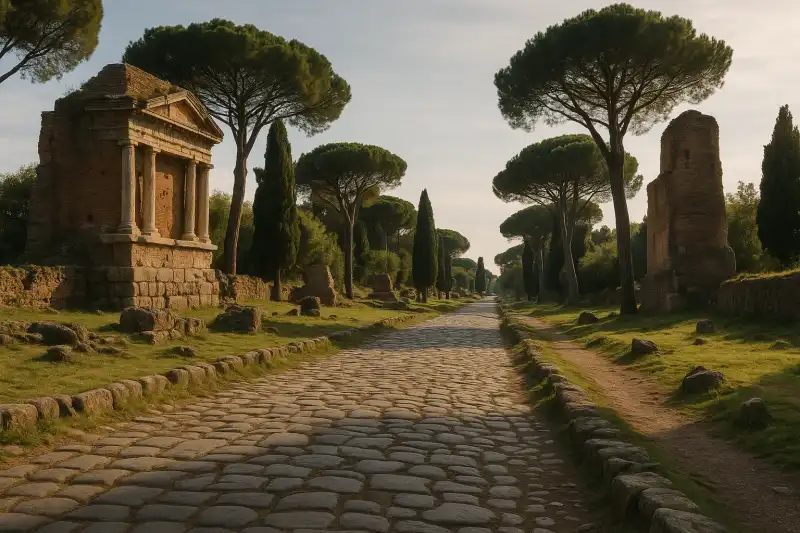
Appian Way Rome Guide 2026
RomanPlan a smart visit to the Appian Way with route choices, catacomb logistics, bike-vs-walk strategy, ...
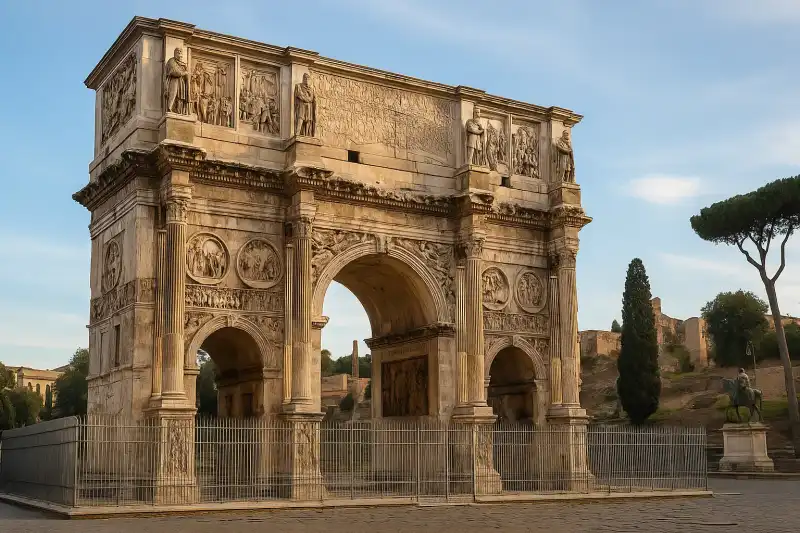
Arch of Constantine Rome: Triumph Over Maxentius Guide
Roman EmpireThe Arch of Constantine commemorates Constantine's 312 CE victory. Spolia details, best photo angles...
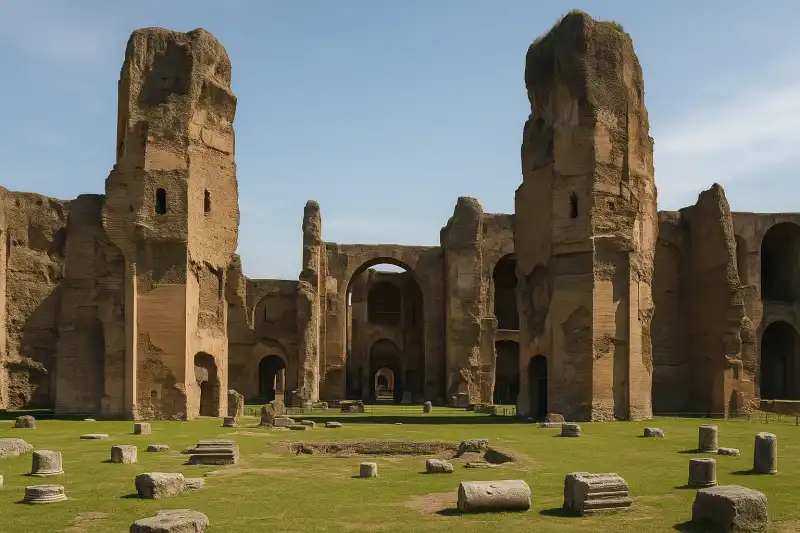
Baths of Caracalla Rome Guide 2026
RomanPlan your visit to the Baths of Caracalla with practical route advice, history context, timing, and ...