Quick Info
At a glance
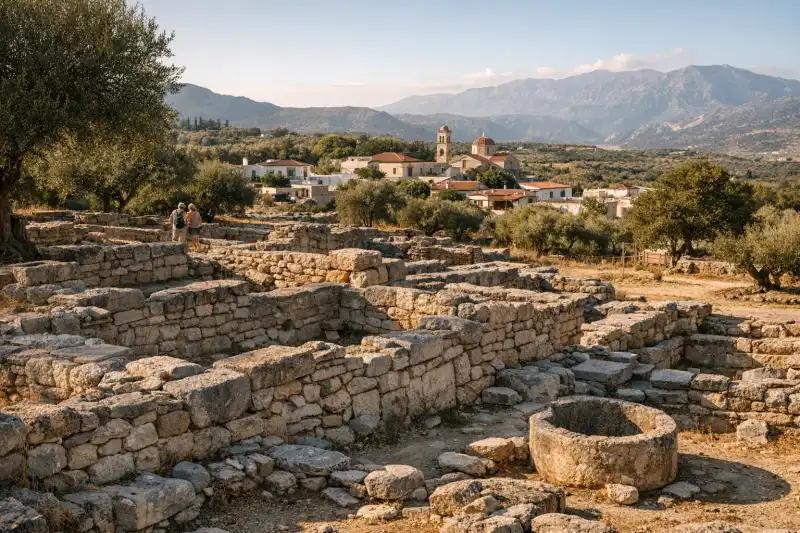
Tylissos in Greece is one of those archaeological places that quietly rewards attention. It does not announce itself with the monumental scale of Knossos or the dramatic cliffside setting of some island sanctuaries. Instead, it invites a slower kind of discovery. Set inland on Crete, not far from Heraklion, Tylissos preserves the traces of a prosperous Minoan community whose houses, storerooms, and working spaces reveal how wealth and influence were expressed beyond the island’s great palace centers. The setting still feels connected to that older landscape: low hills, cultivated fields, and routes that once linked the coast, the interior, and the mountains.
For travelers interested in Bronze Age Crete, Tylissos offers something valuable and distinctive. Here, the story is not just about royal display or ceremonial spectacle, but about regional power, domestic architecture, storage, trade, and everyday administration. The remains are fragmentary, as ancient ruins often are, yet they speak clearly enough to suggest a place of status and organization. You can see broad rooms, magazines for storing goods, paved areas, and structural details that hint at both comfort and control. Visiting Tylissos also helps place the famous Minoan world in context. It shows that ancient Crete was not built only around a few iconic sites, but through networks of settlements large and small, each contributing to the island’s economic and cultural life.
History
Early Minoan beginnings
The area around Tylissos was occupied long before the site reached its best-known phase. Like many places on Crete, it likely developed gradually through the Early Bronze Age as farming communities became more complex and more closely connected to wider exchange networks across the island and the eastern Mediterranean. Its location helps explain why settlement here made sense. Tylissos stood in a strategic zone west of present-day Heraklion, with access to arable land, routes to the coast, and communication lines leading inland toward central Cretan uplands.
During the early Minoan centuries, settlements across Crete were evolving from relatively modest village structures into communities with clearer signs of hierarchy and specialization. Although the archaeological picture at Tylissos is not as complete as at larger sites, evidence suggests that the area was part of this wider transformation. Local elites, agricultural surplus, and growing regional connections were beginning to shape life on the island. Over time, Tylissos developed from a settlement into a place with more substantial architecture and social importance.
The rise of a prosperous settlement
Tylissos flourished particularly during the Middle and Late Minoan periods, when Crete’s complex Bronze Age society reached remarkable levels of architectural, artistic, and administrative sophistication. By this stage, the island was organized through a network of major centers and secondary settlements. Tylissos appears to have been one of those important secondary centers: not a palace on the scale of Knossos, but certainly no ordinary village.
Excavations brought to light several large buildings often referred to as villas. The term can be a little misleading if understood in a modern sense. These were not simply country houses. They were substantial multiroom structures that likely combined elite residence, storage, administration, craft activity, and perhaps ceremonial functions. Their scale and layout suggest that Tylissos was home to local authorities who managed resources and maintained links with broader Minoan power structures.
Among the discoveries from Tylissos were giant bronze cauldrons and storage facilities that point to considerable wealth. Such finds indicate access to valuable materials and the capacity to host feasting, storage, or redistribution activities. In the Minoan world, storage was not merely practical. It was political. Control over grain, oil, wine, and other goods reinforced status and authority. Tylissos therefore seems to have played a meaningful role in the economic life of north-central Crete.
Destruction, rebuilding, and changing power
Like many Minoan sites, Tylissos experienced episodes of destruction and rebuilding. Across Bronze Age Crete, earthquakes were a constant risk, and some settlements also suffered fires or wider disruptions associated with political change. The island’s major sites often show multiple occupation phases, with buildings repaired, expanded, or altered over generations. Tylissos followed that broader pattern.
The major villas at the site belong principally to the Neopalatial and post-Neopalatial periods, when Minoan architecture and administration were at their height and then later adapting to new realities. After the destructions that affected several Cretan centers in the late 2nd millennium BCE, the balance of power on the island shifted. Knossos seems to have remained influential for a time, while other sites declined or changed character. Tylissos likely continued to be occupied, but its role may have been reduced or transformed within a different political landscape.
This period also corresponds with increased Mycenaean influence in Crete. Scholars continue to debate the precise nature of these transitions at many sites, but the broad picture is one of change rather than abrupt disappearance. Settlements like Tylissos help illustrate that the end of the classic Minoan world was uneven. Some communities were abandoned, some survived in altered form, and some retained local importance even as island-wide systems weakened.
Rediscovery and archaeology
Modern archaeological interest in Tylissos grew in the early 20th century, during the same era that brought intense attention to Minoan Crete. Excavations revealed the outlines of major buildings and highlighted the significance of the site as a window into elite life outside the principal palaces. The remains did not produce the same international fame as Knossos, but specialists recognized their importance for understanding regional settlement patterns.
The exposed architecture at Tylissos is especially useful because it helps reconstruct the social and economic framework of Minoan society. Archaeologists could study building plans, storage areas, circulation through rooms, and relationships between domestic and administrative spaces. Finds from the site, some now displayed in museums, further deepened knowledge of Minoan craftsmanship and wealth.
Today, Tylissos stands as a comparatively understated but historically meaningful destination. Its value lies not in monumental restoration, but in the authenticity of its ruins and the perspective it gives on the distributed nature of power in Bronze Age Crete.
Key Features
What makes Tylissos memorable is the way the site reveals Minoan life through architecture rather than spectacle. The first thing many visitors notice is the arrangement of the major buildings. These structures, often described as villas, are laid out in a way that shows deliberate planning. Rooms connect in sequences that suggest movement between public and private functions, between storage and residence, between practical work and elite display. Even when walls survive only to a modest height, the footprint of the buildings is enough to convey scale and complexity.
The storerooms are among the most evocative features. In Minoan archaeology, storage areas are always significant because they speak to production, redistribution, and authority. At Tylissos, magazines and large storage jars point to the handling of agricultural surplus. Olive oil, wine, grain, and other commodities were the basis of wealth on ancient Crete, and the ability to gather and control these goods was a sign of local power. Standing among these spaces, it becomes easier to imagine Tylissos not just as a place where people lived, but as a center where resources were organized and managed.
Another important feature is the quality of domestic architecture. The remains indicate that these were comfortable and substantial buildings, not simple rural dwellings. There were paved floors, carefully built walls, and room groupings that imply upper stories and sophisticated internal arrangements. Minoan architecture is often admired for its adaptability to terrain and for its concern with light, air, and circulation, and traces of those qualities can still be sensed here. The structures at Tylissos were designed for people of standing, perhaps local administrators or elite families tied into larger Cretan networks.
The site is also known through notable finds associated with ritual or status, including impressive bronze vessels discovered during excavation. These artifacts are now more easily appreciated in museum settings than on the ground itself, but knowing they came from Tylissos adds another layer to the visit. They suggest feasting, display, ceremonial activity, or at least a household wealthy enough to own rare and prestigious metalwork. That kind of evidence helps move Tylissos beyond the category of an ordinary settlement.
Equally compelling is the landscape context. Tylissos is inland but not isolated. The surrounding geography helps explain the site’s historical importance. From here, ancient inhabitants could exploit fertile agricultural zones while remaining connected to the coast and to inland routes. In many ways, the setting is one of the site’s key interpretive features. Minoan civilization was not simply urban or palace-based; it depended on networks of communities integrated with their environment. Tylissos demonstrates that relationship especially well.
Visitors often appreciate how manageable the ruins are. This is not an overwhelming archaeological expanse requiring hours of navigation. Instead, the site can be explored at a measured pace, allowing close attention to wall lines, room divisions, thresholds, and circulation patterns. For travelers who enjoy reading architecture, Tylissos is rewarding because its scale encourages observation. You can compare the dimensions of spaces, think about what activities may have taken place in each zone, and imagine the vertical dimension of buildings that once rose above the surviving foundations.
There is also an important contrast between Tylissos and more heavily reconstructed sites. Here, interpretation relies less on dramatic visual restoration and more on archaeological imagination supported by visible evidence. That appeals strongly to some travelers. The remains feel quieter, more open-ended, and perhaps more honest in their fragmentary state. You are not being told exactly what to see; you are being given the material clues from which a settlement’s life can be inferred.
Finally, Tylissos works particularly well as part of a broader exploration of Minoan Crete. If you have already visited Knossos or the Heraklion Archaeological Museum, Tylissos adds nuance. It shows how elite architecture and administrative practices extended into the countryside, where local centers anchored regional systems. If you visit before those larger attractions, it can sharpen your eye for what to look for elsewhere. Either way, its greatest feature may be interpretive: it deepens understanding of how the Minoan world actually functioned.
Getting There
Tylissos is easiest to reach from Heraklion, the main city and transport hub of central Crete. By car, the journey usually takes around 20 to 30 minutes depending on traffic and your exact starting point. Rental cars are widely available in Heraklion, including at the airport and ferry port. Expect a small economy car to cost roughly €30 to €60 per day in the shoulder season, with higher prices in summer. Driving is the most convenient option if you want flexibility to combine Tylissos with Knossos, the Heraklion Archaeological Museum, or villages in the interior.
Taxis from central Heraklion to Tylissos generally cost about €20 to €35 one way, though fares can vary with time of day and pickup point. This can be a practical choice for travelers who want a direct trip without the need to navigate local roads. If you plan to return the same day, arranging a pickup time in advance can save waiting.
Public transport may be possible via local bus services toward the modern village of Tylissos, but routes and frequencies can change seasonally. Fares are usually modest, often in the range of €2 to €5 each way from Heraklion, though buses may not stop directly at the archaeological entrance. If using public transport, check current schedules locally and be prepared for a short walk.
Organized tours are another good option, especially if your main interest is Minoan archaeology. Day tours from Heraklion that focus on Knossos and surrounding sites sometimes include or can be adapted to include lesser-known stops like Tylissos. Prices often begin around €50 to €120 per person depending on transport, guide services, and included admissions.
When to Visit
The best times to visit Tylissos are spring and autumn, when Crete is warm, bright, and far more comfortable for walking among open ruins. From April to early June, the countryside is often green, wildflowers may still be visible, and daytime temperatures are pleasant, usually ideal for combining archaeology with broader sightseeing. September and October are similarly appealing, with warm weather, softer light, and fewer crowds than the height of summer.
Summer is certainly possible, and many travelers visit Crete then, but the heat can be intense. Temperatures in July and August often climb well above what is comfortable for exposed archaeological sites with limited shade. If you go in midsummer, aim for early morning or late afternoon and bring water, sun protection, and a hat. The ruins are easier to appreciate when you are not rushing to escape the heat.
Winter can also be rewarding for visitors who prefer quiet travel. Crete remains milder than much of Europe, and you may find a peaceful atmosphere around inland sites. However, opening hours can be reduced, and occasional rain or wind may make exploration less appealing. Transport options, especially local buses or seasonal tours, can also be more limited.
For photography, spring and autumn usually provide the best balance of clear skies and gentle light. Morning visits are especially good if you want cooler temperatures and a calmer experience. In practical terms, Tylissos is most enjoyable when you can take your time, so choose a season and hour that let you move slowly through the site rather than simply checking it off a list.
| Quick Facts | Details |
|---|---|
| Location | Near Heraklion, Crete, Greece |
| Ancient culture | Minoan |
| Main period | Middle to Late Bronze Age |
| Known for | Elite villas, storerooms, bronze finds |
| Best paired with | Knossos and the Heraklion Archaeological Museum |
| Time needed | 45 minutes to 1.5 hours |
| Closest major city | Heraklion |
| Best season | Spring and autumn |
| Ideal visitors | Archaeology enthusiasts, history travelers, Minoan culture fans |
Tylissos may not be the most famous ancient site in Greece, but that is part of its charm. It offers a more intimate encounter with Minoan Crete, one grounded in architecture, landscape, and the practical realities of Bronze Age power. Rather than dazzling with sheer size, it rewards visitors who are curious about how ancient societies were structured beyond their great ceremonial centers. In the foundations of its villas and storerooms, Tylissos preserves a story of regional wealth, social organization, and connection across the island.
For anyone building a deeper understanding of ancient Crete, this site is far more than a minor detour. It fills an essential gap between the famous palace complexes and the ordinary settlements that sustained them. The result is a visit that feels thoughtful and revealing. If you are already in Heraklion or exploring the archaeology of Crete, Tylissos is well worth the short journey inland.
Guided tours: worth it?
Most travelers can visit Tylissos independently. Compare a tour only if you want a tighter history-focused visit, easier logistics, or a guide who can answer questions on the spot.
Best for
- Short visits where a planned route saves time
When to go self-guided
Go independently if you prefer setting your own pace, reading as you go, and checking official hours or ticket rules directly before you arrive.
What I’d avoid
Skip paid tours that bundle unrelated stops you do not actually want. The best option should either save meaningful planning time or add historical context you would miss on your own.
Crete Archaeology Tours
Useful when: you want to compare guided formats before deciding
Heraklion Day Tours
Useful when: you want to compare guided formats before deciding
Knossos and Heraklion Tours
Useful when: you want to compare guided formats before deciding
Some tour links are affiliate links, which may earn Ancient Travel a small commission at no extra cost to you. I try to surface options that make practical sense for the site—not just anything bookable.
Frequently Asked Questions
What is Tylissos?
Tylissos is an ancient Minoan site on Crete in Greece, best known for the remains of substantial Bronze Age houses or villas, storerooms, and evidence of elite life.
Where is Tylissos located?
Tylissos lies west of Heraklion on the island of Crete, in the foothills leading toward Mount Ida, making it an easy stop from the island's capital.
How do you get to Tylissos?
Most visitors reach Tylissos by rental car, taxi, or organized day trip from Heraklion. Public buses may get you to the modern village area, but schedules can be limited.
How much time do you need at Tylissos?
Around 45 minutes to 1.5 hours is enough for most travelers to walk the exposed ruins, read site panels, and enjoy the landscape.
Why is Tylissos important?
Tylissos is important because it offers insight into affluent Minoan settlement patterns, architecture, storage systems, and regional power on Bronze Age Crete beyond the major palaces.
Is Tylissos suitable to visit with Knossos?
Yes. Many travelers pair Tylissos with Knossos and the Heraklion Archaeological Museum to better understand both palace-centered and regional Minoan life.
Nearby Ancient Sites
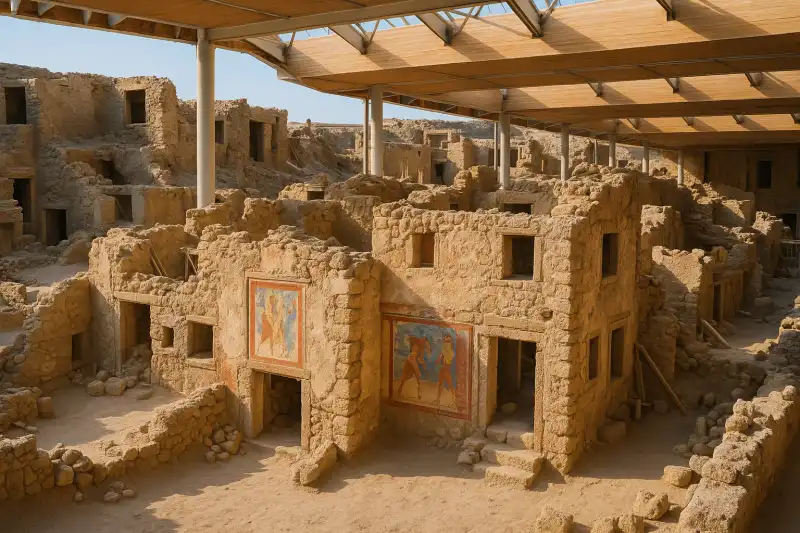
Akrotiri
Minoan / CycladicExplore Akrotiri, the Bronze Age Minoan city buried under volcanic ash on Santorini around 1613 BCE ...
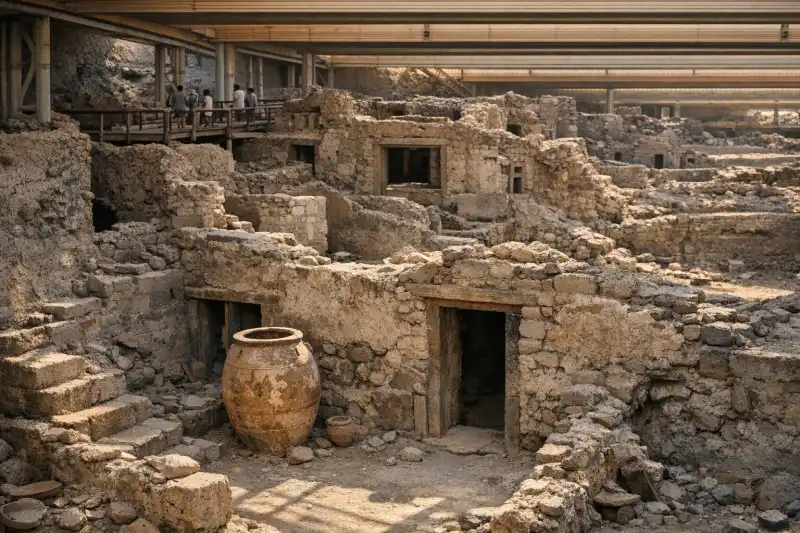
Ancient Akrotiri (Santorini)
Explore Ancient Akrotiri, the breathtaking Bronze Age settlement preserved in volcanic ash on Santor...
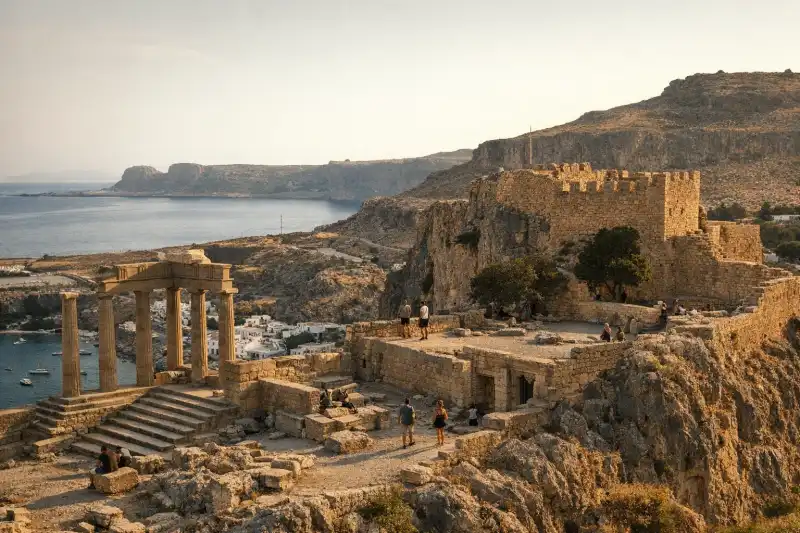
Acropolis of Lindos
Ancient Greek, Hellenistic, Roman, Byzantine, Knights HospitallerThe Acropolis of Lindos on Rhodes, Greece, is a spectacular ancient citadel blending Classical and m...