Quick Info
At a glance
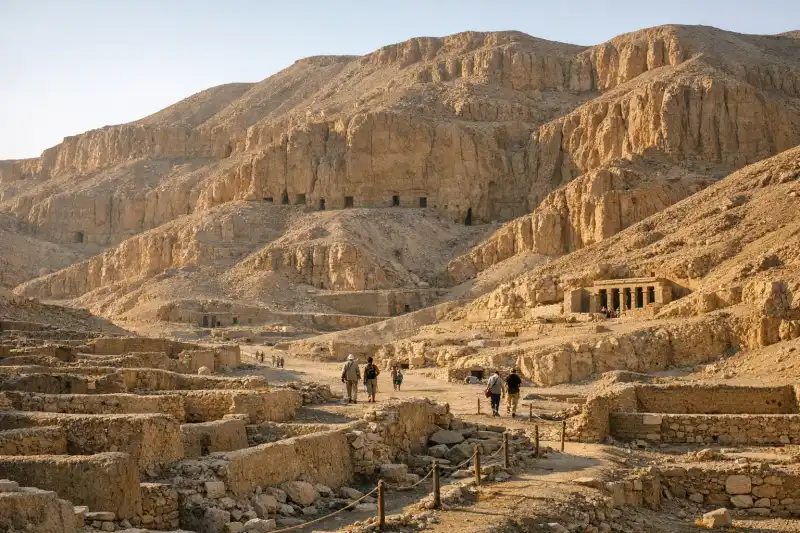
Tucked away amid the arid western hills of Luxor, Egypt, the Valley of the Artisans—known in antiquity as Set Maat (“The Place of Truth”) and today most commonly referred to as Deir el-Medina—offers an unparalleled window into the lives of the craftsmen who constructed the royal tombs of the Valley of the Kings and Queens. Unlike the more famous necropolises dedicated to pharaohs and high officials, the Valley of the Artisans spotlights the community of ordinary yet highly skilled workers, artists, and their families whose creativity and devotion shaped Egypt’s most iconic mortuary monuments. With its sunbaked stone ruins, compact adobe streets, remarkably decorated tombs, and visual echoes of long-vanished daily routine, the site conjures the sounds of chisels, laughter, children, and the recitals of sacred texts nearly 3,500 years old.
What particularly distinguishes the Valley of the Artisans is its authenticity and rare continuity. Here, nestled in the shadow of surrounding cliffs, lies a self-contained village where generations of tomb-builders and painters lived under the vigilant administration of the state, organized in a way that preserved not just skillful craftsmanship, but also the myths, disputes, dramas, and hopes of an entire microcosm of ancient society. The archaeological treasures and mummified echoes within Deir el-Medina—artistically flamboyant tombs, domestic ruins, ostraca (pottery shards inscribed with letters and notes), and public chapels—lay bare the intimate, sometimes surprising realities of ancient Egyptian life and death. For any traveler seeking to understand the human side of ancient Egypt beyond the monumental grandeur, the Valley of the Artisans is nothing short of revelatory—a place where the hands behind Egypt’s immortality come profoundly alive.
History
Foundation and the New Kingdom
The origins of the Valley of the Artisans trace back to the early 18th Dynasty of Egypt, around the reign of Pharaoh Thutmose I (circa 1500 BCE). This period marked the ascendancy of the New Kingdom, a time when Egypt’s imperial reach, prosperity, and artistic expression reached dazzling heights. The state began constructing more elaborate royal tombs in hidden desert valleys west of Thebes (modern Luxor), requiring not only confidentiality but also unparalleled skill. To serve this intensive royal project, an exclusive village was established at Deir el-Medina—a carefully planned settlement built to house the craftsmen, their families, and essential administrators. The workers were referred to as the “Servants in the Place of Truth,” a title that carried both honor and responsibility; their duty was to construct the royal afterlife.
The choice of the village’s site was deliberate. Its location, nestled between desert cliffs and within walking distance of both the Valley of the Kings and the Valley of the Queens, enabled tight control over the workforce and protected the supernatural secrets of tomb-building from prying eyes. Living in modest yet sturdy mudbrick houses, the artisans formed tight-knit communities, their daily lives tied intimately to the rhythm of shifts, religious rituals, and social interactions. The village soon became a multi-generational settlement, sustained through centuries by the ongoing need for new royal tombs.
Social Life and Daily Routine
Life within Deir el-Medina was strikingly well-documented, thanks to thousands of ostraca and papyri unearthed by archaeologists. These records reveal an intricate social structure comprising artists, stonemasons, painters, carpenters, and family members, overseen by government-appointed foremen and scribes. The administration was robust and sometimes suffused with drama—ostraca detail wage disputes, absenteeism, legal cases, love affairs, and even workers’ strikes (one of the earliest recorded in human history, during the reign of Ramesses III).
This administrative detail extended to religious life. The villagers had their own chapels, festivals, and community deities—particularly the goddess Hathor and the god Ptah, both patrons of artisans. Work-life was organized around a 10-day week (the ancient Egyptian “decade”), with two days off. Pay was in kind, usually rations of grain, beer, vegetables, and occasional bonuses from the state, particularly during major building campaigns.
Artistic Achievements and the Decline
The crowning achievements of the Valley of the Artisans were the tombs themselves. Unlike the austere, secretive royal complexes nearby, the tombs at Deir el-Medina were private and vividly personal. Artisans adorned their own sepulchers with brilliantly painted scenes of daily life, family portraits, and elaborate visions of the afterlife, inspired by the same iconography and canon they used for pharaonic monuments. Many of these tombs remain in superb condition, their colors dazzlingly preserved by the arid climate.
Yet, no community is eternal. By the end of the 20th Dynasty, as the New Kingdom waned in the face of foreign invasion, economic turmoil, and internal strife, the royal tomb-building enterprise faltered. Security became precarious, tomb-robbing increased, and state resources dwindled. The village was gradually abandoned after more than 400 years of occupation, its mudbrick houses and tombs left to the encroaching sands. Rediscovered and excavated in modern times, the Valley of the Artisans now stands as one of the best-documented ancient communities—offering a uniquely personal portrait of the people behind Egypt’s monumental heritage.
Key Features
Visitors to the Valley of the Artisans experience an archaeological site that feels both intimate and astonishingly rich in detail. The first impression is that of a compact, grid-like settlement, its streets lined by the low remains of mudbrick houses—spaces where up to 70 families lived, worked, and dreamed. Though roofless, these dwellings evoke domestic routines: kitchens with ancient ovens, courtyards for daily chores, storage bins, and the faint traces of painted walls that once brightened these humble interiors. Tourists can meander freely among the ruins, glimpsing the spatial arrangements that shaped family life more than three millennia ago.
Beyond domestic remains, Deir el-Medina dazzles visitors with its small yet intensely decorated private tombs. These are the true jewels of the Valley of the Artisans. Tombs such as those of Sennedjem (TT1), Inherkhau (TT359), and Pashedu (TT3) are open to the public and present artwork of astounding preservation and charm. Scenes of daily chores, family meals, musical performances, and working life adorn chapel walls, interwoven with mythic journeys to the afterlife. Here, the deities encountered by the artisans—Osiris, Hathor, Anubis—are rendered with astonishing color and grace. These motifs contrast with the more formal, idealized imagery of royal burial monuments, making the artisans’ tombs a window into the aspirations and fears of ordinary people who lived with closeness to both the dead and the divine.
Religious and public architecture rounds out the site. The village’s main community temple, dedicated to Hathor, was rebuilt as a Christian monastery during Egypt’s Christian era—the “Deir” in Deir el-Medina means “monastery.” Vestiges of shrines and chapels for other deities remain scattered across the site, their foundations testifying to the village’s ritual heart. In a wadi (valley) just beyond the settlement lie workmen’s tombs carved into rock faces, forming an evocative necropolis distinct from royal graves but no less artistically vibrant.
Perhaps most charming of all are the thousands of ostraca littering the ground—some on display in Luxor’s museums, others protected in situ. These pottery shards and limestone chips record everything from shopping lists to bawdy jokes, prayers, and detailed personal letters. For scholars and enthusiasts, they offer a living tapestry of real voices from an ancient world.
In sum, the Valley of the Artisans is archaeologically unique in its human scale. It opens the private world of Egypt’s skilled laborers, showing their homes, their artistry, their trials and joys, and even the administrative machinery that bound them together. It is a site where ancient history feels distinctly close, vivid, and surprisingly relatable.
Getting There
The Valley of the Artisans is conveniently reached from Luxor, the principal urban hub and gateway to Upper Egypt’s archaeological wonders. Most travelers begin their visit in Luxor’s east bank, where the city’s modern amenities, Nile riverfront, and many hotels are located. Crossing to the west bank is both a practical and atmospheric start to your exploration—fleets of small passenger ferries ply the Nile, providing a five-minute crossing for just 10–20 EGP per person. Private water taxis and motorboats are also available for a more flexible, if slightly pricier, transfer.
Once on the west bank, the Valley of the Artisans (Deir el-Medina) is about 8 km from the ferry landing. The most popular approach is by taxi. Standard fares for a round-trip journey—allowing time to visit not only Deir el-Medina but also neighboring sites like the Valley of the Kings, Colossi of Memnon, and the Ramesseum—range from 200 to 400 EGP, depending on duration and haggling skills. Many visitors choose to hire a driver for a half-day (or full day) tour of the west bank, with fares between 500 and 800 EGP, customizable by route and air-conditioned comfort.
Organized group tours are abundant, bundling Deir el-Medina with other star attractions. Such tours usually include transport, guide services, and sometimes tickets, ensuring a smooth and informative experience. Prices start around 700 EGP ($20+ USD) per person for group itineraries, and higher for private, guide-led journeys.
Public minibuses and local buses do serve the west bank, but schedules are erratic and stops infrequent, making them less practical for time-limited travelers. Cycling is another adventurous option—bicycle rentals are widely available in Luxor, and the ride through palm-dotted fields and sunlit desert to the site is picturesque, though only advisable in cooler seasons.
At the site, amenities include a small ticket office, rest areas, and occasionally guides-for-hire. Most visitors spend 1–2 hours at the Valley of the Artisans, though archaeology enthusiasts may linger. Always carry water, sun protection, and cash (for tickets and tips); while the site is less crowded than the Valley of the Kings, it can still become busy during peak tourist hours.
When to Visit
The best time to discover the Valley of the Artisans is from October to April, when Upper Egypt’s climate is mild, and daytime temperatures typically range from 18°C to 28°C (64°F to 82°F). During this period, mornings and late afternoons offer especially pleasant conditions for exploring the open-air ruins and painted tombs. The soft golden angle of sunlight enhances the drama of the desert landscapes and the vibrant hues within the subterranean chapels.
Winter months (December–February) are the coolest, sometimes dipping to 10°C (50°F) at night but rarely cold by international standards. This is also the peak tourist season; expect more fellow travelers, though the Valley of the Artisans is generally quieter than the sprawling Valley of the Kings. Advance booking for tours and accommodations is recommended from December through January.
From May to September, Luxor experiences intense heat, with midday temperatures often soaring above 40°C (104°F). Site exploration during these months demands precautions: plan your visit for early morning or late afternoon, wear a wide-brimmed hat, and carry ample water. Fortunately, the Valley of the Artisans sees fewer crowds, so those resilient to heat may enjoy atmospheric solitude—even in summer’s furnace. The upside: photography is easier with fewer tourists, and you can often linger alone amid ancient stones.
Ramadan (dates vary yearly) can affect opening hours and the availability of food and drink nearby, so check schedules in advance if visiting during this Islamic holy month. Regardless of season, aim to arrive early to beat both the sun and the rush.
| Quick Facts | |
|---|---|
| Location | West Bank, Luxor Governorate, Egypt |
| Ancient Name | Set Maat (“Place of Truth”) |
| Modern Name | Deir el-Medina / Valley of the Artisans |
| Civilization | Ancient Egypt |
| Period | New Kingdom (18th–20th Dynasties) |
| Established | Circa 1500 BCE |
| UNESCO World Heritage | Yes (part of Ancient Thebes with its Necropolis) |
| Notable Tombs | Sennedjem (TT1), Inherkhau (TT359), Pashedu (TT3) |
| Distance from Luxor | ~8 km west, 30 min drive |
| Ticket Price | 60–100 EGP (varies, discounts for students) |
| Opening Hours | 6am–5pm (seasonal variations apply) |
| Best Time to Visit | October to April |
| Closest Major City | Luxor |
Guided tours: worth it?
A guide can be genuinely useful at Valley of the Artisans, especially if you want help with transport, timing, tickets, or understanding a large site without losing half the day to logistics.
Best for
- First-time visitors who want context, not just photos
- Travelers who want transport, timing, or entry logistics handled
- Short visits where a planned route saves time
When to go self-guided
Go independently if you already have transport and tickets sorted, enjoy moving at your own pace, and are comfortable checking the latest official rules before you arrive.
What I’d avoid
Skip paid tours that bundle unrelated stops you do not actually want. The best option should either save meaningful planning time or add historical context you would miss on your own.
Deir el-Medina and Valley of the Artisans Tour from Luxor
Useful when: transport or pickup logistics matter
West Bank Treasures: Valley of the Artisans, Habu Temple & More
Useful when: you want to compare guided formats before deciding
Full Day of Luxor's Craftsmanship: Artisans' Valley and Ancient Workshops
Useful when: you want to compare guided formats before deciding
Some tour links are affiliate links, which may earn Ancient Travel a small commission at no extra cost to you. I try to surface options that make practical sense for the site—not just anything bookable.
Frequently Asked Questions
Where is the Valley of the Artisans located?
The Valley of the Artisans lies on the west bank of the Nile in Luxor Governorate, near Deir el-Medina and the Valley of the Kings.
What is special about the Valley of the Artisans?
It's the site of Deir el-Medina, home to the craftspeople who built the royal tombs, with well-preserved tombs, chapels, and houses revealing everyday ancient life.
How do I reach the Valley of the Artisans from Luxor?
Taxis, private tours, and West Bank ferries are common. It takes about 30 minutes by road, with fare around 200–300 EGP for a round-trip taxi.
What are the opening hours for visiting?
The site typically opens from 6am to 5pm daily, but hours can vary seasonally and during holidays—check official sources before your visit.
Are there guided tours available at the site?
Yes, guided tours are available, either as part of group packages or with on-site guides offering insight into the site's history and daily artisan life.
Can I visit the tombs inside the Valley of the Artisans?
Several tombs and chapels are open to visitors, with vibrant wall paintings and preserved inscriptions showcasing daily life and afterlife beliefs.
Nearby Ancient Sites
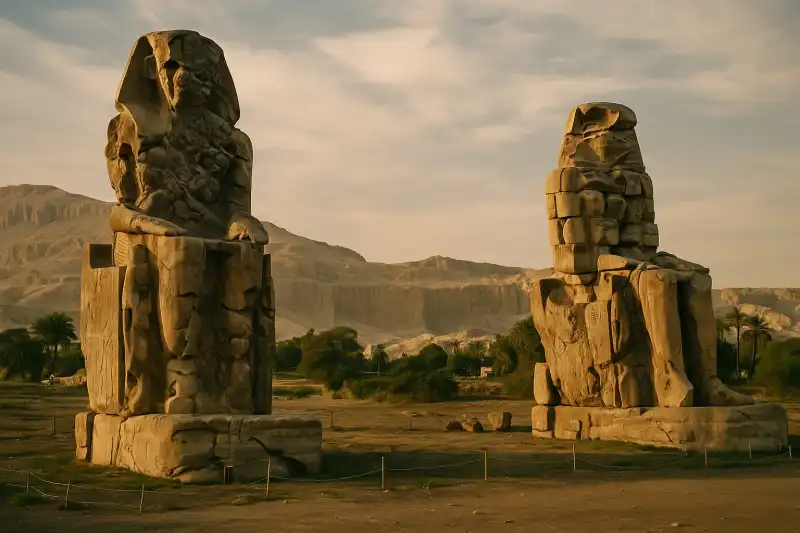
Colossi of Memnon
Ancient Egypt (New Kingdom)Twin colossal statues of Pharaoh Amenhotep III guarding the Theban necropolis on Luxor's West Bank, ...
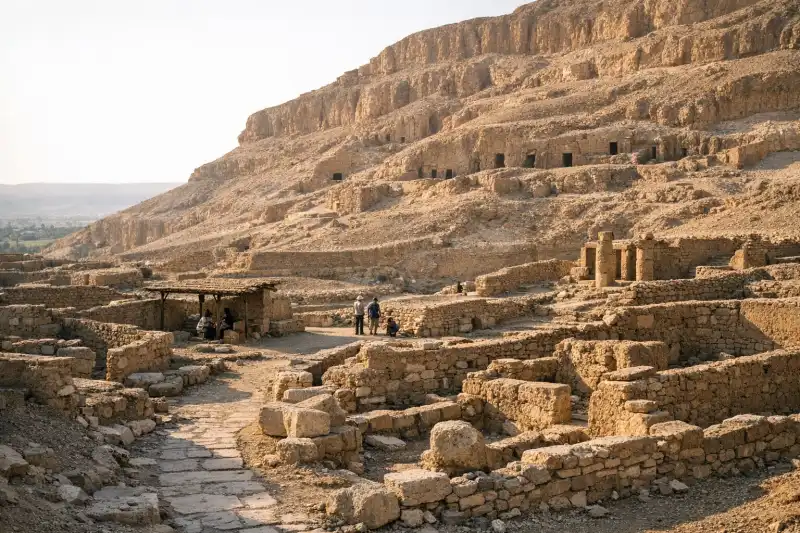
Deir el-Medina
Deir el-Medina is an ancient Egyptian workers’ village near Luxor, renowned for its remarkably prese...
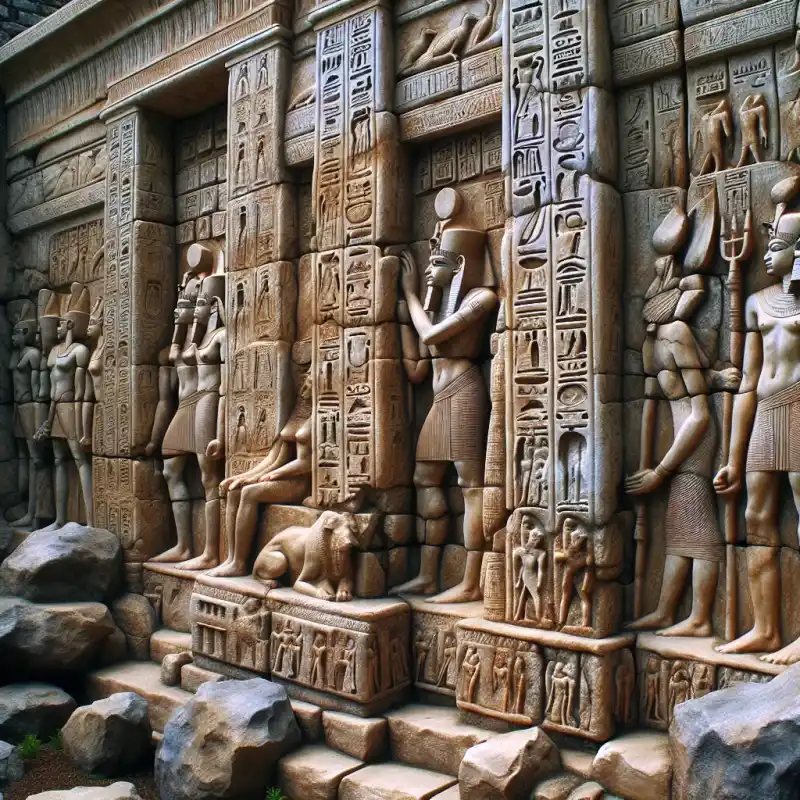
Abydos Temple Egypt Guide 2026: Temple of Seti I & King List
New Kingdom-PtolemaicAbydos Temple near Luxor: magnificent Temple of Seti I with war reliefs, ancient king list, and vibr...
Dendera Temple Complex Egypt Guide 2026: Temple of Hathor & Zodiac Ceiling
Ptolemaic-RomanExplore Dendera's magnificent Temple of Hathor near Luxor. Star-mapped zodiac ceiling, Ptolemaic arc...
Dendera Temple Complex
The Dendera Temple Complex in Egypt is a remarkably preserved ancient site renowned for its grand Te...