Quick Info
At a glance
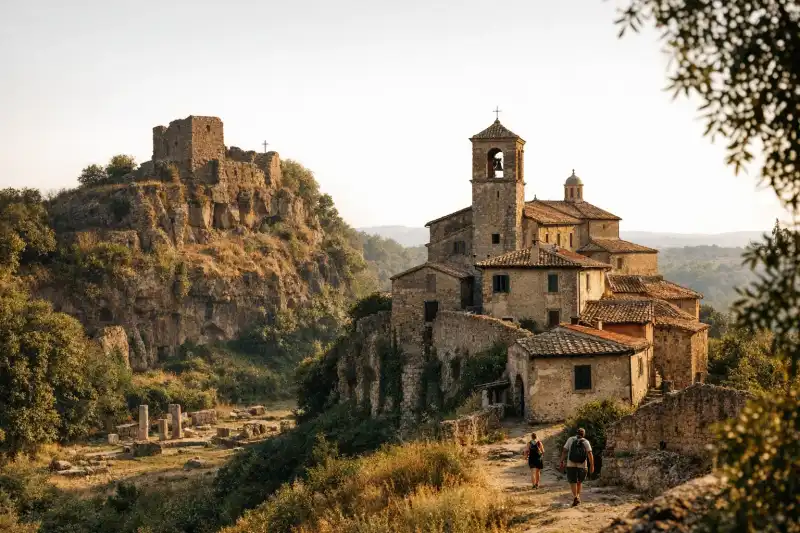
Veii, in Italy, is one of those ancient places that reveals its power gradually. Unlike Rome’s crowded forums or the monumental silhouettes of famous imperial landmarks, Veii asks visitors to imagine a city through landscape, distances, and fragments. Set in the rolling countryside of Lazio just north of modern Rome, it was once among the richest and most formidable Etruscan centers in central Italy. Today, the archaeological park spreads across a broad plateau cut by streams and ravines, creating a dramatic natural setting that helps explain why the city grew here in the first place.
Walking through Veii is less about ticking off a single iconic monument and more about understanding how an ancient urban world was built into the land. Defensive cliffs, roads worn into the terrain, sanctuaries on strategic edges, and burial grounds outside the city all survive in ways that reward patient exploration. This was not a minor settlement overshadowed by Rome from the beginning. For centuries, Veii was a rival power controlling trade routes, fertile territory, and valuable connections between the Tyrrhenian coast and inland communities.
For travelers interested in the Etruscans, Veii offers one of the best opportunities near Rome to step beyond Roman history and encounter an earlier civilization that shaped much of central Italy. Even in ruin, the site carries a sense of scale and ambition. Its quiet atmosphere, open views, and layered past make it a memorable destination for anyone willing to trade crowds for context.
History
Early settlement and Etruscan rise
Veii emerged during the early Iron Age, probably between the 9th and 8th centuries BCE, when communities in this part of Lazio began consolidating into larger centers. Its position was excellent: the city sat on a naturally defended plateau between watercourses, with access to agricultural land, trade networks, and routes linking the interior to the coast. Over time, small villages in the area coalesced into an urban center that became one of the major cities of Etruria.
By the 7th and 6th centuries BCE, Veii had grown wealthy from agriculture, craft production, and exchange. The city benefited from its proximity to the Tiber corridor, a zone of commerce and movement that was also crucial to Rome. This closeness brought opportunity, but it also created competition. Veii developed aristocratic elites, elaborate cult spaces, and extensive cemeteries, all hallmarks of a powerful Etruscan city-state. Archaeological discoveries, including high-quality terracottas and rich tomb goods, show that it participated fully in the artistic and religious world of the Etruscans.
One of Veii’s most famous sanctuaries was at Portonaccio, where the celebrated terracotta statue often called the Apollo of Veii was found. Though the original is now in a museum, the sanctuary demonstrates the city’s sophistication in religious architecture and sculptural decoration. Veii was not merely prosperous; it was culturally dynamic and deeply connected to wider Mediterranean influences.
Rivalry with Rome
Veii’s history cannot be separated from its long and often hostile relationship with Rome. As Rome expanded in the early centuries of the Republic, conflict with neighboring powers became increasingly intense, and Veii stood out as one of its strongest adversaries. The two cities were unusually close geographically, making disputes over territory, river access, and political influence almost inevitable.
Ancient literary sources describe several wars between Rome and Veii. Although these accounts were written later and should be used cautiously, they preserve the memory of a prolonged struggle. The decisive turning point came in the early 4th century BCE. According to Roman tradition, the city was captured in 396 BCE after a long siege led by the general Marcus Furius Camillus. Roman narratives cast this as a foundational victory, one that dramatically expanded Roman territory and prestige.
Whether or not every detail of the traditional story is accurate, the fall of Veii was undeniably significant. It marked one of Rome’s earliest major conquests of a neighboring urban rival and gave the Romans access to land and resources that strengthened their position in central Italy. For Veii, it meant the end of independence.
Under Roman control
After the conquest, Veii did not simply vanish. Like many ancient cities, it entered a new phase under a different political order. Roman settlement and administrative structures reshaped the area, though the city never regained the status it had held in Etruscan times. Some of its territory was absorbed into Roman systems of landholding and colonization, and parts of the old urban area continued to be occupied.
The transformation was gradual. The memory of Veii as an Etruscan capital persisted even as the Roman world expanded around it. Roads, farms, and rural installations changed the landscape. Sanctuaries were altered, abandoned, or reused. The old city’s prominence faded as Rome’s did the opposite. What had once been a dangerous competitor became part of the Roman hinterland.
By the imperial period, Veii survived more as a place-name and local settlement than as a major center. Yet its historical importance remained disproportionate to its later political role. Roman authors treated its conquest as a milestone in Rome’s rise, while modern archaeology has restored attention to Veii’s own identity before subjugation.
Rediscovery and archaeology
Interest in Veii revived in the modern era as scholars, antiquarians, and archaeologists sought to understand the Etruscans and early Rome. Excavations in the 19th and 20th centuries revealed tombs, roads, defensive features, sanctuaries, and domestic remains spread across a remarkably large area. The discovery of the Portonaccio sanctuary and its sculptural decoration was especially important, helping confirm Veii’s place among the leading Etruscan cities.
Today the site is part of a protected archaeological landscape. What survives is often fragmentary, but the broader setting is invaluable. Instead of seeing one isolated ruin, visitors encounter an ancient city in relation to its natural defenses, approaches, sacred spaces, and necropoleis. That landscape-scale experience is one of Veii’s greatest strengths and one reason it matters so much to the study of pre-Roman Italy.
Key Features
The most striking feature of Veii is its setting. The city occupied a broad tuff plateau enclosed by steep slopes and watercourses, a natural fortress that immediately explains why people settled and defended it here. Even before you focus on individual ruins, the terrain communicates strategy. Veii was built in a position that offered protection, visibility, and control over movement through the surrounding countryside. For modern visitors, this means the site feels expansive and atmospheric rather than densely monumental.
Among the most important archaeological areas is the Sanctuary of Portonaccio. This was one of the major religious centers of Veii and has become central to the site’s fame because of the terracotta sculptures discovered there. The original masterpieces, including the well-known Apollo, are preserved in museums, but the sanctuary itself remains crucial for understanding Etruscan religion and architecture. Here, worship, civic identity, and artistic display came together in a sacred complex that projected the city’s wealth and cultural confidence. Even in its reduced state, the sanctuary gives a sense of the ceremonial life that once animated Veii.
Another defining element is the network of roads and access routes associated with the city. Ancient roadways cut through the landscape, sometimes worn deep into the stone or bordered by dramatic embankments. These routes are more than practical remains; they reveal how Veii connected its plateau to the surrounding region, its cemeteries, and nearby water sources. Walking them can be one of the most evocative parts of a visit because they preserve the feeling of movement into and out of the city. They also remind visitors that ancient urbanism was never only about walls and temples. It depended on circulation, trade, ritual processions, and constant interaction with the countryside.
The necropolis areas around Veii are equally important. Like many Etruscan cities, Veii placed its dead in organized burial zones outside the main inhabited center. Tombs and funerary landscapes provide insight into social hierarchy, family memory, and local artistic traditions. Some remains are modest, while others speak to elite display. Even where structures survive only partially, the presence of the necropoleis helps complete the picture of an Etruscan city whose life and death were carefully mapped onto the surrounding terrain.
Visitors should also pay attention to the defensive logic of the site. Veii did not need massive freestanding walls everywhere because the cliffs and ravines formed part of its fortification system. This integration of human planning with natural topography is one of the site’s most revealing characteristics. Standing at the edges of the plateau, you can appreciate how difficult an assault would have been and why Veii could challenge Rome for so long. The natural barriers are not secondary scenery; they were part of the city’s military architecture.
Scattered remains of habitation and later Roman occupation add another layer. Veii is not frozen in a single period. Instead, it preserves traces of continuity and change, showing how an Etruscan city was transformed after conquest. In some areas, the remains are subtle and require imagination, but that is part of the site’s appeal. Veii rewards visitors who are interested in historical processes, not only dramatic ruins.
Perhaps the most valuable feature of all is the overall archaeological landscape. Many ancient sites are approached as collections of monuments. Veii is better understood as a lived environment. The distances between features, the open spaces, and the relationship between sacred, residential, and funerary zones all matter. This gives the site a rare quality near Rome: it allows you to experience an ancient city at something closer to its real scale.
Getting There
Veii is easiest to reach from Rome, which lies roughly 20 to 25 kilometers to the south depending on your starting point and the exact entrance you plan to use. For most travelers, a rental car or taxi is the simplest option. Driving from central Rome usually takes 40 to 60 minutes, depending on traffic. A taxi or rideshare can cost roughly €35 to €70 each way, while a rental car offers more flexibility if you want to explore other parts of northern Lazio on the same day.
Public transport is possible but usually involves some planning. One common approach is to take a regional train from Rome toward the area around La Storta or nearby suburban stops, then continue by local bus or taxi. Train fares are typically inexpensive, often in the €1.50 to €3 range for the suburban leg, while local buses add only a few euros more. The challenge is that the archaeological zones are spread out, and service frequency may not always line up neatly with sightseeing plans. If you choose public transport, check current regional schedules before you go and be prepared for some walking.
Guided day trips from Rome can also be worth considering, especially if your main interest is Etruscan history rather than independent logistics. Prices vary widely, but small-group or private cultural tours often start around €80 and can go much higher depending on transport and inclusions.
Because Veii is a landscape site, not a compact urban museum, comfortable walking shoes are essential. Bring water, especially in warm weather, and do not rely on finding many services immediately next to every archaeological area.
When to Visit
Spring is arguably the best time to visit Veii. From March through May, the countryside of Lazio is usually green, temperatures are mild, and walking conditions are far more comfortable than in peak summer. This season also suits the character of the site: open landscapes, paths, and ravine edges are easier to enjoy when the weather is pleasant and visibility is good. Wildflowers and fresh vegetation can make the archaeological park especially attractive.
Autumn is another excellent choice. From late September through November, temperatures often return to a manageable range after the summer heat, and the softer light can be ideal for photography. The site tends to feel particularly peaceful at this time of year, with fewer visitors than more famous Roman attractions and a strong sense of rural quiet.
Summer visits are possible, but they require preparation. From June through August, central Italy can be very hot, and Veii offers long stretches of open terrain where shade may be limited. If you go in summer, start early in the morning, carry plenty of water, and wear a hat and sunscreen. Midday can be tiring, especially if you plan to cover multiple sectors of the site on foot.
Winter has advantages too, especially for visitors who prefer solitude and cooler hiking conditions. Rain, however, can make paths muddy and some areas less comfortable to explore. Shorter daylight hours also mean you should begin earlier than you might expect.
Whatever the season, the best visits usually happen when you allow enough time to move slowly. Veii is not a place to rush. It rewards visitors who treat it as both an archaeological destination and a countryside walk through one of ancient Italy’s most consequential landscapes.
| Quick Facts | Details |
|---|---|
| Location | Near Rome, Lazio, Italy |
| Ancient Culture | Etruscan, later Roman |
| Best Known For | Major Etruscan city and early rival of Rome |
| Estimated Origins | c. 9th-8th century BCE |
| Famous Sanctuary | Portonaccio |
| Visit Duration | 3-5 hours, or half a day |
| Best Seasons | Spring and autumn |
| Nearest Major City | Rome |
| Terrain | Plateau, ravines, archaeological parkland |
| Access | Best by car, taxi, or mixed public transport from Rome |
Guided tours: worth it?
Self-guided works here, but a guide can add real value if you want the ruins explained as a living place rather than just a sequence of monuments.
Best for
- First-time visitors who want context, not just photos
- Short visits where a planned route saves time
When to go self-guided
Go independently if you prefer setting your own pace, reading as you go, and checking official hours or ticket rules directly before you arrive.
What I’d avoid
Skip paid tours that bundle unrelated stops you do not actually want. The best option should either save meaningful planning time or add historical context you would miss on your own.
Rome Etruscan history day tours
Useful when: you want to compare guided formats before deciding
Rome countryside archaeological tours
Useful when: you want to compare guided formats before deciding
Lazio ancient sites tours from Rome
Useful when: transport or pickup logistics matter
Some tour links are affiliate links, which may earn Ancient Travel a small commission at no extra cost to you. I try to surface options that make practical sense for the site—not just anything bookable.
Frequently Asked Questions
What is Veii known for?
Veii is best known as one of the most powerful Etruscan cities and as an early rival of Rome before its conquest in the 4th century BCE.
Is Veii easy to visit from Rome?
Yes. Veii lies just north of Rome in Lazio and is usually reached by car, taxi, or a combination of train or bus plus a short local transfer.
How much time do you need at Veii?
Most visitors should allow at least half a day to walk the archaeological area, with longer if you want to explore tombs, trails, and the sanctuary in detail.
Are there visible ruins at Veii?
Yes. Visitors can see stretches of ancient roads, sanctuary remains, necropolis areas, defensive topography, and the broader urban plateau of the old city.
What should I bring to Veii?
Bring water, sun protection, sturdy walking shoes, and offline maps, since the site is spread out and much of the experience involves walking in open countryside.
When is the best time to visit Veii?
Spring and autumn are usually the best seasons, with mild temperatures, greener landscapes, and more comfortable conditions for walking around the large site.
Nearby Ancient Sites
Appian Way Rome Guide 2026
RomanPlan a smart visit to the Appian Way with route choices, catacomb logistics, bike-vs-walk strategy, ...
Arch of Constantine Rome: Triumph Over Maxentius Guide
Roman EmpireThe Arch of Constantine commemorates Constantine's 312 CE victory. Spolia details, best photo angles...
Baths of Caracalla Rome Guide 2026
RomanPlan your visit to the Baths of Caracalla with practical route advice, history context, timing, and ...