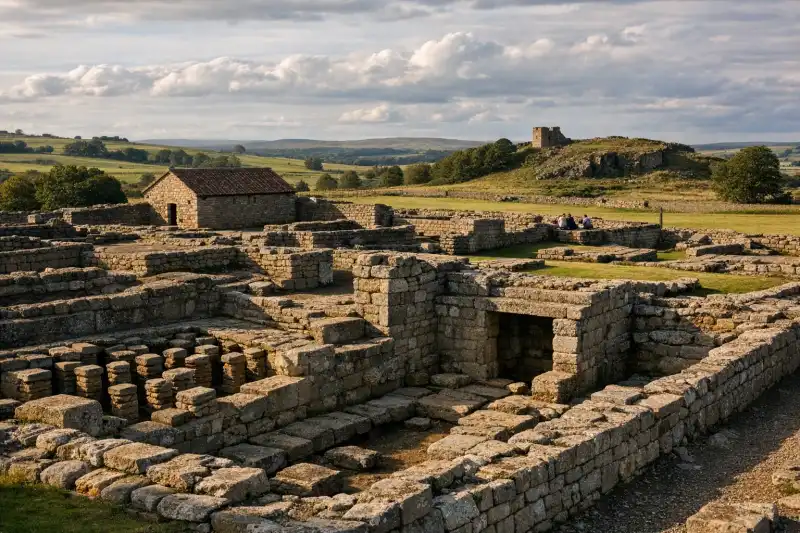
Quick Info
At a glance
Vindolanda Roman Fort in the United Kingdom is one of the most evocative Roman sites in northern Europe, a place where the frontier world of imperial Rome still feels startlingly close. Set amid the rolling landscape of Northumberland, not far from the line of Hadrian’s Wall, the site combines dramatic ruins, a superb museum, and one of the most important archaeological discoveries ever made in Roman Britain. Unlike places where only monumental stone survives, Vindolanda also preserves traces of ordinary lives: shoes worn by children, letters written by soldiers’ families, scraps of leather and wood, and the outlines of barracks, workshops, shrines, and homes.
What makes a visit especially compelling is the sense of continuity between landscape and history. The fort sits in open countryside that still conveys the strategic logic of Rome’s northern frontier. Wind moves across the fields, low hills fold into one another, and the ruins emerge not as isolated museum pieces but as part of a larger defensive and administrative network that once linked forts, roads, and garrisons across the edge of empire. For travelers interested in archaeology, military history, or the everyday realities of ancient life, Vindolanda offers something unusually vivid: not just the story of Roman conquest, but the voices, routines, and resilience of the people who lived at the frontier.
History
Early frontier settlement before Hadrian’s Wall
Vindolanda began life before Hadrian’s Wall was built, probably in the late 1st century CE, when the Romans were consolidating control over northern Britain after decades of campaigning. At this stage, the region was not yet marked by the famous continuous wall that would later define the frontier. Instead, Rome relied on roads, forts, and mobile military deployments to police movement and project authority. Vindolanda occupied a key position along the Stanegate, an important Roman road running east to west across northern England.
The earliest fort at Vindolanda was likely constructed from timber and earth, as was common in rapidly established military zones. These early installations housed auxiliary troops rather than legionaries. Auxiliary soldiers were recruited from across the empire and often came from regions far from Britain, bringing their own languages, customs, and military traditions. This diversity shaped life at Vindolanda from the beginning, turning it into a multicultural outpost at the edge of Roman power.
The Hadrianic period
In the early 2nd century CE, Emperor Hadrian ordered the construction of the wall that would bear his name. Although Vindolanda is located slightly south of the wall itself, it became closely integrated into the new frontier system. The fort was rebuilt several times during this period, transitioning from timber to more durable stone structures. Its role evolved as Rome’s frontier policy became more formalized, with garrisons managing supply routes, patrols, administration, and communication.
This was a period of intense military and logistical activity. Soldiers stationed at Vindolanda needed food, clothing, equipment, and building materials, all of which had to be organized and transported across difficult terrain. The site developed into more than a barracks complex: it included commanding officers’ residences, granaries, bathhouses, workshops, and religious spaces. The nearby civilian settlement, or vicus, also grew, populated by traders, craftspeople, relatives, and others drawn to the economic life that clustered around the fort.
It is from these early 2nd-century levels that the famous Vindolanda Tablets emerged. These thin wooden writing tablets, preserved in oxygen-poor soil, contain correspondence, military reports, supply requests, and even a birthday invitation. They transformed scholarly understanding of Roman Britain by revealing not only official administration but also personal relationships and domestic concerns.
Rebuilding and life in the 3rd century
Like many frontier forts, Vindolanda did not remain static. It was demolished, expanded, modified, and rebuilt repeatedly over generations. These successive occupations created a complex archaeological sequence that makes the site especially valuable to researchers. By the 3rd century CE, the fort had become a mature part of Rome’s northern defensive system, with stone buildings arranged in a more formal and enduring pattern.
Daily life at this stage blended military routine with a broader frontier economy. Soldiers trained, guarded roads, maintained order, and interacted with local communities. Merchants supplied goods from near and far. Religious worship continued in official and private forms, with shrines and altars dedicated to Roman deities as well as gods associated with particular military units or provinces. The fort was part of a living landscape, not merely a line of defense.
Archaeology at Vindolanda has demonstrated that life on the frontier was neither wholly isolated nor uniformly harsh. There were moments of discomfort and danger, but there was also literacy, trade, family life, and adaptation. The material remains show a society both deeply Roman and distinctly local, shaped by climate, distance, and cultural exchange.
Late Roman occupation and afterlife
Vindolanda remained occupied into the later Roman period, though the character of frontier life changed as imperial priorities shifted. By the 4th century CE, the fort still formed part of the administrative and defensive world of Roman Britain, but the empire as a whole was under growing pressure. Military reorganization, political instability, and changing patterns of support affected frontier sites throughout the region.
After Roman authority in Britain receded in the early 5th century, the fort gradually fell out of its original use. Stone was reused, buildings collapsed, and the site became absorbed into the rural landscape. For centuries, the remains lay partly hidden beneath fields and later occupations.
Modern Vindolanda is the result of sustained excavation and conservation, especially from the 20th century onward. Archaeologists have uncovered layer after layer of occupation, making the site one of the richest windows into Roman Britain. Ongoing digs continue to produce new discoveries, and this sense of an active, unfolding past is part of what distinguishes Vindolanda from many other ancient sites. It is not only a ruin to be observed; it is a place where history is still being recovered.
Key Features
Vindolanda’s greatest strength is the way it allows visitors to experience a Roman fort as a complete environment rather than as a single surviving monument. Walking through the excavated remains, you can trace the outlines of barracks, headquarters buildings, stores, workshops, and domestic spaces. Foundations and walls define streets and rooms clearly enough that the fort’s organization begins to feel legible. Even without standing architecture on an imperial scale, the site communicates the disciplined practical intelligence behind Roman military planning.
One of the most memorable features is the fort’s changing archaeological layers. Vindolanda is not a single-phase ruin but a palimpsest of repeated construction. This gives depth to the experience. You are not just looking at one moment in time but at generations of occupation built over one another. Interpretive panels and reconstructions help explain these phases, making it easier to imagine timber forts beneath stone, or older roads buried under later buildings.
The museum is essential to understanding the site. While the ruins provide the setting, the artifacts provide the people. The Vindolanda Tablets are the most celebrated finds, and even reproductions or contextual displays of them are enough to remind visitors how extraordinary they are. These documents capture inventory lists, requests for supplies, troop matters, and personal exchanges. They strip away the distance of centuries and reveal concerns that feel unexpectedly familiar: invitations, shortages, duty rosters, and household management.
Other finds are equally affecting in quieter ways. Vindolanda has yielded one of the largest collections of Roman shoes ever discovered, including footwear for men, women, and children. These objects speak directly to everyday life. They suggest movement, climate, family presence, and the practical business of living in a wet frontier zone. Leather goods, tools, armor fragments, pottery, jewelry, altars, and inscriptions all add texture to the picture. Instead of a simplified narrative of conquest, the museum presents a working community.
The reconstructed elements around the site also enrich the visit. Vindolanda has invested in helping travelers visualize ancient spaces without overwhelming the authenticity of the ruins. Recreated sections and interpretive installations offer scale and atmosphere, particularly useful for visitors less familiar with Roman military architecture. They make clear how a fort functioned as a small, highly organized town with defensive, administrative, domestic, and ritual dimensions.
Another key feature is the surrounding landscape. Vindolanda is inseparable from its setting near Hadrian’s Wall country. The open terrain, broad skies, and gently shifting hills frame the archaeological remains in a way that feels appropriate to a frontier site. Nearby trails and linked heritage locations allow visitors to place the fort within a much larger Roman system. If you combine Vindolanda with a walk along Hadrian’s Wall or a visit to the Roman Army Museum, the regional story becomes much more vivid.
Finally, what sets Vindolanda apart is the living nature of its archaeology. Excavation seasons often continue on site, and depending on when you visit, you may see archaeologists at work. This creates a rare sense of immediacy. Ancient history here does not feel closed or fully cataloged. It is a place where new objects, inscriptions, and structural clues can still emerge from the ground, reshaping what is known about Roman Britain.
Getting There
Vindolanda Roman Fort is in Northumberland, in the countryside between Hexham and the central section of Hadrian’s Wall. The easiest base for most visitors is Hexham, a market town with rail connections to Newcastle upon Tyne and Carlisle. From Newcastle, trains to Hexham typically take around 35 to 40 minutes, with standard fares often in the range of £8 to £15 one way depending on booking time and operator.
From Hexham, driving is the simplest option. The journey to Vindolanda usually takes about 25 to 30 minutes by car via the B6318 military road and local routes. Car rental from Newcastle or Hexham gives the most flexibility if you plan to combine several sites along Hadrian’s Wall. Parking is generally available on site, though it can be busier in summer.
Public transport is possible but requires more planning. Seasonal bus services serving Hadrian’s Wall country, such as the AD122 route in peak tourist months, can connect Hexham, Haltwhistle, and key Roman sites. Single fares are often modest, commonly under £5 for local stretches, though schedules are less frequent outside high season. Check current timetables before setting out, as services can change.
Taxis from Hexham are a practical alternative for travelers without a car. Expect to pay roughly £25 to £40 each way depending on time of day and company. If you are already touring Hadrian’s Wall, many guided day trips from Newcastle or the surrounding region may include transport and commentary, which can be worthwhile for first-time visitors.
When to Visit
Late spring to early autumn is the most rewarding time to visit Vindolanda. From May through September, the Northumberland landscape is at its most inviting, with longer daylight hours, greener surroundings, and a better chance of mild weather. This is also when the region’s seasonal tourism infrastructure is strongest, including bus links and broader opening options at nearby attractions. Summer brings the liveliest atmosphere, and if excavations are active, you may have the added interest of seeing archaeologists at work.
That said, summer also means more visitors, especially during school holidays. Vindolanda rarely feels crowded in the way major urban attractions do, but museum galleries and parking areas can be busier on fine days. If you prefer a quieter experience, June and September are often ideal compromises, offering relatively good weather with fewer peak-season crowds.
Spring and autumn can be excellent for photography and for travelers who enjoy a more contemplative mood. The low light across the hills can be beautiful, and cooler temperatures make walking comfortable. Still, conditions in this part of northern England change quickly. Wind, rain, and muddy ground are always possible, so waterproof clothing and sturdy footwear are wise in any season.
Winter visits are possible and can be atmospheric, with stark skies and a strong sense of frontier isolation. However, shorter days and harsher weather may limit how long you want to stay outdoors. Some services in the area are reduced outside the main season. If visiting in winter, check opening hours in advance and allow extra time for travel on rural roads.
| Quick Facts | Details |
|---|---|
| Site name | Vindolanda Roman Fort |
| Location | Northumberland, England, United Kingdom |
| Nearest town | Hexham |
| Historical era | Roman Britain |
| Established | Late 1st century CE |
| Best known for | The Vindolanda Tablets and exceptionally preserved frontier archaeology |
| Relation to Hadrian’s Wall | Just south of the wall, part of the wider Roman frontier system |
| Suggested visit length | 2 to 4 hours |
| Best time to visit | May to September |
| Suitable for families | Yes, though some surfaces are uneven |
Guided tours: worth it?
Self-guided works here, but a guide can add real value if you want the ruins explained as a living place rather than just a sequence of monuments.
Best for
- First-time visitors who want context, not just photos
- Short visits where a planned route saves time
When to go self-guided
Go independently if you prefer setting your own pace, reading as you go, and checking official hours or ticket rules directly before you arrive.
What I’d avoid
Skip paid tours that bundle unrelated stops you do not actually want. The best option should either save meaningful planning time or add historical context you would miss on your own.
Vindolanda Roman Fort tours
Useful when: you want to compare guided formats before deciding
Hadrian's Wall day tours
Useful when: you want to compare guided formats before deciding
Northumberland Roman sites tours
Useful when: you want to compare guided formats before deciding
Some tour links are affiliate links, which may earn Ancient Travel a small commission at no extra cost to you. I try to surface options that make practical sense for the site—not just anything bookable.
Frequently Asked Questions
What is Vindolanda Roman Fort best known for?
Vindolanda is best known for its exceptionally well-preserved Roman remains and the Vindolanda Tablets, handwritten wooden documents that reveal daily life on the Roman frontier.
Is Vindolanda Roman Fort part of Hadrian's Wall?
Vindolanda lies just south of Hadrian's Wall and is closely connected to the frontier system, though the fort itself predates the wall and continued in use alongside it.
How much time should I allow for a visit to Vindolanda?
Most visitors should allow at least two to three hours to explore the fort, museum, and surrounding remains comfortably.
Can you see original artifacts at Vindolanda?
Yes, the on-site museum displays original finds from excavations, including shoes, tools, inscriptions, and examples linked to the famous writing tablets.
Is Vindolanda Roman Fort suitable for families?
Yes, Vindolanda is family-friendly, with open-air ruins, museum displays, and plenty of space to explore, though some ground is uneven.
What is the best season to visit Vindolanda Roman Fort?
Late spring through early autumn offers the best weather and longest daylight hours, though quieter visits are possible in shoulder seasons.
Nearby Ancient Sites
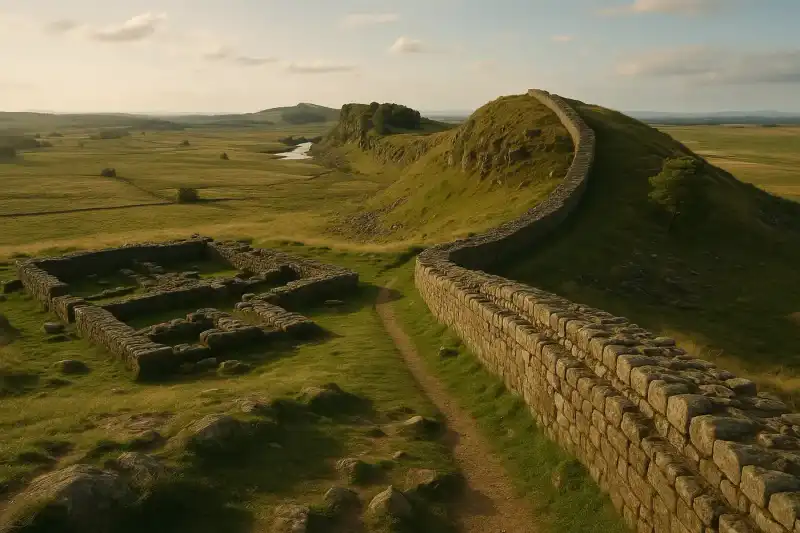
Hadrian's Wall Travel Guide 2026: Best Sections, Roman History, and Practical Planning
Roman BritainPlan a UK frontier-heritage day at Hadrian's Wall with clear section priorities, practical one-day r...
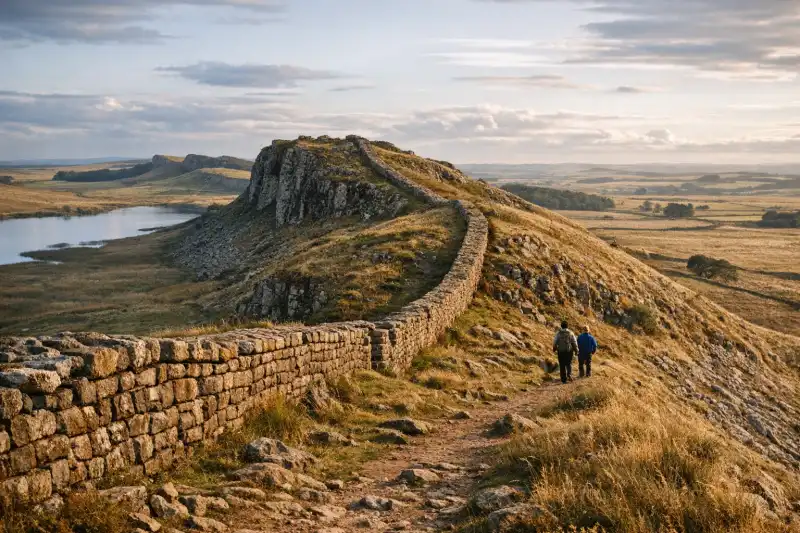
Hadrian's Wall
RomanExplore Hadrian’s Wall in the United Kingdom, Rome’s great northern frontier of forts, milecastles, ...
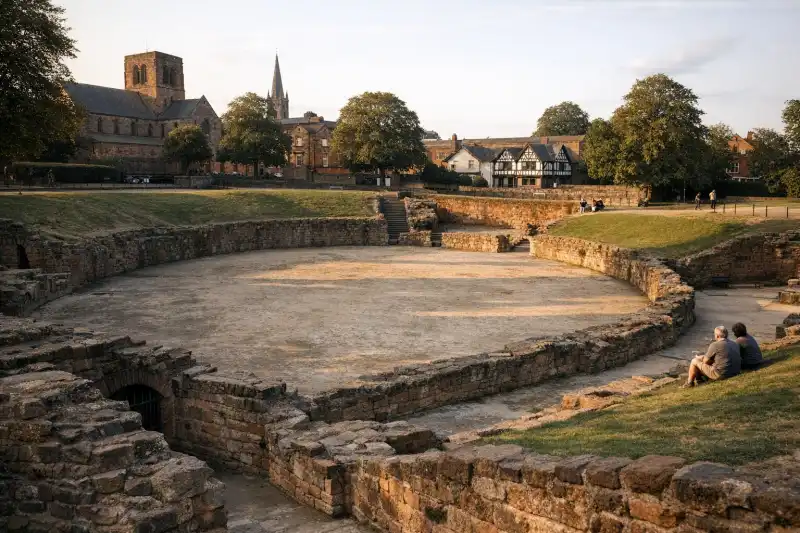
Chester Roman Amphitheater
Explore Chester Roman Amphitheater in the United Kingdom, the largest known Roman amphitheater in Br...